Cypriot Pottery
From the Island of Cypress
|
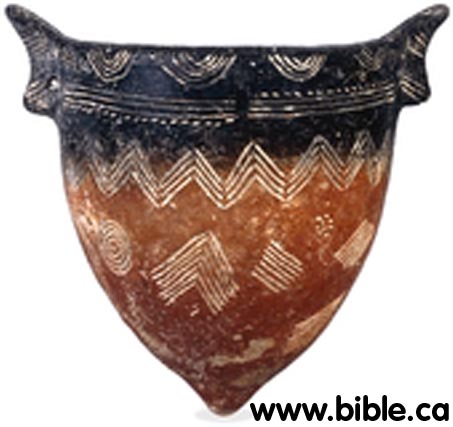
Cypriot pottery From the Island of Cypress, this pottery was key to proving the location of Jericho. |
|
Discussion:
- Although Kathleen Kenyon made great contributions to controlled stratigraphic excavation techniques, she was above all A BIBLE HATING SKEPTIC.
- Pottery is one of the key methods of dating an ancient ruined city and Kenyon had no training or experience in reading pottery. In fact, in her final report, she devoted a single short paragraph to pottery.
- Kathleen Kenyon rejected the Bible story of Joshua causing the walls of Jericho to fall based primarily on pottery. She never found Cypriot pottery herself and she misread the pottery she did find by over 150 years too early.
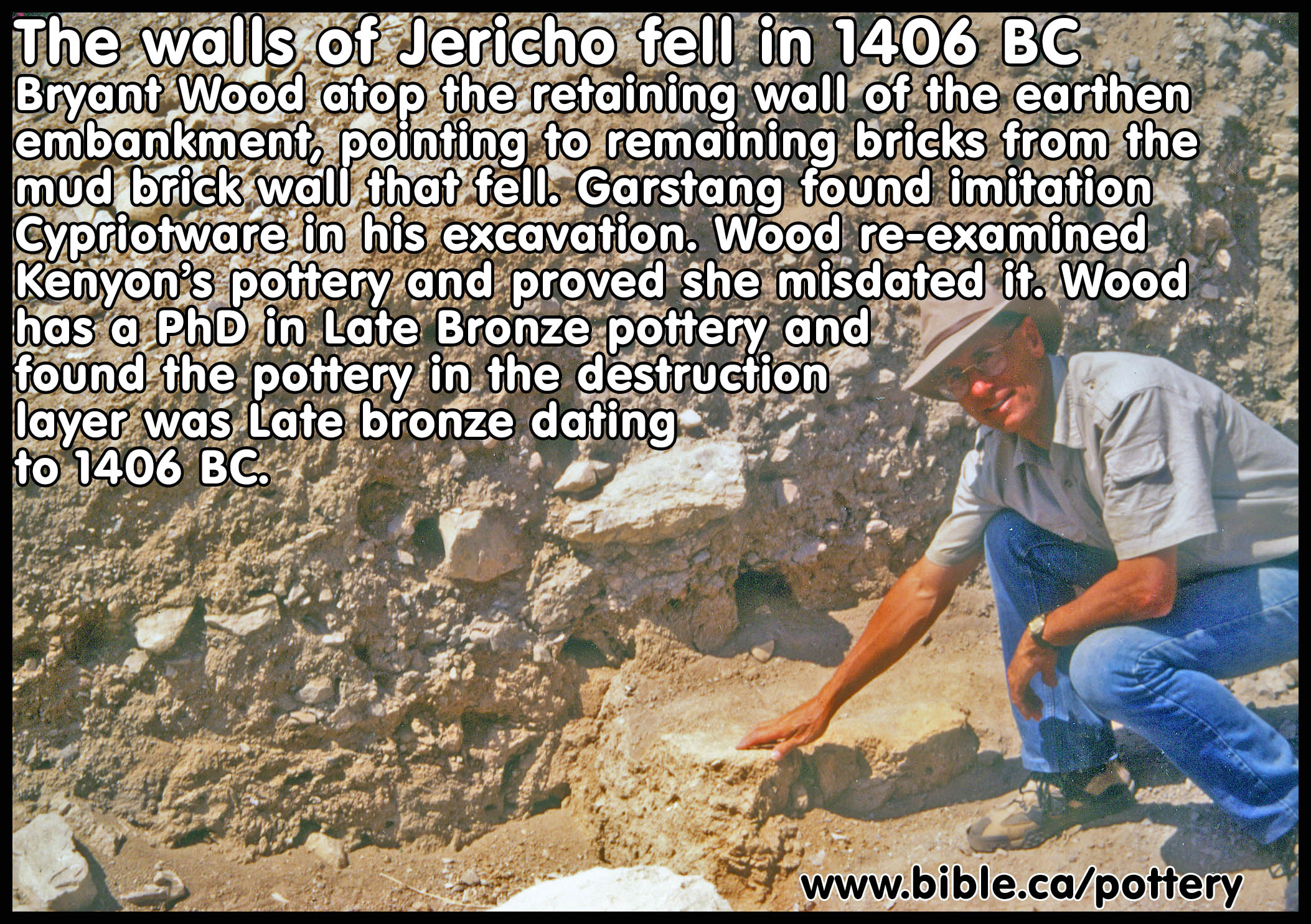
- Kathleen Kenyon excavated Jericho in the 1950's and concluded that the walls fell 150 years before the Bible says they did in 1600 BC because she had no training in reading late Bronze pottery and she ignored the fact that Garstang found imitation Cypriotware in his excavations in the 1920's. Dr. Bryant Wood has a PhD in Late Bronze pottery and when he reexamined Kenyon's misdated pottery, he proved her conclusions wrong and gave Jericho back to Bible believing Christians.
- Kathleen Kenyon (excavations: 1952-58) said the tel belonged to time much earlier and could not be Biblical Jericho based on the absence of the imported Cypriote ware pottery. She did acknowledge the city was, "blackened or reddened by fire. . . in most rooms the fallen debris was heavily burnt," Digging Up Jericho, 1957, p. 370
- Bryant
Wood, Professor of Near Eastern Studies, University of Toronto noted that
Garstang had found the diagnostic "Imitation Cypriotware"
pottery on the east side of the tel, a more prosperous part of the city.
Additionally he found a continuous series of Egyptian scarabs with dated
inscriptions on bottom. Unbroken series extended from 18th century BC to
time of Israel's conquest (1406 BC).
- The sequence of continuous occupation at Beidha is unique in the Levant. Similarities exist between the round buildings at Beidha and Jericho because at both sites, round buildings were replaced by square ones. At Jericho, it is not clear if the round or later square buildings were destroyed by the Hebrews during the conquest in 1446 BC. But Joshua placed a curse upon the city and it appears to have not been rebuilt until the time of Hiel in 860 BC: Jericho continued to be occupied down to the time of Jesus: "Then Joshua made them take an oath at that time, saying, "Cursed before the Lord is the man who rises up and builds this city Jericho; with the loss of his firstborn he shall lay its foundation, and with the loss of his youngest son he shall set up its gates."" Joshua 6:26 "In his days Hiel the Bethelite built Jericho; he laid its foundations with the loss of Abiram his firstborn, and set up its gates with the loss of his youngest son Segub, according to the word of the Lord, which He spoke by Joshua the son of Nun." 1 Kings 16:34. "He entered Jericho and was passing through. And there was a man called by the name of Zaccheus; he was a chief tax collector and he was rich." Luke 19:1-2: "PPNB: Beidha is currently the only southern Levantine site that documents this transition in residential architecture. Elsewhere in the southern Levant, the transition is either completely abrupt without transitional steps (such as at Jericho) or else PPNB sites have either curvilinear or rectangular architecture (Byrd 2000). At Jericho, largely undifferentiated PPNA curvilinear buildings were abruptly replaced by PPNB rectangular pier houses considerably earlier than rectangular buildings were first constructed at Beidha (Kenyon 1981). The pier-house style of architecture was then used over a wide area of the southern Levant during the PPNB and was well suited to be internally subdivided (Byrd and Banning 1988)." (Early Village Life At Beidha: Neolithic, Brian Byrd, 2005 AD, Conclusion)
- "For example, at many early village communities (such as Jericho, CayOnti, and Abu Hureyra) individual buildings were repeatedly built virtually directly on top of earlier ones (Kenyon 1981; Moore et al. 2001; Ozdogan and 6zdogan 1989). This may imply that building plots were subject to ownership." (Early Village Life At Beidha: Neolithic, Brian Byrd, 2005 AD, Conclusion)
By Steve Rudd: Contact the author for comments, input or corrections.