Paul said Mt. Sinai was in Saudi Arabia: Gal 4:25
Josephus said Ishmael occupied Arabia Felix:
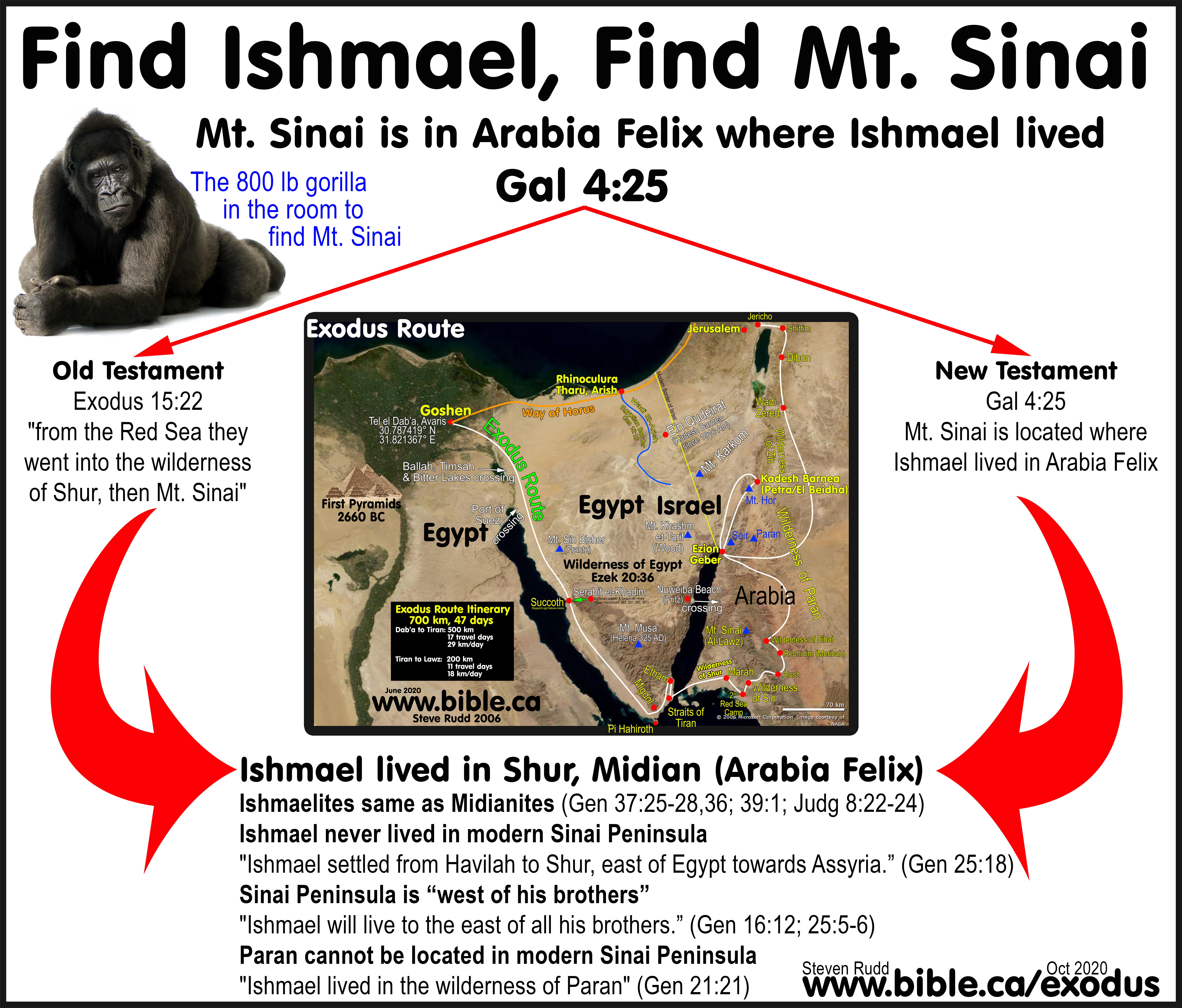
The teaching of Paul is so clear, that we could locate Mt. Sinai by saying: Mount Sinai is located in the land where Ishmael lived: Midian
See: main page on Mt. Sinai in Arabia
A. Arabia in the Bible is Modern Saudi Arabia:
- Arabia in the Bible is always, without exception, the land of Midian. (Modern Saudi Arabia).
- Arabia is associated with Kedar. Kedar is called "men of the east" Jer 49:28.
- Kedar was the son of Ishmael, who intermarried with the Midianites and lived south east of the Dead Sea. "These are their genealogies: the firstborn of Ishmael was Nebaioth, then Kedar" 1 Chronicles 1:29
- Ishmael settled in Shur and the wilderness of Paran: Gen 16:12; 21:21; 25:18
5. "Now Abraham gave all that he had to Isaac; but to the sons of his concubines [Hagar], Abraham gave gifts while he was still living, and sent them away from his son Isaac eastward, to the land of the east." (Genesis 25:5–6)
- “He put him in mind, that when Abraham was come alone out of Mesopotamia into Canaan, he had been made happy, not only in other respects, but that when his wife was at first barren, she was afterwards by him enabled to conceive seed, and bear him sons. That he left to Ishmael and to his posterity the country of Arabia; as also to his sons by Ketura, Troglodytis: and to Isaac, Canaan.” (Josephus Antiquities 2.213)
- Ezek 27:21 clearly shows that Arabia meant Saudi Arabia: "Arabia and all the princes of Kedar". Kedar was
- Isaiah describes Arabia as including Kedar (Ishmael's son): "The oracle about Arabia. In the thickets of Arabia you must spend the night, O caravans of Dedanites. ... all the splendor of Kedar will terminate" Isaiah 21:13, 16
- In describing the swath of land from Babylon (Hazor) to Saudi Arabia (Kedar) Jeremiah 49:28 tells Hazor (Babylon) to invade Kedar (Saudi Arabia) calling them "men of the east". "Concerning Kedar and the kingdoms of Hazor, which Nebuchadnezzar king of Babylon defeated. Thus says the Lord, "Arise, go up to Kedar And devastate the men of the east. " Jeremiah 49:28
- Therefore Arabia = Ishmaelites, Midianites, Kedarites, Wildernesses of Shur and Paran, Midian
- The Ishmaelites, Midianites, Kedarites never lived west of the Arabah valley in the Negev.
B. Josephus said that Hagar and Ishmael lived in Arabia Felix (Saudi Arabia)
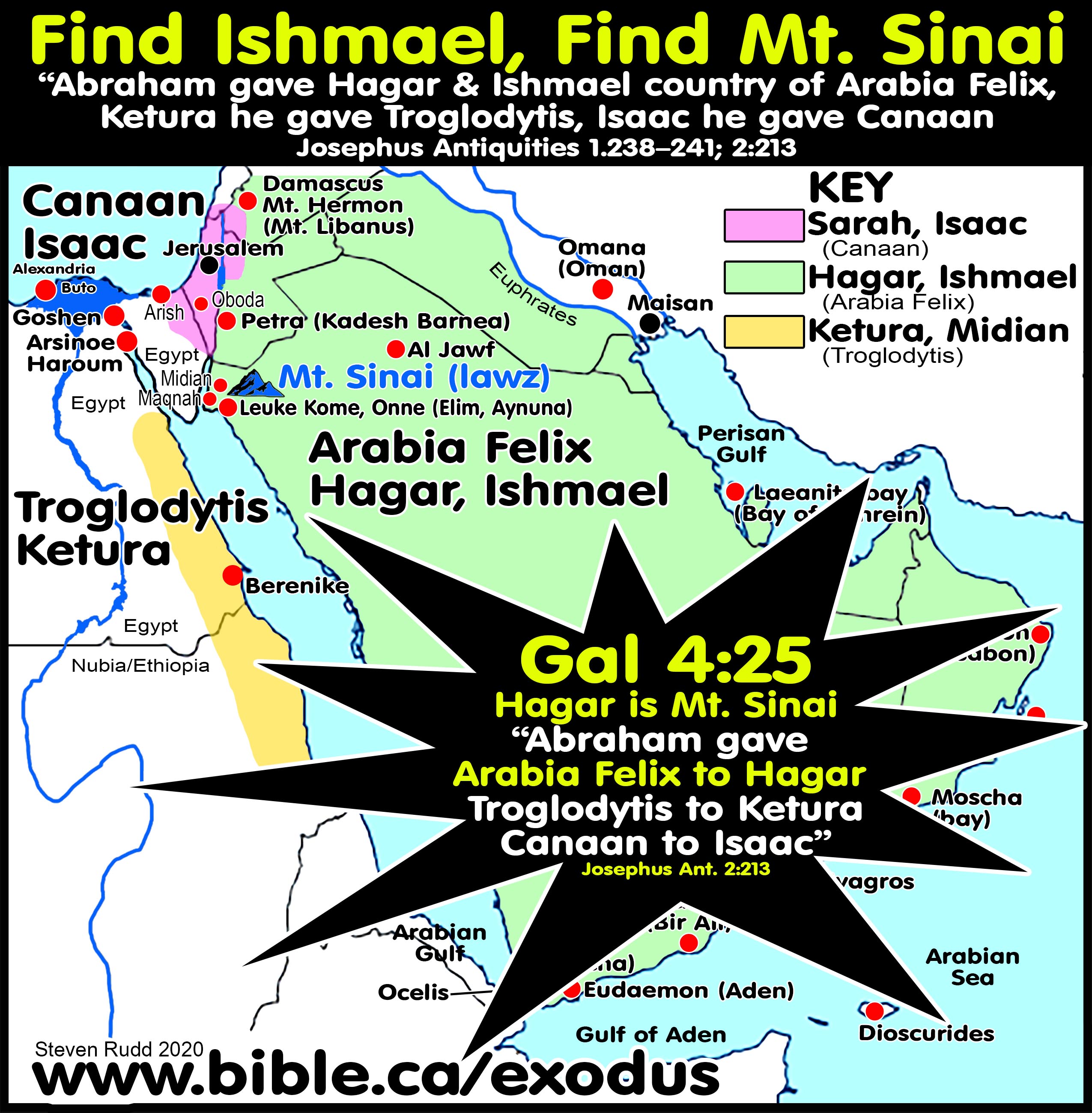
1. Find Hagar and Ishmael, Find Mt. Sinai.
a. Scripture says that Ismael settled in the Wilderness of Shur which is in Midian.
b. According to Josephus, at the time of Abraham, Ketura’s son Midian settled in Troglodytis, which was universally defined by other ancient geographers, as the western shoreline of the Arabian gulf in Egypt and Ethiopia.
c. The three distinct geographic areas outlined by Josephus which correspond to one of Abraham’s wives marks Mt. Sinai in Arabia Felix.
2. Josephus defines Arabia Happy as where Hagar and Ishmael lived and where Mt. Sinai is located:
a. “That he [Abraham] left to Ishmael and to his posterity the country of Arabia [Felix - Antiquities 1.239]; as also to his sons by Ketura, Troglodytis: and to Isaac, Canaan.” (Josephus Antiquities 2.213)
b. Abraham’s children through Ketura and Hagar took possession of Troglodytis, and the country of Arabia the Happy [Arabia Felix], as far as it reaches to the Red Sea.” (Josephus Antiquities 1.238–239)
c. Moses was in the country of the Troglodytes at Midian in 1486 BC when he married Jethro’s daughter: (Josephus Antiquities 2.257–260)
3. Following Midian:
a. Josephus tells us that originally, Ketura’s sons, including Midian, had settled in Troglodytis and Hagar’s sons including Ishmael, had settled from “Havalia to Shur” [Wilderness of Shur] in Arabia Felix.
b. Scripture tells us that in 1899 BC Joseph was sold to the Midianites/Ishmaelites, who had become one tribe (likely through intermarriage).
c. Josephus tells us that Moses in 1486 BC fled to Midian which Josephus describes as the country of the Troglodytes (Josephus Ant. 2.257–260).
d. Josephus is the only ancient geographer to say that Midian at the Wilderness of Shur, was the land of Troglodytis because he understood that originally, all the sons of Ketura had located near the Egyptian, Ethiopian border on the opposite side of Arabia Felix but that Midian moved back to join tribes with Ishmael in Shur.
4. Josephus identifies three distinct geographic areas (Canaan, Arabia Felix, Troglodytis) and marks Mt. Sinai to be in Arabia Felix, which at the time of Paul, included all of Saudi Arabia south of the Gulf of Aqaba including Midian.
See: main page on Mt. Sinai in Arabia
C. Commentaries on Gal 4:25: Mt. Sinai in Arabia
- "For Sinai is a mountain in Arabia. It calls attention to the geographical position of Sinai, giving definiteness to our conception of the great mountain and silently reminding us that it was the home of Hagar's children. ... For, that Mount Sinai is in the land of Hagar's children, whether or not the mountain bore her name, reveals in clear light the appropriateness of Paul's allegory." (Commentary on Galatians, Joseph Agar Beet, 1885 AD, Gal 4:25, p135)
- "What is actually new in Paul's argument lies in the first clause. The manuscript tradition of the text shows the problems that early copyists and translators had with this argument. Paul's intention here is to equate Hagar with Mount Sinai in Arabia. How does he arrive at this? The reader is first reminded that Paul himself was in Arabia (cf. 1:17) and will therefore credit him with a certain local familiarity. Arabia is indicated both by the name Hagar as well as by the location of Mount Sinai. Hagar is, to be sure, an Egyptian according to Gen. 16:1, but the region that is later accorded to her son Ishmael and his offspring is to be found in Arabia (cf. Gen. 25:6, 18). There one can also find Hagar as the name of a locality (cf. 1 Chron. 5:10, 19-20; Ps. 83:6), and this name may be preserved today in the place named Chegra. In the vicinity of this modern city of Chegra, however, to which the Hagar/Ishmael traditions seem to be related, is also the possible location (according to the geographic concepts of the Old Testament) of Mount Sinai, on which Moses received the law. Not until around the fourth century C.E. was it located on the peninsula that is known to us as Sinai. The writers of "the five books of Moses" seem to identify the "reed sea" with the Gulf of Aqaba, not with the Red Sea, and to have imagined Mount Sinai in the mountains that one can find in today's atlases south of the city of Tabuk in extreme northwest Saudi Arabia, where the city of Chegra also lies. The only question is whether the mountains actually bore the name Hagar from that city. That, however, is what Paul seems to assert here, for that is where the logic of his argument seems to rest. Paul is apparently referring to information that he acquired during his stay in Arabia (cf. 1:17). After the rationale for equating Hagar with Mount Sinai, the allegorical explanation now goes further, saying that Hagar therefore corresponds to the present Jerusalem because-and here Paul harks back again to 4:1-7-the present Jerusalem is in slavery just as Hagar and her children were." (Galatians, A Continental Commentary, Luhrmann, Dieter, 1992 AD, Gal 4:25)
- "for Hagar is a mountain in Arabia (it); for Mount Sinai is in Arabia (S, C, G). C. K. Barrett ("The Allegory of Abraham, Sarah, and Hagar," 163-64) notes that "a decisive consideration in favor of the long text is that the omission of Hagar leaves a bare piece of geographical information of little interest to the readers or relevance to the context." In the Greek text, Hagar is governed by the neuter article to (literally, "the Hagar") which is not translated in English. The article indicates that it is not Hagar the person that Paul has in mind but the word "Hagar" which is in the text; for this reason Hagar is placed in quotation marks. Paul may have associated Hagar with Mount Sinai because Sinai is located in Arabia, the land of Hagar's descendants through Ishmael. See Ps 83:6 which speaks of the "Hagrites." It is less likely that Paul is dependent upon the linguistic similarity between the Arabic word hajar ("rock" or "cliff") and certain place names of the Sinai peninsula. (Galatians, Matera, Frank J., 1992 AD, Gal 4:25)
- "For Agar is Mount Sinai. Represents Sinai. This Mount Sinai is in Arabia, the very home of Ishmael and his race. Some also add that one name of the mountain is Hagar, but this is not certain." (The People's New Testament, B.W. Johnson, 1891 AD, Gal 4:25)
- For this Agar is mount Sinai in Arabia. The condition of the text at this point is rather uncertain. Some manuscripts have (a) de Hagar Sina, (b) some gar Hagar Sina, (c) some de Sina, and (d) others gar Sina. The points at issue are (a) whether the word Hagar should be included or omitted and (b) whether the clause should be introduced by gar or de. The major uncial texts are divided between the first and third readings and the oldest papyrus text has the second reading. Hence, there is a good bit of uncertainty regarding exactly how this should read. The problem is caused by the meaning of the phrase being dubious; the scribes probably emended the text to make the sense of the passage clearer. Another suggestion is that this phrase is a gloss transferred from the margin of the text, a not very likely possibility because of the uncertainty of its meaning. Two explanations of this verse are worthy of our attention. These two positions are summarized for us as follows: So far as can be determined from the rather uncertain text, the equating of Hagar with Sinai is suggested either by the location of Sinai in Arabia, the land of Ishmael and his progeny, or by the linguistic similarity of an Arabian word hajar (rock or cliff), with which certain place names on the Sinaitic peninsula seem to be related (Theological Dictionary New Testament, 1:56). The two positions then are as follows: (1) Paul is arguing that the word Hagar sounds like an Arabian term used to refer to a mountain in the Sinai peninsula; (2) Paul is arguing that Sinai is located in the land possessed by the descendants of Ishmael. In arguing against the first interpretation, Lightfoot seems correct in charging that it is not likely that Paul would have expected the Greek-speaking Galatians to have understood his meaning if he were arguing that the word Hagar sounds like hagar in Arabian speech. Secondly, the proof that hagar was ever used to refer to Mt. Sinai is rather uncertain. The evidences that have been cited are Chrysostom in the fourth century and a Bohemian traveler of the year 1598 (Lightfoot 195). Neither is evidence of what was current in Paul's day. The weakness of these two arguments is sufficient reason for rejecting this explanation. The other interpretation simply has Paul further identifying who Hagar represents in the allegory. To Hagar (this Hagar) identifies Hagar, not as the woman, but as the Hagar of the allegory. His argument is that Mt. Sinai is located in Arabia, the land inherited by the descendants of Ishmael and outside the limits of Canaan, the land of promise. This ties Mt. Sinai and the giving of the Law to the side of Ishmael rather than to Isaac. And answereth to Jerusalem which now is. The word answereth means "to stand or march in the same row with ... hence to stand over against, be parallel with." The word was used to refer to a file of soldiers. It shows that Mt. Sinai stands on the side of Ishmael and not on the side of Isaac. (Galatians, Mike Willis,1994 AD, Gal 4:25)
- ""one [covenant coming] from Mount Sinai..., that is Hagar; but Mount Sinai lies in Arabia, yet it corresponds to the present Jerusalem": This is the reading of the oldest Pauline manuscript. (P46) and it is supported by several others. Another well attested reading is: "Now Hagar means Mt. Sinai in Arabia." In either case, wishing to emphasize that the slavery the Law introduced was the condition of the rejected son of Abraham, Paul identifies Hagar with the Sinai pact and the "present Jerusalem." Verse 25a is a geographical detail explaining how Hagar, although connected with a holy place outside of the Promised Land, is yet equated with the "present Jerusalem." Geographically, Hagar represents a place in Arabia, but even so she stands for enslavement and so corresponds to Jerusalem. But why does Paul mention Arabia at all? possibly because Mt. Sinai is in Arabia, which is Ishmaelite territory: he thus associates the Sinai pact with the eponymous patriarch of Arabian tribes (see Gn 25:12-18; Ps 82:7). He thus suggests that the Law itself stems from a situation extrinsic to the promised Land and to the real descendants of Abraham. Paul's Jewish colleagues would not have been happy with this allegory. (The Jerome Biblical commentary, Brown, R. E., Fitzmyer, J. A., & Murphy, R. E. 1968 AD, Gal 4:25)
- "In this case the actual meaning of Paul's typology is more evident than the historical referent that lies behind it. On what basis could Paul equate Hagar with Mount Sinai, and why did he make the seemingly gratuitous allusion to Arabia? After all, Paul was not giving a geography lesson or writing a travel guide for visitors to the Holy Land. Some have pointed to the similarity in sound between the name Hagar and a similar Semitic word meaning "rock" or "crag." It is more likely, however, that Paul was here reflecting a certain geographical orientation acquired during his earlier sojourn in Arabia (cf. 1:17). According to Gen 25 (vv. 6, 18), Hagar and Ishmael were expelled to "the land of the East," that is, to the region later known as Arabia. The name Hagar also appears in other Old Testament texts (cf. 1 Cron 5:10, 19-20; Ps 83:6) to describe the geographical locality south of the Dead Sea and north of the Arabian peninsula. The word "Hagar" itself is still preserved in the name of the modern city of Chegra, located in what is today the extreme northwestern section of Saudi Arabia. According to certain ancient traditions, the mountain range near this vicinity was believed to be the site of Mount Sinai, where Moses received the law. Assuming that Paul had a certain local familiarity with this region and was cognizant of the popular traditions linking both the expulsion of Hagar and the giving of the law to this particular region, it is not surprising that he would have found a certain typological congruence in the identification of Hagar and Mount Sinai. By emphasizing that Mount Sinai is in Arabia, the land of the Ishmaelites, Paul was preparing his readers for the dramatic reversal he was about to make in the received interpretation of the Sarah-Hagar analogy." (New American Commentary, George, T., 1994 AD, Gal 4:25)
- “For this Agar is mount Sinai in Arabia (mount Sinai was then called Agar by the Arabians) (Matthew Henry, Gal 4:25)
- "Arabia" included Mount Sinai, south of Judea, as well as the northward area mentioned in 1:17. The Nabataean Arabs were viewed as Ishmaelites, descendants of Hagar, in Paul's day, thus making the connection clearer to ancient readers familiar with eastern Mediterranean geography. (The IVP Bible background commentary, Keener, C. S., 1993 AD, Gal 4:25)
- "Although the heartland of the Arab nations was what is known today as Saudi Arabia, the Romans gave the name Arabia to a province of their empire which lay south and east of Palestine, in the corner of the Mediterranean world between Syria and Egypt. It comprehended the Negev, southern Syria, all of Jordan, and northwest Saudi Arabia." ... "when Augustus added to his realm the former kingdom of Judaea as a province under equestrian procurators, there remained in the circuit of imperial provinces along the desert's edge only the space extending across the Sinai, from Egypt into and encompassing the Negev, together with the entire territory of Transjordan, from the Syrian Hawran to the Gulf of 'Aqaba. It was this substantial tract that Trajan annexed in A. D. 106 under the name of the province of Arabia. This was Roman Arabia, as distinct from the land of incense and perfume in the south of the [Arabian] peninsula, which was known as the kingdom of Saba, or, to the Romans, Arabia Felix." (G. W. Bowersock, Roman Arabia, 1983, p 1-2)
See: main page on Mt. Sinai in Arabia
D. Discussion:
1. In AD 70, Apion located Mt. Sinai in the Sinai Peninsula, but did not believe that the modern Sinai Peninsula was part of Arabia. This creates a problem for those today who say the Sinai Peninsula was considered as being “Arabia”.
a. Josephus comments: “However, our admirable author Apion has before told us, that “they came to Judea in six days’ time;” and again, that “Moses went up to a mountain that lay between Egypt and Arabia, which was called Sinai, and was concealed there forty days, and that when he came down from thence he gave laws to the Jews.” But then, how was it possible for them to tarry forty days in a desert place where there was no water, and at the same time to pass all over the country between that and Judea in the six days?" (Josephus, Against Apion 2.25)
b. It is important to realize that Apion made deliberate attempts at creating a false narrative about the exodus. In other words, if Apion placed Mt. Sinai in the Sinai Peninsula, we can be certain it is not located there. “This is that novel account which the Egyptian Apion gives us concerning the Jews’ departure out of Egypt, and is no better than a contrivance of his own. But why should we wonder at the lies he tells us about our forefathers, when he affirms them to be of Egyptian original, when he lies also about himself?” (Josephus, Against Apion 2.28)
2. Arabia in the Old Testament was well defined to include Midian and east of the Arabah Valley where Edom lived. Arabia in the Bible was never considered as being in the Sinai Peninsula. 1 Chron 1:29-31 tells us that Kedar and Tema were sons of Ishmael who lived in Midian (Arabia). Dedan was associated with Arabia, Edom, Kedar, Tema in Jeremiah 25:23-24; 49:7-8. From a strict Bible definition, Arabia specifically excluded the Sinai Peninsula:
|
The Sinai Peninsula was never considered to be Arabia |
||
|
Saudi Arabia |
Sinai Peninsula |
|
|
Arabia had many kings: |
Yes |
No |
|
Paid Tax to Solomon: |
Yes |
No |
|
Silver and gold mines: |
Yes |
No (copper, turquoise) |
|
Arabia is where Hagar and Ishmael lived: |
Yes |
No |
|
Arabia is where Kedar, Tema and Dedan lived: |
Yes |
No |
|
Arabs bordered the Ethiopians: |
Yes |
No |
- "besides that from the traders and the wares of the merchants and all the kings of the Arabs and the governors of the country. " 1 Kings 10:15
- "besides that which the traders and merchants brought; and all the kings of Arabia and the governors of the country brought gold and silver to Solomon." 2 Chronicles 9:14
- "The oracle about Arabia. In the thickets of Arabia you must spend the night, O caravans of Dedanites. " Isaiah 21:13
- "Dedan, Tema, Buz and all who cut the corners of their hair, and all the kings of Arabia and all the kings of the foreign people who dwell in the desert" Jeremiah 25:23-24
- "Dedan traded with you in saddlecloths for riding. Arabia and all the princes of Kedar, they were your customers for lambs, rams and goats; for these they were your customers. " Ezekiel 27:21
- "Then the Lord stirred up against Jehoram the spirit of the Philistines and the Arabs who bordered the Ethiopians; " 2 Chronicles 21:16
Conclusion:
1. In Gal 4:25 Paul said that Hagar and Ishmael represented Mt. Sinai in Arabia.
a. Josephus said that Hagar and Ishmael lived in Arabia Felix, which is Saudi Arabia. (Josephus Antiquities 1.238–239; 2.213).
b. Hagar and Ishmael lived in Shur, which is near Midian.
2. Mt. Sinai is not located in the Sinai Peninsula:
a. Scriptures says that Ismael lived between Havalia and Shur, “east” of his brothers in Saudi Arabia, not west of his brothers in the Sinai Peninsula: Genesis 16:12; 25:5-6; 25:18; 21:21; Psalm 83:6
b. Arabia in the Old Testament always means Saudi Arabia, without exception.
c. At no point in history has the Sinai Peninsula been defined as Arabia Felix by any ancient geographer.
d. At the time of Paul, the Sinai Peninsula was not defined as Arabia Petra by any ancient geographer.
e. Only after AD 106 was the Sinai Peninsula annexed by Trajan and defined as Arabia Petra.
3. In Gal 1:17 Paul went to Mt. Sinai in Arabia in AD 36 at the time of his initial conversion to fulfill one of the 40 ways that he was a type of Moses.
See: main page on Mt. Sinai in Arabia
By Steve Rudd: Contact the author for comments, input or corrections.