SAUL HUNTS DAVID
Saul Hunts David 4 years: 1018-1014 BC
David in Ziklag 4 years: 1014-1010 BC
David is 22-30 years
old during this 8 year period.
1 Samuel 21-31 + 2 Samuel 1
Saul's last 8 years: 1018-1010 BC
“After
whom has the king of Israel come out? Whom are you pursuing? A dead dog, a
single flea? …
Just as one hunts a partridge in the mountains.” (1 Samuel 26:20; 24:14, David
said to Saul)
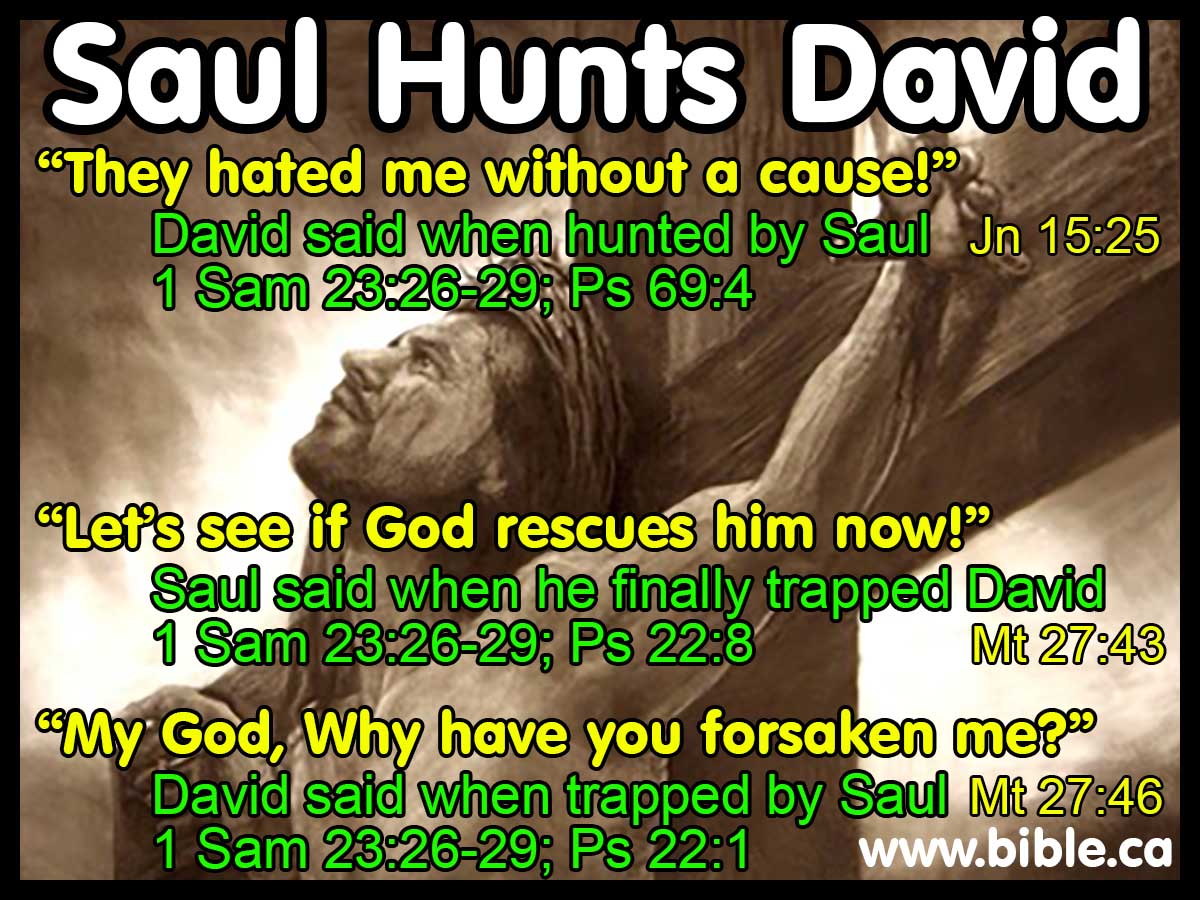
"They hated me without a cause" (David said this of Saul.)
"My God, my God, why have You forsaken me?"
(David said when Saul surrounded him 1 Sam 23:26)
"Trust in shadow of God's
wings" (spoken by both David's grandparents, Boaz and Ruth: Ruth 2:12;
3:9)
“Commit yourself to the LORD; let Him deliver him;
Let Him rescue him, because He delights in him"
(Saul said this mockingly to David
when he had David surrounded 1 Sam 23:26)
David on the Run from Saul
1 Samuel 21-31
1018-1014 BC
“After
whom has the king of Israel come out? Whom are you pursuing? A dead dog, a
single flea? …
Just as one hunts a partridge in the mountains.” (1 Samuel 26:20; 24:14, David
said to Saul)
"They hated me without a cause" (David said this of Saul.)
"My God, my God, why have You forsaken me?"
(David said when Saul surrounded him 1 Sam 23:26)
"Trust in shadow of God's
wings" (spoken by both David's grandparents, Boaz and Ruth: Ruth 2:12;
3:9)
“Commit yourself to the LORD; let Him deliver him;
Let Him rescue him, because He delights in him"
(Saul said this mockingly to David
when he had David surrounded 1 Sam 23:26)
Key focal point: 1018 BC
Jesus, son of David, mouthed the words David spoke at the time thought he was captured by Saul in 1 Sam 23:26 in 1018 BC
- "They hated me without a cause" (Psalm 69:1–4 + Jn 15:23-25) (David said this of Saul at this time.)
- "My God, my God, why have You forsaken me?" (Psalm 22:1 + ) (David said this when Saul successfully surrounded him and was about to be captured until the messenger came and Saul called off the attack: 1 Sam 23:26)
- “Commit yourself to the LORD; let Him deliver him; Let Him rescue him, because He delights in him" Ps 22:8 + Matthew 27:42–44 (Saul said this mockingly to David when he had David surrounded 1 Sam 23:26)
Introduction:
1. This is document is part 3 in the series on Saul and David:
a. Part 1: Saul before David
b. Part 2: David in Saul's Palace: Saul, the psychotic king who drove himself insane
c. Part 3: Saul hunts David (this outline)
2. The setting:
a. Young David had spent 7 years in Saul's palace and will now spend 4 years being hunted by Saul, then another 4 years at Ziklag until he dies on Mt. Gilboa. These 8 years can be broken down into two sets of four years: The first four years Saul hunts David until he enters Gath the second time and then lives at Ziklag. This is the main four years when Saul hunts David. The second four years is when David lives at Ziklag until the death of Saul on Mt. Gilboa.
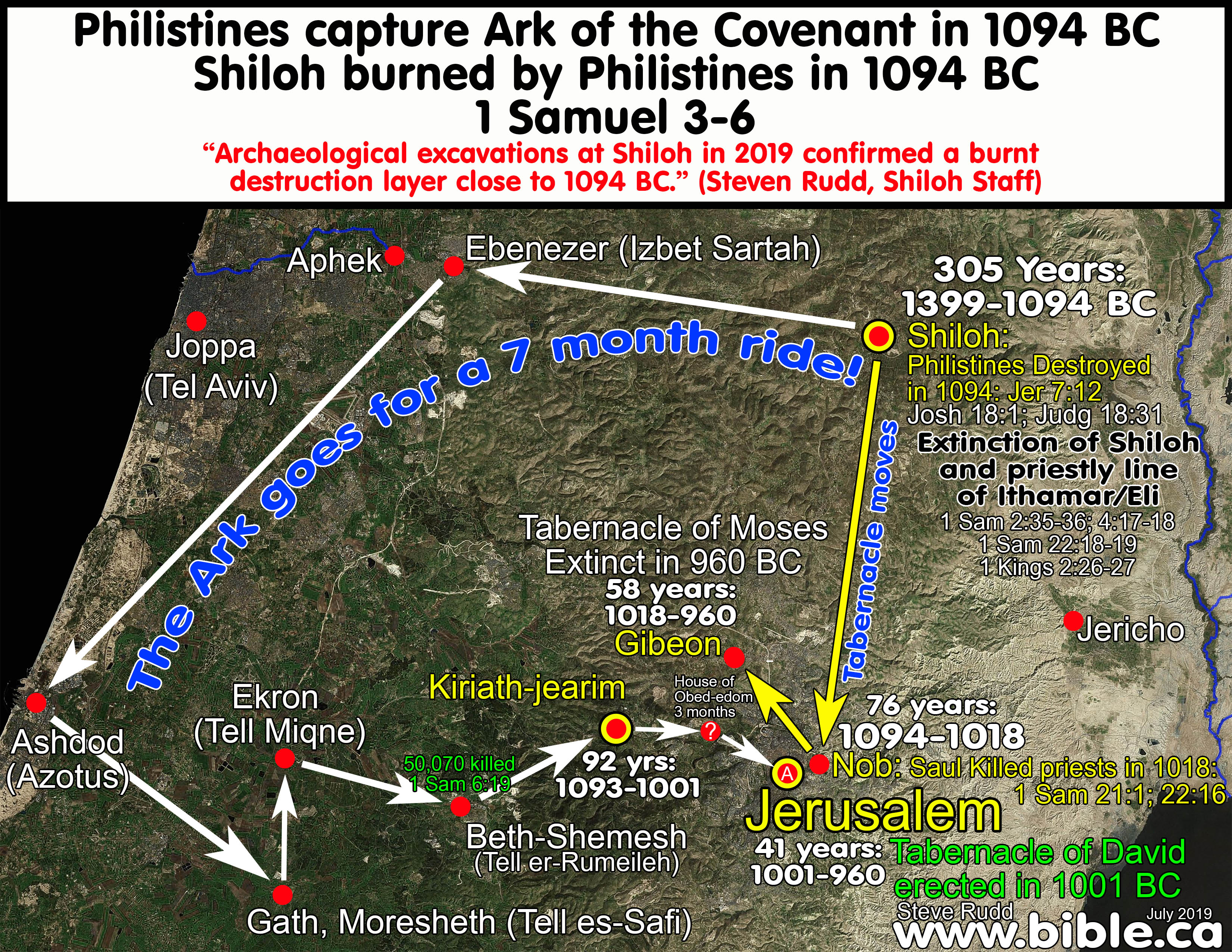
b. The Ark of covenant is at Kiriath-jearim.
c. After 76 years, the Mosaic Tent of Meeting
is moved from Nob to Gibeah in 1018 BC after Saul kills the entire priesthood
at Nob in a psychotic fit of rage against them giving David help. The
Tabernacle will remain at Gibeah until it goes extinct 59 years later in 959 BC
when Solomon finishes the Temple. After Saul kills the priests and moves the
Tabernacle to Gibeah, it functioned with out a high priest until after Saul
died. Abiather, the only survivor of Saul's rage at Nob, travelled with David
until Saul died. Samuel was likely the overseer of the tabernacle during this
period. It when Saul moved the Tabernacle to Gibeon, that he punished all the
sorcerers and mediums and murdered the non-Hebrew Gibeonites (2 Samuel 21) who
had an oath of protection from Joshua.
d. Here is a panorama view of Gibeon from the top of Ramah, where Samuel lived and oversaw the Mosaic Tent of Meeting from 1018-1014 BC until he died. Saul had killed the priests and none officiated during this period.

e. There are still altars at Ramah (Samuel's), Bethel (Jacob’s Gen 35:1), Gilgal and at the two Levitical cities of Gibeon and Geba.
f. Saul’s royal palace is Gibeah of Benjamin, also called Gibeah of Saul. Gibeah is the first Royal city. David's royal city will be Jerusalem 7 years after Saul dies. Saul’s royal palace at Gibeah is the capital of Israel until he dies in 1010 BC.
g. Here is a panorama from the top of Gibeah of Benjamin where Saul's palace stood. You can clearly see Samuel's home at Ramah 5 km away.

h. In 1967 King Hussein built his Jordanian palace on the very spot that Saul's palace stood. Excavations of this site are planned in the next few years. Past excavations have uncovered a large square structure with corner towers that are believed to be Saul's palace. Gibeah is also called the "second Sodom" because in 1290 BC (Judges 19:22), the men of the city committed acts of sodomy and rape that closely parallels the story of Sodom and Gomorrah in Gen 19. This is where the Levite priest had his Bethlehemite wife raped and murdered and he cut her in pieces and sent her to through Israel. The result was a call to war and the tribe of Benjamin was almost wiped out, save 600 men. Saul was a descendant of those men and chose Gibeah, his home town, as his Royal city. Echoing the woman being cut up 250 years earlier from this same spot, Saul cuts up oxen in pieces and sends them throughout Israel as a call to war to defend the men at Jabesh-Gilead who were under attack of Moab. This is how it looks today:

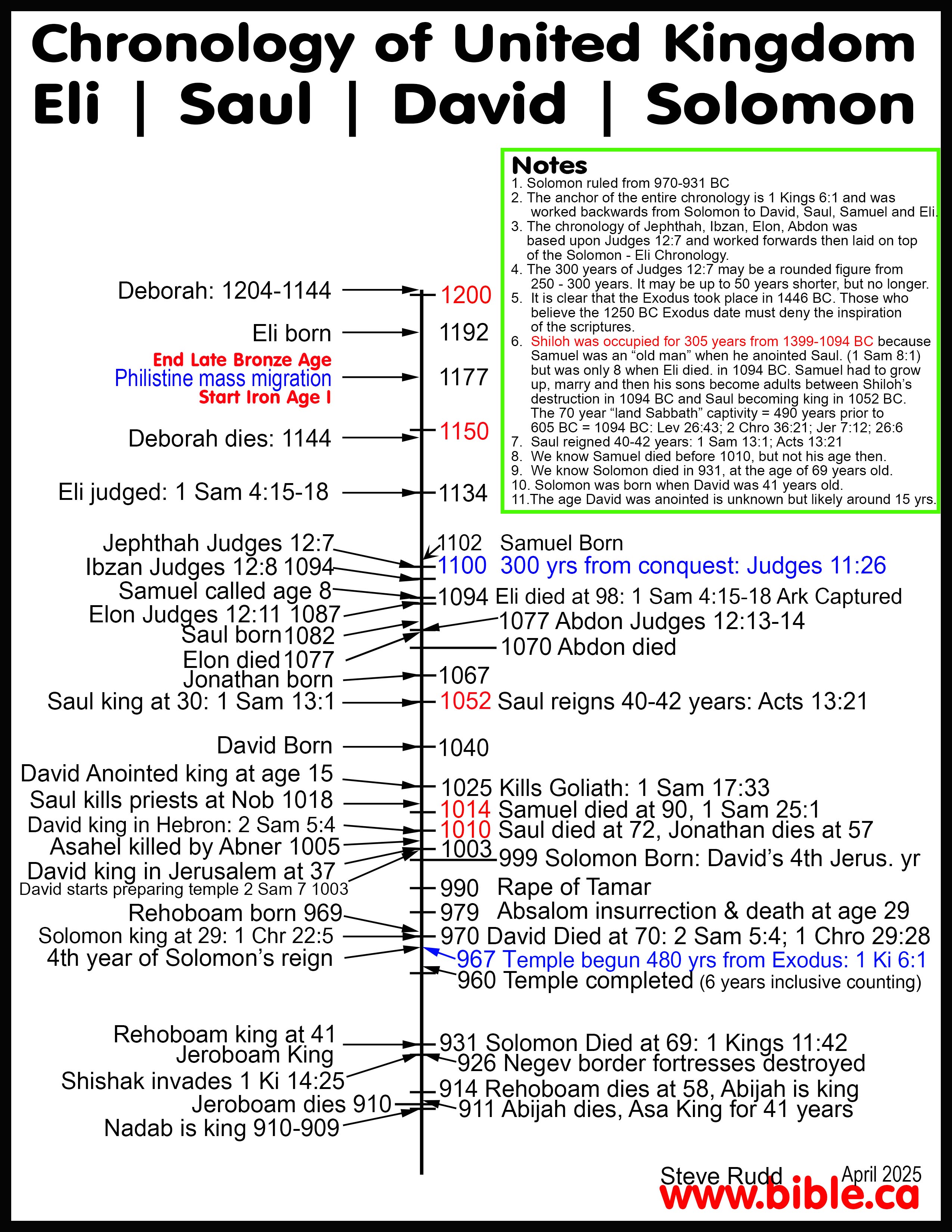
3. Timeline and chronology:
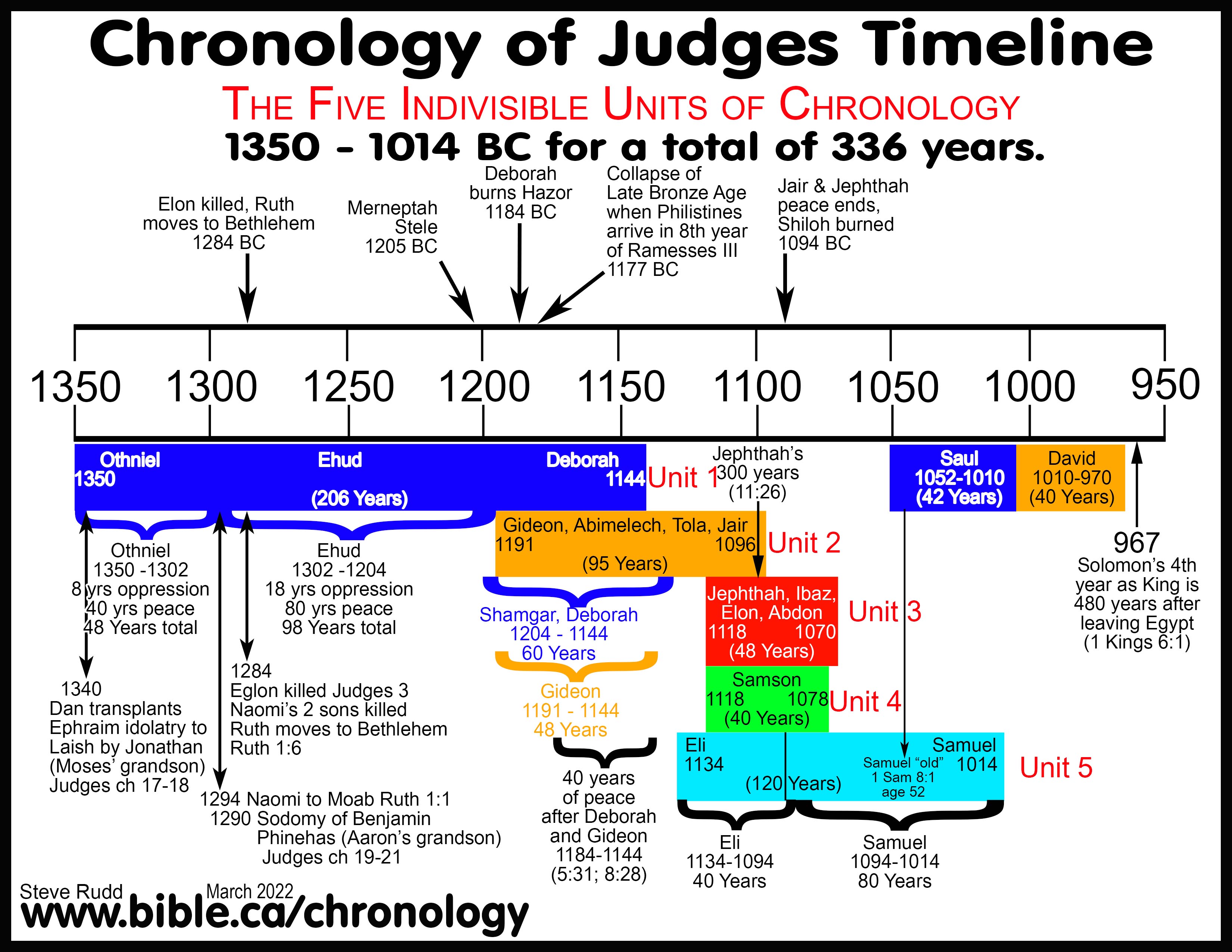
a. In 1082 BC, Saul is born.
b. In Jonathan is likely born around 1067 BC since he is Saul’s oldest son, when Saul is 15 years old.
c. In 1052 BC, Samuel was 52 years old when he anointed Saul at age 30 as king. 1 Sam 13:1
d. In 1040 BC, David is born when Jonathan is about 27 years old and Saul is 42.
e. In 1025 BC David killed Goliath when Saul had been king for 27 years but had failed to obey God twice and is told another will replace him. (David) Johnathan was 42 when David killed Goliath.
f. 1025- 1018 BC: David’s time in the Saul’s palace at Gibeah of Benjamin: 7 years
g. 1018-1014 BC: David’s time on the run in the Judean wilderness until he enters Gath: 4 years.
h. 1014-1010 BC: David lives among the Philistines at Gath, then Ziglag until Saul’s death.
i. In 1014 Samuel dies an old man, likely 90 years old. 1 Sam 25:1. For about 4 years, Samuel can look down from Ramah where he lives and see the Tabernacle between 1018-1014 BC.
j. In 1010 BC Saul and Jonathan die.
(i.) Saul was 72 years old when he died
(ii.) Jonathan was 57 years old when he died.
(iii.) David was 30 when he began to reign as king in Hebron between 1010-1003 BC
k. In 1003 BC David captures Jerusalem and begins his reign at age 37.
l. In 999 BC, Solomon is born.
4. This 4 year period was a time of persecution for David and laid the foundation of many antitypes echoed by Christ and Christians in general. The collection below is a partial list, but these are the ones where the title of the Psalm actually tells us the context of when and where it was written. For a complete list of these see the end just before the conclusion and then a general summary in the conclusion.
|
Index of Psalms written by David when Saul Hunted him between 1018-1010 BC |
||
|
Psalm 7 |
The LORD Implored to Defend the Psalmist against the Wicked. A Shiggaion of David, which he sang to the LORD concerning Cush, a Benjamite. |
Protection from Saul: Cush the Benjaminite refers to Saul the son of Kish |
|
Psalm 59 |
Prayer for Deliverance from Enemies. For the choir director; set to Al-tashheth. A Mikhtam of David, when Saul sent men and they watched the house in order to kill him. |
1 Sam 19 when Michal let David escape from the house out the window. |
|
Psalm 56 |
Supplication for Deliverance and Grateful Trust in God. For the choir director; according to Jonath elem rehokim. A Mikhtam of David, when the Philistines seized him in Gath. (Psalm 56 title) |
Captured by Philistines, when David had to resort to faking insanity to escape Achish, king of Gath. (56&57 are considered twin psalms) |
|
Psalm 34 |
The LORD, a Provider and Deliverer. A Psalm of David when he feigned madness before Abimelech [Achish], who drove him away and he departed. (Psalm 34 title) |
Faked madness to Achish |
|
Psalm 52 |
Futility of Boastful Wickedness. For the choir director. A Maskil of David, when Doeg the Edomite came and told Saul and said to him, “David has come to the house of Ahimelech.” |
Doeg the Edomite kills the 85 priests of Nob. |
|
Psalm 63 |
The Thirsting Soul Satisfied in God. A Psalm of David, when he was in the wilderness of Judah. |
1 Samuel 22:5 when Gad the prophet ordered David back to Judah to rely upon God. |
|
Psalm 54 |
Prayer for Defense against Enemies. For the choir director; on stringed instruments. A Maskil of David, when the Ziphites came and said to Saul, “Is not David hiding himself among us?” |
Ziphites betray David 3 times |
|
Psalm 18 |
The LORD Praised for Giving Deliverance. For the choir director. A Psalm of David the servant of the LORD, who spoke to the LORD the words of this song in the day that the LORD delivered him from the hand of all his enemies and from the hand of Saul. |
When Saul surrounded David but was recalled to fight the Philistines: “Saul went on one side of the mountain, and David and his men on the other side of the mountain; and David was hurrying to get away from Saul, for Saul and his men were surrounding David and his men to seize them. But a messenger came to Saul, saying, “Hurry and come, for the Philistines have made a raid on the land.” So Saul returned from pursuing David and went to meet the Philistines; therefore they called that place the Rock of Escape.” (1 Samuel 23:26-28) |
|
Psalm 57 |
Prayer for Rescue from Persecutors. For the choir director; set to Al-tashheth. A Mikhtam of David, when he fled from Saul in the cave. (Psalm 57 title) |
When David was in the cave at En Gedi and cut the robe of Saul. (56&57 are considered twin psalms) |
|
Psalm 142 |
“Maskil of David, when he was in the cave. A Prayer.” (Psalm 142:title) |
When David was in the cave at En Gedi and cut the robe of Saul. |
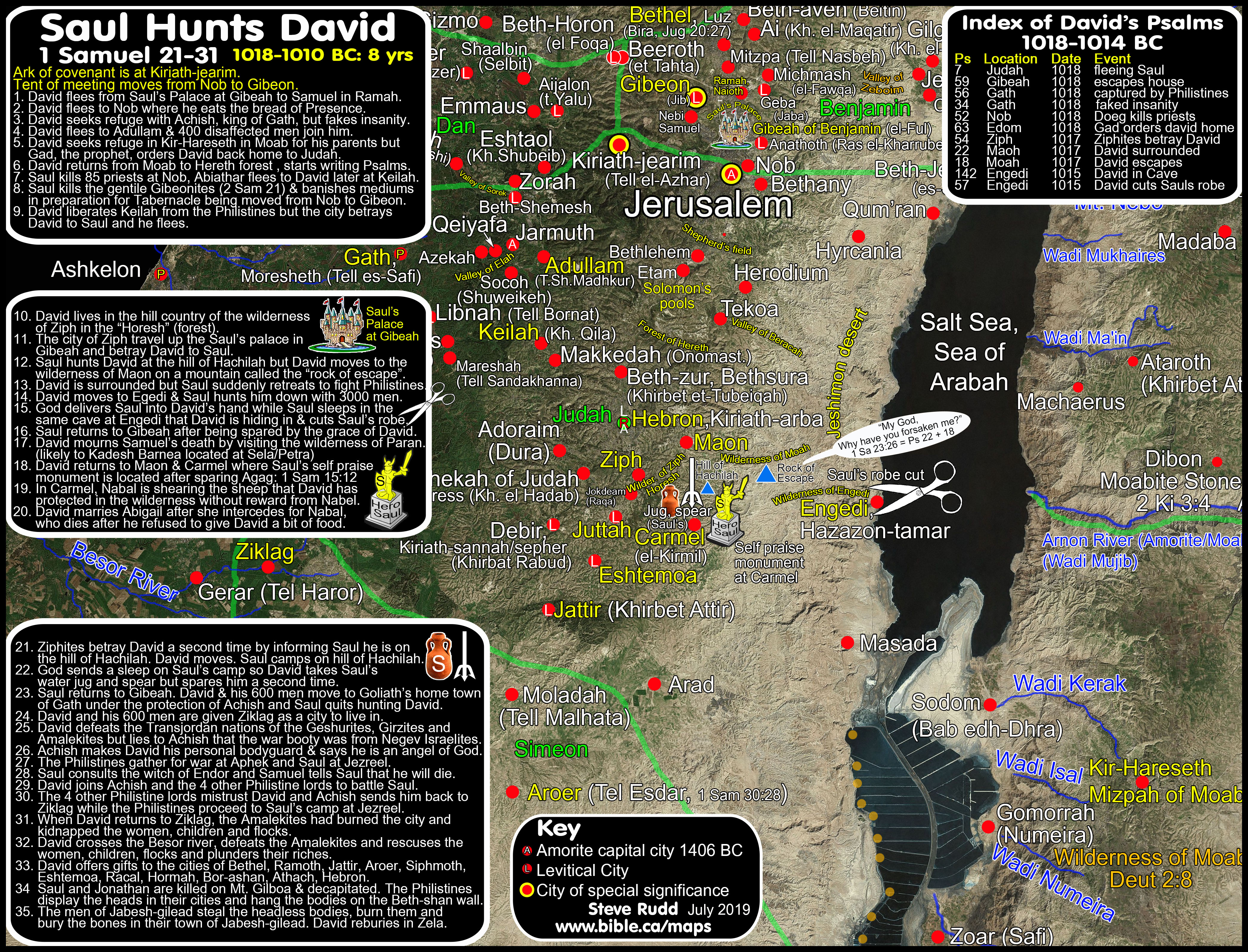
Summary overview of 1 Samuel chapters 21-31:
1. David flees from Saul’s Palace at Gibeah to Samuel in Ramah.
2. David flees to Nob where he eats the bread of Presence.
3. David seeks refuge with Achish, king of Gath, but fakes insanity.
4. David flees to Adullam & 400 disaffected men join him.
5. David seeks refuge in Kir-Hareseth in Moab from Saul for his parents but Gad, the prophet, orders David back home to Judah.
6. David returns from Moab to Hereth forest , starts writing Psalms.
7. Saul kills 85 priests at Nob, Abiathar flees to David later at Keilah.
8. Saul kills the gentile Gibeonites (2 Sam 21) & banishes mediums in preparation for Tabernacle being moved from Nob to Gibeon.
9. David liberates Keilah from the Philistines but the city betrays David to Saul and he flees.
10. David lives in the hill country of the wilderness of Ziph in the “Horesh” (forest).
11. The city of Ziph travel up the Saul’s palace in Gibeah and betray David to Saul.
12. Saul hunts David in the wilderness of Maon in the Arabah south of the Jeshimon desert beside the Salt Sea.
13. David is surrounded but Saul suddenly retreats to fight Philistines.
14. David moves to Egedi & Saul hunts him down with 3000 men.
15. God delivers Saul into David’s hand while Saul sleeps in the same cave at Engedi that David is hiding in & cuts Saul’s robe.
16. Saul returns to Gibeah after being spared by the grace of David.
17. David mourns Samuel’s death by visiting the wilderness of Paran. (likely to Kadesh Barnea located at Sela/Petra)
18. David returns to Maon & Carmel where Saul’s self praise monument is located after sparing Agag: 1 Sam 15:12
19. In Carmel, Nabal is shearing the sheep that David has protected in the wilderness without reward from Nabel.
20. David marries Abigail after she intercedes for Nabal, who dies after he refused to give David a bit of food.
21. Ziphites betray David a second time by informing Saul he is in the wilderness of Ziph.
22. God sends a sleep on Saul’s camp so David takes Saul’s water jug and spear but spares him a second time.
23. Saul returns to Gibeah. David & his 600 men move to Goliath’s home town of Gath under the protection of Achish and Saul quits hunting David.
24. David and his 600 men are given Ziklag as a city to live in.
25. David defeats the Transjordan nations of the Geshurites, Girzites and Amalekites but lies to Achish that the war booty was from Negev Israelites.
26. Achish makes David his personal bodyguard & says he is an angel of God.
27. The Philistines gather for war at Aphek and Saul at Jezreel.
28. Saul consults the witch of Endor and Samuel tells Saul that he will die.
29. David joins Achish and the 4 other Philistine lords to battle Saul.
30. The 4 other Philistine lords mistrust David and Achish sends him back to Ziklag while the Philistines proceed to Saul’s camp at Jezreel.
31. When David returns to Ziklag, the Amalekites had burned the city and kidnapped the women, children and flocks.
32. David crosses the Besor river, defeats the Amalekites and rescuses the women, children, flocks and plunders their riches.
33. David offers gifts to the cities of Bethel, Ramoth, Jattir, Aroer, Siphmoth, Eshtemoa, Racal, Hormah, Bor-ashan, Athach, Hebron.
34 Saul and Jonathan are killed on Mt. Gilboa & decapitated. The Philistines display the heads in their cities and hang the bodies on the Beth-shan wall.
35. The men of Jabesh-gilead steal the headless bodies, burn them and bury the bones in their town of Jabesh-gilead. David reburies in Zela.
A. David flees from Saul to Nob: 1 Sam 21
1. After Saul makes two attempts to kill David with the spear all seems well to Jonathan, Saul's son and heir to the throne. David asks Jonathan to see how Saul reacts when he is not present at the New Moon feast. The result is that Saul tries to kill Jonathan, accusing him of a traitorous allegiance with David.
2. David first fled to Samuel at Ramah and lived there in the prophet's school called Naioth which is about 5 km west of Gibeah.
3. Saul comes to Naioth for David who flees to Nob.
B. Nob, the priest city and location of the Tabernacle: 1 Sam 21
1. The birth of Samuel marked the end of God's grace with Eli, his sons and the pagan and immoral mix of practices they had instituted at the Mosaic tabernacle in Shiloh.
2. God had prophesied through Samuel, that the high priest line of Eli would go extinct. This was fulfilled in two stages:
i. First was the slaughter of the 85 priests at Nob by Saul after he felt betrayed by Ahimelech the high priest, the son of Ahitub, the son of Phinehas, the Son of Eli, for helping David. Only one priestly descendant of Eli survived named Abiathar who sought refuge with David and then served him as High Priest.
ii. Later, Abiathar, (the son of Ahimelech who gave David the "bread of presence"), was replaced by Zadok by Solomon. This action by Solomon fulfilled 100 % the prophecy that Eli's descendants would no longer serve as high priest. “The king appointed Benaiah the son of Jehoiada over the army in his place, and the king appointed Zadok the priest in the place of Abiathar.” (1 Kings 2:35)
3. For 306 years the Tabernacle was in Shiloh during the period of the Judges. In a period of Apostasy within the Judges era, God used the Philistines to defeat Israel and they captured the Ark of the Covenant and destroyed Shiloh in 1094 BC.
4. After the Ark of the Covenant was recovered from the Philistines, it passed through Beth Shemesh, then moved to Kiriath Jearim where it will rest for 92 years (1093 - 1001 BC)
5. However the Tabernacle of Moses was moved from Shiloh to Nob for 76 years (1094 - 1018 BC)
6. When Saul realized that the High priest, Ahimelech, gave food to David, he murdered 85 priests and then every man, woman and child including all animals at Nob.
7. This illustrates just how much Saul hated David and Nob became the vicarious target. It was just one more example of how Saul acted in a psychotic rage of revenge.
8. In 1018 BC, the Mosaic Tent of Meeting was moved to Gibeon where it stayed for 59 years until it went extinct in 953 BC. Gibeon was only 1 KM north of Ramah where Samuel had a spectacular overlooking view. Samuel lived to oversee the tabernacle for about 4 years until he died.
C. David's 3 lies and deceptions
- The three/deceptions lies:
- David instructs Jonathan to lie to Saul that he is in Bethlehem for the new moon feast with his family but is actually hiding near Gibeah.
- David lies to Ahimelech, the high priest, that he is on a secret mission on behalf of Saul, when in fact he is alone and on the run from Saul. David seeks food and the result of this was the death of 70 priests of Nob of the bloodline of Eli.
- David deceives Achish, the king of Gath, by faking that he was insane. While David used insanity to hide his sanity, Saul surrounded himself with sanity, in order to hide his insanity.
- Deception is always a sin but some religions use the sinful example of David's lying to prove it is OK to lie to your enemies. Just as the Bible didn't openly criticize Noah for getting drunk, so too it didn't criticize David's deceptions. This, however, should not be viewed as divine approval because God expects the reader to apply the most basic moral template onto any Bible story for their own discernment of what is right and wrong. Also, in this very text where David is not criticized for lying, no note is made that David ate the sacred showbread form the Tabernacle, which was a violation of the ceremonial law, even though in this case it was not a sin. (see below)
- Jehovah's Witnesses have long been known to practice "theocratic war strategy" or the "Rahab technique.":
- In legal custody battles over children, the watchtower instructs their members to openly lie, give half-truths, remain silent and withhold important information etc. at any cost to retain custody of the children.
- "God's Word commands: "Speak truth each of you wish his neighbor." (Eph. 4:25). This command, however, does not mean that we should tell everyone who asks us all he wants to know. We must tell the truth to one who is entitled to know, but if one is not so entitled we may be evasive. … As a soldier of Christ he is in theocratic warfare and he must exercise added caution when dealing with God's foes. Thus the Scriptures show that for the purpose of protecting the interests of God's cause, it is proper to hide the truth from God's enemies. … “when faced with the alternative of speaking and betraying his brothers or not speaking and being held in contempt of court, the ... [Watchtower follower] will put the welfare of his brothers ahead of his own '" (The Watchtower January 1, 1960:351-352).
- 'No harm is practiced, however, by withholding incriminating information from one who is not entitled to know. ... Various characters of the Bible have been accused of lying, such as Jacob, Rahab, the Gibeonites, David and others, but there is no record in the Bible that they came under divine disapproval for this.' Watchtower Oct 1, 1954, 'Christians Live the Truth', par 21, 25
- 'So in time of spiritual warfare it is proper to misdirect the enemy by hiding the truth. It is done unselfishly; it does not harm anyone; on the contrary, it does much good. Today God's servants are engaged in a warfare, a spiritual, theocratic warfare, a warfare ordered by God against wicked spirit forces and against false teachings. God's servants are sent forth as sheep among wolves and therefore need to exercise the extreme caution of serpents so as to protect properly the interests of God's Kingdom. At all times they must be very careful not to divulge any information to the enemy that he could use to hamper the preaching work.'' Watchtower May 1, 1957 Page 285 - 286.
- 'While malicious lying is definitely condemned in the Bible, this does not mean that a person is under obligation to divulge truthful information to people who are not entitled to it. ... Evidently the course of Abraham, Isaac, Rahab, and Elisha in misdirecting or in withholding full facts from nonworshipers of Jehovah must be viewed in the same light. ' Insight On The Scriptures, Volume 2, 1988 pages 244-245.
- Survey of Jehovah's Witnesses beliefs: An examination of the questionnaires of those who claimed they were not aware of the doctrine shows they were far less involved in the Watchtower—some were at best nominal Witnesses who attended meetings often as a result of family pressure. Dedicated Witnesses who held administrative positions were, with only one exception, very aware of the doctrine and its significance (elders and circuit overseers). Most (98%) knew of the practice or could define it, but some Witnesses did not recognize it by the proper term. Some may have still thought of the doctrine by the old term “Rahab technique.” Some persons may not be aware of the term because the word “theocratic” is used less often now than formerly, but is still common. An example is their official songbook Singing Praises to Jehovah (1984), which is used at all meetings and lists 13 songs under “Theocratic Warfare.”
“How would you best describe Theocratic War Doctrine?”
|
Response of "yes" from 130 X-Jehovah's Witnesses: |
Member |
Pioneer |
Ministerial Servant; Elder |
Circuit Overseer |
|
|
A. |
The court’s definition of truth “One must tell the whole truth and nothing but the truth” must be strictly adhered to. |
3 |
1 |
0 |
0 |
|
B. |
We do not have to follow the rule, i.e., they can withhold the truth from those who have no right to know it. |
38 |
10 |
14 |
4 |
|
C. |
To protect the interests of the Watchtower and God’s organization, it is appropriate to tell what the world might conclude are little white lies. |
38 |
10 |
11 |
4 |
|
D. |
One must use words in such a way to defend God’s organization--even if this means lying in worldly terms. |
23 |
8 |
10 |
4 |
- Catholics are trained to lie:
- "So ... a false statement knowingly made to one who has not a right to the truth will not be a lie." (Catholic Encyclopedia, IX, 471)
- "we are ... under an obligation to keep secrets faithfully, and sometimes the easiest way of fulfilling that duty is to say what is false, or to tell a lie." (Catholic Encyclopedia, X, 195)
- Muslims are trained to lie to infidels, in a practice they call, "Taqiyya" or " Tuqyah":
- "Let not the believers Take for friends or helpers Unbelievers rather than believers: if any do that, in nothing will there be help from Allah: except by way of precaution, that ye may Guard yourselves from them. But Allah cautions you (To remember) Himself; for the final goal is to Allah." Qur'an 3:28
- Islamic commentators interpret the meaning of Qur'an 3:28: "meaning, except those believers who in some areas or times fear for their safety from the disbelievers. In this case, such believers are allowed to show friendship to the disbelievers outwardly, but never inwardly." (Ibn Kathir) He quotes Muhammad's companion, Abu Ad-Darda', who said "we smile in the face of some people although our hearts curse them," and Al-Hasan who said "the Tuqyah is acceptable till the Day of Resurrection." (bin Kathir, Isma'il bin 'Umar, 26 October 2002) [c. 1370], "The Prohibition of Supporting the Disbelievers")
- The Bukhari Hadith says: "Allah's Apostle said, "Who is willing to kill Ka'b bin Al-Ashraf who has hurt Allah and His Apostle?" Thereupon Muhammad bin Maslama got up saying, "O Allah's Apostle! Would you like that I kill him?" The Prophet said, "Yes," Muhammad bin Maslama said, "Then allow me to say a (false) thing (i.e. to deceive Kab). "The Prophet said, "You may say it." ... [Bukhari Vol 5 Book 59 Num 369]
- Taqiyya [deception] is of fundamental importance in Islam. Practically every Islamic sect agrees to it and practices it. We can go so far as to say that the practice of taqiyya is mainstream in Islam, and that those few sects not practicing it diverge from the mainstream...Taqiyya is very prevalent in Islamic politics, especially in the modern era." (Al-Taqiyya Fi Al-Islam)
- "If you [Muslims] are under their [infidels'] authority, fearing for yourselves, behave loyally to them, with your tongue, while harbouring inner animosity for them... Allah has forbidden believers from being friendly or on intimate terms with the infidels in place of believers – except when infidels are above them [in authority]. In such a scenario, let them act friendly towards them." (Al-Tabari, 838-923 AD, )
D. David violates law of Moses with impunity when eating Bread of Presence on the Sabbath day: 1 Sam 21
- While David's eating of the sacred Shew Bread placed on a table inside the Holy Place of the tabernacle goes without even a passing comment, Jewish scholars have always taken note of this strange exception.
- Jesus was accused of breaking the Sabbath and invoked this example of David eating the sacred bread on the Sabbath, to counter their criticism.
- “And it happened that He was passing through the grainfields on the Sabbath, and His disciples began to make their way along while picking the heads of grain. The Pharisees were saying to Him, “Look, why are they doing what is not lawful on the Sabbath?” And He said to them, “Have you never read what David did when he was in need and he and his companions became hungry; how he entered the house of God in the time of Abiathar the high priest, and ate the consecrated bread, which is not lawful for anyone to eat except the priests, and he also gave it to those who were with him?” [““Or have you not read in the Law, that on the Sabbath the priests in the temple break the Sabbath and are innocent? “But I say to you that something greater than the temple is here. “But if you had known what this means, ‘I desire compassion, and not a sacrifice,’ you would not have condemned the innocent.” (Matthew 12:5-7)] Jesus said to them, “The Sabbath was made for man, and not man for the Sabbath. “So the Son of Man is Lord even of the Sabbath.” He entered again into a synagogue; and a man was there whose hand was withered. They were watching Him to see if He would heal him on the Sabbath, so that they might accuse Him. He said to the man with the withered hand, “Get up and come forward!” And He said to them, “Is it lawful to do good or to do harm on the Sabbath, to save a life or to kill?” But they kept silent. After looking around at them with anger, grieved at their hardness of heart, He said to the man, “Stretch out your hand.” And he stretched it out, and his hand was restored. The Pharisees went out and immediately began conspiring with the Herodians against Him, as to how they might destroy Him.” (Mark 2:23–3:6)
- In the parallel texts of Mt 12:1-14; Mk 2:23-3:6; Luke 6:1-11; Luke 13:10-17, eating standing grain that was not your crop was permitted as a general rule, (Deut 23:24-25) but then so was gathering wood, yet both were forbidden on the Sabbath day. Jesus justified gathering food on the Sabbath day, which violated Ex 16:22-30, by using the following argument:
- David eating showbread in 1 Sam 21:1-6, was a double violation of the law of Moses because first, only the priests could eat it and second, the "day old" showbread was to be burned never eaten. (Lev 8:31; 24:9; Ex 29:33-34)
- The priests would break the Sabbath by their temple work because slaughtering animals is very hard and heavy work. It is interesting to note that the common Jew was forbidden to work, but then in the same passage, the priests were told do the work for them in Num 28:9-10; 18-19). So the same work on the sabbath day brought stoning to the common Jew and blessing to the Priests.
- In John 7:19: Jesus justified working/healing on the Sabbath by appealing to the priests who also break the Sabbath by performing circumcision on Sabbath day.
- The priests broke the Sabbath law by kindling fire (Ex 35:3) and baking new showbread (food preparation was forbidden Ex 16:23).
- Next Jesus stated that He was "greater than the temple". By this, Jesus meant that the holiness of the temple overshadowed and allowed the priests to break the Sabbath and do their work. Jesus is the true temple "that He will tear down and raise up in three days".
- Just as the priests were permitted to break the Sabbath because they were in the presence of the physical Jewish temple, Jesus' disciples were permitted to break the Sabbath in their gathering of food because they were in the presence of Jesus himself, the true spiritual temple. Not much wonder the Jews wanted to stone Jesus when he said HE was personally greater than the physical temple.
- Additional examples of Jesus justifying the breaking of the Sabbath:
- "You hypocrites, does not each of you on the Sabbath untie his ox or his donkey from the stall, and lead him away to water him?" Lk 13:15
- "Which one of you shall have a son or an ox fall into a well, and will not immediately pull him out on a Sabbath day?" Lk 14:5
- In John 5:8-18, Jesus healed a lame man on the Sabbath and commanded him, in violation of the law of Moses, to take up his pallet and walk! What the man did was a clear violation to the Sabbath law: Jer 17:21-22, Neh 13:15-22. Jesus justified carrying the pallet which broke the Sabbath law, by answering that both Jesus and the Father are working together, proving that such was an acceptable exception to the Sabbath law. If the same man carried the same pallet the next Sabbath, he would be stoned by Jesus as a Sabbath breaker! Jesus statement, "My Father is working until now, and I Myself am working." is quite remarkable, since we would have expected Jesus to say, "My work does not break the sabbath" or "I am not working." But Jesus’ reply implicates the Father in also breaking the sabbath along side of Jesus. Now we have both the Father and the Son breaking the sabbath.
- In our war against "situation ethics" where liberals argue that all moral laws "ethics" can be broken, given the right "situation", we have thrown the baby out with the bath water.
- There are no situations when moral laws can be broken without sin.
- The sabbath law (the fourth commandment) was a ceremonial law, and God himself gave many examples of when it can be broken right in the law of Moses. (priests in temple for example) It is important to note that we can consistently and powerfully argue that "situation moral ethics" is a false doctrine, while arguing that Jesus was able to break the sabbath without sin. We might call this a type of "situation ceremonial ethics".
- Moral laws never change and have always existed. Ceremonial laws change and have a beginning and ending point. In other words, while lying has always been sin, the sabbath did not exist before Ex 16 and was abolished at the cross. Therefore lying is always sin and it should not surprise us that there are occasions when the ceremonial law can be broken without sin. In fact this is exactly how Jesus argues to defend his breaking of the sabbath. The ceremonial law of circumcision of another example of a temporary law of Moses that we are permitted to break.
- This example of David breaking the ceremonial law of Moses in spite of the fact that David sinned by lying to attain that bread is very instructive to the Christian to discern when the Law of the Greater good comes into play.
- Detailed outline on how Jesus and the Father broke the Sabbath with impunity. This outline is directed at those who reject that Jesus is equal to the Father as an uncreated class of being. Jesus is not a creature but God, the creator.
E. David fakes he is insane to Achish, King of Gath: 1 Sam 21
- About this time, David writes later writes two Psalms.
- His capture by the Philistines in Gath. This is unrecorded except for the title of the Psalm: “For the choir director; according to Mikhtam of David, when the Philistines seized him in Gath.” (Psalm 56:title)
- His faking insanity in front of Achish, king of Gath: “A Psalm of David when he feigned madness before Abimelech, who drove him away and he departed.” (Psalm 34:title)
- “So he disguised his sanity [Strongs: 2940 taam] before them, and acted insanely in their hands, and scribbled on the doors of the gate, and let his saliva run down into his beard. Then Achish said to his servants, “Behold, you see the man behaving as a madman. Why do you bring him to me? “Do I lack madmen, that you have brought this one to act the madman in my presence? Shall this one come into my house?”” (1 Samuel 21:13–15)
- The Hebrew word for "sanity" in 1 Sam 21:13 is "Taam" [Strongs: 2940 taam] and is used in these other passages:
- Amazingly, David wrote Psalm 34, about this time when he faked insanity to King Achish of Gath. The same word "taam" is used in both texts.
- “A Psalm of David when he feigned madness [Strongs: 2940 taam] before Abimelech [ie Achish. lit: my father is king official title for Philistine kings like Pharaoh], who drove him away and he departed. I will bless the LORD at all times; His praise shall continually be in my mouth. My soul will make its boast in the LORD; The humble will hear it and rejoice. O magnify the LORD with me, And let us exalt His name together. I sought the LORD, and He answered me, And delivered me from all my fears.” (Psalm 34:title–22)
- When David faked insanity, the Hebrew word for "madness" in 1 Sam 21:13-14 is "Shaga" [Strongs 7696: Shaga] and is used in these verses:
a. Shaga is used as a curse from God when he inflicts insanity upon sinners:
i. The Philistines had been stricken with madness on several previous occasions and Achish indicates that insanity was common in his kingdom: “Do I lack madmen, that you have brought this one to act the madman in my presence? Shall this one come into my house?” (1 Samuel 21:15)
ii. Deuteronomy 28:34 “You shall be driven mad [Strongs 7696: Shaga]by the sight of what you see.
- Shaga is used as a slur against the true prophets of God:
b. "Now Jehu came out to the servants of his master, and one said to him, “Is all well? Why did this madman [Strongs 7696: Shaga]come to you?” And he said to them, “You know very well the man and his talk.”" (2 Kings 9:11)
c. “The Lord has made you priest instead of Jehoiada the priest, to be the overseer in the house of the Lord over every madman [Strongs 7696: Shaga]who prophesies (Jeremiah), to put him in the stocks and in the iron collar, now then, why have you not rebuked Jeremiah of Anathoth who prophesies to you?" (Jeremiah 29:26)
d. "The days of punishment have come, The days of retribution have come; Let Israel know this! The prophet is a fool, The inspired man is insane [Strongs 7696: Shaga], Because of the grossness of your iniquity, And because your hostility is so great." (Hosea 9:7)
- In the New Testament, the holy men of God were called insane:
- Of Jesus:
i. “When His own people heard of this, they went out to take custody of Him; for they were saying, “He has lost His senses.”” (Mark 3:21)
ii. “Many of them were saying, “He has a demon and is insane. Why do you listen to Him?”” (John 10:20)
- Of Paul: “While Paul was saying this in his defense, Festus said in a loud voice, “Paul, you are out of your mind! Your great learning is driving you mad.” But Paul said, “I am not out of my mind, most excellent Festus, but I utter words of sober truth.” (Acts 26:24–25)
F. David, the original "Robin Hood": 1 Sam 22
“Everyone who was in distress, and everyone who was in debt, and everyone who was discontented gathered to him; and he became captain over them. Now there were about four hundred men with him.” (1 Samuel 22:2)
- David was the righteous protector of the downtrodden.
- The area around the cave of Adullam was the "Sherwood Forest".
- David even had his band of 400 "merry men".
- Of course, David didn't steal money from anyone, he just stood up for what was right.
G. David, evacuates his parents to Moab: 1 Sam 22
- David flees to Mizpah of Moab (Kir-Hareseth) with his parents, who live in Bethlehem and seeks sanctuary and protection for them in Moab.
- Gad, the prophet, orders David back to Judah under the protection of God, not some pagan king.
- This was an important lesson for David and many of the Psalms he wrote were a direct result of the 4 years of tribulation and persecution he suffered. If he remained in Moab, he would have not experienced persecution, but then we would not have some of the most important messianic Psalms.
- For example, Psalm 63 was written during the very time after David returned from Moab:
- “A Psalm of David, when he was in the wilderness of Judah. O God, You are my God; I shall seek You earnestly; My soul thirsts for You, my flesh yearns for You, In a dry and weary land where there is no water. Thus I have seen You in the sanctuary, To see Your power and Your glory.” (Psalm 63:title–2)
- “When I remember You on my bed, I meditate on You in the night watches, For You have been my help, And in the shadow of Your wings I sing for joy. My soul clings to You; Your right hand upholds me. But those who seek my life to destroy it, Will go into the depths of the earth.” (Psalm 63:6–9)
H. David's two spiritual failures:
- The two spiritual failures: trusting in man not God
- Seeking protection and refuge for himself from Achish, king of Gath, instead of God
i. David seeks refuge from Philistines:
ii. David tries to move into Gath, the home town of Goliath.
iii. This spooks Achish, the king of Gath who marks David as a potential threat.
iv. David is captured by the Philistines and brought him to Achish: "Supplication for Deliverance and Grateful Trust in God. For the choir director; according to Jonath elem rehokim. A Mikhtam of David, when the Philistines seized him in Gath." (Psalm 56 title)
v. David fakes that he is insane: "The LORD, a Provider and Deliverer. A Psalm of David when he feigned madness before Abimelech [Achish], who drove him away and he departed." (Psalm 34 title)
- Seeking protection and sanctuary for his parents with the king of Moab, instead of God.
i. David evacuates his parents to Moab for protection of a gentile pagan king. Gad, the prophet immediately orders David back to Judah and to seek the protection of God.
ii. David's flight to Moab in spiritual defeat and return in faith victory is an antitype of the story in the book of Ruth where Elimelech and Naomi had lost faith in God when they moved to Moab, Naomi returned with Ruth in faith victory.
iii. Elimelech and Naomi had lost faith in God and moved to Moab where they married their two sons to pagan Moabite women. Their sons were killed while fighting for Eglon, king of Moab against Ehud. It turned out to be a spiritual success with Ruth when she returned and became the grandmother of David.
iv. Likewise David, in his weakest moment of faith, moves his parents to Moab and is chided by the prophet Gad and ordered to return to trust God.
v. Just as Ruth was told by Boaz that she had come under the protection of the wings of God, so too David echoes the words of his grandmother countless times in the Psalms about these same wings of protection. In one of the most romantic passages in the Bible, Boaz tells Ruth she is under the protection of the wings of God and then Ruth asks Boaz later to spread the [wings] of his covering over her: ““May the Lord reward your work, and your wages be full from the Lord, the God of Israel, under whose wings you have come to seek refuge.”” (Ruth 2:12) “He said, “Who are you?” And she answered, “I am Ruth your maid. So spread your covering over your maid, for you are a close relative.”” (Ruth 3:9)
vi. David sought refuge from a physical fortress outside the graces of God in Moab and returned to seek shelter of his only fortress: God himself, the Rock!
- This was a great spiritual lesson for David.
- David returned to Israel and becomes a pillar of faith and it is then, David writes many Psalms about trusting entirely in God as his "refuge, his rock, his fortress, his stronghold etc".
- Sometimes when we feel defeated, if he cling onto the God of heaven and fix our eyes on Jesus, we will emerge from these trials in faith victory and become pillars of faith.
- The result of David's spiritual failure and subsequent success are the many Psalms David wrote with the theme of protection under Boaz's "shadow of wings of protection" and God is our rock of refuge, not some fortress in a pagan gentile foreign country:
- “Be gracious to me, O God, be gracious to me, For my soul takes refuge in You; And in the shadow of Your wings I will take refuge Until destruction passes by. I will cry to God Most High, To God who accomplishes all things for me.” (Psalm 57:1–2)
- “Wondrously show Your lovingkindness, O Savior of those who take refuge at Your right hand From those who rise up against them. Keep me as the apple of the eye; Hide me in the shadow of Your wings From the wicked who despoil me, My deadly enemies who surround me.” (Psalm 17:7–9)
- “How precious is Your lovingkindness, O God! And the children of men take refuge in the shadow of Your wings.” (Psalm 36:7)
- “Hear my cry, O God; Give heed to my prayer. From the end of the earth I call to You when my heart is faint; Lead me to the rock that is higher than I. For You have been a refuge for me, A tower of strength against the enemy. Let me dwell in Your tent forever; Let me take refuge in the shelter of Your wings. Selah.” (Psalm 61:1–4)
I. David, moves to the forest of Hereth: 1 Sam 22
- The location of Hereth is unknown but it is generally placed east of Keilah.
- This is a high mountain region between the plain of the Salt Sea on the east and the plain of Judah on the west with many long finger-like valleys running east and west. This heavily forested plateau would provide cover, vantage points and multiple easy escape routes for David.
- This is probably when Ps 63 was written: “A Psalm of David, when he was in the wilderness of Judah. O God, You are my God; I shall seek You earnestly; My soul thirsts for You, my flesh yearns for You, In a dry and weary land where there is no water. Thus I have seen You in the sanctuary, To see Your power and Your glory. Because Your lovingkindness is better than life, My lips will praise You. So I will bless You as long as I live; I will lift up my hands in Your name. My soul is satisfied as with marrow and fatness, And my mouth offers praises with joyful lips. When I remember You on my bed, I meditate on You in the night watches, For You have been my help, And in the shadow of Your wings I sing for joy. My soul clings to You; Your right hand upholds me. But those who seek my life to destroy it, Will go into the depths of the earth. They will be delivered over to the power of the sword; They will be a prey for foxes. But the king will rejoice in God; Everyone who swears by Him will glory, For the mouths of those who speak lies will be stopped.” (Psalm 63:title–11)
J. Saul wipes out the high priesthood at Nob in 1018 BC: 1 Sam 22
- After the Philistines captured the ark and destroyed Shiloh in 1088 BC, the tent of meeting was moved to Nob, where it stood for 76 years. After Saul kills the high priest and all the officiating priests of the Tabernacle of Moses, it is moved to the Levitical city of Gibeon.
- Saul takes two steps to make the new location of the Tabernacle at Gibeon holy:
- At this time Saul banishes all mediums, which is seen in the story of the witch of En-dor.
- At this time Saul murders all the gentile Gibeonites who live at Gibeon: (2 Samuel 21)
- The timing on when Saul kills the priests is revealed later to be when David had liberated the city of Keilah:
- “Now it came about, when Abiathar the son of Ahimelech fled to David at Keilah, that he came down with an ephod in his hand.” (1 Samuel 23:6)
- It is ironic that while Saul is killing the high priest, David is liberating his fellow Hebrews from the Philistines.
- About six months after David was at Nob, Delusional and paranoid Saul imagines others are out to get him and like many today who are diagnosed with a sinful behavior problem (mental illness) he makes himself the victim and tolls on the waters of self-pity for some sympathy:
- “For all of you have conspired against me so that there is no one who discloses to me when my son makes a covenant with the son of Jesse, and there is none of you who is sorry for me or discloses to me that my son has stirred up my servant against me to lie in ambush, as it is this day.” (1 Samuel 22:8)
- Doeg the Edomite betrays David and Saul orders the high priest and all the priests who served at the tabernacle to come to his palace at Gibeah to make account for their actions.
- Why was Doeg the Edomite "detained by the Lord" at the tabernacle at the same time David was there?
i. We know from his killing of the high priest and 84 others that he is not a spiritual man, or even a worshipper of YHWH. Saul's Hebrew palace staff and army would not kill the priests.
ii. We know from the Psalm David wrote about him that he is a wicked man.
iii. So Doeg was a wicked non-Hebrew Edomite. If he was a proselyte, it was in name and outward only. Inside he was not a true believer.
iv. Most likely Doeg had been sent to the Tent of Meeting because of some uncleanness or sin that he had to atone for. He likely hated the process and resented the humiliation. He was not likely there as a true believer on a pilgrimage of faith or discharging a vow made on his own free will.
v. Herod the great was an Edomite who had been force converted in 30 BC and he built the temple that Jesus saw but was not really a true Jew or believer.
- Saul asks if Ahimelech, the high priest enquired of God on behalf of David when he also gave him food and Goliath's sword.
i. Ahimelech tells Saul that this was not the first time and that David, being a spiritual man, frequently came to Ahimelech to enquire of God.
ii. This enrages Saul, who obviously had a problem with self-control, envy, rage, selfishness etc.
- Saul orders his court officials and military commanders to kill all the priests but they refuse to do so. He then orders Doeg the Edomite to kill the priests and he is more than willing to do so for great personal reward from the King. David write of Doeg in Ps 52: “Behold, the man who would not make God his refuge, But trusted in the abundance of his riches And was strong in his evil desire.” Killing the priests when all others refused the King, would surely be something that would bring about power and money rewards from Saul. Doeg would not let this opportunity for personal gain pass.
i. This order shows just how wicked Saul was. He was so intent on rebelling against the will of God that David was king and was dethroned, that he was prepared to kill the highest ranking and most holy priests in Israel: The high priest and the priest who officiated at the Mosaic tent of Meeting.
ii. Even Saul's closest and highest ranking officials dare not raise a hand against the priesthood.
iii. While Saul was willing to wipe out the entire anointed priesthood for a righteous deed to David, David was unwilling to kill wicked, sinful and rebellious Saul, even though he had permission from God to kill Saul.
iv. Saul drove himself insane because he refused to repent and was intent on holding on to power as king for his own personal benefit.
v. The entire line of high priests descended from Eli was killed except for one who escaped: Abiathar.
vi. In a psychotic rage, Saul orders the extinction of every man, woman, child and animal at Nob.
vii. This was an example of vicarious rage against the priests with David as the ultimate target in view. This shows just how much Saul hated David. If Saul did this to the priest, how much worse was his wrath against David, given the chance to kill him.
- Young Abiathar escapes and joins David and serves as high priest with David his entire life until Solomon replaces him with Zadok.
i. This was the first stage of fulfillment of Samuel's prophecy that Eli would not have a descendant who is priest.
ii. The final fulfillment was when Abiathar had betrayed David and Solomon, under David's council just before he died, removed him as high priest and replaced him with Zadok.
iii. The Zadok line of priests would exist down to the first century at the time of Jesus as the Pharisees.
- David writes a Psalm about Doeg the Edomite: “For the choir director. A Maskil of David, when Doeg the Edomite came and told Saul and said to him, “David has come to the house of Ahimelech.” Why do you boast in evil, O mighty man? The lovingkindness of God endures all day long. Your tongue devises destruction, Like a sharp razor, O worker of deceit. You love evil more than good, Falsehood more than speaking what is right. Selah. You love all words that devour, O deceitful tongue. But God will break you down forever; He will snatch you up and tear you away from your tent, And uproot you from the land of the living. Selah. The righteous will see and fear, And will laugh at him, saying, “Behold, the man who would not make God his refuge, But trusted in the abundance of his riches And was strong in his evil desire.” But as for me, I am like a green olive tree in the house of God; I trust in the lovingkindness of God forever and ever. I will give You thanks forever, because You have done it, And I will wait on Your name, for it is good, in the presence of Your godly ones.” (Psalm 52:1-9)
- The Mosaic tabernacle was then moved from Nob to Gibeon, which is a conical shaped hill 1 km north of Ramah where Samuel lived.
- However, we have a bit of history in 2 Samuel 21 that is recounted where Saul killed the Gibeonites, most likely to clear the way for the Tabernacle tent.
- Gibeon was a prominent royal city and the Gibeonites were pagan gentiles who tricked Joshua in 1406 BC to spare them. (Josh 9)
- These Gibeonites were likely viewed by Saul as unholy, and they may have been just that. However Joshua had sworn an oath to the Gibeonites that if they were servants of the Israelites, that they would never be killed. If Saul had no regard for murdering David or the High Priest, he certainly would not honor an oath made to them by Joshua.
- Saul murders the High Priest and 70 other priests and then tries to "right the wrong" in a mode of thinking equal to modern "balance scale meritorious salvation", where evil deeds need not be repented of if we do an equal amount of good.
- He moves the Tabernacle to Gibeon under the supervision of Samuel, but compounds his evil by exterminating the gentile Gibeonites whom Joshua protected with an oath. Saul thought he was doing good by ridding his new holy hill of Gentiles. Long after this event happened, after Saul died, there was a famine in Judah that God caused because of Saul's injustice of wiping out the Gibeonites. While Saul thought he was "cleaning of the neighborhood", he brought himself and later David under a curse in 2 Sam 21. The atonement for Saul's sin of killing the Gibeonites resulted in seven of his own relatives being hung at Gibeah of Saul, on the very location of Saul's palace, that was no longer in use.
- He banishes all the mediums and spiritists who called up the dead and used omens at this time. (see the story of the Witch of En-dor)
- While the Bible does not explicitly tell us when either of these two events happened (Gibeonite and medium exterminations) they most likely occurred shortly after the slaughter of the innocent priest at Nob. Understanding the thinking of a psychotic, paranoid and self-serving narcissist like Saul make our guess more certain.
- Psychotic thinking people always want to deceive themselves by doing things they believe are "super-spiritual" in order to make of for exceptionally evil deeds they have already committed. It is noted that Saul removed all the mediums and sorcerers from the land. This was likely done in a way to make his new location of the tabernacle at Gibeon more holy! He reasoned, "See God all the good I am doing you? I wiped out the mediums and created a new place for the tabernacle at Gibeon. I also cleansed the Gibeonites that Joshua allowed to remain… see how spiritual and holy and good I am now?" Of course this was pure delusion and evil.
- Since Abiathar, the high priest was afraid of Saul, he never set foot on Gibeon until after Saul died. This means that Saul had a beautiful EMPTY NON-FUNCTIONING tabernacle tent that lacked a high priest!
- For about 4 years (until Samuel died in 1014 BC) Samuel could look down from his home at Ramah and oversee the tent of meeting.
- From the rest of his life, Abiathar the high priest abandoned Saul and stayed close to David.
- Adonijah, however would betray David on his deathbed in an attempt to crown Adonijah as king, instead of Solomon. (1 kings 1:5)
- For this he was banished and replaced by Zadok: “Then to Abiathar the priest the king said, “Go to Anathoth to your own field, for you deserve to die; but I will not put you to death at this time, because you carried the ark of the Lord GOD before my father David, and because you were afflicted in everything with which my father was afflicted.” So Solomon dismissed Abiathar from being priest to the LORD, in order to fulfill the word of the LORD, which He had spoken concerning the house of Eli in Shiloh.” (1 Kings 2:26–27)
- “‘Behold, the days are coming when I will break your strength and the strength of your father’s house so that there will not be an old man in your house. ‘You will see the distress of My dwelling, in spite of all the good that I do for Israel; and an old man will not be in your house forever. ‘Yet I will not cut off every man of yours from My altar so that your eyes will fail from weeping and your soul grieve, and all the increase of your house will die in the prime of life.” (1 Samuel 2:31–33)
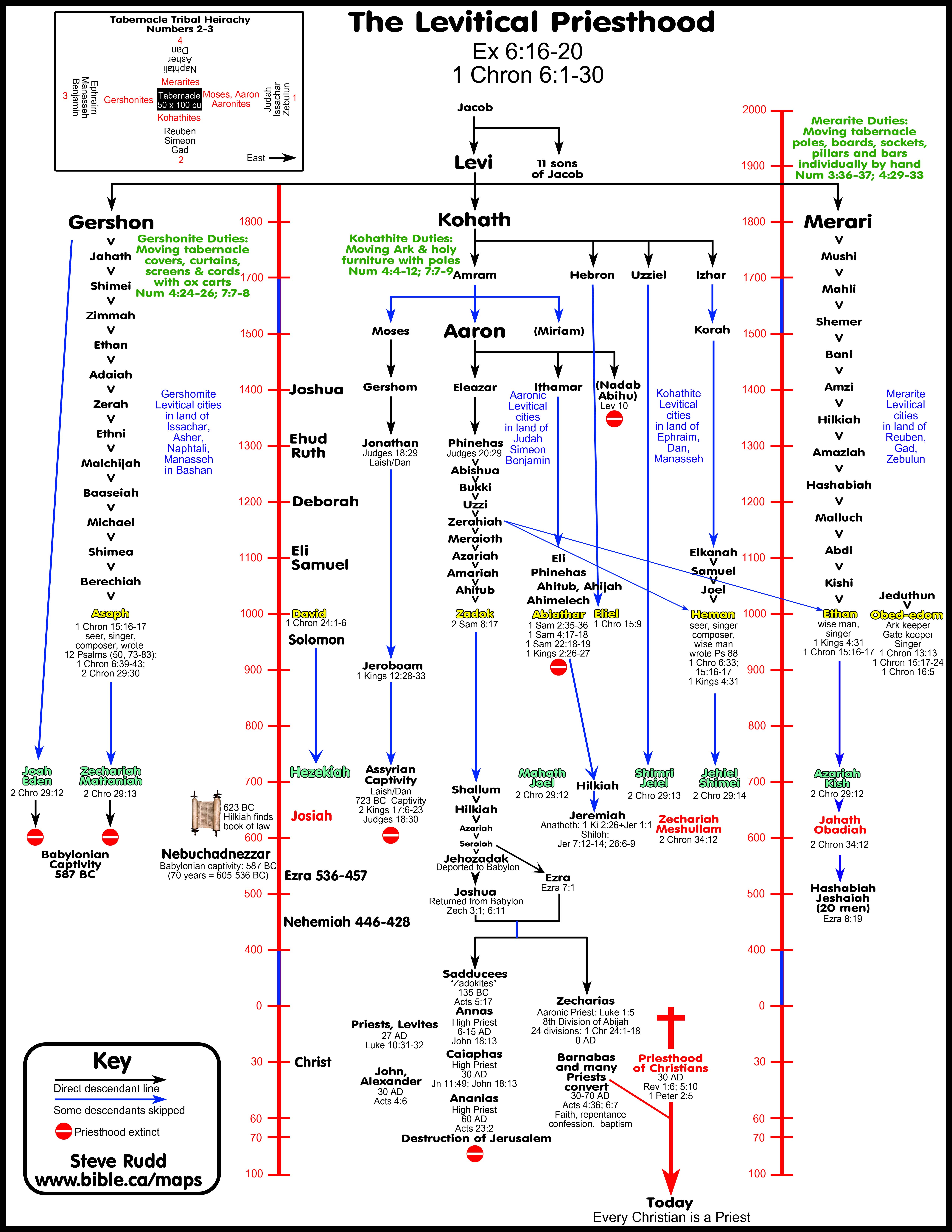
- Here is a link to a detailed discussion on the origin and transmission of the priesthood: Levitical Priesthood. Below is a map of the priesthood where you can see the line from Jacob, Levi, Kohath, Amram, Aaron, Ithamar, Eli, Phinehas, Ahitub, Ahimelech, Abiathar. Then Solomon replaced Abiathar with Zadok which continued as the line of high priests down to the time of Jesus.
K. David liberates Keilah from the Philistines but the city betrays David to Saul and he flees: 1 Sam 23
- Perhaps one of the reasons why God called David back to Israel from Moab, is to defend his fellow Israelites from the Philistines who invaded the city of Keilah.
- In a sad story of heroism and betrayal, the Keilahites reward David their liberator, with betrayal by being willing to hand him over to Saul.
- We know that it was while David was at Keilah that Saul killed the 85 priests at Nob because of this verse: “Now it came about, when Abiathar the son of Ahimelech fled to David at Keilah, that he came down with an ephod in his hand.” (1 Samuel 23:6)
- David consults with the new high priest, Abiathar, through the ephod that he brought down from the sanctuary at Nob.
- The ephod had the twelve gem stones representing the 12 tribes and the gemstones known as the Urim and Thummim, by which God's will was discerned.
- God tells David that the city he just liberated from the Philistines will thank him by turning him over to Saul.
- Saul is at the peak of his psychotic rage and peruses David every day. Saul had just killed 85 priests at his palace in Gibeah, then ordered a holocaust against the men, women, children and animals at Nob. Saul is spending all his energy at killing the righteous, while David does the real job of Saul for him and liberates Keilah.
- David flees to the wilderness of Ziph with his army that has grown from 400 to 600 men now.
L. 1018 BC: David is Betrayed by the Ziphites: 1 Sam 23
"My God, My God, Why have you forsaken me?"
"Now David became aware that Saul had come out to seek his life while David was in the wilderness of Ziph at Horesh. And Jonathan, Saul’s son, arose and went to David at Horesh, and encouraged him in God. Thus he said to him, “Do not be afraid, because the hand of Saul my father will not find you, and you will be king over Israel and I will be next to you; and Saul my father knows that also.” So the two of them made a covenant before the Lord; and David stayed at Horesh while Jonathan went to his house. Then Ziphites came up to Saul at Gibeah, saying, “Is David not hiding with us in the strongholds at Horesh, on the hill of Hachilah, which is on the south of Jeshimon? “Now then, O king, come down according to all the desire of your soul to do so; and our part shall be to surrender him into the king’s hand.” Saul said, “May you be blessed of the Lord, for you have had compassion on me. “Go now, make more sure, and investigate and see his place where his haunt is, and who has seen him there; for I am told that he is very cunning. “So look, and learn about all the hiding places where he hides himself and return to me with certainty, and I will go with you; and if he is in the land, I will search him out among all the thousands of Judah.” Then they arose and went to Ziph before Saul. Now David and his men were in the wilderness of Maon, in the Arabah to the south of Jeshimon. When Saul and his men went to seek him, they told David, and he came down to the rock and stayed in the wilderness of Maon. And when Saul heard it, he pursued David in the wilderness of Maon. Saul went on one side of the mountain, and David and his men on the other side of the mountain; and David was hurrying to get away from Saul, for Saul and his men were surrounding David and his men to seize them. But a messenger came to Saul, saying, “Hurry and come, for the Philistines have made a raid on the land.” So Saul returned from pursuing David and went to meet the Philistines; therefore they called that place the Rock of Escape. David went up from there and stayed in the strongholds of Engedi." (1 Samuel 23:15–29)
- This is one of the most important passages of scripture in the Old Testament. This is after David's two spiritual failures of trusting man by seeking refuge first in Philistine Gath and second in Moab. Gad the prophet taps David on the shoulder in Moab and tells him to get back to Israel. It is during the next four years (1018-1014 BC) that David will be hunted by Saul. During this period of intense persecution David writes about 35 Psalms. It is during this time he pens statements like:
- "They hated me without a cause" (Psalm 69:1–4 + Jn 15:23-25) (David said this of Saul at this time.)
- "My God, my God, why have You forsaken me?" (Psalm 22:1 + ) (David said this when Saul successfully surrounded him and wasa about to be captured until the messenger came and Saul called off the attack: 1 Sam 23:26)
- “Commit yourself to the LORD; let Him deliver him; Let Him rescue him, because He delights in him" Ps 22:8 + Matthew 27:42–44 (Saul said this mockingly to David when he had David surrounded 1 Sam 23:26)
- "Horesh" literally means forest or wood in Hebrew. It either refers to a wooden fortress or more likely a forest in the wilderness of Ziph as we believe.
- While Jonathan, the next in line to the throne, comes down and pledges his loyalty to David as his own successor, the city of Ziph travel up to Saul's palace in Gibeah to rat David out and reveal his secret hiding place.
- “Thus he said to him, “Do not be afraid, because the hand of Saul my father will not find you, and you will be king over Israel and I will be next to you; and Saul my father knows that also.” So the two of them made a covenant before the LORD; and David stayed at Horesh while Jonathan went to his house.” (1 Samuel 23:17–18)
- The Ziphites almost beg Saul to come down and kill David.
- Narcissistic Saul gives God's blessings, not to the righteous who deserve it, but those who assist him in deeds of evil.
i. “Saul said, “May you be blessed of the LORD, for you have had compassion on me.” (1 Samuel 23:21)
ii. Finally, Saul has found someone to feel sorry for him and they will be rewarded by the king with money, privilege and favors.
iii. So again, Saul is self-deceived. He wants to believe that the Ziphites are helping him because they like him, when in fact they are merely using Saul for his money and could care less about his feelings!
- David writes a psalm about the wickeness of the Ziphites:
- “For the choir director; on stringed instruments. A Maskil of David, when the Ziphites came and said to Saul, “Is not David hiding himself among us?” Save me, O God, by Your name, And vindicate me by Your power. Hear my prayer, O God; Give ear to the words of my mouth. For strangers have risen against me And violent men have sought my life; They have not set God before them. Selah. Behold, God is my helper; The Lord is the sustainer of my soul. He will recompense the evil to my foes; Destroy them in Your faithfulness. Willingly I will sacrifice to You; I will give thanks to Your name, O LORD, for it is good. For He has delivered me from all trouble, And my eye has looked with satisfaction upon my enemies.” (Psalm 54:title–7)
- Whereas David was cowering in fear when he fled to the king of Gath, then Moab for protection, now he is a pillar of spiritual strength as the Psalm shows.
- The Ziphites were the worst kind of selfish opportunists and once again in the near future, they will betray David.
- Saul hunts David in the wilderness of Maon, in the Arabah south of the desert.
- The text says David was "in the wilderness of Maon, in the Arabah to the south of Jeshimon."
- Arabah generally refers to the low valley areas north and south of the Salt Sea, but this reference must refer to the area of lowland near the western shoreline of the Salt Sea.
- Here is an outline on the
Arabah.
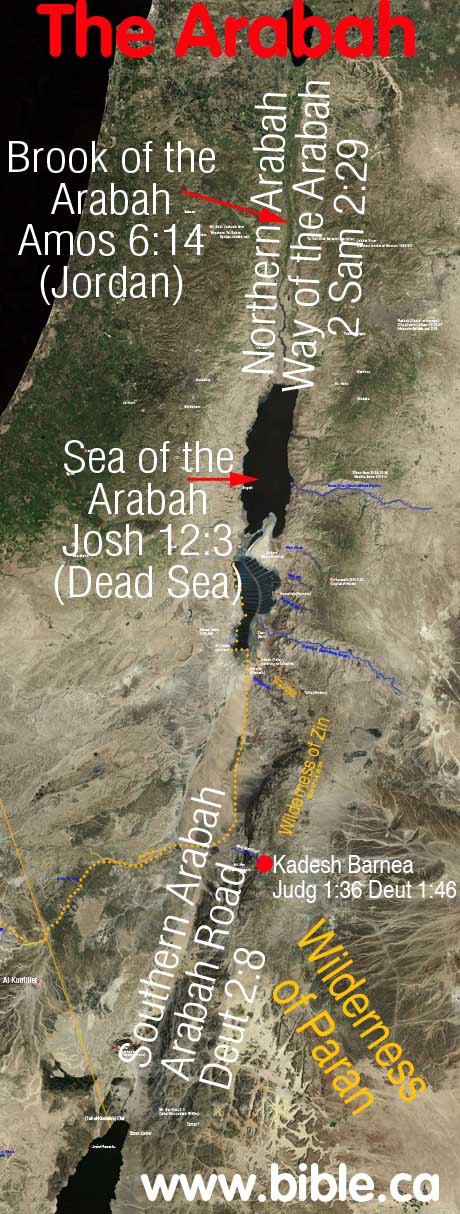
- "South of Jeshimon": Jeshimon means "to the right of the desert/wasteland" in the Hebrew which may refer to either an uninhabited area or a dry, arid desert area.
- The direction of South, meaning "to the right of" can be deciphered when you keep in mind that maps were always oriented "east up", whereas our maps are "north up". That is why modern translators render is "to the south of" for us who are accustomed to "north up" maps.
- This means that we can place, with some confidence, the desert/wasteland in the passage to the north and east of both Maon and Ziph. It was south of Moah because of the "to the right of" reference and it was near the Salt Sea, because of the reference to the "Arabah".
- Here is the oldest map in the world, the Madaba Map. It is oriented facing "east up" like all ancient maps, in contrast to all modern maps are "north up". Here is a link to the oldest maps of Israel in the world.
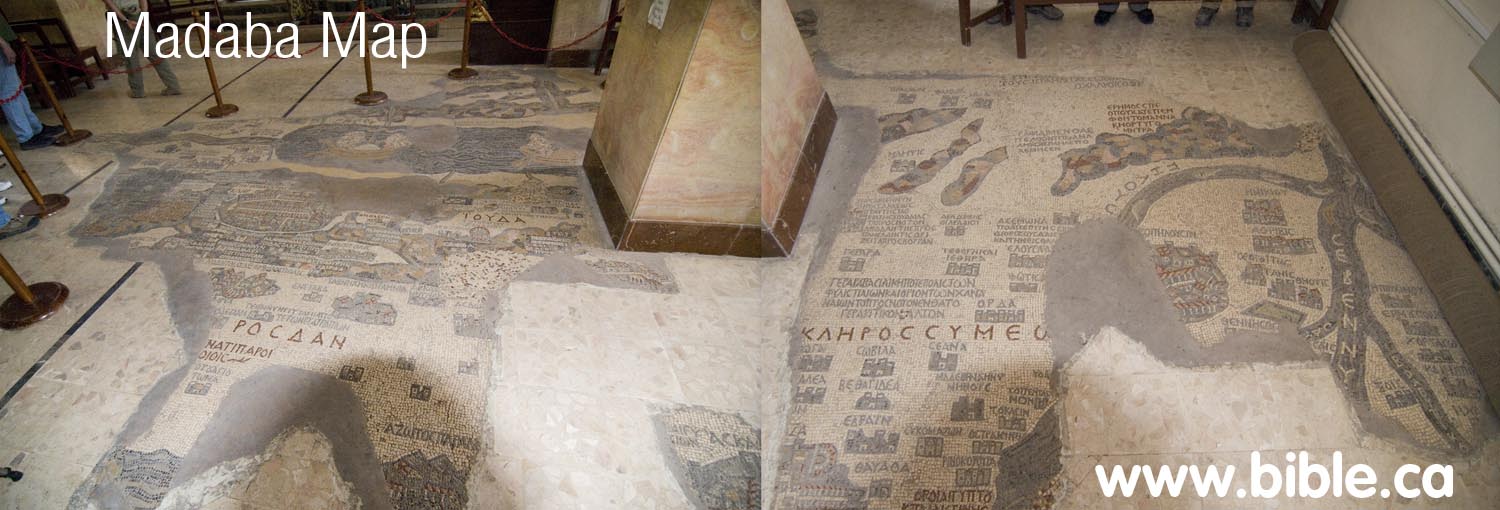
- David is trapped by Saul and about to be surrounded by his army, when suddenly a messenger tells Saul that the Philistines have attacked. Saul calls off the hunt for David, for the time and retreats to fight the Philistines who may have attacked Keilah again to recapture the city. This may explain why Keilah was so willing to betray David a second time to Saul.
- David marks the place he was almost captured as, "the Rock of Escape", an imagery that would frequent many of his Psalms.
M. The "Rock of Escape" of David's refuge: 1 Sam 23:28
- There is a long historical connection with rocks being associated with the protection and providence of God. Here is an outline on the history of the imagery of the Rock.
- Saul had surrounded David: When Saul was called away from trapping David in the Wilderness of Moan, David called it his "the Rock of Escape". There are many references to God being the rock in the Psalms that trace from the present experience of David and God providing water from the Rock at Kadesh Barnea.
- David directly refers to the Rock of Exodus: Psalm 78:15-16,20,35
- Moah and Engedi inspired a second set of images of God as the rock of salvation that had their origin in the Exodus. We see David referring to God as the Engedi Rock who saved him. Examples of this are:
i. "So Saul returned from pursuing David and went to meet the Philistines; therefore they called that place the Rock of Escape. "David went up from there and stayed in the strongholds of Engedi." 1 Samuel 23:28-29
ii. "He said, "The Lord is my rock and my fortress and my deliverer; My God, my rock, in whom I take refuge, My shield and the horn of my salvation, my stronghold and my refuge; My savior, You save me from violence." 2 Samuel 22:2
iii. "The Lord is my rock and my fortress and my deliverer, My God, my rock, in whom I take refuge; My shield and the horn of my salvation, my stronghold." Psalm 18:2
iv. "For in the day of trouble He will conceal me in His tabernacle; In the secret place of His tent He will hide me; He will lift me up on a rock." Psalm 27:5
- David wrote a Psalm specifically about this event: “For the choir director. A Psalm of David the servant of the LORD, who spoke to the LORD the words of this song in the day that the LORD delivered him from the hand of all his enemies and from the hand of Saul. And he said,” (Psalm 18:title)
- Many of the Psalms of David focus on Engedi. But it is clear that David knew about the Rock of water in the wilderness and viewed this as a second example of God being the Rock. (Psalm 78:15-16,20,35)
- David's use of "The Rock", therefore, combines the historical origin during the exodus where water came from the rock and his present experience at Moah and Engedi where God twice rescued him from Saul.
- Clear examples of this are:
i. "For who is God, besides the Lord? And who is a rock, besides our God?" 2 Samuel 22:32
ii. "The Lord lives, and blessed be my rock; And exalted be God, the rock of my salvation," 2 Samuel 22:47
iii. "The God of Israel said, The Rock of Israel spoke to me, 'He who rules over men righteously, Who rules in the fear of God," 2 Samuel 23:3
iv. "For who is God, but the Lord? And who is a rock, except our God," Psalm 18:31
v. "The Lord lives, and blessed be my rock; And exalted be the God of my salvation," Psalm 18:46
vi. "Let the words of my mouth and the meditation of my heart Be acceptable in Your sight, O Lord, my rock and my Redeemer." Psalm 19:14
vii. " A Psalm of David. To You, O Lord, I call; My rock, do not be deaf to me, For if You are silent to me, I will become like those who go down to the pit." Psalm 28:1
viii. "Incline Your ear to me, rescue me quickly; Be to me a rock of strength, A stronghold to save me." Psalm 31:2
ix. "For You are my rock and my fortress; For Your name's sake You will lead me and guide me." Psalm 31:3
x. "I will say to God my rock, "Why have You forgotten me? Why do I go mourning because of the oppression of the enemy?" Psalm 42:9
xi. "From the end of the earth I call to You when my heart is faint; Lead me to the rock that is higher than I." Psalm 61:2
xii. "He only is my rock and my salvation, My stronghold; I shall not be greatly shaken." Psalm 62:2,6
xiii. "On God my salvation and my glory rest; The rock of my strength, my refuge is in God." Psalm 62:7
xiv. "Be to me a rock of habitation to which I may continually come; You have given commandment to save me, For You are my rock and my fortress." Psalm 71:3
xv. "He will cry to Me, 'You are my Father, My God, and the rock of my salvation.'" Psalm 89:26
xvi. "To declare that the Lord is upright; He is my rock, and there is no unrighteousness in Him." Psalm 92:15
xvii. "But the Lord has been my stronghold, And my God the rock of my refuge." Psalm 94:22
xviii. " O come, let us sing for joy to the Lord, Let us shout joyfully to the rock of our salvation." Psalm 95:1
xix. " A Psalm of David. Blessed be the Lord, my rock, Who trains my hands for war, And my fingers for battle;" Psalm 144:1
N. David moves to Engedi & Saul hunts him down but God delivers Saul into David’s hand: 1 Sam 24
- A second time, someone "rats out" and betrays David's secret location to Saul who brings an enormous army of 3000 soldiers. We are not told who, but it is likely the Ziphites again, who will indeed betray him in the future for a third time!
- Saul arrives at the summit of Engedi near the sheepfolds which would be close to the spring on the summit that falls down the gorge. Saul sleeps in the same cave at Engedi that David is hiding in. Tradition places this cave in the gorge under the water falls. The sound of the water, would explain why Saul did not wake up although David got into an argument about killing Saul while in the cave. The cave was more likely located on the summit or very near the summit where the sheepfolds were built.
- David wrote two Psalms about when he was trapped inside the cave with Saul sleeping near the opening:
- Ps 142 focuses on David's feelings of near death when he first realized he was trapped: “Maskil of David, when he was in the cave. A Prayer. I cry aloud with my voice to the LORD” (Psalm 142:title–1)
- Ps 57 focuses on David's feelings of exhilaration and praise when he realizes that God has delivered him from what he thought was certain death: “For the choir director; set to Mikhtam of David, when he fled from Saul in the cave.” (Psalm 57:title)
- It is clear that both the men who were with David and David himself, understood that God had given Saul into his hands to kill. Instead David cuts the corner of Saul's robe off hoping this would bring peace between he and Saul. David was more interested in peacemaking than becoming king by force. Jesus said, Blessed are the peacemakers for they shall be called sons of God. (Mt 5:9)
- Both Moses and David is showed more grace than God in sparing those God had determined to kill.
- God had told Moses to get back from the people so he can kill them and he would make Moses a great nation. Moses interceded for the People.
- God had twice delivered Saul into David's hands to kill, but twice david showed grace and did not kill Saul. This is even more incredible when you realize that David had been praying and singing to God that his enemies be destroyed!
- In classic psychotic behaviour, Saul, who has spent his life trying to kill David, has the gall to make David swear that he will not kill Saul or his descendants. Notice that Saul doesn't swear not to kill David.
- The last time Saul did swear not to kill David, Saul swore "by YHWH" not to kill david he broke it many times over since.
- “Saul listened to the voice of Jonathan, and Saul vowed, “As the LORD lives, he shall not be put to death.”” (1 Samuel 19:6)
- Saul Swore by God, not to kill David in 1018 BC and four years have past as it is now 1014 BC and Saul has spent most of his time as king trying to kill David, in spite of his oath!
- Saul returns to Gibeah but soon begins hunting David again.
- David returns to the stronghold in the mountains just west of Engedi near the wilderness of Ziph and Maon were he was before.
O. David mourns Samuel’s death by visiting the wilderness of Paran: 1 Sam 25:1
- Saul's death triggered a mournful pilgrimage to the wilderness of Paran by David.
- For four years, Samuel has likely been in charge of the Tent of Meeting located at Gibeon, 1 km north of his town.
- For close to 70 years, Samuel has judged Israel and is now in a position of being the highest ranking and most important priest on earth ever since Saul killed the 85 priests at Nob.
- Samuel was clearly the most important spiritual influence in David's life, as well in all of Israel and his death would be a major cause for mourning for David.
- The wilderness of Paran is located Transjordan, east and south of Petra.
- What important place was located in the wilderness of Paran? Kadesh Barnea the ancient city of the dead where 3 million Hebrews died and were buried during the Exodus in 1444-1406 BC.
- Just as Elijah and Paul make pilgrimages to Mt. Sinai (see Gal 1:17), so too David made a pilgrimage to Kadesh, the ancient burial place of Israelites.
- Samuel is buried in Ramah, where his tomb can be visited to this day.
P. David returns to Maon and Carmel and marries Abigail: 1 Sam 25
- David moves back to his stronghold in the forested areas of near Moah, Ziph and Carmel.
- Carmel is where Saul built his self-praise monument after sparing Agag, the king of the Amalekites in 1 Sam 15.
- Saul was told by God to annihilate the Amalekites because of how they attacked Israel a Rephidim one stop before the wilderness of Sinai: Exodus 17:8-16. Saul disobeys God and spares Agag and sheep.
- In one of the most stunning contrasts in the Bible, while Saul is building his statue in Carmel in praise of himself and the battle against the Amalekites, Samuel is on root to tear the kingdom away from him as a result of God's anger against Saul.
- This statue would likely make the locals in the area sympathetic to Saul because almost no one knew about the kingdom being torn from Saul except Samuel and David.
- Nabal, a descendant of Caleb, and his wife Abigail, live in Carmel. Moses had given the nearby city of Hebron to Caleb and his descendants as an inheritance when they were both in Kadesh Barnea. Nabal was probably one of the richest men in the area and even though he was a foolish man, his money and power bought him Abigail as a trophy wife.
- David and his men had been protecting the flocks herdsman of Nabal for some time, asking little or nothing in return.
- While Nabal is shearing and slaughtering his sheep in Carmel, where Saul's self-praise monument is located, David sends men asking for a gift of food since he is in need.
- Nabal, being rich and well informed, would likely know all about how Saul was chasing David all around the nearby area.
- So here was a rich man, shearing sheep in the very city where Saul's statue of his greatness was located, being asked by the man Saul had been trying to kill for 5 years, being asked to give David some help.
- It is easy to see why Nabal refused, even though it was the wrong thing to do.
- The very day he refused to help David, he held an elaborate king like banquet for himself. This echoes the story of the Rich man and Lazarus in Luke 16:19, where the rich man lived in splendor every day and was unwilling to give the poor man even the crumbs that fell off his table. Likewise, Nabal would not give David a single crumb from the feast he was preparing for himself at the very time David asked him.
- David gathers his men to annihilate Nabal's entire clan, but Abigail intercedes and sends David a large amount of food.
- Nabal is stricken by God and dies 10 days later:
- Nabal was described as a very rich man, a "son of Belial" ie. wicked, worthless and unapproachable.
- The story of Nabal may have been what Jesus had in mind when he told the parable of the rich farmer.
i. “And He told them a parable, saying, “The land of a rich man was very productive. “And he began reasoning to himself, saying, ‘What shall I do, since I have no place to store my crops?’ “Then he said, ‘This is what I will do: I will tear down my barns and build larger ones, and there I will store all my grain and my goods. ‘And I will say to my soul, “Soul, you have many goods laid up for many years to come; take your ease, eat, drink and be merry.” ’ “But God said to him, ‘You fool! This very night your soul is required of you; and now who will own what you have prepared?’ “So is the man who stores up treasure for himself, and is not rich toward God.”” (Luke 12:16–21)
ii. This pre-echoes the later event when Absalom avenged Amnon for raping Tamar, at a feast when he was drunk.
iii. This pre-echoes Daniel 5, when Belshazzar held a feast and died that very night after the "handwriting was on the wall".
- David marries Abigail which is his third wife.
- David's first wife, Michal, had been given to Palti the son of Laish, who was from the unknown town of Gallim but seems to be located just north of Jerusalem and south of Gibeah of Saul.
- David's second wife was "Ahinoam of Jezreel". Jezreel is located 9 km east of Carmel: “Maon, Carmel and Ziph and Juttah, and Jezreel and Jokdeam and Zanoah, Kain, Gibeah and Timnah; ten cities with their villages.” (Joshua 15:55–57)
- Abigail is David's third wife who came with riches, intelligence, wisdom and good looks. Unfortunately she was not the perfect wife because she didn't like Jazz. In spite of this defect, however, she did like to do housework: “She arose and bowed with her face to the ground and said, “Behold, your maidservant is a maid to wash the feet of my lord’s servants.” (1 Samuel 25:41)
- Abigail in fact, exactly mirrors the perfect wife of Proverbs 31 in that she was submissive, domestic oriented, yet self-directed, enterprising, independent and was able to manage large amounts of money and assets like any executive. What more could a man ask for? Here is one of the richest and most prominent women in the area with many servants at her disposal and her acceptance message to David's offer of marriage is, “Behold, your maidservant is a maid to wash the feet of my lord’s servants.” This is truly remarkable and rare.
Q. Ziphites betray David a third time by informing Saul he is in the wilderness of Ziph: 1 Sam 26
- This is the third time the Ziphites have betrayed David:
- First: “Then Ziphites came up to Saul at Gibeah, saying, “Is David not hiding with us in the strongholds at Horesh, on the hill of Hachilah, which is on the south of Jeshimon?” (1 Samuel 23:19)
- Second: Although it doesn't say it was the Ziphites, it probably was. “Now when Saul returned from pursuing the Philistines, he was told, saying, “Behold, David is in the wilderness of Engedi.”” (1 Samuel 24:1)
- Third: This incident: “Then the Ziphites came to Saul at Gibeah, saying, “Is not David hiding on the hill of Hachilah, which is before Jeshimon?”” (1 Samuel 26:1)
- Saul's black heart is again revealed in that he again starts to hunt David down in spite of his vows to YHWH and numerous apologies. In fact Saul comes after David with the same army of 3000 that he had used previously.
- The Ziphites tell Saul that David is on the "hill of Hachilah" so he goes there and camps right on top of it.
- This time, David comes to the camp of Saul, instead of running away.
- Saul's pattern was to have everyone camp in a circle with him in the middle.
- We saw this when David killed Goliath: “So David arose early in the morning and left the flock with a keeper and took the supplies and went as Jesse had commanded him. And he came to the circle of the camp while the army was going out in battle array shouting the war cry.” (1 Samuel 17:20)
- For a second time, God has delivered Saul into David's hands with full permission to kill Saul:
- “Then Abishai said to David, “Today God has delivered your enemy into your hand; now therefore, please let me strike him with the spear to the ground with one stroke, and I will not strike him the second time.”” (1 Samuel 26:8)
- David again, shows more grace to Saul than God had allotted and spares him by only taking his royal spear and water jug.
- The principle is that if God anointed him, God will either kill him directly, as was the case with Nabal or die in battle, as in the actual case of how finally died: “But David said to Abishai, “Do not destroy him, for who can stretch out his hand against the LORD’S anointed and be without guilt?”” (1 Samuel 26:9)
- This attitude of David exceeded all kings who would follow him. Whereas David would never kill a sitting king, many of the kings who would follow gained their power through bloody coups and wiping out entire royal families.
- God sends a deep sleep upon the entire army of Saul and David steals Saul's spear and water jug. This action of God clearly shows that David had God's full stamp of approval if he wanted to kill Saul.
R. Saul fake repented with fake tears for personal gain
- When Saul "lifted up his voice and wept" it was a sickening display of self-pity and relief he wasn't dead, and had nothing to do with really being sorry for trying to kill David.
- Saul's tears were because he was saved from death, not because he was sorry for trying to kill David.
- When Saul claimed he sinned and David was the righteous one, it exactly mirrors what Pharaoh said to Moses.
- Saul repented to Samuel merely to retain power and gain honour:
- “Then Saul said to Samuel, “I have sinned; I have indeed transgressed the command of the LORD and your words, because I feared the people and listened to their voice. … Then he said, “I have sinned; but please honor me now before the elders of my people and before Israel, and go back with me, that I may worship the LORD your God." (1 Samuel 15:24,30)
- Twice Saul repented to David to make himself look good in front of his soldiers:
- “When David had finished speaking these words to Saul, Saul said, “Is this your voice, my son David?” Then Saul lifted up his voice and wept. He said to David, “You are more righteous than I; for you have dealt well with me, while I have dealt wickedly with you. “You have declared today that you have done good to me, that the LORD delivered me into your hand and yet you did not kill me. “For if a man finds his enemy, will he let him go away safely? May the LORD therefore reward you with good in return for what you have done to me this day. “Now, behold, I know that you will surely be king, and that the kingdom of Israel will be established in your hand. “So now swear to me by the LORD that you will not cut off my descendants after me and that you will not destroy my name from my father’s household.”” (1 Samuel 24:16–21)
- “Then Saul said, “I have sinned. Return, my son David, for I will not harm you again because my life was precious in your sight this day. Behold, I have played the fool and have committed a serious error.”” (1 Samuel 26:21)
- Saul joins a long list of wicked sinners who put on a good show for personal benefit but are never really sorry. Notice each time Pharaoh seeks something from the one whom he is repenting:
- “Then Pharaoh sent for Moses and Aaron, and said to them, “I have sinned this time; the LORD is the righteous one, and I and my people are the wicked ones. “Make supplication to the LORD, for there has been enough of God’s thunder and hail; and I will let you go, and you shall stay no longer.”” (Exodus 9:27–28)
- “Then Pharaoh hurriedly called for Moses and Aaron, and he said, “I have sinned against the LORD your God and against you. “Now therefore, please forgive my sin only this once, and make supplication to the LORD your God, that He would only remove this death from me.”” (Exodus 10:16–17)
- “let there be no immoral or godless person like Esau, who sold his own birthright for a single meal. For you know that even afterwards, when he desired to inherit the blessing, he was rejected, for he found no place for repentance, though he sought for it with tears.” (Hebrews 12:16–17)
- Summary Chart of fake repentance and the benefit they sought to gain through their fake tears. Only the wicked would ask for a favour immediately after confessing their sins:
|
Who |
Passage |
Their repentance |
What they really wanted |
|
Pharaoh to Moses |
Exodus 9:27-28 |
I have sinned, God is holy |
Stop the hail |
|
Pharaoh to Moses |
Exodus 10:16–17 |
I have sinned |
Remove the death |
|
Esau: |
Hebrews 12:16–17 |
sold birthright, sought with tears |
Wanted his birthright back and the power and money that comes with it. |
|
Saul to Samuel |
1 Samuel 15:24,30 |
I have sinned |
Retain power. please honor me now before the elders |
|
Saul to David |
1 Samuel 24:16-21 |
Crying he said: I have sinned, you are more righteous than I. |
Descendants retain power. Promise me you will not kill me or my descendants. |
|
Saul to David |
1 Samuel 26:21 |
I have sinned. |
Descendants retain power. To make himself look good in front of his soldiers for the second time. |
- The psychotic and those diagnosed with behaviour associated "mentally illness", have learned to sin.
- Mental illness is a behavour choice, not a bodily disease.
- The behaviours associated with mental illness are chosen and practiced in order to gain some personal benefit.
- Getting diagnosed with a Mental illness is the world's way of telling you that others find you are annoying, troublesome, offensive, dependent and cost others time and money.
- Those who have been diagnosed with a Mental illness are very quick to say, "I have sinned and I am sorry" but they rarely mean it and use it as a way of regaining your favours and so you will continue to serve them with both time and money. It is a cheap ploy and is pure evil, but it is quite effective to those with little experience these sinful behaviour patterns.
- Evil and hypocritical people will often use "instant repentance" and "quick sorrys" as a way of avoiding punishment, neutralizing anger and erasing their sin through the grace of others.
- Saul's fake tears and repentance for personal gain, is typical of those who are diagnosed with a mental disease.
David at Ziklag after the death of Samuel: 1014 - 1010 BC
S. Saul returns to Gibeah. David and his 600 men move to Gath under the protection of Achish: 1014-1010 BC
- Samuel dies in 1014 BC which may have motivated David move under the protection of the Philistines. He realizes Saul will never quit hunting him and now that his spiritual mentor (Samuel) is dead, David was more fed up than afraid of Saul.
- Saul never quit hunting David on his own free will. Only when David began to live in Gath, the home town of Goliath, did Saul finally give up hunting David.
- David moves to Gath with his two wives and 600 men and their families and Achish gives Ziklag as a city for them all to live in.
- David plunders three groups of nations:
- the Geshurites: Residents of the Transjordan area east and north of the sea of Galilee
- the Girzites: unknown
- the Amalekites: this was a large group of caravan traders like the Ishmaelite's who travelled the vast deserts in Arabia.
- David lies to Achish that the war booty from these three nations came from fighting Israelites in the Negev. This convinces Achish that David has truly defected and makes him his body guard.
T. Saul's final battle at Mt. Gilboa:
- The Philistines gathered at their final staging ground at Shunem to attack Saul, who is at Mt. Gilboa.
- Saul consults the witch of En-dor and Samuel tells Saul that he his two sons, including Jonathan will die.
- Saul's act of removing all the mediums probably happened after he killed the entire priesthood at Nob and moved the Mosaic Tabernacle to Gibeon. This act was another example of Saul's deluded thinking. He kills the priests then thinks he is doing God a favour by facilitating the tabernacle at its new location. Sure, mediums were clearly condemned but which is worse? Killing off the priesthood or acting as a medium? Saul likely thought that his act of banishing all witches and spiritists would make God happy with him and that the good outweighed the bad, in a kind of balance scale salvation concept.
- While Saul's action of removing the mediums was good, his motivation was likely for his own personal benefit and in the end… who does Saul hire for spiritual guidance utter hypocrisy? A medium!
- Earlier, the Philistines were on route to Aphek, while Israel camped in Jezreel.
- The 4 other Philistine lords mistrust David and Achish send him back to Ziklag.
- The Philistines then head straight for Saul's camp at Jezreel which causes him to retreat to Mt. Gilboa.
U. Ziklag is burned by the Amalekites and David's wives captured:
- When David returns the Amalekites had burned Ziklag & captured the women and children. This would clearly be a retaliatory attack, since David had previously plundered them.
- What David thought was a defeat, turned out to be pure providence
- The 600 men who are with David are very angry and wanted to stone him.
- David turns to God and enquires through Abiathar the high priest via the ephod.
- God's answer was to attack the Amalekites.
- David was hurt that Achish would not let him join the battle against his fellow Israelites against Saul. Yet God did not want David fighting his own brethren and this would have clearly hindered is ability rule as king.
- David was terrified and distraught when the 600 men spoke of stoning him, yet the entire matter was God's doing and not only did David defeat the Amalekites, he brought back a huge amount of plunder which he used as gifts.
- David crosses the Besor River, defeats the Amalekites and rescues the men’s families.
- David offers gifts to the cities of Bethel, Ramoth, Jattir, Aroer, Siphmoth, Eshtemoa, Racal, Hormah, Bor-ashan, Athach, Hebron.
- This may be something he did after learning Saul was dead, in a political effort to garner favour.
- David made this a law in his kingdom: “For as his share is who goes down to the battle, so shall his share be who stays by the baggage; they shall share alike.”” (1 Samuel 30:24)
- This law is similar to the New Testament gospel principle: “I planted, Apollos watered, but God was causing the growth. So then neither the one who plants nor the one who waters is anything, but God who causes the growth. Now he who plants and he who waters are one; but each will receive his own reward according to his own labor.” (1 Corinthians 3:6–8)
- Those who stayed back and guarded the luggage were just as important to success as those on the battle line.
- Today there are those in churches who support preachers and teachers on the battle line against Satan. Both are equally important and essential.
V. The death of Saul and Jonathan: 2 Sam 1; 1 Chron 10
- Jonathan and his brother area already dead when Saul is hit by an arrow and falls on his own sword after his armour bearer refused to kill him (1 Chron 10). Saul's armour bearer then fell on his sword after Saul fell on his. But it seems that although both fell on their own swords, Saul did not die immediately as it seems his armour bearer did.
- While dying he asks a random Amalekite wanderer to kill him and take his crown and arm bracelet to David.
- This strange turn of events has a random Amalekite who not part of either army, who just happened to be on the mountain, being near Saul when he died.
- The Amalekite was not a treasure seeker, for then he would not have run 100 miles south to Ziklag to find David.
- Stranger still is why he came to David, or even knew about David.
- The only possible conclusion is that Saul must have given the Amalekite a large money payment for acting as a courier for Saul to David and/or the promise of a large reward upon making the delivery. Why else would this Amalekite be so eager to run 100 miles?
- So in death, Saul sent his crown to David, who he knew would succeed him now that his own two sons were dead.
- Saul, Jonathan and his two brothers Abinadab and Malchi-shua are killed on Mt. Gilboa, decapitated & their bodies hung at Beth-shan. The heads are sent around the five Philistine cities as a tribute to their pagan gods.
- The men of Jabesh-gilead who were liberated by Saul from the Ammonites some 42 years earlier, travel to Beth-shan and bring the bodies to Jabesh-gilead where they burn off the flesh and bury them in their town.
W. Messianic Psalm with imagery, whose origin was when Saul hunted David for 4 years:
See summary in the conclusion.
- Psalm 7
- Here is a Psalm written specifically about Saul son of Kish (Cush). Notice how innocent David is searching his own heart and asking what sin he is committed. The righteous examine themselves when the wicked make false accusations. The wicked never examine themselves. David has spent quite a bit of time in self examination listing all the possible sins he might have committed to justify God sending Saul to punish him. Saul was a man who often chose to have angry fits of psychotic rage.
- “A Shiggaion of David, which he sang to the LORD concerning Cush, a Benjamite. O LORD my God, in You I have taken refuge; Save me from all those who pursue me, and deliver me, Or he will tear my soul like a lion, Dragging me away, while there is none to deliver. O LORD my God, if I have done this, If there is injustice in my hands, If I have rewarded evil to my friend, Or have plundered him who without cause was my adversary, Let the enemy pursue my soul and overtake it; And let him trample my life down to the ground And lay my glory in the dust.Selah. Arise, O LORD, in Your anger; Lift up Yourself against the rage of my adversaries, And arouse Yourself for me; You have appointed judgment.” (Psalm 7:title–6)
- Psalm 59
- You have some of the earliest "stronghold, refuge" imagery here. Notice David understands he has done no wrong.
- “For the choir director; set to Al-tashheth. A Mikhtam of David, when Saul sent men and they watched the house in order to kill him. Deliver me from my enemies, O my God; Set me securely on high away from those who rise up against me. Deliver me from those who do iniquity And save me from men of bloodshed. For behold, they have set an ambush for my life; Fierce men launch an attack against me, Not for my transgression nor for my sin, O LORD,” (Psalm 59:title–3)
- “But as for me, I shall sing of Your strength; Yes, I shall joyfully sing of Your lovingkindness in the morning, For You have been my stronghold And a refuge in the day of my distress. O my strength, I will sing praises to You; For God is my stronghold, the God who shows me lovingkindness.” (Psalm 59:16–17)
- Psalm 56
- Although there is no record of David being arrested by the Philistines when he fled to Achish at Gath, this Psalm recounts the event which prompted him to fake insanity.
- “For the choir director; according to Mikhtam of David, when the Philistines seized him in Gath. Be gracious to me, O God, for man has trampled upon me; Fighting all day long he oppresses me. My foes have trampled upon me all day long, For they are many who fight proudly against me. When I am afraid, I will put my trust in You. In God, whose word I praise, In God I have put my trust; I shall not be afraid. What can mere man do to me?” (Psalm 56:title–4)
- Psalm 34
- In this Psalm David resorts to faking insanity to be released from Achish king of Gath. David assumed after his capture that he would suffer physically including broken bones. He escaped without even a scratch, much less any broken bones. This is the origin of the imagery that is applied to Christ when his bones were not broken when he hung on the cross. So the sufferings David endured on while being hunted by Saul, were an antitype of when Jesus suffered on the cross.
- “A Psalm of David when he feigned madness before Abimelech, who drove him away and he departed.” (Psalm 34:title)
- “The righteous cry, and the LORD hears And delivers them out of all their troubles. The LORD is near to the brokenhearted And saves those who are crushed in spirit. Many are the afflictions of the righteous, But the LORD delivers him out of them all. He keeps all his bones, Not one of them is broken. Evil shall slay the wicked, And those who hate the righteous will be condemned. The LORD redeems the soul of His servants, And none of those who take refuge in Him will be condemned.” (Psalm 34:17–22)
- “but coming to Jesus, when they saw that He was already dead, they did not break His legs. But one of the soldiers pierced His side with a spear, and immediately blood and water came out. And he who has seen has testified, and his testimony is true; and he knows that he is telling the truth, so that you also may believe. For these things came to pass to fulfill the Scripture, “NOT A BONE OF HIM SHALL BE BROKEN.”” (John 19:33–36)
- Psalm 52
- Doeg ratted out David to Saul when the high priest at Nob gave him the bread of presence. When Saul called the entire priesthood to his palace at Gibeah, Saul ordered his men to kill the 85 priests. They, being Hebrews, refused, but Doeg, being an faithless Edomite, killed them with the sword.
- “For the choir director. A Maskil of David, when Doeg the Edomite came and told Saul and said to him, “David has come to the house of Ahimelech.” Why do you boast in evil, O mighty man? The lovingkindness of God endures all day long. Your tongue devises destruction, Like a sharp razor, O worker of deceit. You love evil more than good, Falsehood more than speaking what is right.” (Psalm 52:title–3)
- Psalm 63
- This Psalm was written during the period when David was being hunted by Saul near Moan, Carmal and Engedi where the imagery of protection under God's wings had its origin. David took his turn doing night watch for any possible attack from Saul.
- “A Psalm of David, when he was in the wilderness of Judah. O God, You are my God; I shall seek You earnestly; My soul thirsts for You, my flesh yearns for You, In a dry and weary land where there is no water. Thus I have seen You in the sanctuary, To see Your power and Your glory.” (Psalm 63:title–2)
- “When I remember You on my bed, I meditate on You in the night watches, For You have been my help, And in the shadow of Your wings I sing for joy. My soul clings to You; Your right hand upholds me. But those who seek my life to destroy it, Will go into the depths of the earth.” (Psalm 63:6–9)
- Psalm 54
- Three times the Ziphites betrayed David's secret location to Saul. The Ziphites are described as violent and godless.
- “For the choir director; on stringed instruments. A Maskil of David, when the Ziphites came and said to Saul, “Is not David hiding himself among us?” Save me, O God, by Your name, And vindicate me by Your power. Hear my prayer, O God; Give ear to the words of my mouth. For strangers have risen against me And violent men have sought my life; They have not set God before them. Selah.” (Psalm 54:title–3)
- Psalm 18
- Ps 18 clearly had Saul in mind when he hunted and surrounded David before he barely escaped because messenger told Saul the Philistines had attacked and he retreated from David. Notice that language of being surrounded by Saul is applied to Jesus on the cross in Ps 22. Jesus had David in mind when he was crucified.
- “For dogs have surrounded me; A band of evildoers has encompassed me; They pierced my hands and my feet. I can count all my bones. They look, they stare at me;” (Psalm 22:16–17)
- “For the choir director. A Psalm of David the servant of the LORD, who spoke to the LORD the words of this song in the day that the LORD delivered him from the hand of all his enemies and from the hand of Saul. And he said,” (Psalm 18:title)
- ““I love You, O LORD, my strength.” The LORD is my rock and my fortress and my deliverer, My God, my rock, in whom I take refuge; My shield and the horn of my salvation, my stronghold. I call upon the LORD, who is worthy to be praised, And I am saved from my enemies. The cords of death encompassed me, And the torrents of ungodliness terrified me. The cords of Sheol surrounded me; The snares of death confronted me.” (Psalm 18:1–5)
- “As for God, His way is blameless; The word of the LORD is tried; He is a shield to all who take refuge in Him. For who is God, but the LORD? And who is a rock, except our God, The God who girds me with strength And makes my way blameless? He makes my feet like hinds’ feet, And sets me upon my high places.” (Psalm 18:30–33)
- “The LORD lives, and blessed be my rock; And exalted be the God of my salvation, The God who executes vengeance for me, And subdues peoples under me. He delivers me from my enemies; Surely You lift me above those who rise up against me; You rescue me from the violent man.” (Psalm 18:46–48)
- Psalm 142
- This Psalm captures the terror and defeat David felt when Saul entered the same cave David was hiding in. David was "trapped" and "in prison" with no way of escape. Saul was a strong man with an army of 3000 against David. This is where David cuts Saul's robe and spares his life.
- “Maskil of David, when he was in the cave. A Prayer. I cry aloud with my voice to the LORD; I make supplication with my voice to the LORD. I pour out my complaint before Him; I declare my trouble before Him. When my spirit was overwhelmed within me, You knew my path. In the way where I walk They have hidden a trap for me. Look to the right and see; For there is no one who regards me; There is no escape for me; No one cares for my soul. I cried out to You, O LORD; I said, “You are my refuge, My portion in the land of the living. “Give heed to my cry, For I am brought very low; Deliver me from my persecutors, For they are too strong for me. “Bring my soul out of prison, So that I may give thanks to Your name; The righteous will surround me, For You will deal bountifully with me.”” (Psalm 142:title–7)
- Psalm 57
- David must have thought his life was over when Saul first came inside the very cave David was in. But it turned to victory for David when he cut the corner of Saul's royal robe. Just like when Saul attacked Samuel and tore his robe and Samuel replied the kingdom has been torn from you, so this was fulfilled when David cut Saul's robe. It was also very humiliating for Saul to have been spared by the very man Saul had told his army wanted to kill him. Notice the word "reproach" applied to Saul.
- “For the choir director; set to Mikhtam of David, when he fled from Saul in the cave. Be gracious to me, O God, be gracious to me, For my soul takes refuge in You; And in the shadow of Your wings I will take refuge Until destruction passes by. I will cry to God Most High, To God who accomplishes all things for me. He will send from heaven and save me; He reproaches him who tramples upon me. Selah. God will send forth His lovingkindness and His truth.” (Psalm 57:title–3)
- PSALM 17 Prayer for Protection against Oppressors. A Prayer of David.
- This Psalm likely refers to the time when David was entirely surrounded by Saul, but he retreated when the report of the Philistines attacking came by messenger.
- "I have called upon You, for You will answer me, O God; Incline Your ear to me, hear my speech. Wondrously show Your lovingkindness, O Savior of those who take refuge at Your right hand From those who rise up against them. Keep me as the apple of the eye; Hide me in the shadow of Your wings From the wicked who despoil me, My deadly enemies who surround me. They have closed their unfeeling heart, With their mouth they speak proudly. They have now surrounded us in our steps; They set their eyes to cast us down to the ground. He is like a lion that is eager to tear, And as a young lion lurking in hiding places. Arise, O LORD, confront him, bring him low; Deliver my soul from the wicked with Your sword,” (Psalm 17:6–13)
- PSALM 35 Prayer for Rescue from Enemies.
- Here we have the classic question of why the wicked hate the righteous without a cause. The gnashing of teeth in anger is seen in the stoning of Stephen in Acts 6.
- “For without cause they hid their net for me; Without cause they dug a pit for my soul. Let destruction come upon him unawares, And let the net which he hid catch himself; Into that very destruction let him fall. And my soul shall rejoice in the LORD; It shall exult in His salvation.” (Psalm 35:7–9)
- “Malicious witnesses rise up; They ask me of things that I do not know. They repay me evil for good, To the bereavement of my soul. But as for me, when they were sick, my clothing was sackcloth; I humbled my soul with fasting, And my prayer kept returning to my bosom. I went about as though it were my friend or brother; I bowed down mourning, as one who sorrows for a mother. But at my stumbling they rejoiced and gathered themselves together; The smiters whom I did not know gathered together against me, They slandered me without ceasing. Like godless jesters at a feast, They gnashed at me with their teeth.” (Psalm 35:11–16)
- “Do not let those who are wrongfully my enemies rejoice over me; Nor let those who hate me without cause wink maliciously. For they do not speak peace, But they devise deceitful words against those who are quiet in the land. They opened their mouth wide against me; They said, “Aha, aha, our eyes have seen it!”” (Psalm 35:19–21)
- PSALM 69 A Cry of Distress and Imprecation on Adversaries. For the choir director; according to Shoshannim. A Psalm of David
- The imagery of David being hated by Saul without a cause is used by Jesus: ““He who hates Me hates My Father also. “If I had not done among them the works which no one else did, they would not have sin; but now they have both seen and hated Me and My Father as well. “But they have done this to fulfill the word that is written in their Law, ‘THEY HATED ME WITHOUT A CAUSE.’” (John 15:23–25)
- “Save me, O God, For the waters have threatened my life. I have sunk in deep mire, and there is no foothold; I have come into deep waters, and a flood overflows me. I am weary with my crying; my throat is parched; My eyes fail while I wait for my God. Those who hate me without a cause are more than the hairs of my head; Those who would destroy me are powerful, being wrongfully my enemies; What I did not steal, I then have to restore.” (Psalm 69:1–4)
- PSALM 36 Wickedness of Men and Lovingkindness of God.
- Saul killed the entire priesthood at Nob which indicates he had no fear of God. Saul also meditated and planned to kill david day and night.
- “Transgression speaks to the ungodly within his heart; There is no fear of God before his eyes. For it flatters him in his own eyes Concerning the discovery of his iniquity and the hatred of it. The words of his mouth are wickedness and deceit; He has ceased to be wise and to do good. He plans wickedness upon his bed; He sets himself on a path that is not good; He does not despise evil.” (Psalm 36:1–4)
- PSALM 37 Security of Those Who Trust in the LORD, and Insecurity of the Wicked.
- Seems to be written when David was old. Notice his reference to Saul gnashing his teeth at David and how in the end, king Saul with all his luxury, was no more!
- “The wicked plots against the righteous And gnashes at him with his teeth. The Lord laughs at him, For He sees his day is coming.” (Psalm 37:12–13)
- “I have been young and now I am old, Yet I have not seen the righteous forsaken Or his descendants begging bread.” (Psalm 37:25)
- “The wicked spies upon the righteous And seeks to kill him. The LORD will not leave him in his hand Or let him be condemned when he is judged. Wait for the LORD and keep His way, And He will exalt you to inherit the land; When the wicked are cut off, you will see it. I have seen a wicked, violent man Spreading himself like a luxuriant tree in its native soil. Then he passed away, and lo, he was no more; I sought for him, but he could not be found.” (Psalm 37:32–36)
- PSALM 61 Confidence in God’s Protection. For the choir director; on a stringed instrument. A Psalm of David.
- The imagery of refuge and shelter under the wings of God is found in other Psalms we know he wrote when he escaped Saul.
- “Hear my cry, O God; Give heed to my prayer. From the end of the earth I call to You when my heart is faint; Lead me to the rock that is higher than I. For You have been a refuge for me, A tower of strength against the enemy. Let me dwell in Your tent forever; Let me take refuge in the shelter of Your wings. Selah.” (Psalm 61:1–4)
- PSALM 62 God Alone a Refuge from Treachery and Oppression. For the choir director; according to Jeduthun. A Psalm of David.
- The imagery of the rock and stronghold were born when David was in the mountains and at Engedi when Saul hunted him. This is one of the most common images of the Bible.
- “My soul waits in silence for God only; From Him is my salvation. He only is my rock and my salvation, My stronghold; I shall not be greatly shaken. How long will you assail a man, That you may murder him, all of you, Like a leaning wall, like a tottering fence?” (Psalm 62:1–3)
- “My soul, wait in silence for God only, For my hope is from Him. He only is my rock and my salvation, My stronghold; I shall not be shaken. On God my salvation and my glory rest; The rock of my strength, my refuge is in God. Trust in Him at all times, O people; Pour out your heart before Him; God is a refuge for us.Selah.” (Psalm 62:5–8)
- PSALM 64 Prayer for Deliverance from Secret Enemies. For the choir director. A Psalm of David.
- Saul was killed by God with an arrow and here we have a Psalm of David where David says God will shoot his enemies with an arrow: “So Saul died for his trespass which he committed against the Lord, because of the word of the Lord which he did not keep; and also because he asked counsel of a medium, making inquiry of it, and did not inquire of the Lord. Therefore God killed him and turned the kingdom to David the son of Jesse.” (1 Chronicles 10:13-14)
- It is also important to remember that when David was told that God had given Saul into his hands to kill, that David replied that God would kill him (like Nabal) or he would die in battle: “David also said, “As the LORD lives, surely the LORD will strike him, or his day will come that he dies, or he will go down into battle and perish.” (1 Samuel 26:10) The context of this statement was when God caused a deep sleep to fall on Saul's army and David took his spear and water jug. In the end both statements were true: God killed him with an arrow in battle.
- “They hold fast to themselves an evil purpose; They talk of laying snares secretly; They say, “Who can see them?” They devise injustices, saying, “We are ready with a well-conceived plot”; For the inward thought and the heart of a man are deep. But God will shoot at them with an arrow; Suddenly they will be wounded. So they will make him stumble; Their own tongue is against them; All who see them will shake the head.” (Psalm 64:5–8)
- PSALM 70 Prayer for Help against Persecutors. “For the choir director. A Psalm of David; for a memorial.
- This cry for help is consistent with other Psalms where Saul was hunting David.
- God, hasten to deliver me; O LORD, hasten to my help! Let those be ashamed and humiliated Who seek my life; Let those be turned back and dishonored Who delight in my hurt. Let those be turned back because of their shame Who say, “Aha, aha!” Let all who seek You rejoice and be glad in You; And let those who love Your salvation say continually, “Let God be magnified.” But I am afflicted and needy; Hasten to me, O God! You are my help and my deliverer; O LORD, do not delay.” (Psalm 70:title–5)
- Ps 71
- The imagery of refuge, rock of habitation, fortress originated when Saul hunted David. Notice Saul is described as wicked, wrongdoer, ruthless etc. Having killed 85 priests who officiated at the Mosaic tent, these are understate his evil.
- “In You, O LORD, I have taken refuge; Let me never be ashamed. In Your righteousness deliver me and rescue me; Incline Your ear to me and save me. Be to me a rock of habitation to which I may continually come; You have given commandment to save me, For You are my rock and my fortress. Rescue me, O my God, out of the hand of the wicked, Out of the grasp of the wrongdoer and ruthless man, For You are my hope; O Lord GOD, You are my confidence from my youth. By You I have been sustained from my birth; You are He who took me from my mother’s womb; My praise is continually of You. I have become a marvel to many, For You are my strong refuge. My mouth is filled with Your praise And with Your glory all day long. Do not cast me off in the time of old age; Do not forsake me when my strength fails. For my enemies have spoken against me; And those who watch for my life have consulted together, Saying, “God has forsaken him; Pursue and seize him, for there is no one to deliver.” O God, do not be far from me; O my God, hasten to my help! Let those who are adversaries of my soul be ashamed and consumed; Let them be covered with reproach and dishonor, who seek to injure me. But as for me, I will hope continually, And will praise You yet more and more. My mouth shall tell of Your righteousness And of Your salvation all day long; For I do not know the sum of them. I will come with the mighty deeds of the Lord GOD; I will make mention of Your righteousness, Yours alone. O God, You have taught me from my youth, And I still declare Your wondrous deeds. And even when I am old and gray, O God, do not forsake me, Until I declare Your strength to this generation, Your power to all who are to come.” (Psalm 71:1–18)
- Ps 86 A Prayer of David.
- When David first ran from Saul's palace his first refuge was Samuel. However after that he went to Nob for food, then Gath, then Moab. Then Gad the prophet called David back to Israel where he would learn to totally trust God for protection, not some pagan gentile king. This Psalm reflects the fruits of that lesson he never would have learned if he remained in exile in Moab.
- Incline Your ear, O LORD, and answer me; For I am afflicted and needy. Preserve my soul, for I am a godly man; O You my God, save Your servant who trusts in You. Be gracious to me, O Lord, For to You I cry all day long. Make glad the soul of Your servant, For to You, O Lord, I lift up my soul. For You, Lord, are good, and ready to forgive, And abundant in lovingkindness to all who call upon You. Give ear, O LORD, to my prayer; And give heed to the voice of my supplications! In the day of my trouble I shall call upon You, For You will answer me. There is no one like You among the gods, O Lord, Nor are there any works like Yours. All nations whom You have made shall come and worship before You, O Lord, And they shall glorify Your name. For You are great and do wondrous deeds; You alone are God. Teach me Your way, O LORD; I will walk in Your truth; Unite my heart to fear Your name. I will give thanks to You, O Lord my God, with all my heart, And will glorify Your name forever. For Your lovingkindness toward me is great, And You have delivered my soul from the depths of Sheol. O God, arrogant men have risen up against me, And a band of violent men have sought my life, And they have not set You before them. But You, O Lord, are a God merciful and gracious, Slow to anger and abundant in lovingkindness and truth. Turn to me, and be gracious to me; Oh grant Your strength to Your servant, And save the son of Your handmaid. Show me a sign for good, That those who hate me may see it and be ashamed, Because You, O LORD, have helped me and comforted me.” (Psalm 86:title–17)
- Ps 91
- The imagery of refuge and fortress, refuge under God's wings were born from David fleeing Saul.
- “He who dwells in the shelter of the Most High Will abide in the shadow of the Almighty. I will say to the LORD, “My refuge and my fortress, My God, in whom I trust!” For it is He who delivers you from the snare of the trapper And from the deadly pestilence. He will cover you with His pinions [wing tips], And under His wings you may seek refuge; His faithfulness is a shield and bulwark. You will not be afraid of the terror by night, Or of the arrow that flies by day; Of the pestilence that stalks in darkness, Or of the destruction that lays waste at noon.” (Psalm 91:1–6)
- Ps 94
- When Saul hunted David, he spent a lot of time in high mountainous rocky cliffs and the imagery of a foot slipping would naturally be born at this time. Notice the rock of refuge and stronghold imagery is also present. It also echoes the time when Israel was fleeing from Pharaoh through the Red Sea and God's miracles did not allow their foot to slip as they made the crossing: see Ps 38:16; 73:2. “Then His people remembered the days of old, of Moses. Where is He who brought them up out of the sea with the shepherds of His flock? Where is He who put His Holy Spirit in the midst of them, Who caused His glorious arm to go at the right hand of Moses, Who divided the waters before them to make for Himself an everlasting name, Who led them through the depths? Like the horse in the wilderness, they did not stumble;” (Isaiah 63:11–13)
- “If the LORD had not been my help, My soul would soon have dwelt in the abode of silence. If I should say, “My foot has slipped,” Your lovingkindness, O LORD, will hold me up. When my anxious thoughts multiply within me, Your consolations delight my soul. Can a throne of destruction be allied with You, One which devises mischief by decree? They band themselves together against the life of the righteous And condemn the innocent to death. But the LORD has been my stronghold, And my God the rock of my refuge. He has brought back their wickedness upon them And will destroy them in their evil; The LORD our God will destroy them.” (Psalm 94:17–23)
- Ps 109
- The imagery of being hated without a cause and being surrounded by evildoers who wag their heads, was born when Saul was hunting David, yet the same imagery was applied to Christ.
- “O God of my praise, Do not be silent! For they have opened the wicked and deceitful mouth against me; They have spoken against me with a lying tongue. They have also surrounded me with words of hatred, And fought against me without cause. In return for my love they act as my accusers; But I am in prayer. Thus they have repaid me evil for good And hatred for my love.” (Psalm 109:1–5)
- “For I am afflicted and needy, And my heart is wounded within me. I am passing like a shadow when it lengthens; I am shaken off like the locust. My knees are weak from fasting, And my flesh has grown lean, without fatness. I also have become a reproach to them; When they see me, they wag their head. Help me, O LORD my God; Save me according to Your lovingkindness. And let them know that this is Your hand; You, LORD, have done it. Let them curse, but You bless; When they arise, they shall be ashamed, But Your servant shall be glad. Let my accusers be clothed with dishonor, And let them cover themselves with their own shame as with a robe.” (Psalm 109:22–29)
- Ps 141
- Saul was like the jaws of a trap set for David but God was his refuge!
- “For my eyes are toward You, O GOD, the Lord; In You I take refuge; do not leave me defenseless. Keep me from the jaws of the trap which they have set for me, And from the snares of those who do iniquity. Let the wicked fall into their own nets, While I pass by safely.” (Psalm 141:8–10)
- Ps 143
- Saul persecuted David mercilessly for his own wicked need to retain power. Notice the contrast of David being forced by Saul to live in dark places (caves) where bones are kept when he really wanted to be able to walk on normal flat gound instead of mountain rocks and cliffs.
- “For the enemy has persecuted my soul; He has crushed my life to the ground; He has made me dwell in dark places, like those who have long been dead. Therefore my spirit is overwhelmed within me; My heart is appalled within me.” (Psalm 143:3–4)
- “Teach me to do Your will, For You are my God; Let Your good Spirit lead me on level ground. For the sake of Your name, O LORD, revive me. In Your righteousness bring my soul out of trouble. And in Your lovingkindness, cut off my enemies And destroy all those who afflict my soul, For I am Your servant.” (Psalm 143:10–12)
- Ps 144
- The imagery of the rock, fortress, deliverer, refuge is common to when David was hunted by Saul.
- “Blessed be the LORD, my rock, Who trains my hands for war, And my fingers for battle; My lovingkindness and my fortress, My stronghold and my deliverer, My shield and He in whom I take refuge, Who subdues my people under me. O LORD, what is man, that You take knowledge of him? Or the son of man, that You think of him? Man is like a mere breath; His days are like a passing shadow.” (Psalm 144:1–4)
- Ps 22
- Ps 22 is clearly messianic but notice the context of the Psalm is when David was being hunted by Saul. Jesus echoed these words, whose origin was David. Jesus had the sufferings of David in mind when he hung on the cross. Now we know why Gad the prophet called David back to Judah from Moab. If David had not been forced to endure this suffering, none of the Psalms would have been written!
- What is fascinating, is that the very words: "They separate with the lip, they wag the head, saying, “Commit yourself to the LORD; let Him deliver him; Let Him rescue him, because He delights in him" may have come out of the mouth of Saul who knew God was with David, but had departed from himself! This is applied to Christ in the gospels: ““He saved others; He cannot save Himself. He is the King of Israel; let Him now come down from the cross, and we will believe in Him. “HE TRUSTS IN GOD; LET GOD RESCUE Him now, IF HE DELIGHTS IN HIM; for He said, ‘I am the Son of God.’ ” The robbers who had been crucified with Him were also insulting Him with the same words.” (Matthew 27:42–44)
- So the very words, could be written as something Saul said to David: "David trusts in God, let God rescue you now David, since I have surrounded you with my army of 3000!"
- “For the choir director; upon Aijeleth Hashshahar. A Psalm of David. My God, my God, why have You forsaken me? Far from my deliverance are the words of my groaning. O my God, I cry by day, but You do not answer; And by night, but I have no rest. Yet You are holy, O You who are enthroned upon the praises of Israel. In You our fathers trusted; They trusted and You delivered them. To You they cried out and were delivered; In You they trusted and were not disappointed. But I am a worm and not a man, A reproach of men and despised by the people. All who see me sneer at me; They separate with the lip, they wag the head, saying, “Commit yourself to the LORD; let Him deliver him; Let Him rescue him, because He delights in him.” Yet You are He who brought me forth from the womb; You made me trust when upon my mother’s breasts. Upon You I was cast from birth; You have been my God from my mother’s womb. Be not far from me, for trouble is near; For there is none to help. Many bulls have surrounded me; Strong bulls of Bashan have encircled me. They open wide their mouth at me, As a ravening and a roaring lion. I am poured out like water, And all my bones are out of joint; My heart is like wax; It is melted within me. My strength is dried up like a potsherd, And my tongue cleaves to my jaws; And You lay me in the dust of death. For dogs have surrounded me; A band of evildoers has encompassed me; They pierced my hands and my feet. I can count all my bones. They look, they stare at me; They divide my garments among them, And for my clothing they cast lots. But You, O LORD, be not far off; O You my help, hasten to my assistance. Deliver my soul from the sword, My only life from the power of the dog. Save me from the lion’s mouth; From the horns of the wild oxen You answer me. I will tell of Your name to my brethren; In the midst of the assembly I will praise You. You who fear the LORD, praise Him; All you descendants of Jacob, glorify Him, And stand in awe of Him, all you descendants of Israel. For He has not despised nor abhorred the affliction of the afflicted; Nor has He hidden His face from him; But when he cried to Him for help, He heard. From You comes my praise in the great assembly; I shall pay my vows before those who fear Him. The afflicted will eat and be satisfied; Those who seek Him will praise the LORD. Let your heart live forever! All the ends of the earth will remember and turn to the LORD, And all the families of the nations will worship before You. For the kingdom is the LORD’S And He rules over the nations. All the prosperous of the earth will eat and worship, All those who go down to the dust will bow before Him, Even he who cannot keep his soul alive. Posterity will serve Him; It will be told of the Lord to the coming generation. They will come and will declare His righteousness To a people who will be born, that He has performed it.” (Psalm 22)
Conclusion:
- Jesus, son of David, mouthed the words David spoke at the time thought he was captured by Saul in 1 Sam 23:26:
- "They hated me without a cause" (Psalm 69:1–4 + Jn 15:23-25) (David said this of Saul at this time.)
- "My God, my God, why have You forsaken me?" (Psalm 22:1 + ) (David said this when Saul successfully surrounded him and was about to be captured until the messenger came and Saul called off the attack: 1 Sam 23:26)
- “Commit yourself to the LORD; let Him deliver him; Let Him rescue him, because He delights in him" Ps 22:8 + Matthew 27:42–44 (Saul said this mockingly to David when he had David surrounded 1 Sam 23:26)
- Saul spent his entire life as king, hunting down David and even though he swore to God and promised to David he would stop hunting him, he never quit until he was unable when David began to live in Gath. Had David not entered Gath, Saul would have continued forever.
- For four years, Saul hunted David until he entered Gath: 1018 -1014 BC. These four years of hardship and persecution could have been avoided if David had disobeyed Gad, the prophet and stayed in Gath. However, by enduing these four years, some of the most beautiful messianic Psalms were written which give encouragement and hope for 3000 years and all Christians. God could see this larger greater good that would result when He called David back to Judah in the cat and mouse gave Saul played in hunting David. David, like when Abraham was called, had no idea the greater good they could do for mankind.
- The second four years were when Saul stopped hunting David after he entered Ziklag until Saul's death.
- It is notable that Samuel died in 1014 BC, which coincided with the time when Saul stopped hunting David when he entered Gath and then Ziklag.
- Saul died in 1010 BC after a reign of 42 years at the age of 72.
- David begins to reign for 7 years in Hebron, then he reigns in Jerusalem for 33 years after he captures it from the Jebusites.
- When David was experiencing a weak moment in faith, he first fled to Gath, then Moab for protection. Now we know why Gad the prophet called David back to Judah from Moab. If David had not been forced to endure this suffering, none of the messianic Psalms like Ps 22 "the innocent servant who suffered" would have been written! Ps 22 is clearly messianic but notice the context of the Psalm is when David was being hunted by Saul. Jesus echoed these words, whose origin was David. Jesus had the sufferings of David in mind when he hung on the cross. The following imagery was born from these 4 years when Saul hunted David:
- Trust in God as your rock, fortress, deliverer, refuge, salvation: Ps 59; Ps 61; Ps 62; Ps 71; Ps 91; Ps 94; Ps 141; Ps 144
- Trust in the shadow of the wings of God were words spoken by both David's grandparents, Boaz and Ruth: Ruth 2:12; 3:9; Ps 63; Ps 17; Ps 91
- The righteous suffering when they have not sinned: Ps 59
- When David escaped physical harm at Gath, he wrote that the righteous do not have their bones broken, which is applied to Christ's crucifixion: Ps 34; Ps 18; Jn 19:33-36
- One of the most pressing questions that all Christians ask is "Why do the wicked peruse, persecute and hate the righteous?" Ps 35; Ps 69; Ps 86; Ps 94; Ps 109
i. There is no answer, but is understood as a universal law which is stated by Jesus: ““This is the judgment, that the Light has come into the world, and men loved the darkness rather than the Light, for their deeds were evil. “For everyone who does evil hates the Light, and does not come to the Light for fear that his deeds will be exposed. “But he who practices the truth comes to the Light, so that his deeds may be manifested as having been wrought in God.”” (John 3:19–21)
ii. The imagery of David being hated by Saul without a cause is used by Jesus: ““He who hates Me hates My Father also. “If I had not done among them the works which no one else did, they would not have sin; but now they have both seen and hated Me and My Father as well. “But they have done this to fulfill the word that is written in their Law, ‘THEY HATED ME WITHOUT A CAUSE.’” (John 15:23–25)
- Protection from being hunted and surrounded by evildoers. This is applied to Christ and Christians in general today when Muslims murder them while they worship peacefully in their buildings. Ps 17; Ps 18; Ps 22
- God will avenge the righteous when they are persecuted by the wicked: Ps 57
- Saul and the wicked gnash their teeth at the righteous as we see in David in Ps 35; Ps 37, we also see in Stephen: Acts 6.
- The wagging of the head of Saul against David in Ps 109 and Ps 22 is applied to Christ when he hung on the cross: Matt 27:39; Mark 15:29
- The foot of the righteous will not slip: Ps 94; Ps 38:16; 73:2. The foot not slipping imagery, echoes the time when Israel was fleeing from Pharaoh through the Red Sea and God's miracles did not allow their foot to slip as they made the crossing: “Then His people remembered the days of old, of Moses. Where is He who brought them up out of the sea with the shepherds of His flock? Where is He who put His Holy Spirit in the midst of them, Who caused His glorious arm to go at the right hand of Moses, Who divided the waters before them to make for Himself an everlasting name, Who led them through the depths? Like the horse in the wilderness, they did not stumble;” (Isaiah 63:11–13)
- “Commit yourself to the LORD; let Him deliver him; Let Him rescue him, because He delights in him" may have been actual words Saul spoke of David. Saul knew that the Spirit had departed from him and that God was with David. These very words may have come out of the mouth of Saul as a jealous vengeful, taunt and mockery of the true situation: "They separate with the lip, they wag the head, saying, “Commit yourself to the LORD; let Him deliver him; Let Him rescue him, because He delights in him" Ps 22. A paraphrase of regarding the origin of these words would be: "So you have the Spirit of God with you David? Well how is God going to help you now when I have you surrounded with 3000 men? You claim to trust in God. Can God rescue you from me now? Just keep on singing your spiritual songs to God. Sure God delights in you, but where is your God now you are about to die?" God intervened by having the messenger recall Saul when the Philistines attacked Keilah.
- "My God, my God, why have You forsaken me? Far from my deliverance are the words of my groaning. O my God, I cry by day, but You do not answer; And by night, but I have no rest. Yet You are holy" Ps 22 were words David mouthed when Saul had surrounded him or when he was trapped in the cave at Engedi and all seemed lost. Jesus echoed these very words of David when he hung on the cross.
- Sadly, the foresight, dreams and covenants made between David and Jonathan would never be realized.
a. Jonathan knew that David had been anointed by God to be king the day he killed Goliath and had intuitively abdicated his succession of the throne to David.
b. At that time and many times afterwards, the two would renew the covenant that David would be king and Jonathan would not only serve him but be second in command beside David.
c. “Thus he said to him, “Do not be afraid, because the hand of Saul my father will not find you, and you will be king over Israel and I will be next to you; and Saul my father knows that also.”” (1 Samuel 23:17)
d. So from 1025 BC - 1010 BC (15 years) Jonathan had been dreaming of the day he would serve beside David in the new dynasty.
e. In spite of these human plans, it was not the will of God who arranged that righteous Jonathan was killed at the same time as wicked Saul.
f. Why did God have Jonathan killed? It was hard enough for David to secure the throne with Saul's other sons who survived. Jonathan, although loyal to David, must therefore have complicated and hindered David's ascent to the throne, due to no fault of Jonathan himself.
g. Jonathan was a giant of faith, equal to David, who unilaterally wiped out a garrison of Philistines at Geba and Michmash when he was 15 years old. 27 years later David killed Goliath at age 15 and the now 42 year old Jonathan is attracted to faith like his own.
h. This is one of the saddest stories in the Bible of righteous men dreaming about the future with plans that never came to pass. I hope that in heaven Jonathan serves beside David his king forever.
i. When Jonathan died, he likely wanted to ask God why He killed him since he was righteous. This is a lesson that the plans of man are not always the choice of God.
- We have labeled Saul as the psychotic king who drove himself mad. By this we mean that he made the wrong moral choices instead of repenting. The result is "cognitive dissonance" otherwise known as suffering from the consequences of a bad conscience which always leads to self-delusion.
j. He was delusional, paranoid and engaged in rages where he murdered large numbers of innocent people.
k. He would be diagnosed by any psychiatrist with a mentally illness cause by chemical imbalances of the brain.
i. This is pure junk science and myth.
ii. Mental illness is a metaphoric term like "computer virus" or "spring fever" and is a behaviour choice whose origin is the human spirit not a disease caused by mythical and theoretical chemical imbalances in the brain.
- As we can see, Saul engaged in sinful behaviours on his own freewill that the Bible labels as sin, not insanity or mental illness.
- Saul was not ill or sick but a sinner and the cure was repentance not neuroleptic drugs.
- Schizophrenia, insanity, madness are synonymous terms that describe an individual who has chosen to allow themselves to form the habit of engaging in sinful behaviours that annoy, bother, offend, threaten others and create their own false reality of self-delusion for the purpose of escaping some personal life problem which they achieve through the control of others for personal gain through lies, manipulation, and sympathy through outward displays of self-created suffering, hardship, victimhood and dependency. This is the total sum of all mental illness.
- Whereas Saul is a classic example of someone who engages in behaviours that get him labeled as mentally ill, David is a classic example of someone who attempted to rationalize why Saul wanted to kill him. David set a pattern for how the righteous react in such circumstances. David repeatedly examined himself for sin wrongly assuming he was the cause of the problem. David went out of his way to show goodness to Saul by sparing him twice when even God had given him permission to kill Saul. David returned good for evil and in the end nothing stopped Saul from trying to kill him. Jesus explains that there is a law that darkness hates light, but never explains why except to say that is the behavior of those who are evil.
- Saul had nothing wrong with him. He did not suffer from that modern mythical chemical imbalance to the brain that drove his psychotic behaviour as quack chemical psychiatrists maintain, because they are atheistic, evolutionary and deny the dichotomous nature of man having a body and spirit. Christians know better. Saul was evil. How he behaved was evil. He simply wanted to retain power as king for himself and his children in spite of the fact he was God who both gave and took that power and privilege away.
- “So Saul died for his trespass which he committed against the LORD, because of the word of the LORD which he did not keep; and also because he asked counsel of a medium, making inquiry of it, and did not inquire of the LORD. Therefore God killed him and turned the kingdom to David the son of Jesse.” (1 Chronicles 10:13-14)
- David described himself as a dead dog and a flea, when he was a giant of faith: “After whom has the king of Israel come out? Whom are you pursuing? A dead dog, a single flea? … Just as one hunts a partridge in the mountains.” (1 Samuel 26:20; 24:14)
By Steve Rudd: Contact the author for comments, input or corrections.