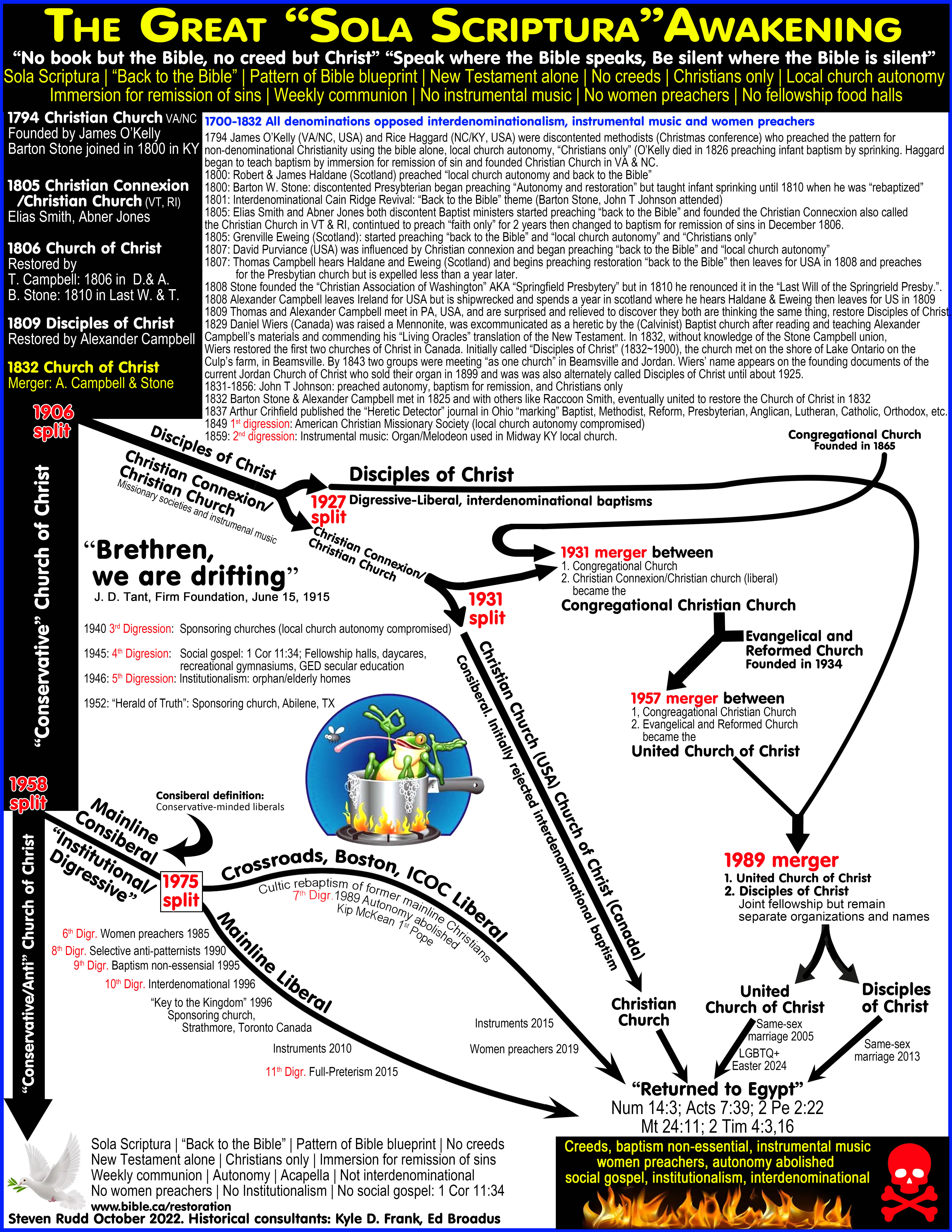
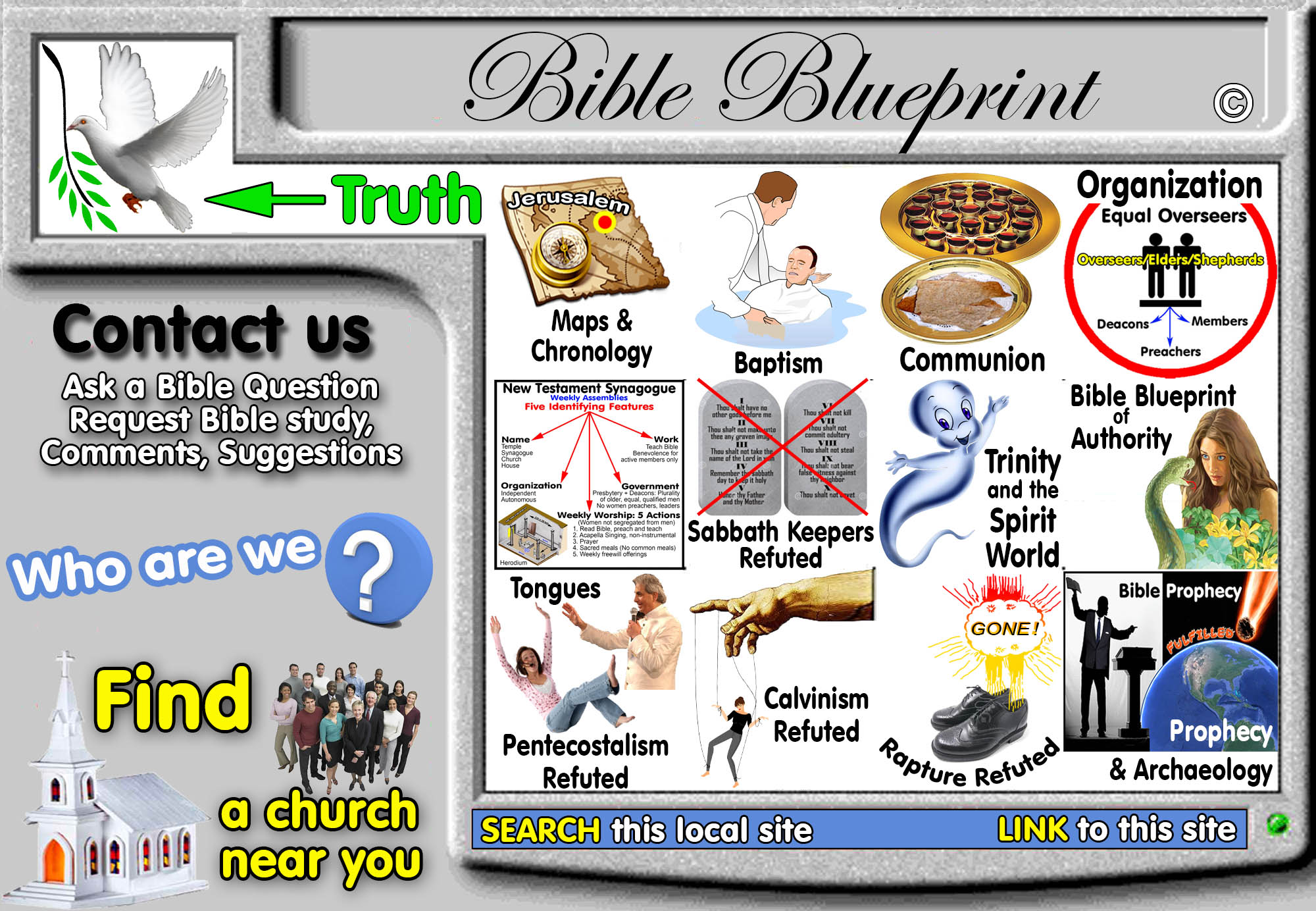
Bible Blueprint of Authority and Obeying God’s Silence
|
|
Bible Blueprint Decalogue Curriculum 150 pages, 8.5 x 11, full color or digital |
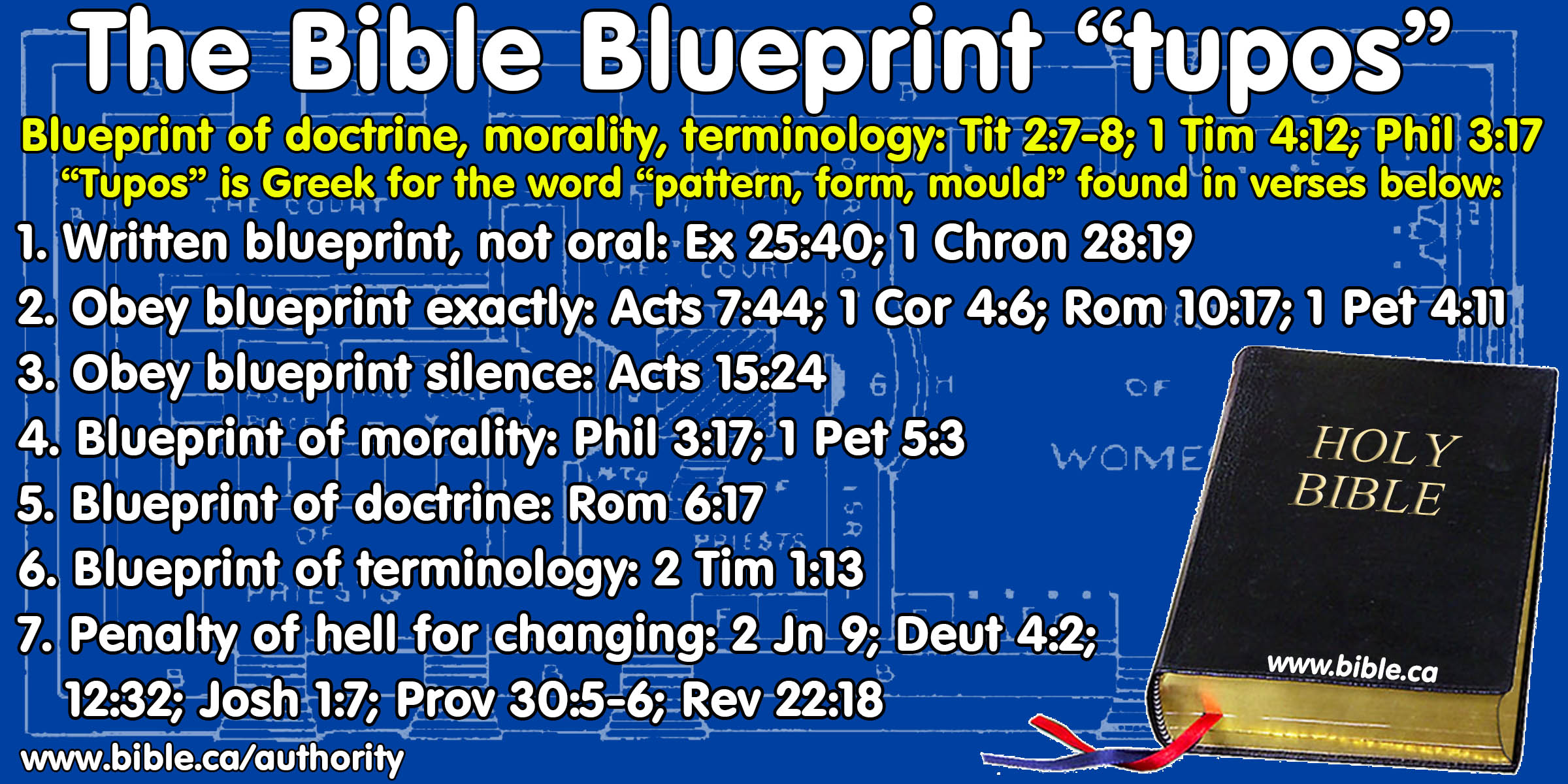
Word Study of usages of the word “tupos” in the Bible:
Introduction:
A. The Bible blueprint is inspired of God:
1. “you accepted the gospel, not as the word of men, but for what it really is, the word of God." (1 Thess 2:13)
2. “Know of first importance that no prophecy of Scripture is the prophet’s personal interpretation, for no prophecy ever had its origin in human will, instead, men moved by the will of the Holy Spirit spoke from God." (2 Pe 1:20–21)
3. "All Scripture is breathed from God’s mouth." (2 Timothy 3:16–17)
4. "God touched my mouth and said, ‘I have put My words in your mouth’.” (Jer 1:9)
B. Five ways religious people ignore the Bible blueprint and guess about their salvation:
1. Religious leaders: “My pastor/priest taught me...”
2. Majority: “I’m a member of one of the largest churches”
3. My parents: “Both my parents taught me what I believe”
4. Sincerity: “God doesn’t care what I believe as long as I’m sincere”
5. Emotions: “I know I’m saved because one day I had this wonderful feeling”
C. Everybody can read and understand the Bible equally:
1. "God’s words gives light and understanding to the simple." (Ps 119:130)
2. "When you read Paul’s inspired letters, you can understand spiritual matters equal to how Paul understands them" (Eph 3:3-5)
3. The Bible can be understood by reading alone, without the direct help of the Holy Spirit.
4. Irresistible Grace is one of five false doctrines of Calvinism that teach nobody can understand the Bible unless he is guided by the Holy Spirit.
5. Christians and non-Christians can both understand the Bible by reading it. For example, non-Christians understand the gospel story of Christ.
D. The Bible blueprint is a precise and calculated revelation:
1. “According to” is used about 800 times in scripture appealing to an established, fixed pattern.
2. Examples include “according to the pattern” (1 Chron 28:18; Heb 8:5); “according to the law” (Ezra 7:14; Heb 8:7); “according to the commandment” (Neh 9:20; 1 Tim 1:1); “according to what is written” (2 Cor 4:13; Josh 1:8); “according to the gospel” (1 Tim 1:11); “according to the way” (Acts 24:14); “according to the traditions of men rather than the traditions of Christ” (Col 2:8); “according to will of God” (1 Pe 5:2).
E. Scripture is a complete and all-sufficient guide book for perfect holy living and all church doctrine.
1. “The Spirit of truth will guide you into all the truth" (John 16:13)
2. “Scripture equips for every good work." (2 Timothy 3:16–17)
3. "God gave us everything pertaining to life and godliness" (2 Pe 1:3)
4. "the faith which was once for all handed down to the saints." (Jude 3)
I. The Bible blueprint:
1. The educated know all authority is possessed by Christ and church leaders have zero authority.
a. Authority comes from either man or God: Mt 21:23-37; Acts 4:7; Acts 5:38-39
b. All authority was given to Christ: Mt 28:18; Eph 1:20–22; Phil 2:9-11; Col 2:10; 1 Pet 3:22
c. Christ gave authority to Paul who wrote half the New Testament: 2 Cor 10:8; 13:10.
d. No Bible verse says Christ gave any special “authority” to Apostle Peter alone.
2. The servant of Christ accepts his position in the chain of inspiration:
a. Jesus spoke ONLY what he heard without addition: Jn 12:49-50.
b. The Holy Spirit speaks ONLY what He heard without addition: Jn 16:12-13
c. Man must speak where the Bible speaks and be silent where the Bible is silent without addition.
3. The righteous treasure God’s word:
a. “A lamp to my feet” Ps 119:105
b. “A lamp shining in a dark place” 2 Pet 1:19
c. “As the deer pants for water” Ps 42:1
d. “Love and meditation all day long” Ps 119:97
e. “sweeter than honey” Psalm 119:103
f. “A joy and the delight of my heart” Jeremiah 15:16
4. The obedient do exactly what God said:
a. Jesus quoted scripture 3x when tempted: Mt 4
b. We will be judged by the words of Jesus written in scripture: Jn 12:48
c. We will be judged by Paul’s writings: 1 Cor 14:37
d. We will be judged by what is written in books: Deut 28:58; Rev 20:12
5. The satanic contradict God’s word:
a. Devil: “you will not die” (Gen 3:4)
b. Pharisees “Corban” rule to not help parents financially: Mark 7:9-13
c. False teachers turn the truth of God into lies: Rom 1:25
6. The wise do nothing when God is silent and act only according to the Bible blueprint:
a. The lawless will be cast into hell: Mt 13:41–42
b. The lawless falsely claim to prophesy, perform miracles, and cast out demons: Deut 18:20; Mt 7:22-23
c. Moses followed the blueprint for the tabernacle: Ex 25:37 = Heb 8:5
d. Balaam: "Whatever the LORD speaks, that I must do." (Num 23:26)
e. Micaiah: “As the Lord lives, what the Lord says to me, that I shall speak.”" (1 Ki 22:14)
f. Half-Jew who blasphemed and cursed YHWH: Lev 24:10-16
g. Sabbath breaking by gathering wood: Num 15:32-36
h. Go beyond what is taught in scripture: 1 Cor 4:6; 1 Pet 4:11; 2 John 9
7. The humble obey God’s silence only and act when God speaks:
a. God was silent about the tribe of Judah as a priesthood: Jesus forbidden: Heb 7:14
8. The arrogant bind practices when God is silent:
a. “Worship gods which I have not commanded” Deut 17:3
b. Pharisees handwashing (Mk 7:1-9)
c. Child sacrifice to Baal and Molech: Jer 32:35
d. Circumcision was commanded by Moses but not initially forbidden in the New Test.: Acts 15:1,24
e. Instrumental music was commanded in the Old Testament but nowhere forbidden in New: Eph 5:19
f. Tithing was commanded by Moses but nowhere forbidden in the New, being replaced with freewill offerings: 1 Cor 16:2; 2 Cor 9:7
9. The disobedient refuse to do what God said:
a. Jonah
b. Zedekiah refused to surrender: Jeremiah 38:17-28
c. Other examples?
10. The rebellious change the Bible blueprint: “God never forbad me to do it a different way”.
a. Death for not following blueprint of the tabernacle: Nadab and Abihu killed as an example!
i. Use coals from Altar of burnt offering for incense or die: Lev.16:12-13. Nadab and Abihu were drunk and offered strange fire: Lev 10:1-11.
ii. Bells alert God when High Priest enters or die: Ex 28:34-35
iii. Wash hands and feet before service or die: Ex 30:20-21
iv. Undergarment cloak to cover entire body or die, Exodus 28:42-43
v. Drink no wine when serving or die: Lev 10:9
b. Uzzah was killed by God because they moved the Ark with ox carts rather than poles. David used the wrong people to move the Ark in the wrong way: 2 Sam 6:7. David was initially angry at God until then repented and used poles rather than ox carts: 1 Chron 15:13–15
i. The Gershonites moved the tabernacle covers, curtains, and screens, with two carts with 4 oxen: Num 7:7; 3:25-26; 4:24-26
ii. The Kohathites moved the temple furniture, like the Ark of the Covenant and altar of incense with poles on their shoulders, not with ox carts: Num 7:9; 3:29-32; 4:4-12;
iii. The Merarites moved the tabernacle frames, bars, pillars, sockets with 4 carts with 8 oxen: Num 7:8; 3:33-37; 4:29-33
c. Believe, repent, and be baptized (Jesus: Mk 16:16) vs. the Sinner’s prayer (Billy Graham)
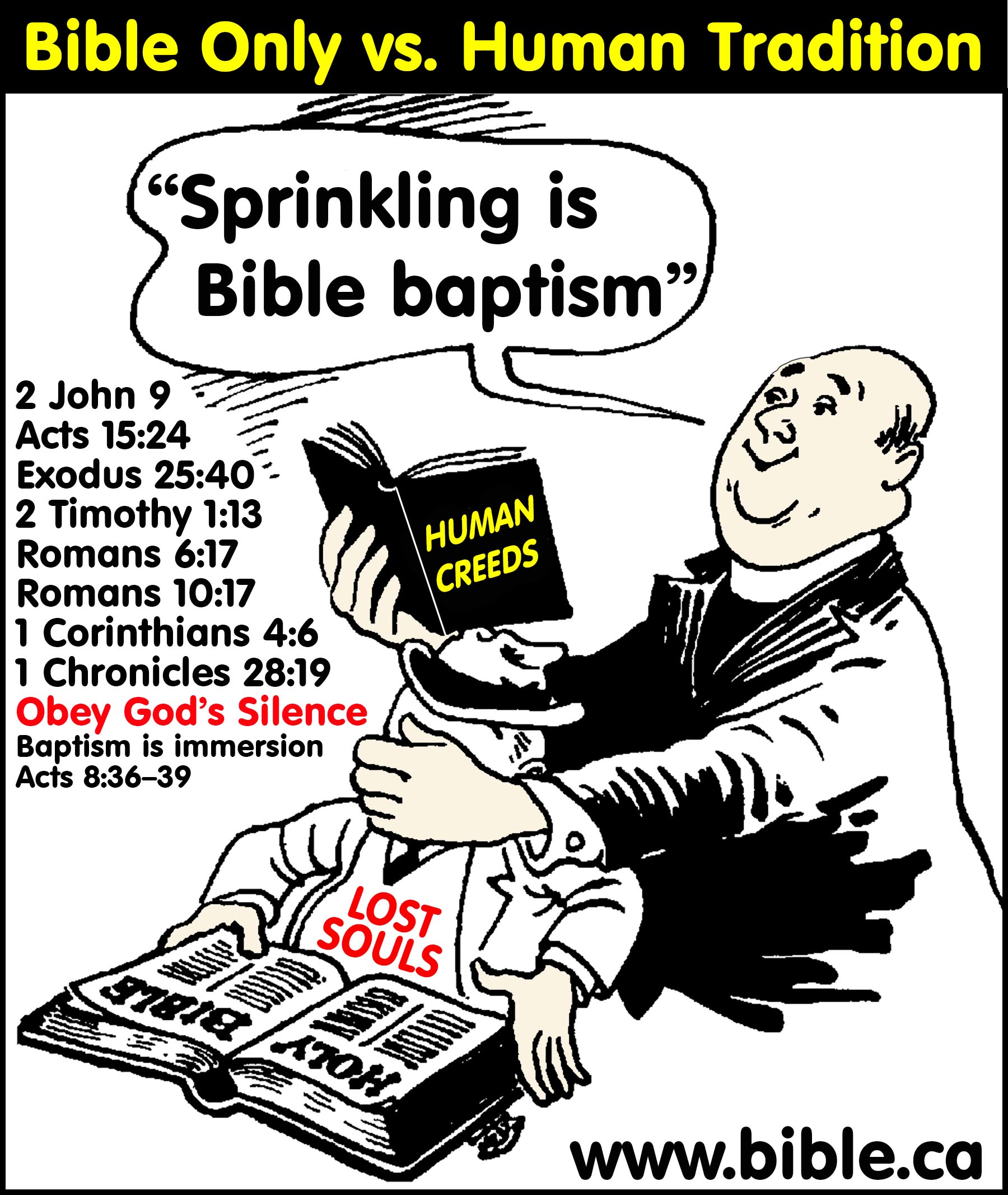
d. Baptism by immersion vs. sprinkling: Acts 8:36-39, Greek “baptism” = immersion
e. Salvation by faith AND works of obedience vs. salvation by faith alone: Jas 2:24 (Billy Graham)
f. Baptism saves (1 Pe 3:21) vs. Baptism doesn’t save (Billy Graham)
11. The hypocrite focuses on the small and foolish and ignores the big important things: Mt 23:23
a. instead of practicing all that is commanded: Mt 28:20
b. Old Testament laws that are abolished, genealogies: Titus 3:9; Gal 3:28–29
12. The fool refuses to follow the Bible:
a. Following the popular majority in religion leads to hell: Mt 7:13-14; 1 Tim 4:1-4; 2 Tim 3:13; 4:1-4; Eph 4:14; Gal 1:6-9
b. Following the religious tradition of your parents who oppose scripture leads to hell: Mt 10:37; Lk 14:26-27
c. Following a church that uses human tradition and not scripture leads to hell: Prov 14:12; Isa 55:8-11
13. The false teacher is an enemy of God:
a. "Will die if he speaks when God is silent” (Deut 18:20)
b. "Is a liar if he who speaks when God is silent” (Prov 30:5–6)
c. "Exceeds what is written” (1 Cor 4:6)
d. "Adulterate the word of God" (2 Cor 4:2)
e. "Invalidating the word of God by your tradition which you have handed down" (Mk 7:13)
f. "Accursed if you distort the gospel of Christ" (Gal 1:6-9)
g. "Condemned if you add to or take away from the word" (Deut 4:2; 12:32)
h. "Does contrary to the command of God." (Num 22:18; 24:13)
i. "Has a mistaken understanding of Scripture" (Mt 22:29)
j. "Rejects and does not receive what Jesus says" (Jn 12:48)
k. "Will not observe all the words of this law." (Deut 29:29)
l. "Brings self-destruction upon self if he distorts the Scriptures written by Paul" (2 Pet 3:16)
14. The Denominational church fabricates non-biblical
ways to be saved violating the silence of God:
a. Lutheran, Catholic, Anglican: Infant Baptism + Confirmation
b. United Pentecostal: Believe, baptized + speak in tongues
c. TV Evangelists: Place hand on TV set + mail preacher lots of money
d. Mormon: Through faith & commitment of spouse
e. Catholic: Priest absolves you of sin after death
f. United: Be a good moral person then get preached into heaven at funeral
g. Baptist, Pentecostal, Alliance: Faith only + Pray sinners prayer + ask Jesus into heart
h. Presbyterian, Calvinist: The direct action of the Holy Spirit to confirm you are elect
i. Methodist, Calvinist 1850AD: Mourners bench to "get religion"
j. Unitarian: Nothing: hell doesn't exist!
k. Jewish Christians in 50 AD: Circumcised + Baptism: Acts15:1
II. Oral human tradition not found in the written Bible Blueprint is heresy:
A. The Bible Blueprint is always written and oral tradition that contradicts the Blueprint is false doctrine:
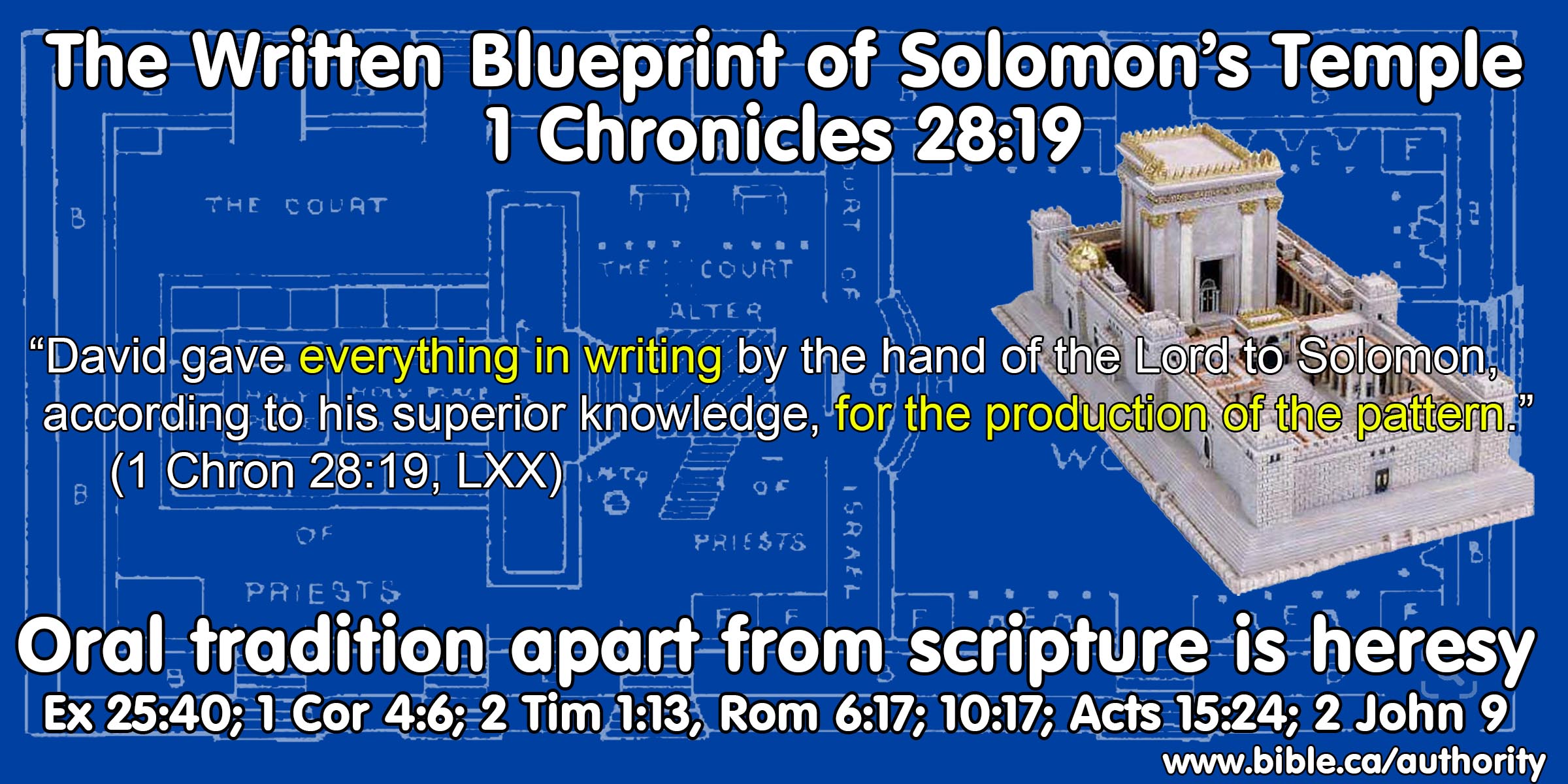
B. Orthodox and Roman Catholic both claim apostolic oral tradition that contradicts each other:

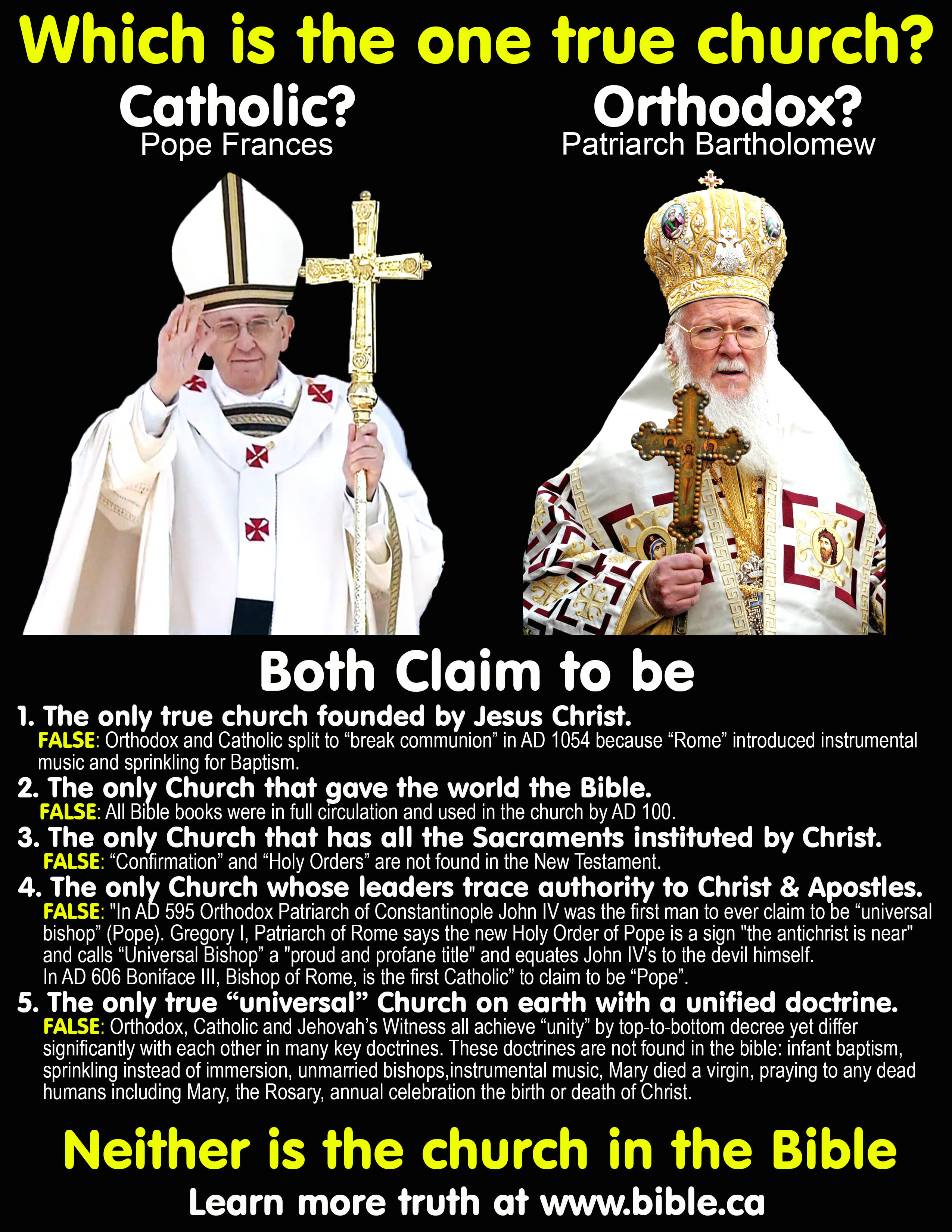
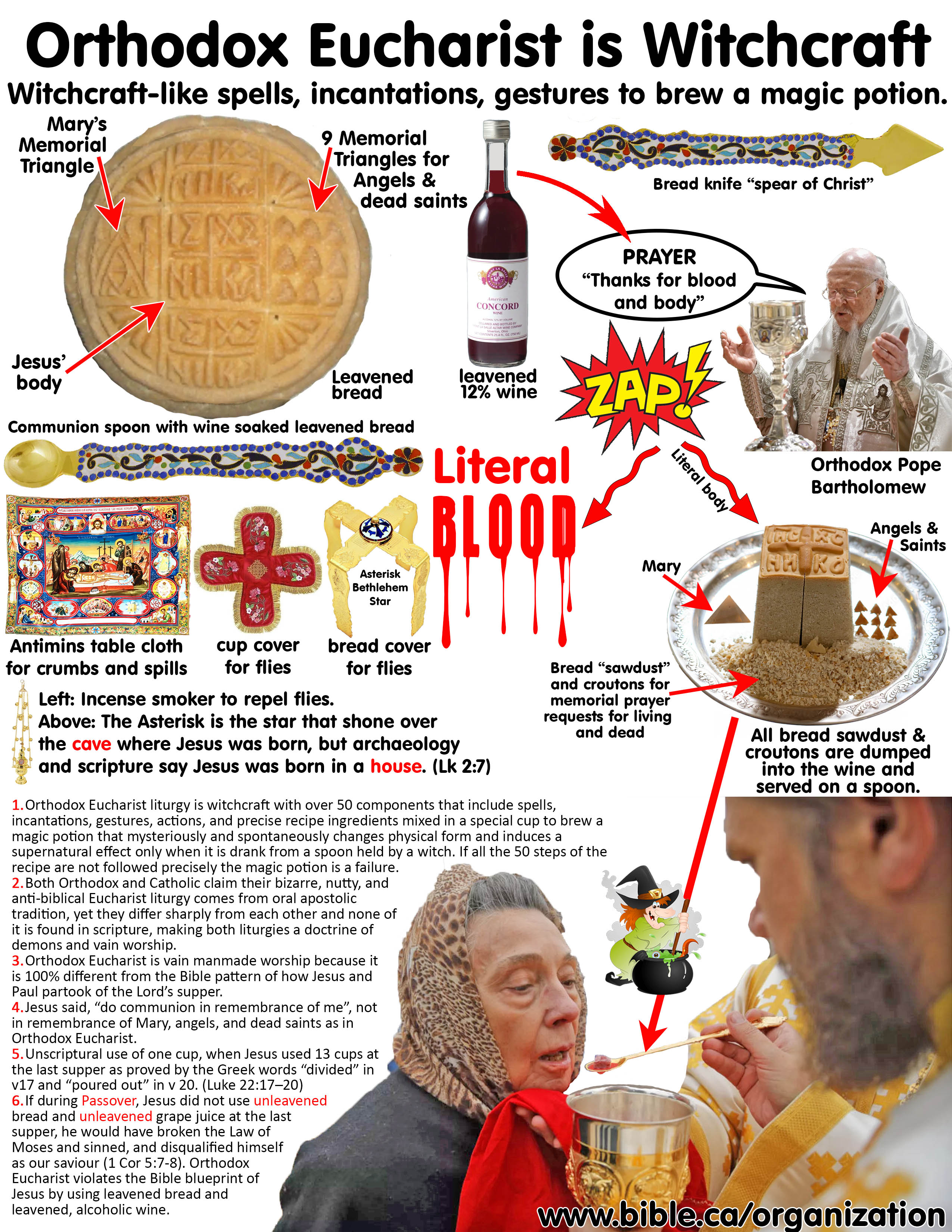
Unbiblical Orthodox Church Communion is Witchcraft
1. Orthodox Eucharist liturgy is witchcraft with over 50 sequential component stages that include spells, incantations, gestures, actions, and precise recipe ingredients mixed in a special cup to brew a magic potion that mysteriously and spontaneously changes physical form and induces a supernatural effect only when it is drank from a spoon held by a witch. If all the 50 steps of the recipe are not followed precisely the magic potion is a failure.
2. Both Orthodox and Catholic claim their bizarre, nutty, and anti-biblical Eucharist liturgy comes from oral apostolic tradition, yet they differ sharply from each other and none of it is found in scripture, making both liturgies a doctrine of demons and vain worship.
3. Orthodox Eucharist is vain manmade worship because it is 100% different from the Bible pattern of how Jesus and Paul partook of the Lord’s supper.
4. Jesus said, “do communion in remembrance of me”, not in remembrance of Mary, angels, and dead saints as in Orthodox Eucharist. A memorial pinch of bread for each living and dead person for whom prayer has been requested is put on the plate, yet communion bread is not a symbol of supplication prayer for living Christians but of the body of Christ. We do not pray for the dead because they have been judged, are in the hands of God, and we do not know their needs in the spirit world. Local dead members are memorialized through communion for 40 days.
5. Unscriptural use of one cup, when Jesus used 13 cups at the last supper as proved by the Greek words “divided” in v17 and “poured out” in v 20 (Luke 22:17–20). The “holy grail” (communion cup) of Jesus is widely believed to be a Jewish ritual purity stone cup, certainly never gold or silver as used in the Orthodox and Catholic churches.
6. If during Passover, Jesus did not use unleavened bread and unleavened grape juice at the last supper, he would have broken the Law of Moses and sinned and disqualified himself as our saviour (1 Cor 5:7-8). Orthodox Eucharist violates the Bible blueprint of Jesus by using leavened bread and leavened, alcoholic wine. Jesus likely used “Passim wine” made from soaking grapes in water and squeezing out the juice in a press. Without exception, the Greek word used in the New Testament for communion juice is “fruit of the vine”, not “oinos” (wine).
7. In Matthew 26:26-30, Jesus’ liturgy served bread and juice separately and sequentially in two steps, but the nutty Orthodox liturgy combines the bread and wine together in a cup and consumed in a single step on a spoon! You have to be on cheap psychedelic drugs to even think something up so different from what Jesus did! Leavened bread sawdust and croutons are dropped into wine then eaten from a communal spoon. Archeologically, spoons were never used by Jesus or anyone during meals. Jesus was accused of eating with unwashed hands not cutlery.
8. A “portable altar” (AKA, a tablecloth) made of cloth called “Antimins” (“instead of a altar”) has body parts of the local dead patron saint sewn into it, to catch any holy breadcrumbs or juice and prevent the horror of it touching the unholy table. Whereas Catholics mix martyr bones into their marble altar tops, Orthodox sew them into a tablecloth. So much for unified oral apostolic tradition!
9. The “Asterisk Star” is a metal support of another veil that covers the bread and represents the star of Bethlehem shining over the cave where Jesus was born, but archeology and scripturally, Jesus that was born on the main floor of a house, not a cave or an inn. (Luke 2:7)
10. A “cup veil cloth” and incense “censor” are used primarily to keep insects away, but if a bug drops into the wine is believed to have communed with Christ and the priest eats it alive or puts it on the plate if it has died.
11. In a complex sequence of incantations, actions, and gestures, the priest cuts the one loaf into four sections: First, one square of bread representing Jesus. Second, one large triangle of bread representing Mary. At this point, the priest then reads and misapplies Psalm 45:9 to Mary, as the MOTHER of Jesus, when in context it is the WIFE of Solomon. Third, nine small triangles of bread representing the spirit world (angels and dead saints). Fourth, the priest rasps the bread with the “spear of Christ” to create a pile of bread sawdust. Then the priest drops one chunk of bread into the cup and drinks three times. Finally, all the leavened bread on the plate is dumped into the one communion cup of leavened, sweet, alcoholic wine mixed with water, ready for consumption by the 2nd rank “laity” Christians who leave their lowly pews and line up one by one at the high and holy altar before the priest to be spoon fed like children. If any of the witch’s brew is left over when the service over, the priest is required to drink it all himself in the epitome of unbiblical sacramentalism gone to seed. The demons rejoice!
12. Abstinence from sex and food, and incantational prayers are mandatory before communion is offered on a communal spoon with a wine-soaked crouton or bread “sawdust” porridge. Arms must be crossed during communion, after which you must kiss (worship) the communion cup. If a drop of wine falls on a recipient’s clothing, the priest must physically cut it out of the cloth. If the priest runs out of wine, communion ends, and the remainder are sent home without communion.
13. Contrary to science, priests teach the wine/bread “magic brew” miraculously kills diseases commonly transmitted by sharing one spoon. Science says the risk is real but low with a spoon and zero using multiple cups like Jesus and the apostles did in scripture.
10 HERESIES OF THE GREEK ORTHODOX CHURCH
1. Elevates human tradition equal to scripture.
2. Obeys human tradition when it contradicts scripture.
3. Inclusion of uninspired books into their Bible canon.
4. Only ordained priests can infallibly understand scripture.
5. Unbiblical use of leavened bread for communion.
6. Unbiblical elevation of Mary to being equal to God as the recipient of prayers.
7. Unbiblical Infant baptism.
8. Unbiblical triple baptism.
9. Unbiblical redefinition of saint and priest from all Christians to leaders.
10. Unbiblical organization of the global church.
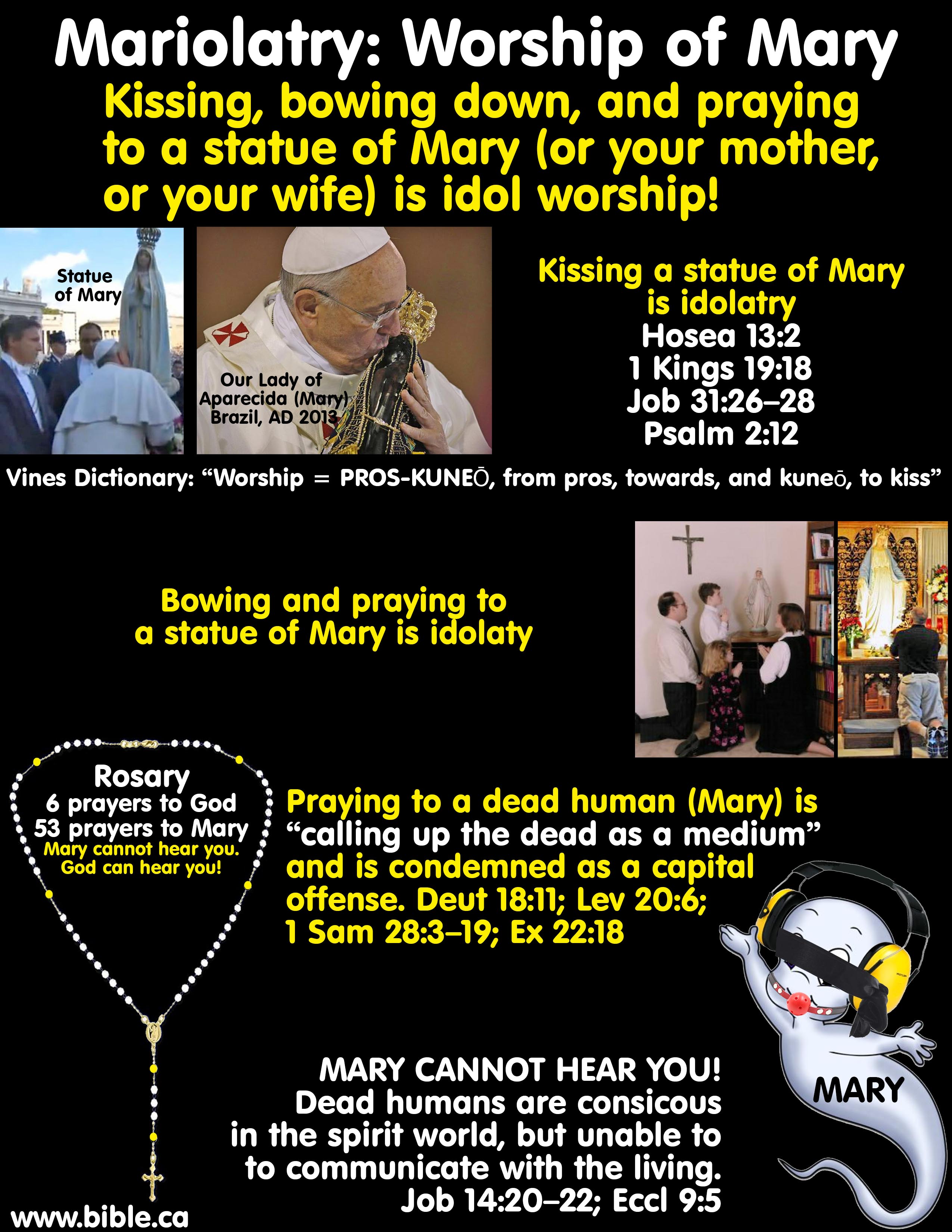
III. Obey God’s silence vs. oral human tradition:
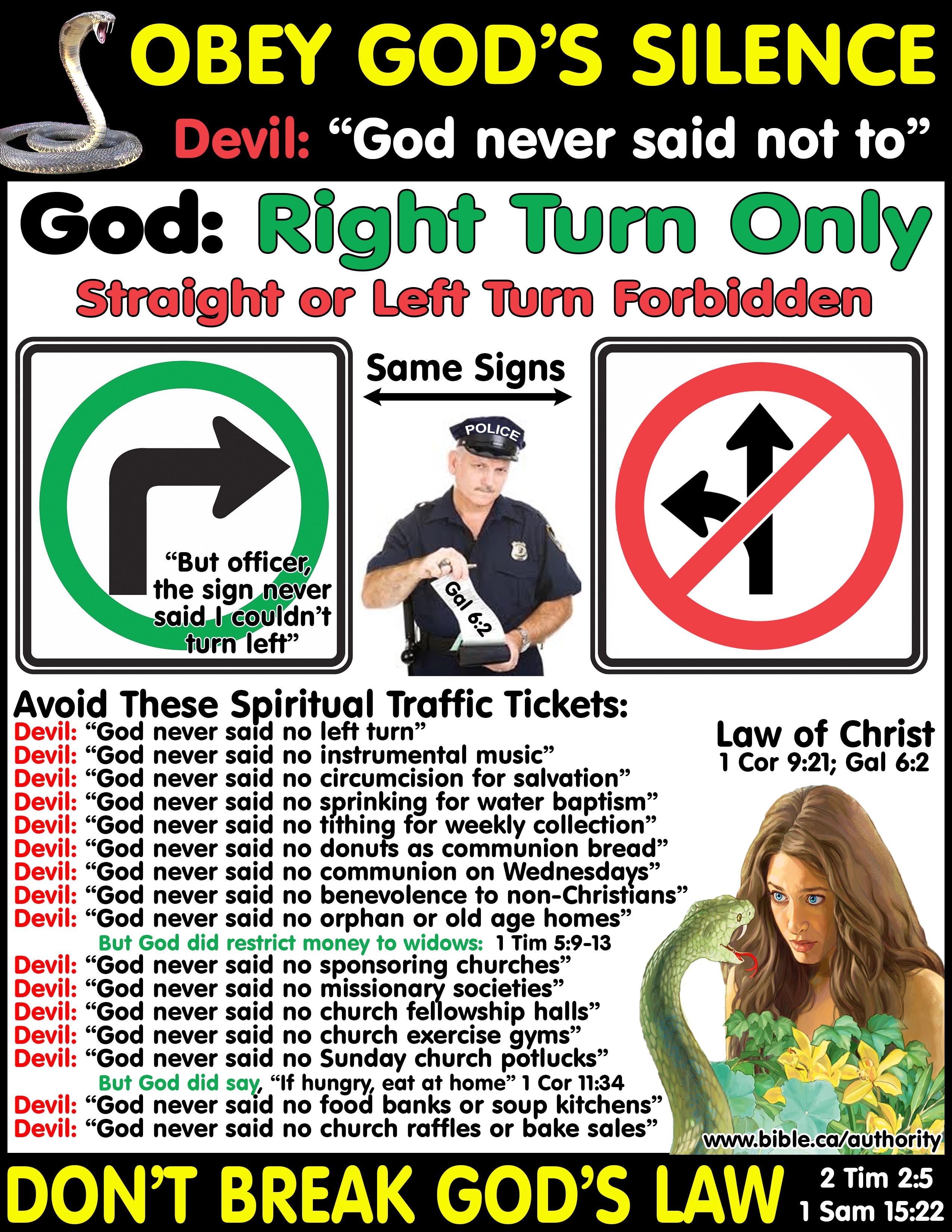
Acts 15 is the Foundation of Biblical Hermeneutics:
The Chart below is the foundation of Biblical hermeneutics that most denominationalists are completely ignorant about and many in the Lord’s body fail to fully comprehend. In the past, Acts 15 has been used as a hermeneutical template where each of the three examples command, example, and inference. However, the three speakers did not exclusively demonstrate command, example, and inference in a perfect “cookie cutter” three-point sermon where Peter exclusively used “necessary inference”, Paul exclusively used “approved example”, and James exclusively used “thus said the Lord” by quoting scripture. This tripartite partitioned understanding is superficial and misplaced because the over arching principle is violating the silence of God in Acts 15:1 + 24 which was restored when Peter and Paul both used inference + example, and James used inference + scripture. Two primary keys that decode the passage is first, to understand that commanding circumcision violated God’s silence and second, that inference was used as tools to restore the silence and refute the false teachers. This is the correct and precise exegeses of Acts 15 many brethren have failed to comprehend for decades. As a final takeaway, Acts 15 becomes an irrefutable argument that outlaws circumcision, tithing, and instrumental music in the church because all three were commanded and practiced in the Old Testament by Jews, but God never said, “not to do these things” in the New Testament, because God expected his silence to be obeyed.
|
Decoding Acts 15 Silence violated: Men violated God’s silence by commanding circumcision. |
||
|
|
Wrong exegesis |
Correct exegesis |
|
Peter |
Inference |
Inference + example |
|
Paul |
Example |
Inference + example |
|
James |
Bible quote |
Inference + Bible quote |
|
Silence restored: The inspired letter in Acts 15:24 does not say, “you don’t need to be circumcised”, and does not even mention circumcision, despite the entire reason for the Jerusalem council was to discuss circumcision. When the Christians in Antioch read the letter from Jerusalem they might initially be puzzled that it does not mention circumcision, they very issue the letter was to resolve. The lesson to Christians is God doesn’t have to say “not to practice circumcision, tithing, and instrumental music”, he tells us what we must do: baptism, freewill offerings, and acapella singing. |
||
|
|
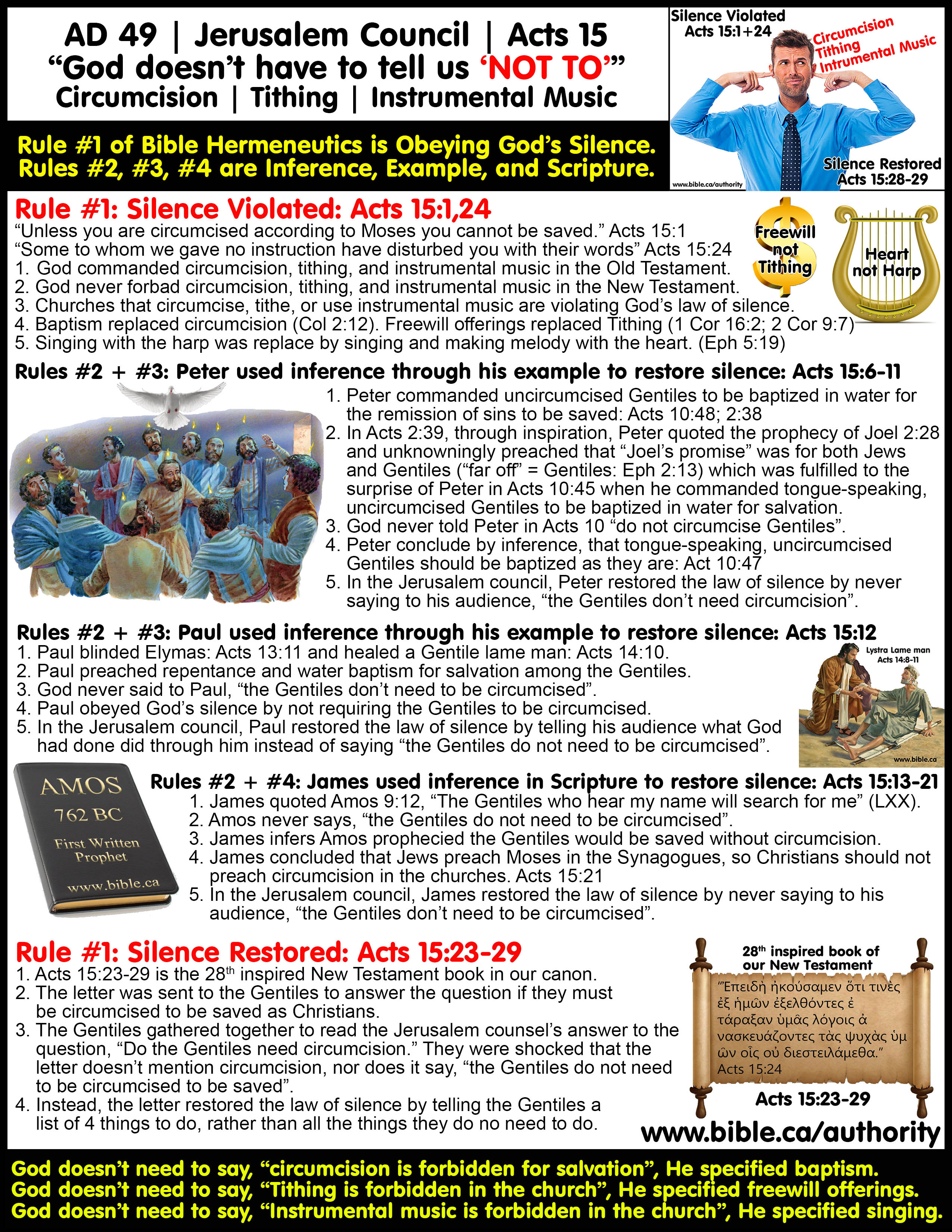
“GOD NEVER SAID WE COULDN’T!” The Bible is a blueprint that defines church doctrine and individual moral conduct. Deviating from God’s blueprint is speaking where God was silent. We are not at liberty to add to the Bible blueprint when God is silent. God speaks his will without the need to add a long list of prohibitions. Like a blueprint, God told doesn’t list all the wrong and forbidden ways to worship Him. The law of silence is broken, when God specifies that water baptism is by immersion, but churches practice sprinkling and say, “God never prohibited sprinkling”. God never outlawed Old Testament circumcision in the New Testament at the time of the Jerusalem council in Acts 15, but His silence was prohibitive. God never outlawed Old Testament Tithing in the New Testament, but it is prohibited because we are commanded to make weekly freewill offerings. God never outlawed Old Testament instrumental music in the New Testament, but it is prohibited using the same logic as circumcision and tithing when God commanded us to sing 9 times. The command to be baptized to be saved, outlawed circumcision through silence. The command to make weekly freewill offerings, outlawed tithing through silence. The command to sing, outlawed instrumental music through silence. This is how you obey the law of silence. False doctrine is the result of not obeying God’s silence. |
IV. Generic Authority vs. Specific Authority AND Authorized Aids vs. Prohibited Changes:
|
|
“Learn not to exceed what is written accurately teaching the word.” 1 Cor 4:6 + 2 Tim 2:15 |
|||
|
Generic Authority |
Specific Authority |
Authorized Aid |
Prohibited change or addition |
|
|
Noah’s Ark Gen 6:14–16 |
Gopher wood, 3 floors, rooms, window, 300 cubits |
Axe, hammer, nails, saw |
Solid Oak wood, raft, 400 cubits, 4 floors |
|
|
Abraham’s Sacrifice Gen 22:2-6 |
Isaac, Mt. Moriah (future temple mount in Jerusalem) |
Wood, fire, knife, servants, donkey |
2 Goats, Hebron |
|
|
Ark of Covenant Ex 25:10-22, 37 |
Acacia wood, gold, poles, rings, 2.5 cubits, 2 cherubim |
Tools, hammer, nails, saw |
Oak, silver, ox carts, 4 cubits, 1 cherubim + 1 dove |
|
|
Naaman Cleansed 2 Kings 5:14 |
Baptize 7 times in Jordan river |
Walk, ride horse, upper or lower Jordan river, shoes on or off |
Sprinkle, baptize only 1 time, Abanah or Pharpar rivers |
|
|
Baptism Acts 2:38; 8:36-39 |
Immersion, Salvation, believer |
Lake, river, water temperature, towels, shoes on or off |
Sprinkling, infant, circumcision, sinner’s prayer |
|
|
Assembly 1 Cor 11:18, 20, Heb 10:25 |
Gather Sundays for collection and communion |
House, church building, toilets, air conditioning, water, lights: Acts 20:8 |
TV or Zoom worship from home (unless sick) |
|
|
Collection 1 Cor 16:2; 2 Cor 9:7 |
Sunday, Freewill, weekly, benevolence to Christians |
Envelope, bank account, Cash, cheque, e-transfer, treasurer |
Tuesday, tithing, bake sale, public fundraiser, public soup kitchen |
|
|
Communion Acts 20:7; 1 Cor 11:23-34 |
1st Day, unleavened wine & bread, assembly |
10AM or 3PM, shape of bread, water to wine ratio, plastic cups |
Friday, Donuts, coffee, alone when travelling |
|
|
Music Eph 5:19 |
All sing, spiritual songs, play heart strings |
Song book, pitch pipe, 4-part harmony, responsive, antiphonal |
Play harp strings, secular songs, Rapp, drums, solo, choir |
|
V. Bible blueprint of the Local Church treasury:
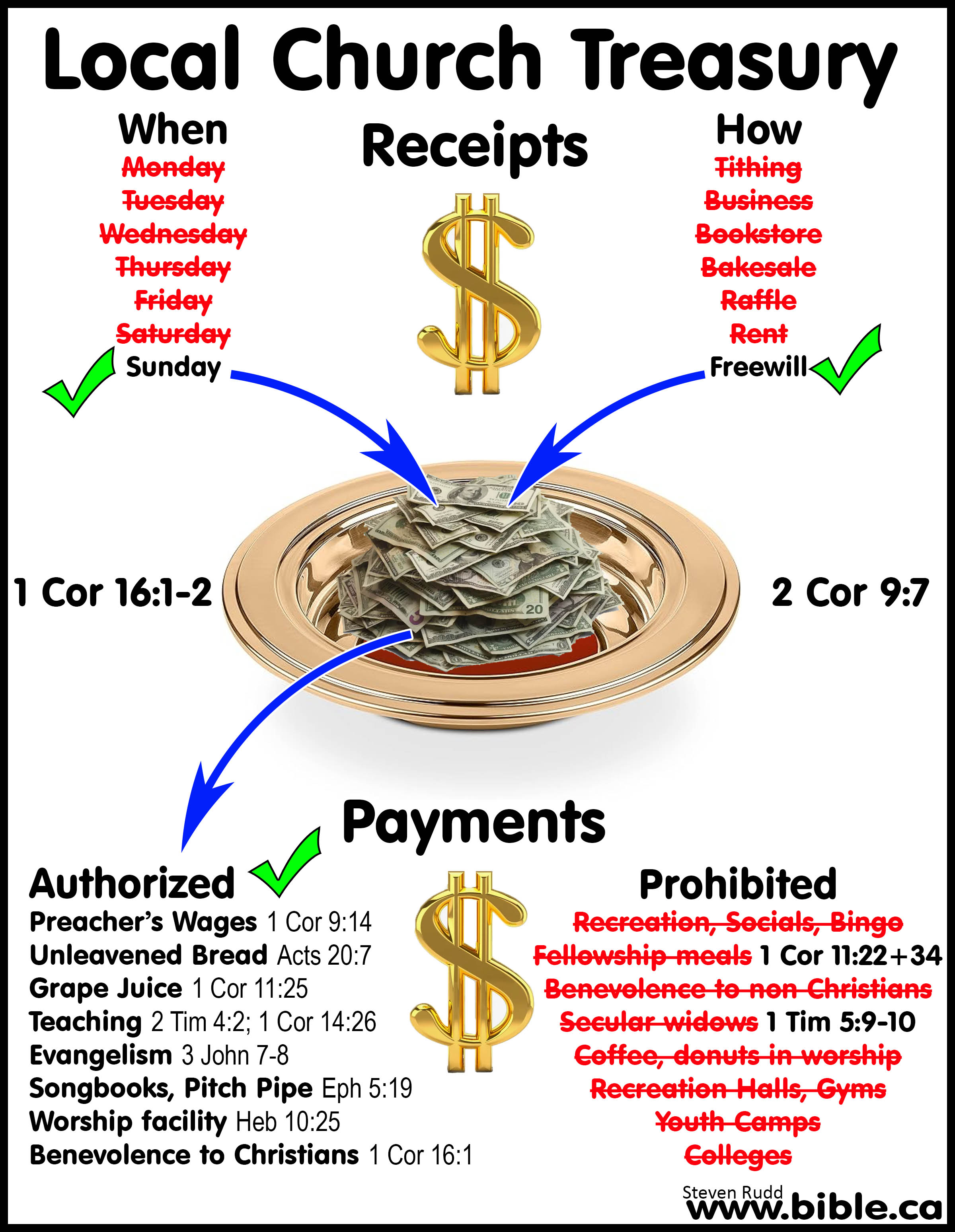
|
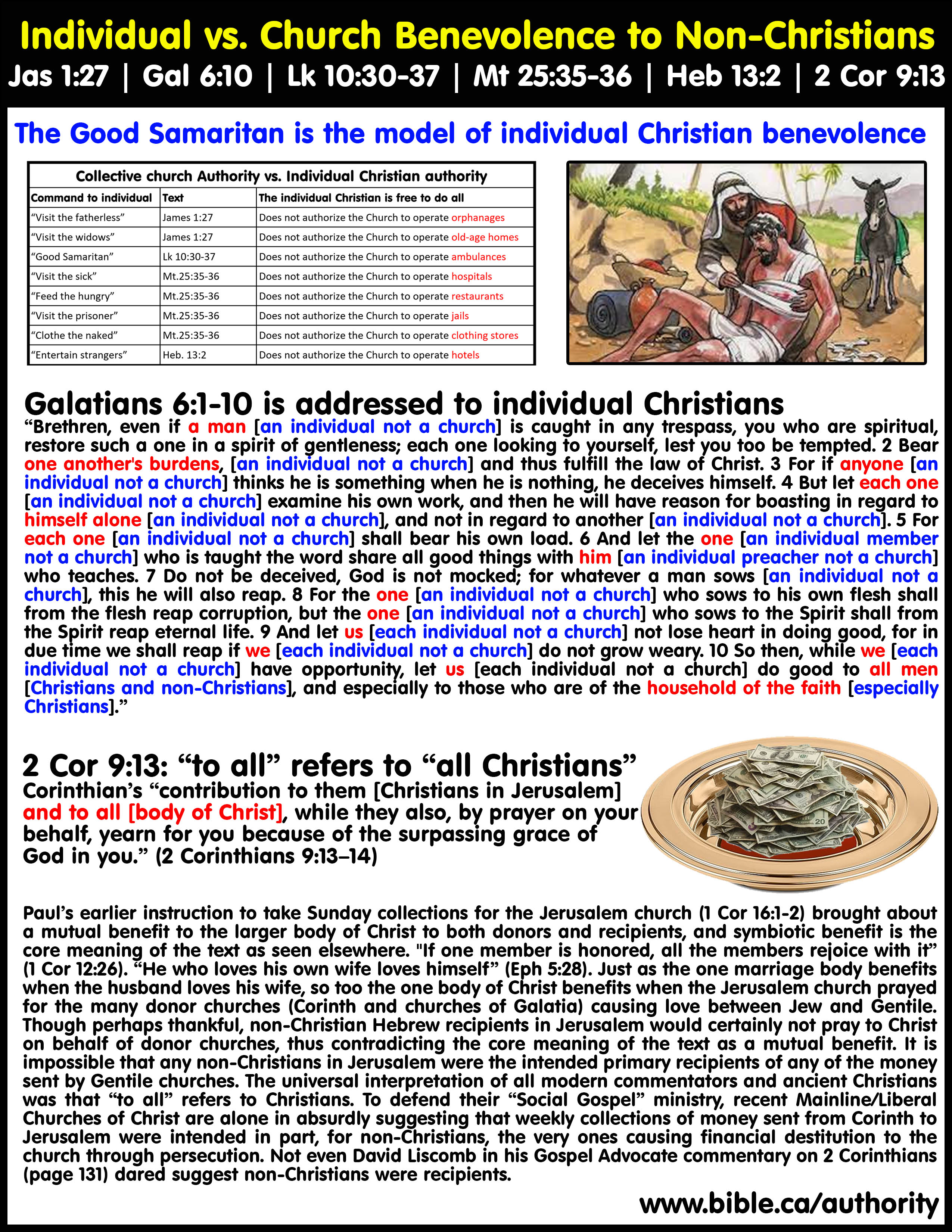
Collective church Authority vs. Individual Christian authority |
||
|
Command to individual |
Text |
The individual Christian is free to do all |
|
“Visit the fatherless” |
James 1:27 |
Does not authorize the Church to operate orphanages |
|
“Visit the widows” |
James 1:27 |
Does not authorize the Church to operate old-age homes |
|
“Good Samaritan” |
Lk 10:30-37 |
Does not authorize the Church to operate ambulances |
|
“Visit the sick” |
Mt.25:35-36 |
Does not authorize the Church to operate hospitals |
|
“Feed the hungry” |
Mt.25:35-36 |
Does not authorize the Church to operate restaurants |
|
“Visit the prisoner” |
Mt.25:35-36 |
Does not authorize the Church to operate jails |
|
“Clothe the naked” |
Mt.25:35-36 |
Does not authorize the Church to operate clothing stores |
|
“Entertain strangers” |
Heb. 13:2 |
Does not authorize the Church to operate hotels |
1. James 1:27 is a command to the individual to financially help widows and orphans if the need arises. James 1:27 cannot be used as Bible authority for non-Christian widows to be supported out of the church treasury because such directly contradicts the specifics of church supported (honor) widows in 1 Timothy 5:3–16.
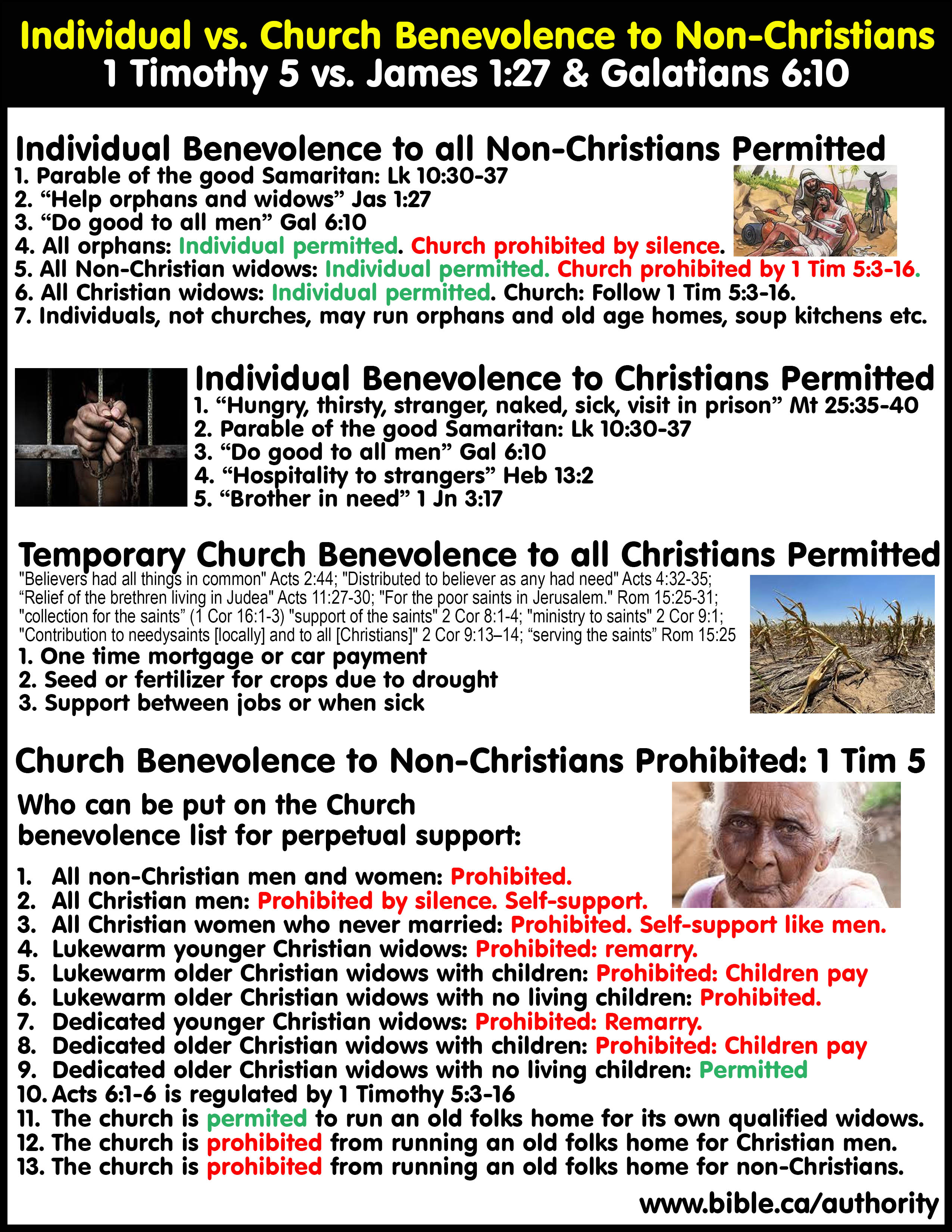
2. 1 Timothy 5:3-16: “Honour widows indeed”. This text specifically and forever prohibits a church run old folks’ home that includes either men or non-Christians. To receive regular payments from the church treasury a widow must meet the following strict conditions:
a. She must be a woman: men totally excluded.
b. She must be over 60 years old: widows 59 and younger are excluded.
c. She must be a widow: Single and married women excluded.
d. She must have raised children: old needy widows with no children were excluded.
e. She must have no living relatives: Excluded if they have living family.
f. She must have had a long-established reputation of working hard with the church leaders for the gospel: Spiritually lukewarm widows excluded.
3. Eating regular “Fellowship Meals” in the church building, funded by the church treasury is prohibited:
a. "What! Do you not have houses in which to eat and drink? Or do you despise the church of God and shame those who have nothing? What shall I say to you? Shall I praise you? In this I will not praise you. … If anyone is hungry, let him eat at home, so that you will not come together for judgment." (1 Cor 11:22,34)
b. Although the Corinthians had turned the Lord’s supper into a “Fellowship Meal”, Paul DID NOT SAY for them to eat their “Fellowship Meals” in a way worthy of Christ so that everybody gets something to eat, but to STOP having “Fellowship Meal” when you assemble and eat your meals individually at home!
c. Paul did not correct how they were eating in the church building, he outlawed it altogether!
4. The Social Gospel: Fun, Food, and Friends
a. John 6 is where Jesus proves to us that the social gospel of attracting church goers with fun, food, and entertainment doesn’t work. Jesus has done the science experiment for us so we never repeat it. Jesus proved once for all time that the social gospel is a failure in evangelism. Several times Jesus fed thousands of people during his ministry. It is important to note that he fed them because they first came to hear Him preach first and after became hungry. Jesus never used food to attract the crowds as liberal and mainline churches practice in vain. In fact, Jesus chastised those who came only for the food. In John 6:1-15 Jesus fed the 5000 at Tiberias then abandoned the crowd and went to Capernaum (Jn 6:24). When the crowds followed Jesus to Capernaum, He said, “You seek Me because you ate of the loaves and were filled." (Jn 6:26) Jesus then rebuked the 5000 for following him for food, instead of the gospel (Jn 6:25-65). The story ends with all 5000 leaving except for the twelve, “As a result of his teaching many disciples withdrew and were not walking with Him anymore." (John 6:66).
b. Today churches us Fun, Food, and Friends to grow church attendance and it doesn’t work. When the food runs out, so do the members run out of the church in search of another that does!
|
The Social Gospel: 26 Wrong Reasons to Attend with a Specific Local Church |
|
|
Summer camping retreats offered |
Ethnic, language or race similarities |
|
You really like the preacher: dynamic or handsome |
Church building is large & beautiful |
|
Support groups & exercise classes |
Its where your parents attended |
|
Its the church you got married in |
Midweek daycare for your children |
|
They have a popular TV program |
Building is geographically convenient |
|
Craft classes & lady’s tea afternoons |
Family social evenings & youth groups |
|
Monetary & food gifts for members |
They run a 'Christian' public school |
|
You agree with their political views |
They teach pre-martial or deviant sex is OK |
|
You are dating one of their members |
Opportunity for business contacts |
|
Musical programs and dinner theaters |
Bingo, raffles and bazaars |
|
The people are friendly and loving |
The church needs me to do maintenance |
|
important or influential people attend |
The services are exciting |
|
Large (or small) number of members who attend |
Only members get to use auditorium for weddings. |
|
12 Excuses why people forsake the assembly (Heb 10:25) |
|
|
Too busy or tired with work or school |
Weekly attendance is not important |
|
Rather do some work around the house |
Jesus doesn't expect me to attend |
|
I must work every Sunday |
Guests visiting for the weekend |
|
Christ is important ...Not the church |
Hard to form the habit of assembling |
|
Would rather sleep in |
Organized religion is corrupt |
|
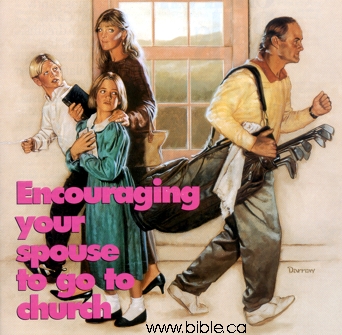
Rather go shopping or go to the cottage, or go golfing |
Attendance causes family tension |
VI. Three cases: Bible Blueprint of Church Treasury benevolence to Christians:
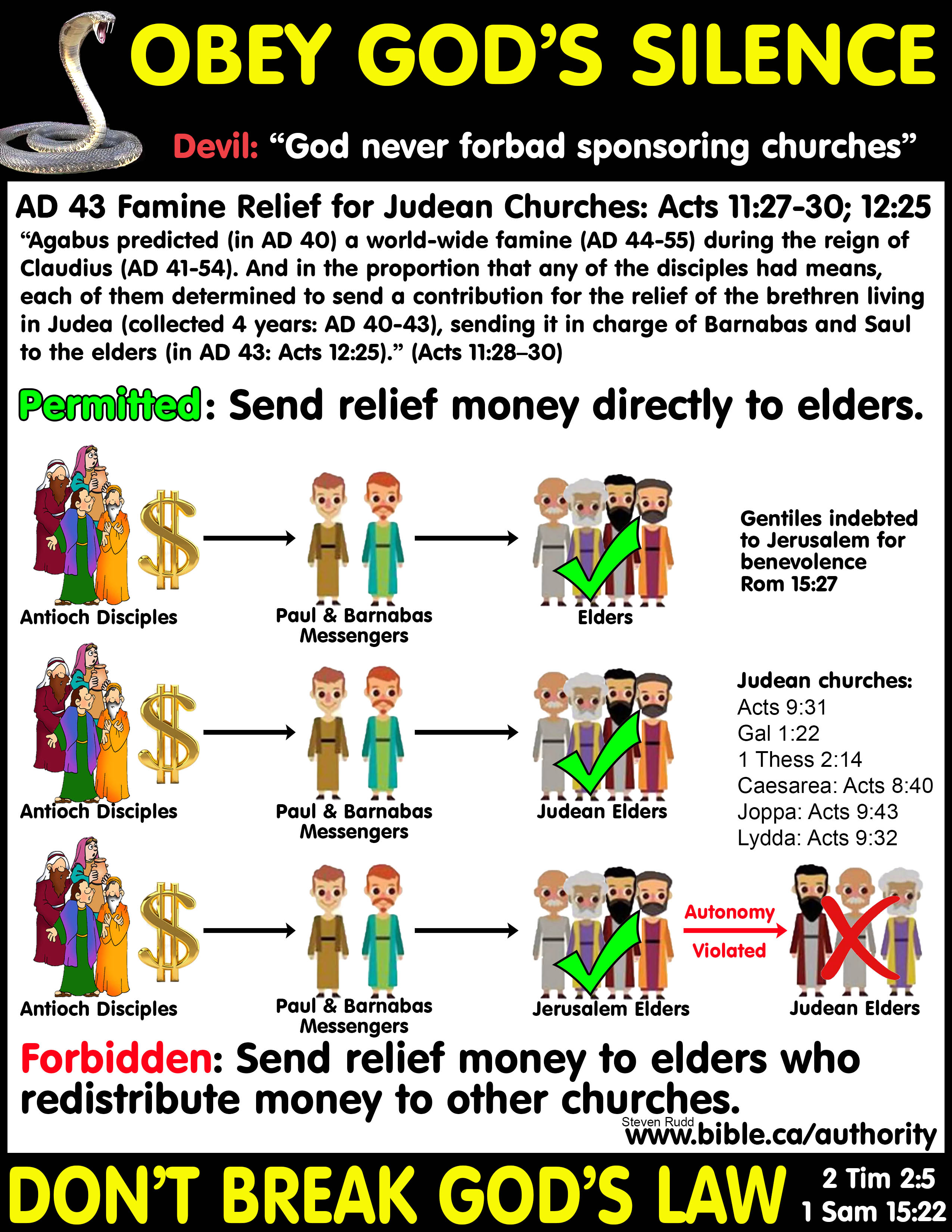
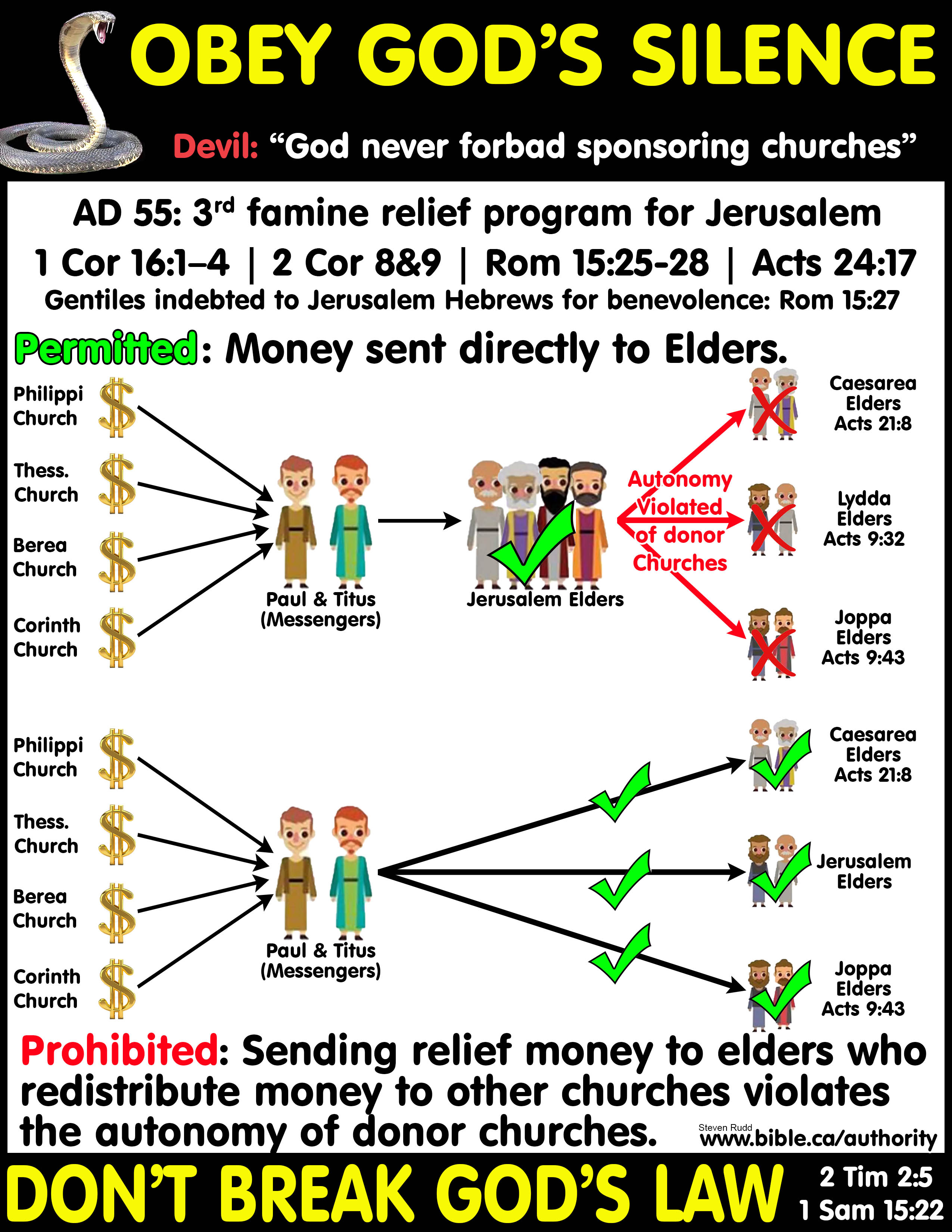
1. AD 43: Acts 11:29: Paul’s 2nd visit to Jerusalem: 1st famine relief program delivered to the Judean elders
a. Judean churches: Jerusalem, Joppa (Acts 9:36-43), Lod/Lydda (Acts 9:32) or others: Acts 9:31; Gal 1:22; 1 Thess 2:14.
b. “Agabus predicted (in AD 40) a world-wide famine (AD 44-55) during the reign of Claudius (AD 41-54). And in the proportion that any of the disciples had means, each of them determined to send a contribution for the relief of the brethren living in Judea (collected 4 years: AD 40-43), sending it in charge of Barnabas and Saul to the elders (in AD 43: Acts 12:25).” (Acts 11:28–30)
c. In this case, the relief effort took 4 years to collect and was delivered one year before the 11-year famine began in AD 44.
d. Scripture gives us little detail about this program. We are not sure if it was an individual collection the Christians at Antioch saved up over 4 years or if they made weekly freewill offerings to the local church treasury like 1 Cor 16:1-4 later instructed 10 years later in AD 54. The relief was for the “Judean brethren” but this might refer to only the Hebrew Christians in Jerusalem, or it might include several other local Judean churches for relief. Paul and Barbabas delivered the relief “to the elders” but this could refer only to the Jerusalem elders, or it might also include elders of other Judean local churches. We cannot be sure that Jerusalem was even included in the relief program. Paul may have personally delivered all the money to the elders in all recipient Judean churches including Jerusalem, or he may have sent messengers from Jerusalem with money for each of the other Judean church elders. There is absolutely no authority for the elders in Jerusalem acting like a sponsoring “mother church” who then send the money to the elders of other local churches in Judea. Paul may even have asked the elders in Jerusalem to help him to find men to take the money from himself and deliver it to the elders in other churches in Judea, but even in this case, the elders of Jerusalem exercised no control or oversight over the distribution of money, they merely assisted Paul as agents of transport to churches that the church in Antioch had predetermined. The elders in Jerusalem did not usurp, interfere or change the will and decision of the church in Antioch.
e. Today, the elders of a single large liberal mainline church collect money from many smaller local churches and then send the money for benevolence at their sole discretion, overriding and usurping the authority of the elders in the smaller churches. This is stage 1 apostacy to the Roman Catholic Papal system. In AD 1989 the International Church of Christ (ICOC) brazenly appointed one man, Kip McKain, as the pope of the world church, which finally collapsed around AD 2015 into splinter groups, which today are in full digression by using instrumental music in worship and women preachers. All this destructive error and false doctrine could have been avoided if they had just OBEYED GOD’S SILENCE and never had elders from one church, act as a sponsoring church by collecting money from other smaller churches and redirecting the funds for benevolence and preacher support around the world. “Speak where the Bible speaks and be silent where it is silent” is the best safeguard against apostacy.
2. January AD 49: Acts 15 Jerusalem council. Paul’s 3rd visit to Jerusalem and 2nd famine relief program for Jerusalem. When the matter of circumcision for salvation was settled, the Jerusalem church asked Paul to “remember the poor” which likely implied Jerusalem but may have been any poor Christian living anywhere: Gal 2:10. While Galatians was written in AD 53, Gal 2:10 looks back to AD 49. There is no record of this second famine relief program, unless it occurred six years later in AD 55 and is one and the same relief effort. If so, there are only two famine relief programs in the New Testament, not three as proposed herein.
3. June/July AD 55: Paul’s 4th visit to Jerusalem and 3rd famine relief program for Jerusalem.
a. The churches who contributed were those in Galatia (Antioch, Lystra, Iconium, Derbe), Macedonia (Philippi, Thessalonica, Brea), and Achaia (Corinth).
b. The 11-year long (AD 44-55) world-wide famine predicted in AD 40 by Agabus in Acts 11:27-30 ended the same year Paul delivered the money to Jerusalem in AD 55. It is ironic that 15 years after the prophet Agabus had warned of a famine, the same Agabus now warns Paul, who is bringing famine relief funds, not to enter Jerusalem and deliver the money: Acts 21:10–13.
c. 1 Corinthians was written during the third missionary journey from Ephesus in AD 54 just before he left to visit Corinth. Paul is now visiting the churches of Philippi and Thessalonica etc., enroute to Corinth, when he gets word back from Corinth that the church accepted his letter with repentance, and he writes 2 Corinthians in AD 54. While collecting the famine relief funds from Corinth (Acts 20:3), Paul writes Romans in AD 55 just before he leaves Corinth for Jerusalem. Paul’s 3rd missionary journey ends when he delivers the Gentile church famine relief to Jerusalem and is arrested in AD 55.
d. In AD 55, Paul was arrested in Jerusalem when he brought relief for Jerusalem: Acts 21:27.
VII. Bible blueprint of individual benevolence to non-Christians:
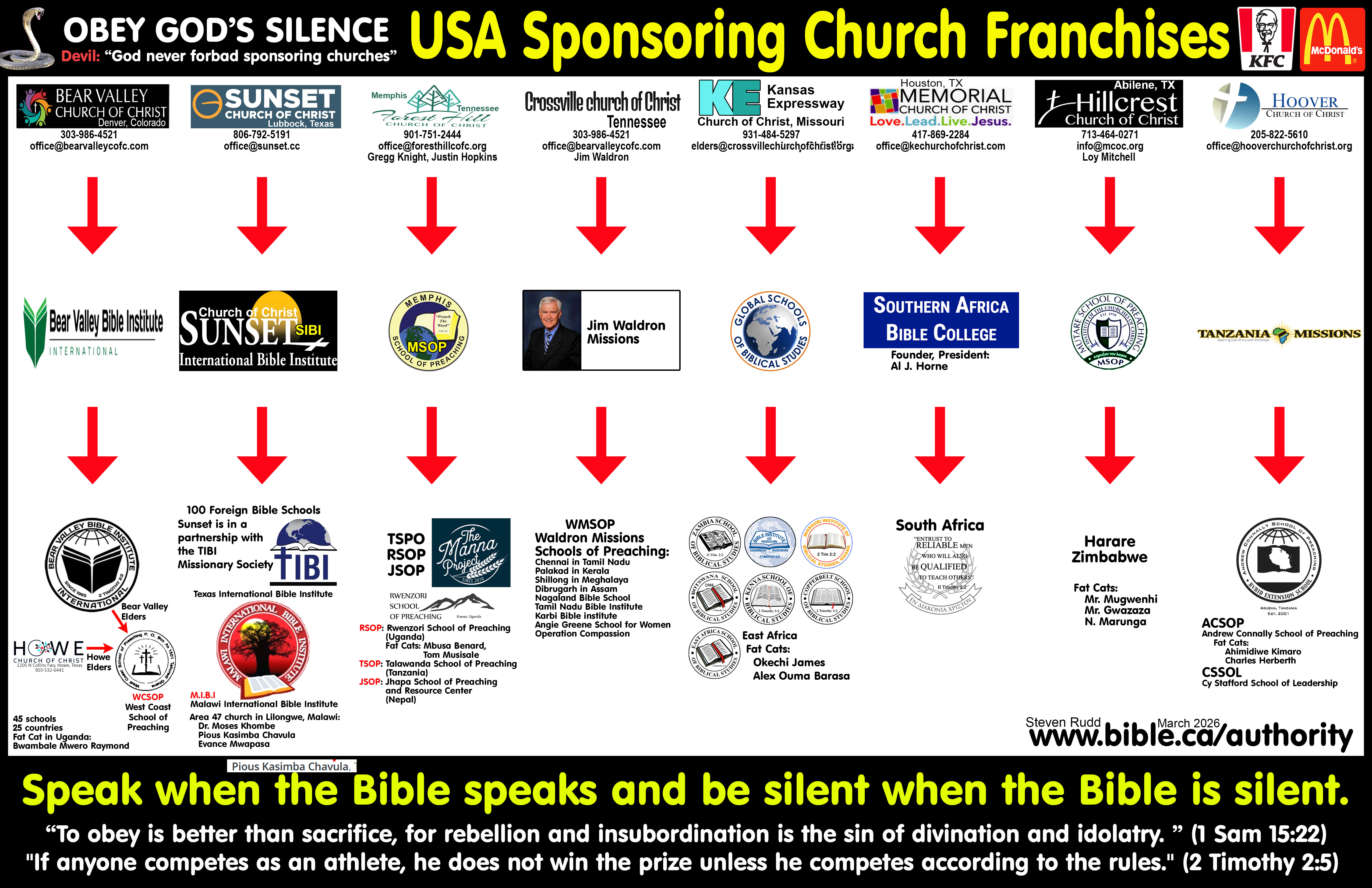
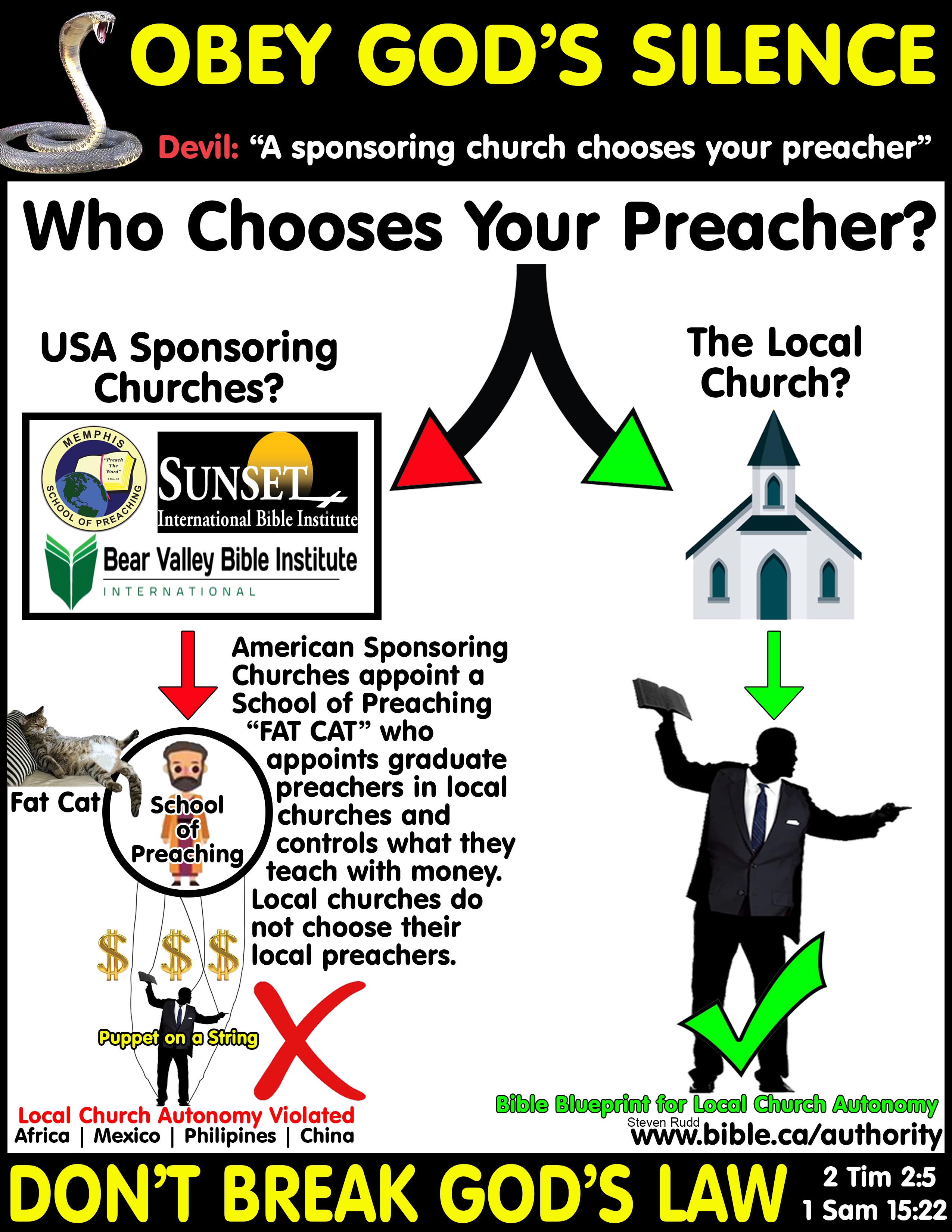
VIII. Bible Blueprint of Evangelism vs. the Sponsoring Church:
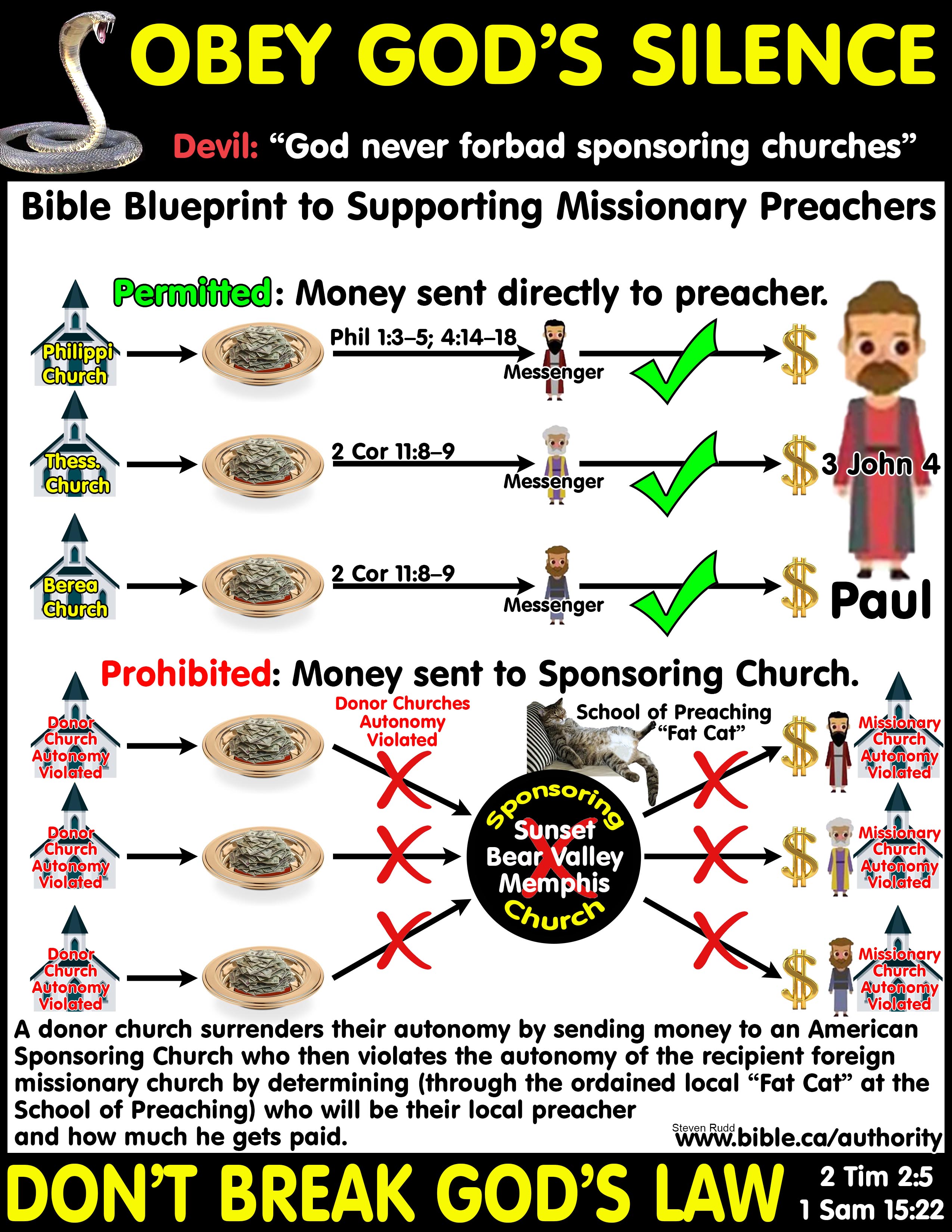
IX. Bible Blueprint of Missionary Preacher Wages vs the Sponsoring Church:
X. Bible Blueprint of Evangelism vs. the Missionary Society:
XI. Documenting Violations of Bible authority by Sponsoring churches and their Bible schools.
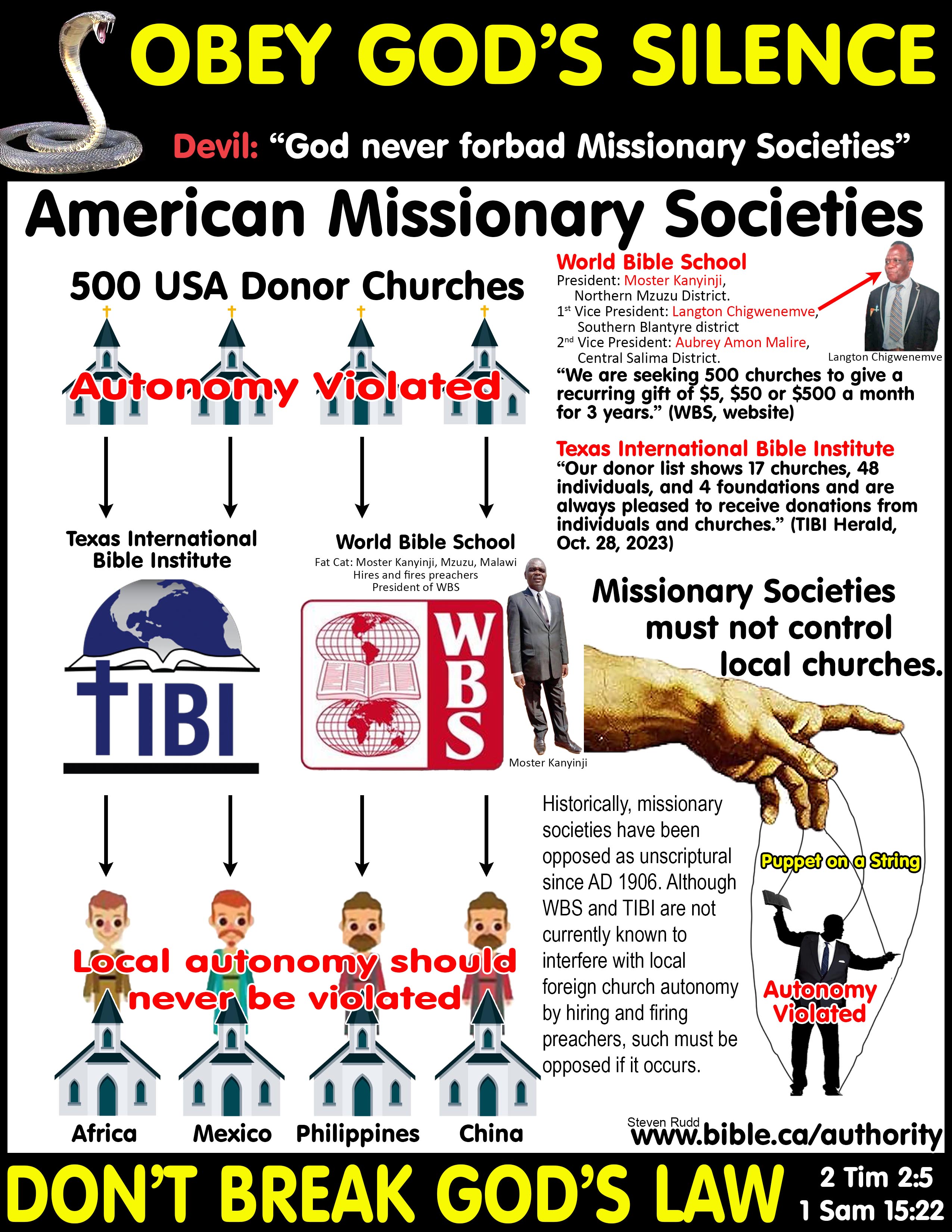
In the spring of 2024, Steven Rudd solicited firsthand accounts from foreign gospel preachers that document the abuses they suffered at the hands of eight USA sponsoring church franchises and their Bible schools, who violate the Bible blueprint of local church autonomy by the hiring and firing local church preachers, and engaging in unscriptural collection and distribution practices of church treasury funds, sometimes through missionary societies and human institutions like the Texas International Bible Institute, and the World Bible School. The result was 12 pages of responses from 16 different gospel preachers. Several asked to remain anonymous for fear of attacks from the sponsoring church franchises and their agents. It was decided to remove all the names to protect them from harm. After the accounts below were collected, each of the 8 sponsoring churches in the USA were sent a personal letter from Steven Rudd requesting comment about these violations of Bible authority and local church autonomy in August 2024. Only Bear Valley replied by affirming they do not violate local church autonomy and rejected all charges as false, despite numerous accounts to the contrary.
The church is a court and a school, so it is unauthorized for churches to scripturally run schools with no tuition that are funded and overseen by the local church elders. Sponsoring churches violate God’s plan because it is impossible for a single eldership to effectively manage 40-100 Bible schools in many foreign countries. This oversight distortion is created when sponsoring churches violate the Bible blueprint and solicit funds from other smaller church treasuries, providing funds that are 50 times greater than their own local treasury. If they did not solicit funds from other churches, the Bible schools would cease to exist for lack of funds. Such centralization was never God’s plan for the church since the largest organization in the New Testament is the autonomous local church. The smaller donor churches surrender their oversight autonomy to the sponsoring church who have complete control over the money they receive. This money collection from many local church treasuries into a single local church treasury is the first violation of local church autonomy suffered by the donor churches despite voluntary participation. Rather than directly controlling their money, they surrender this control to another church exactly like a denominational diocese, where sending money to the overseeing church is not voluntary. Voluntary giving doesn’t change the result of violating local church autonomy.
An elder’s job is to rule the flock among them. Large churches often support 30 men to preach with money in foreign churches but their work ends when the elders mail the check so they can focus on the full-time job of shepherding the local flock. Supporting churches do not interfere with the autonomy of the local churches whose preachers they support. Supporting churches do have total control over who they support and if they want to stop supporting someone. Bible schools on the other hand, require massive amounts of oversight far beyond what the local elders can supply. Its like a mother with 4 preschool kids who decides to take on a full-time job and the kids suffer. Something’s got to give. A single eldership cannot oversee a local church and 50 Bible schools, so they delegate oversite to men who run the schools, known in Africa as “big cats”, “fat cats”, or the “big bull of the herd”. God’s Bible blueprint is to limit a local church’s “reach” within the boundaries of their own local treasuries. Large churches may be able to effectively run, manage, and directly oversee 1 or 2 foreign Bible schools, but it is impossible for 10 elders to oversee a local congregation and 100 foreign Bible schools. The result is management by delegation in a franchise type business model where direct control exists only as delusional stated dogma. Just like Biden was the president but others ran the country, so too with elders of sponsoring churches who claim they run the Bible schools, but in reality, do not. The abuses documented therefore, are predicable systemic problems inherent in the unscriptural, sponsoring church organization which began, divisively, in the 1950’s.
Sometimes, there is a clear differential between what American sponsoring churches think is happening in their foreign Bible schools, versus the actual experiences and perceptions of foreign Christians. On the other hand, not all mainline sponsoring churches feel it is wrong to hire and fire preachers in local foreign churches through their schools. The mainline/institutional church that was born in the 1950’s spawned the ICOC (International church) in the 1970’s, who suspended all local church autonomy and adopted an organization like the Roman Catholic church. The blackballing and shunning of non-institutional churches combined with a virtual ban of all pulpit teaching of Bible authority, easily paved the way for ICOC to appoint a pope over the whole ICOC church with subordinate bishops. Growing up, ICOC leaders witnessed how sponsoring churches violated local church autonomy, and then they took it one step further in a classic slippery slope scenario and appointed a pope. The shocking firsthand “whistleblower” accounts speak for themselves and the fear these men of God expressed in coming forward speaks volumes of a system that is rotten to the core.
Many debates have occurred where institutional minded brethren defend sponsoring churches with a major emphasis on emotion, by labelling their opponents as “orphan haters” or saying, “I would rather go to hell for doing something good, rather than nothing at all. This is combined with shallow arguments, like the “Bible doesn’t say we can’t”. Most members of mainline churches are oblivious to basic Bible doctrine of how to establish Bible authority through general or specific authority, and command, necessary inference and example.
XII. Application for the church today:
1. It’s ok for the church to have a food bank for benevolence, if it is for Christians only and widows who meet the strict criteria of 1 Tim 5. If you want to help non-Christian widows, sell your house and give them the money or start a privately funded old folks home.
2. It’s ok the church to run a hostel for visiting out of town Christians and preachers for gospel meetings but it’s not ok to start a hotel that charges discounted rates to random European backpackers travelling the world for fun. Churches are authorized to own manses as part of the preacher’s wages.
3. It’s ok for the church to have storage buildings for scripture, books, bible libraries but its not ok to start a public “U-Store It” business. Most churches have libraries and storage rooms.
4. It’s ok for the church to have civic style meetings for non-spiritual matters that directly relate to Christians (Acts 6), but its not ok to allow outside civic governments to use the church as a polling station for modern elections or all candidates meetings for city mayor. Disputing local members will often meet with the elders at the church building to resolve civic disputes because the church is a court.
5. It’s ok for the church to get members to donate household goods and clothing for other local needy members, but it’s not ok to start a public thrift store that accepts donations from non-Christians to resell the goods to the general public for profit that is used to fund the construction of new church buildings or missionaries oversees or Bibles. Churches raise their money through weekly Sunday freewill offerings not business ventures.
6. It’s ok for a church to have a fridge and stove in the church building as long at it is used exclusively to bake the communion unleavened bread and keep the grape juice cold so it doesn’t spoil. Most churches have a fridge to store the Lord’s supper elements.
7. It’s ok for money from the church treasury to be given to for occasional “one-time needs” of any Christian anywhere, but it never ok to give a single dollar to any non-Christian from the church treasury. Churches regularly give money for medical emergencies of members.
8. It’s ok for one church to send money to another church overseas to help the local Christians as disaster relief, but it is not ok for any church to give money to the Red Cross or any generic relief agency. Christians are free to donate privately to the Red Cross.
9. It’s ok for one church to send money to another recipient church where members need humanitarian relief, but its not ok to send the money to rebuild African towns, build or run secular schools and provide medical aid for non-Christians. Benevolence from the church treasury cannot be used to support non-Christians the same way Jewish Temple and Synagogue treasuries only gave their benevolence to fellow needy Jews.
10. It’s ok for a larger wealthy church to send money to a smaller needy church for benevolence, but its never ok for many smaller churches to send money to one larger and more wealthy “sponsoring church” that has much more money in its own church treasury, than all the smaller churches combined. A small “poorer” church sending money to a larger “richer” church is directly opposite to the New Testament pattern, without scriptural authority and always wrong regardless of the “greater good” being done.
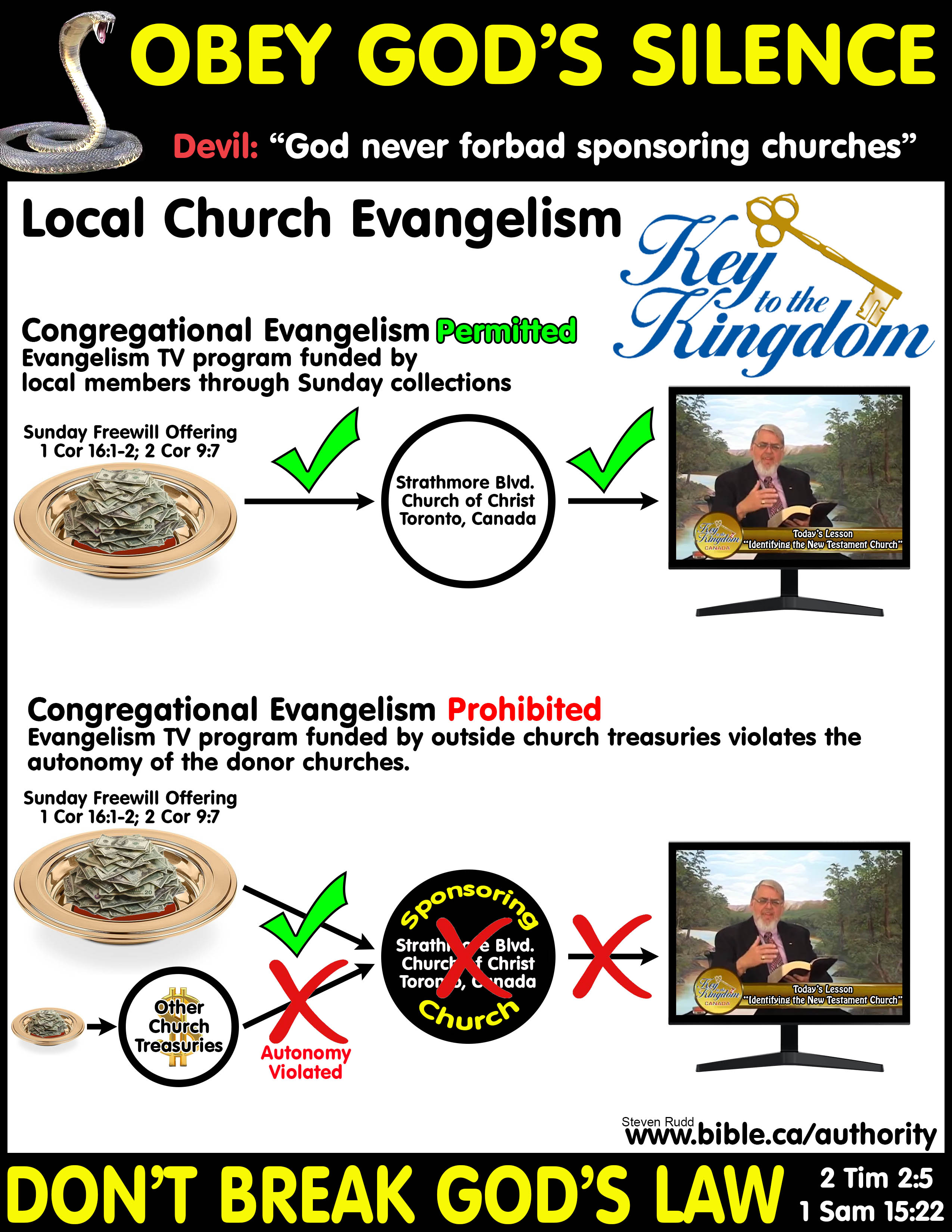
11. It’s ok for a local church to spend money for evangelism but its never ok for many smaller churches to send their money a larger “sponsoring church” to create a pool of money to run a multimillion-dollar national evangelism program on behalf of the many churches. This is a violation of autonomy and is without any Bible authority.
12. It’s ok for the church to have a full sized, government certified kitchen, complete with halon fire extinguishing system, as long as the only food they prepare is the unleavened bread and grape juice for communion or for qualified widows as per 1 Tim 5. While such a kitchen may be authorized, all would agree it is an outrageous waste of the Lord’s money which could be spent in other areas. However, a congregation of 10,000 Christians would likely save time and money by having a large church kitchen with multiple ovens to bake the unleavened bread and bunker style fridges to store the grape juice and commercial dishwashers for washing communion cups for the for weekly communion.
13. It’s ok to dig a well and install a drinking water fountain in the church building for members but its not ok for a church to install clean drinking water wells for non-Christians in third world towns that are dying from thirst. If you really care, you are free to sell your house, fly over and save the town with your own personal money by digging local water wells.
14. It’s ok for a church to run a fully accredited university, if it is “tuition free”, funded only through weekly freewill offerings of Christians Sunday morning and teaches only Bible classes.
15. It’s ok for a church to install a mikveh (baptistry) but its not ok for a church to construct an Olympic size public swimming to attract outside young families to the Sunday services by offering midweek swimming lessons for half the going rate at other civic swimming pools. The church should not be in competition with the local YMCA in providing social needs of the local non-Christian community by building church gyms, basketball courts, secular theatre stages, public soup kitchens, etc.