Bible Blueprint of Weekly Communion of Unleavened Juice and Bread
|
|
Bible Blueprint Decalogue Curriculum 150 pages, 8.5 x 11, full color or digital |


Refuting One Cuppers: There were 13 communion cups at the Last Supper

Introduction:
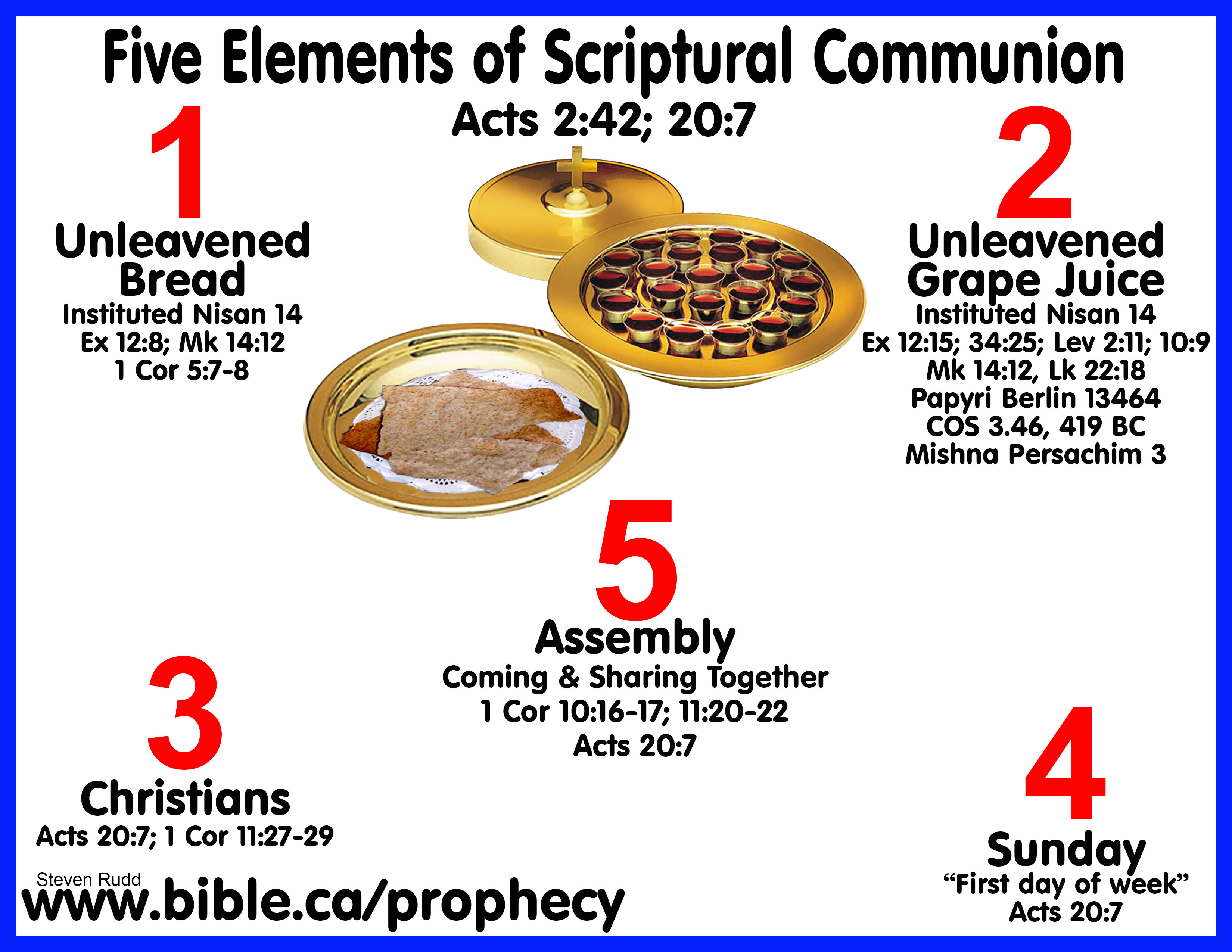
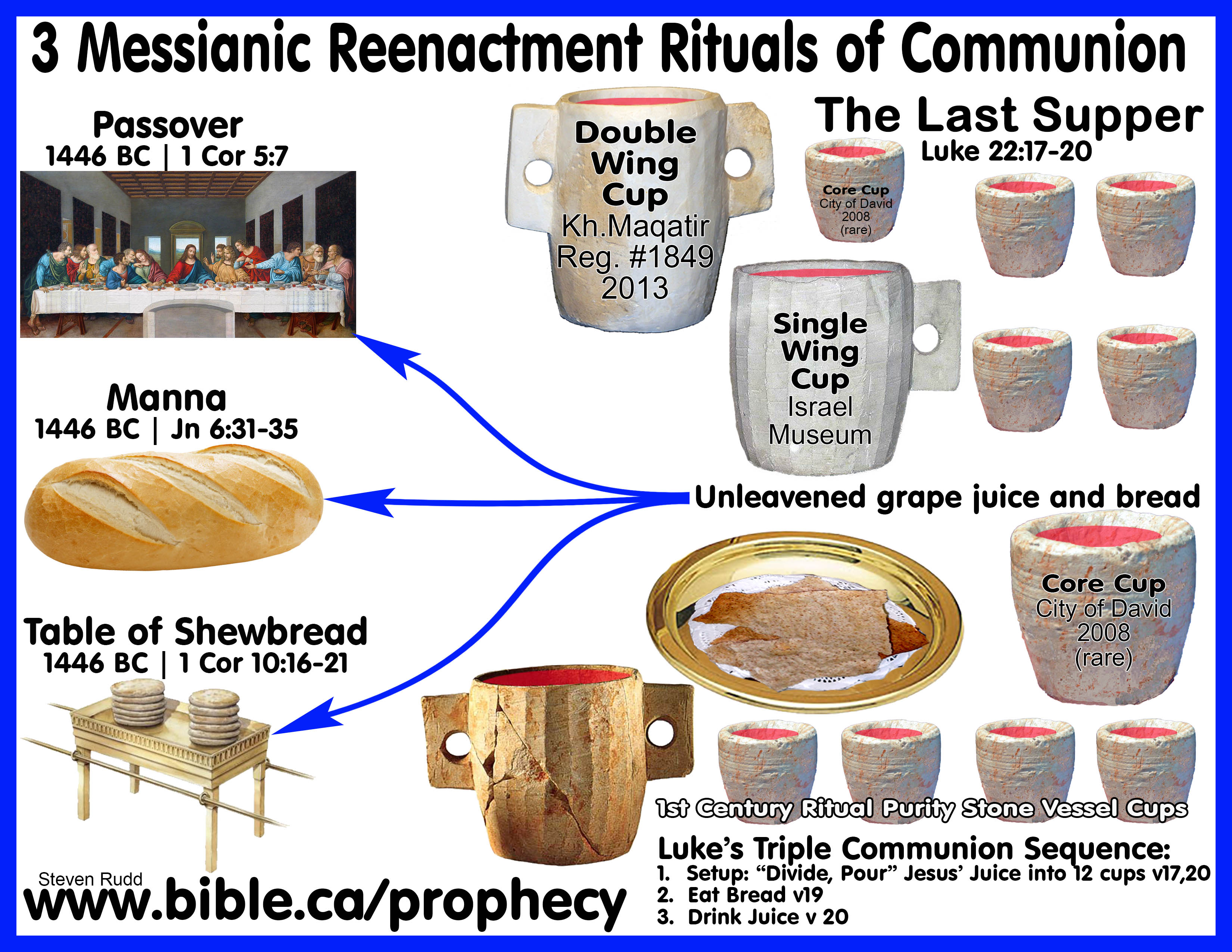
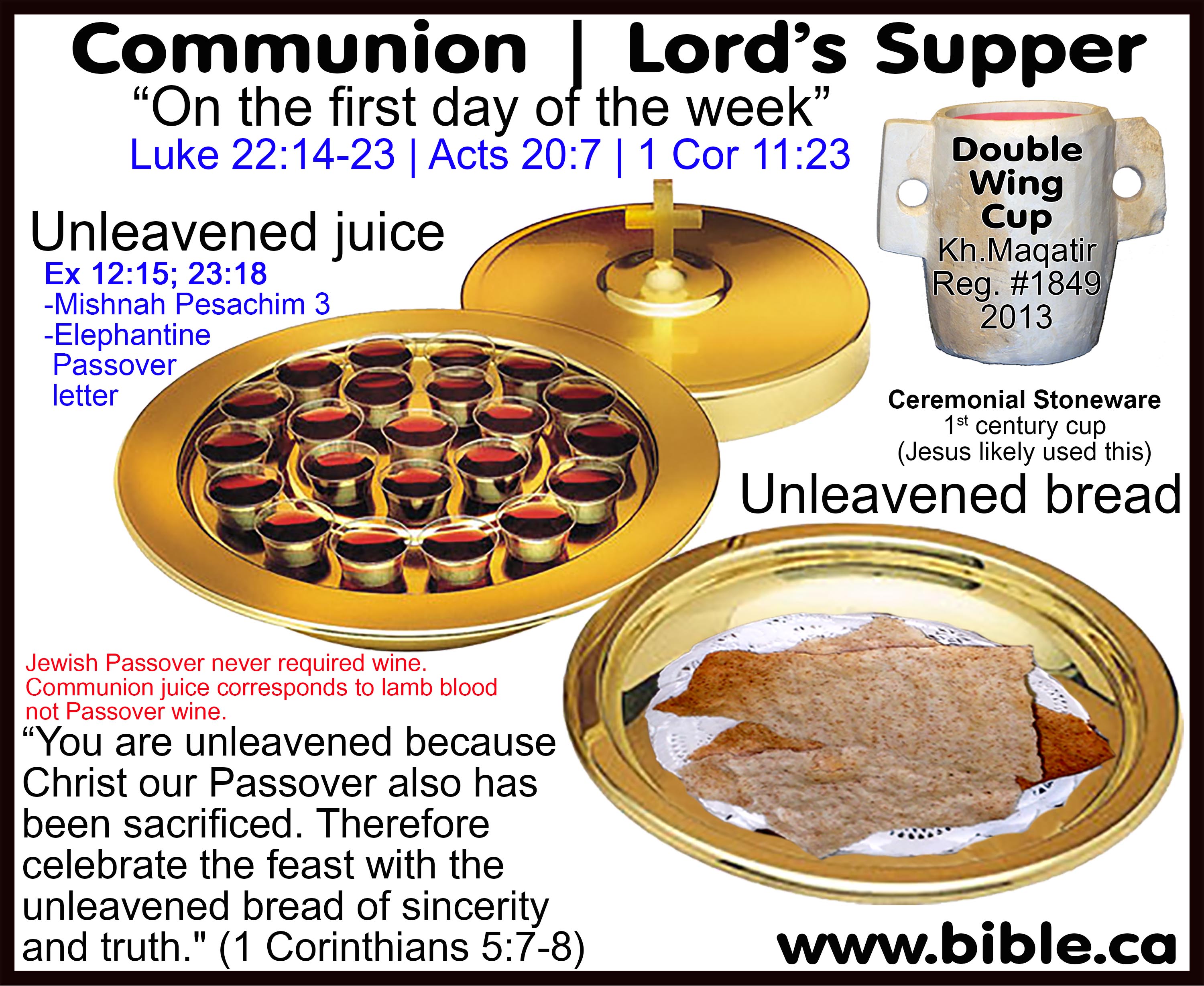
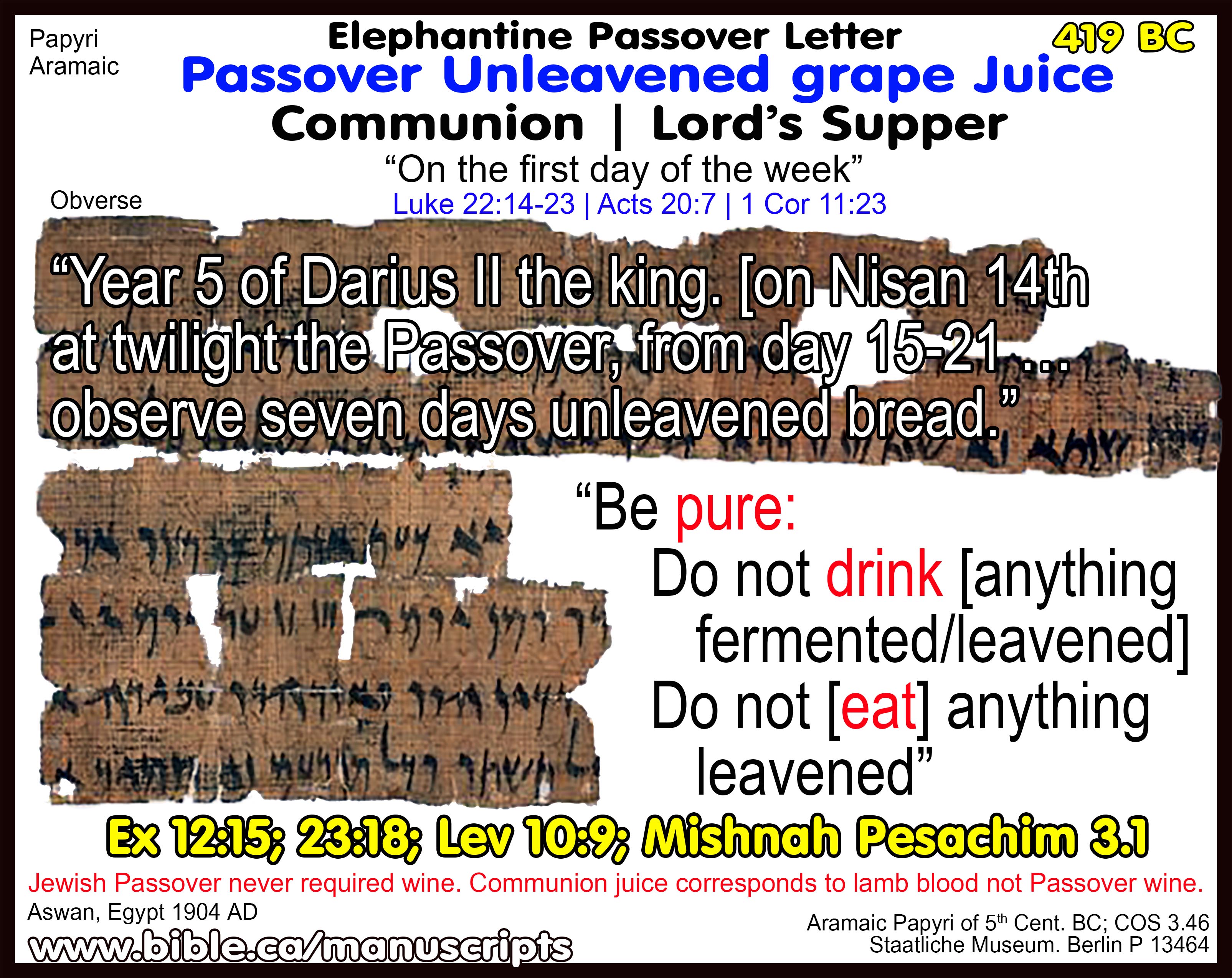
Using 1, 2 or 25 cups in communion is fine, but binding a single cup is heresy because Luke 22:17-20 proves there were 13 different communion cups used at the last supper, the night before Jesus was crucified, on Friday (Nisan 14,15, AD 33). Since it was a sin for Jesus to consume leaven during Passover, combined with 1 Cor 5:7, unleavened bread and unleavened fruit of the vine is what Christians must use for communion; not leavened bread or wine that contains leaven. This is confirmed by the Aramaic Passover Papyri that dates to 419 BC. In AD 2013, Steven Rudd was first to suggest that Jewish ritual purity stoneware vessels were used at the last supper, including cups and the foot washing basin of John 13:5, after excavating them in Israel that excavation season at Kh. El-Maqatir, biblical Ephraim. These stone cups and basins were in use from 63 BC – AD 70.
Impossible to drink a cup:
One cuppers reject Jesus’ use of metonymy in 1 Corinthians 11:26, where He commands Christians to “drink the cup.” It is literally impossible to drink a cup proving, the metaphoric figure of speech “drink the cup” obviously means to drink the juice inside the cup, not the cup itself. Five times in scripture, “Drink the cup” by metonymy, obviously means drink the juice in the cup, not the cup itself: Mt 20:22; 1 Cor 10:21; 11:26–28. The cup of God’s wrath in Rev 14:10 continues the pattern of using metonymy where the cup is a symbol of God’s spiritual wrath.
Myopic Hermeneutics:
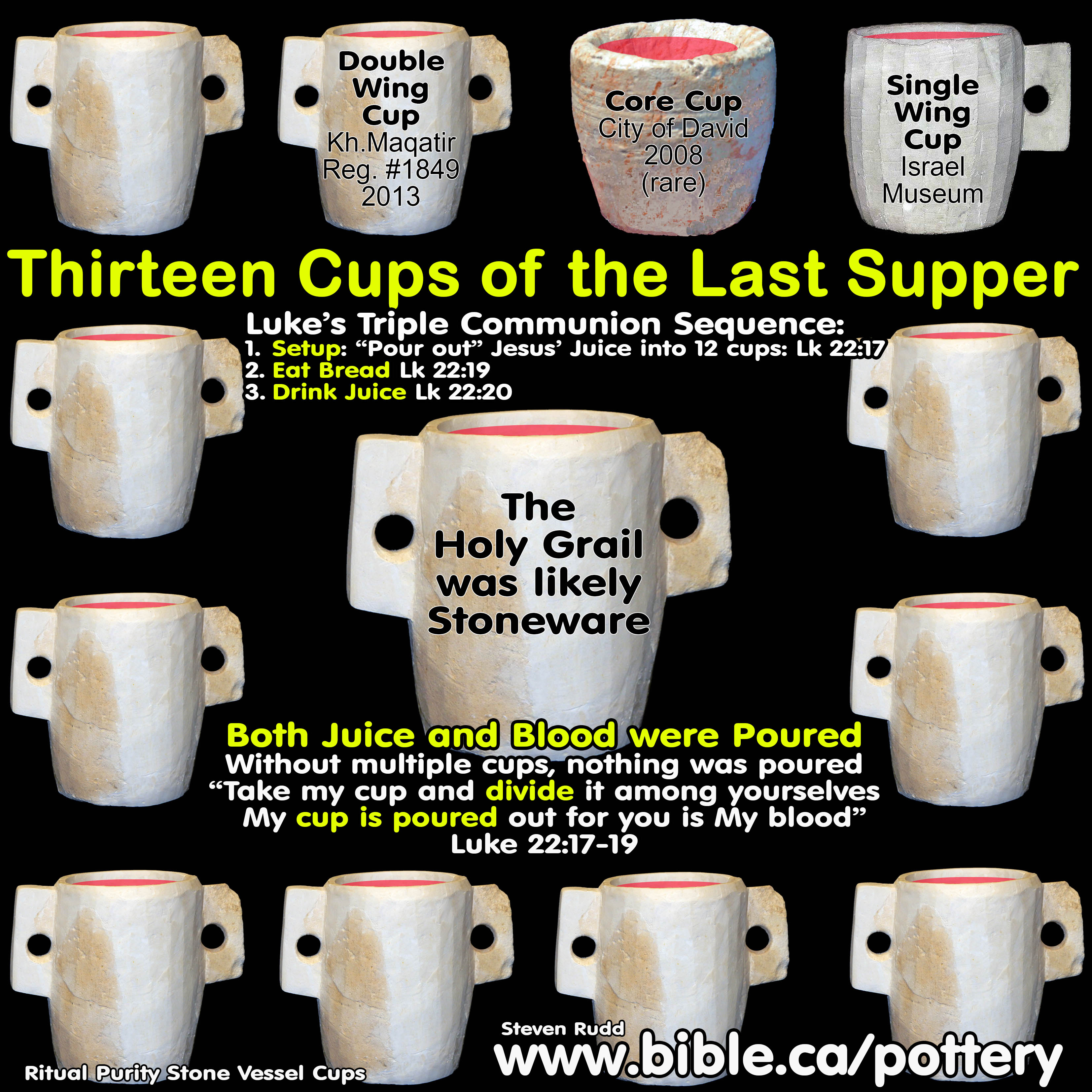
Contrary to Jesus’ advice that we must “live on EVERY word God speaks” (Mt 4:4), they obsess on a single verse that refers metonymically to a single cup (Mt 26:27), they ignore the more graphically detailed Luke 22:17-20, which reveals there were 13 cups. One cuppers are like Baptists who blindly point only to John 3:16 (Mt 26:27) while ignoring Acts 2:38 (Lk 22:17f). A typical first century Passover table would have one cup and one plate for each person, just like table settings today. Luke 22 reveals a three-step process for communion. Jesus started by handing his cup to the apostles (“take this”) and ordering them to “divide” (v17) and “pour out” (v20) some juice from His cup into each of their 12 cups. Step one was the preparation stage before communion began by “dividing” and “pouring out” the juice for a total of 13 cups. The Greek words for “divide” (diamerizō) and “poured out” (ekcheō) cannot refer to the act of drinking because later Jesus then told them to “drink” with a different Greek word (pino). In step two, the Lord’s supper formally begins when Jesus prays and divides (v19) the bread by breaking it into 13 pieces (Greek: klaō) and handing it to the apostles, who likely put it on their 12 plates waiting for the next instruction. So, Jesus began with one juice in one cup and one loaf on one plate but divided the juice into 13 cups and the bread onto 13 dinner plates. Only then does Jesus order them to eat the piece of bread that was on their respective plates. In step three, Jesus told the apostles to “drink” (pino) the juice from their own cup, that He had previously, “poured out” from His cup, and “divided.” Whether they ate and drank sequentially one after the other, or all at the same time is not important. So, we are certain there were 13 communion cups and 13 communion plates at the last supper and binding one cup is based upon an absurd, sloppy and fictional record of scripture.
Literalizing the symbolic:
One cuppers multiply their error when they literalize the physical one cup instead of focusing on the symbolism of the juice, representing blood inside the cup. In a metaphor of unity, the one cup and one bread in 1 Corinthians 10:16–17 mean one in unity, not one in number. In the same way, there is one body/the church, with many individual members (1 Corinthians 12:12). The husband and wife are called “one flesh” (Gen 2:24; Mt 19:5). This metaphoric “one cup and one bread” is shared by all Christians every Sunday, in thousands of different congregations around the world; each with their own communion cups. When one cuppers reject metaphor and literalize the one cup because there is only one covenant and only one body, then there can only be one communion cup to be shared by all local churches on planet earth including Mars. It is just as illogical to demand one cup in a local church as it is to demand one cup on earth because they logically both stand or fall together. If multiple communion cups are wrong in one local church, then it is also wrong for multiple local churches to each have one cup and it is wrong to have more than one communion cup in the world. If there is only one cup, then nobody can have communion until archaeologists find the original “Holy Grail” Jesus used, because it is the only valid cup to use in communion. Once Indiana Jones finds the relic “Holy Grail,” then all believers in every congregation the world over, must drink only from that one cup and no other. One cuppers turn the communion cup into a physical holy sacrament like the Roman Catholics who teach transubstantiation, while rejecting all symbolism. One cuppers, literalize “drink the cup,” and demand only one cup. In the same way, Catholics literalize, “this is my blood” and teach the wine turns into literal blood (transubstantiation), despite Jesus calling it “fruit of the vine” (Mt 26:29) after offering thanks and saying, “this is my blood” in the verse before (v28).
The Cup is not the covenant:
The absurd literalism of one cuppers forces them to say the cup itself was the new covenant based upon Lk 22:20 and 1 Cor 11:25, despite two passages that say the “blood (not the cup) is the New Covenant” (Mt 26:28; Mk 14:24). Two passages say the cup was the covenant and two passages say the blood was the covenant. In fact, neither the cup nor the blood is the covenant. Just as blood was sprinkled on written text of the covenant and the Jews (Heb 9:19), so too the blood of Christ was symbolically sprinkled upon the text of the New Covenant and drank by Christians. The blood of Christ inaugurated the Second Covenant (Law of Christ) and was distinct from the covenant itself, in the same way the cup was distinct from the juice.
Covenant is Law text not a cup:
There is almost universal agreement that there are only two elements of communion: Juice and Bread. Nowhere, in the Bible, is the cup described as a third element of the Lord’s Supper. The literalism of one cuppers forces them to unscripturally fabricate the cup as a third element, which they say represent the New Covenant. Since there is only one covenant, their flawed logic binds only one communion cup. Even worse, we are told that the first covenant was the text of the ten commandments, written on stone, (Ex 34:28; Deut 4:13; 9:9; 1 Kings 8:9+21) not the cup Moses held that contained the blood of animals. Just as the two tablets of stone were never represented as the first covenant apart from the text written on the stone, so too the cup itself was not important, but the blood inside the cup. If the two tables of stone correspond to the cup of Jesus, then we would expect the text of the New Covenant to be written on the cup. Both the first and second covenants were brought into force with blood, not a cup that held the juice or a knife or a spear that drew the blood. (Ex 24:8; Mt 26:28, Heb 9:18; 13:20). The first covenant was the Law of Moses, specially the Ten Commandments, and the New Testament was the Law of Christ, recorded in 27 inspired books. So, Moses’ two tables of stone and the stone cup of Jesus were incidental with no special significance other than the Law was written on stone and the blood was in a cup. It is shockingly naïve for one cuppers to teach a stone represents the covenant, when we are explicitly told that the covenant was text written on stone for the Hebrews or text written on papyrus, not stone, for Christians.
Twisted Typology:
If the cup was centrally important because it represented the covenant distinct from the blood inside the cup, then the cup of Moses would be highlighted and connected in typology as important with the cup of Christ, but no connection is made. The cups of Jesus and Moses were incidental containers to hold the blood with no revealed special significance. Moses used a cup to hold the blood that was sprinkled on the Jews to inaugurate the First Covenant (Exodus 24:5–8) just as Jesus used a cup to hold His blood (grape juice) which Christians drank during communion before the New Covenant was inaugurated. The cups of Moses and Christ did not represent the first and second covenants any more than the knife that drew the blood of animals or the spear that drew the blood of Christ. Fabricating unbiblical meanings to the literal cup that held the juice is as heretical as fabricating new meanings to the centurion’s literal spear that shed the literal blood.
Logistically impossible:
One cup churches tend to be very small, but if they grew to 300 or 3000, like in Jerusalem, there is not enough juice in the cup. A typical individual plastic communion cup, half-filled, holds ½ an ounce. A church of 300 requires a cup that holds 150 ounces or 4.5 litres (US gallon = 130 oz), weighing about 12 pounds with the huge cup. The communion cup for a church of 3000 weighs 120 lbs. and holds 40 gallons of juice.
The first get communion, but the last get nothing:
One cup churches sometimes underestimate the amount of juice or bread needed on Sunday and when they run out of juice, communion ends, and those who remain are prevented from partaking communion. This is because the rigid “One Cup Theology” prevents refilling the cup once the communion service has begun. This occurs when juice volume is underestimated, when individuals “sip” a large amount, or when unexpected visitors show up at the last minute. Even worse, since communion starts at the front and moves to the rear, it is the first time visitors who arrive late and sit at the back or stand outside who are left out, and of course they never return when they are refused communion. Jesus said the “first shall be last and the last shall be first”, but in one cup churches the “first get communion and the last do not get communion”. While rare, this is not acceptable.
Steven Rudd, March 2025
B. Orthodox and Roman Catholic both claim apostolic oral tradition that contradicts each other:

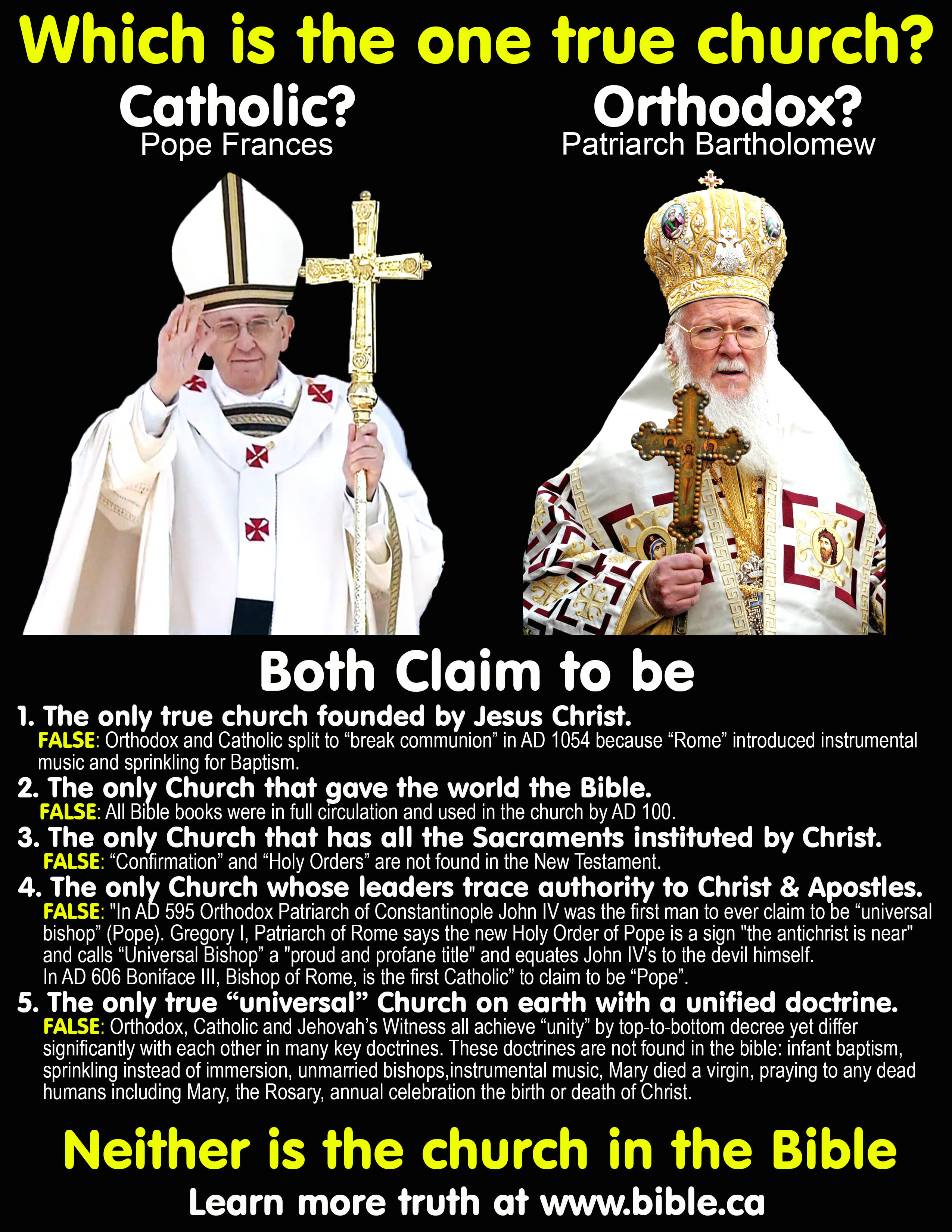
10 HERESIES OF THE GREEK ORTHODOX CHURCH
1. Elevates human tradition equal to scripture.
2. Obeys human tradition when it contradicts scripture.
3. Inclusion of uninspired books into their Bible canon.
4. Only ordained priests can infallibly understand scripture.
5. Unbiblical use of leavened bread for communion.
6. Unbiblical elevation of Mary to being equal to God as the recipient of prayers.
7. Unbiblical Infant baptism.
8. Unbiblical triple baptism.
9. Unbiblical redefinition of saint and priest from all Christians to leaders.
10. Unbiblical organization of the global church.
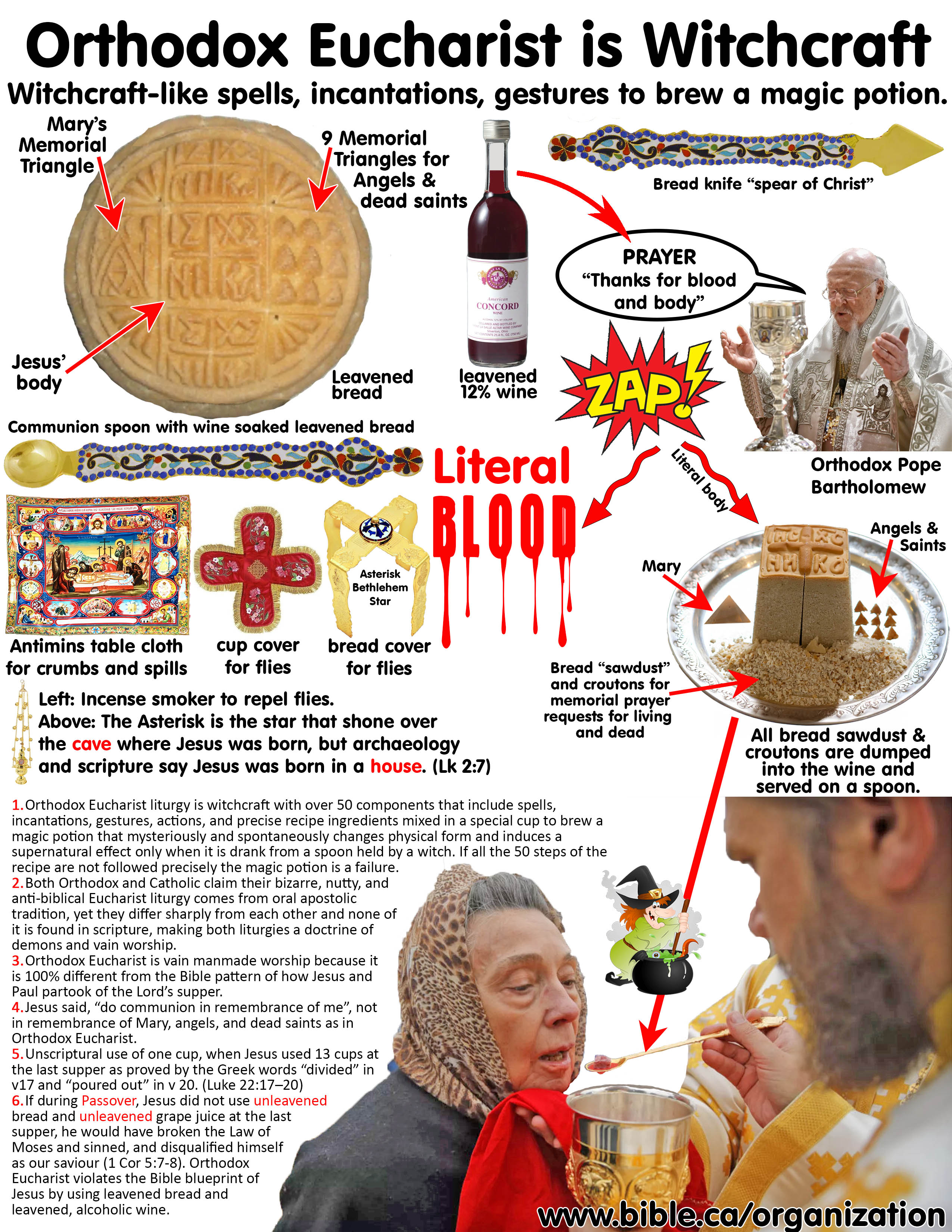
Unbiblical Orthodox Church Communion is Witchcraft
1. Orthodox Eucharist liturgy is witchcraft with over 50 sequential component stages that include spells, incantations, gestures, actions, and precise recipe ingredients mixed in a special cup to brew a magic potion that mysteriously and spontaneously changes physical form and induces a supernatural effect only when it is drank from a spoon held by a witch. If all the 50 steps of the recipe are not followed precisely the magic potion is a failure.
2. Both Orthodox and Catholic claim their bizarre, nutty, and anti-biblical Eucharist liturgy comes from oral apostolic tradition, yet they differ sharply from each other and none of it is found in scripture, making both liturgies a doctrine of demons and vain worship.
3. Orthodox Eucharist is vain manmade worship because it is 100% different from the Bible pattern of how Jesus and Paul partook of the Lord’s supper.
4. Jesus said, “do communion in remembrance of me”, not in remembrance of Mary, angels, and dead saints as in Orthodox Eucharist. A memorial pinch of bread for each living and dead person for whom prayer has been requested is put on the plate, yet communion bread is not a symbol of supplication prayer for living Christians but of the body of Christ. We do not pray for the dead because they have been judged, are in the hands of God, and we do not know their needs in the spirit world. Local dead members are memorialized through communion for 40 days.
5. Unscriptural use of one cup, when Jesus used 13 cups at the last supper as proved by the Greek words “divided” in v17 and “poured out” in v 20 (Luke 22:17–20). The “holy grail” (communion cup) of Jesus is widely believed to be a Jewish ritual purity stone cup, certainly never gold or silver as used in the Orthodox and Catholic churches.
6. If during Passover, Jesus did not use unleavened bread and unleavened grape juice at the last supper, he would have broken the Law of Moses and sinned and disqualified himself as our saviour (1 Cor 5:7-8). Orthodox Eucharist violates the Bible blueprint of Jesus by using leavened bread and leavened, alcoholic wine. Jesus likely used “Passim wine” made from soaking grapes in water and squeezing out the juice in a press. Without exception, the Greek word used in the New Testament for communion juice is “fruit of the vine”, not “oinos” (wine).
7. In Matthew 26:26-30, Jesus’ liturgy served bread and juice separately and sequentially in two steps, but the nutty Orthodox liturgy combines the bread and wine together in a cup and consumed in a single step on a spoon! You have to be on cheap psychedelic drugs to even think something up so different from what Jesus did! Leavened bread sawdust and croutons are dropped into wine then eaten from a communal spoon. Archeologically, spoons were never used by Jesus or anyone during meals. Jesus was accused of eating with unwashed hands not cutlery.
8. A “portable altar” (AKA, a tablecloth) made of cloth called “Antimins” (“instead of a altar”) has body parts of the local dead patron saint sewn into it, to catch any holy breadcrumbs or juice and prevent the horror of it touching the unholy table. Whereas Catholics mix martyr bones into their marble altar tops, Orthodox sew them into a tablecloth. So much for unified oral apostolic tradition!
9. The “Asterisk Star” is a metal support of another veil that covers the bread and represents the star of Bethlehem shining over the cave where Jesus was born, but archeology and scripturally, Jesus that was born on the main floor of a house, not a cave or an inn. (Luke 2:7)
10. A “cup veil cloth” and incense “censor” are used primarily to keep insects away, but if a bug drops into the wine is believed to have communed with Christ and the priest eats it alive or puts it on the plate if it has died.
11. In a complex sequence of incantations, actions, and gestures, the priest cuts the one loaf into four sections: First, one square of bread representing Jesus. Second, one large triangle of bread representing Mary. At this point, the priest then reads and misapplies Psalm 45:9 to Mary, as the MOTHER of Jesus, when in context it is the WIFE of Solomon. Third, nine small triangles of bread representing the spirit world (angels and dead saints). Fourth, the priest rasps the bread with the “spear of Christ” to create a pile of bread sawdust. Then the priest drops one chunk of bread into the cup and drinks three times. Finally, all the leavened bread on the plate is dumped into the one communion cup of leavened, sweet, alcoholic wine mixed with water, ready for consumption by the 2nd rank “laity” Christians who leave their lowly pews and line up one by one at the high and holy altar before the priest to be spoon fed like children. If any of the witch’s brew is left over when the service over, the priest is required to drink it all himself in the epitome of unbiblical sacramentalism gone to seed. The demons rejoice!
12. Abstinence from sex and food, and incantational prayers are mandatory before communion is offered on a communal spoon with a wine-soaked crouton or bread “sawdust” porridge. Arms must be crossed during communion, after which you must kiss (worship) the communion cup. If a drop of wine falls on a recipient’s clothing, the priest must physically cut it out of the cloth. If the priest runs out of wine, communion ends, and the remainder are sent home without communion.
13. Contrary to science, priests teach the wine/bread “magic brew” miraculously kills diseases commonly transmitted by sharing one spoon. Science says the risk is real but low with a spoon and zero using multiple cups like Jesus and the apostles did in scripture.
Both Catholics and Orthodox pray to Mary