Trinity and the Spirit world
|
|
Bible Blueprint Decalogue Curriculum 150 pages, 8.5 x 11, full color or digital |
Part 1: Conscious life after death and eternal conscious torment in Hell
Part 2: Biblical Trinity
The Spirit world vs. Neo-Sadduceeism: Acts 23:8
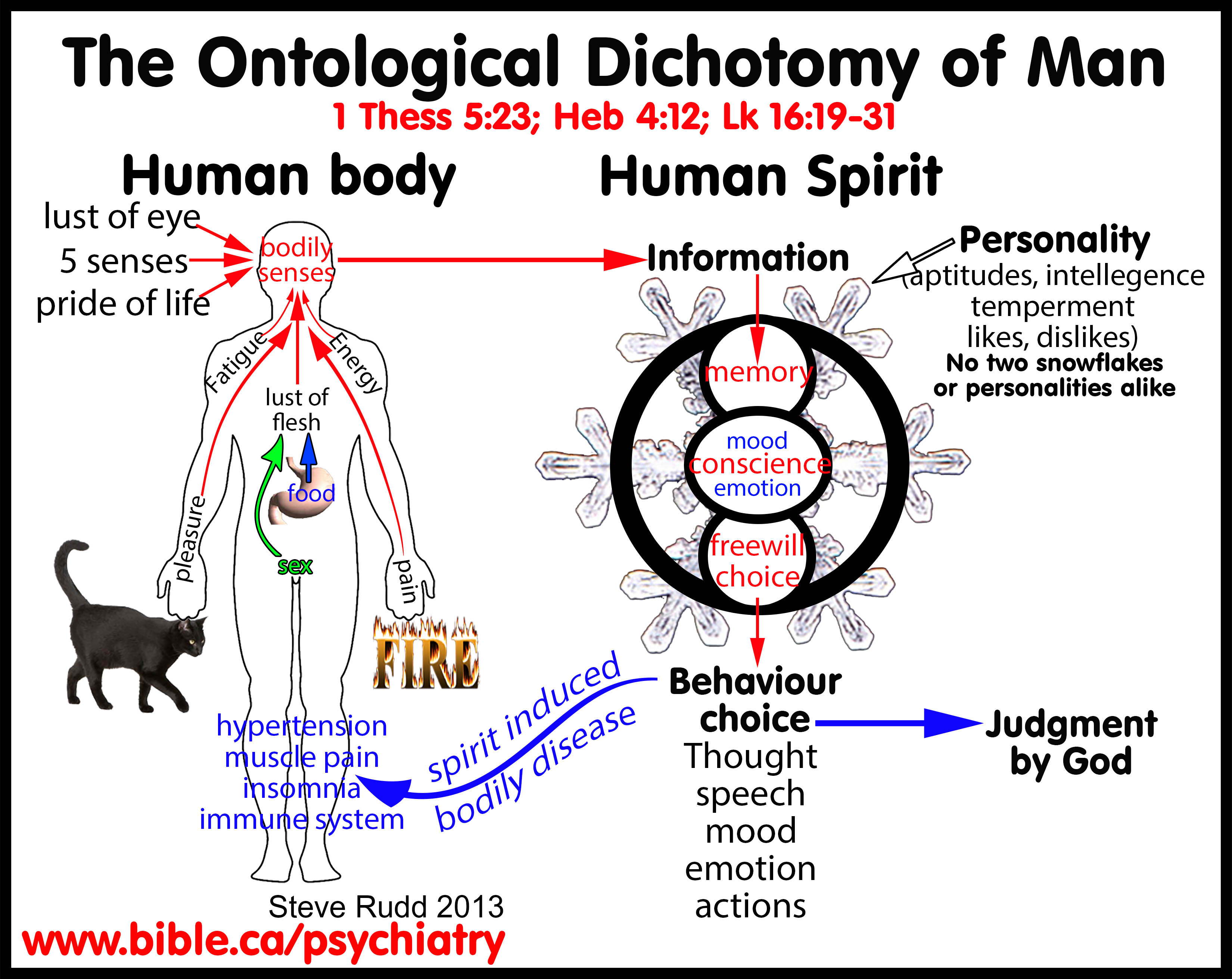
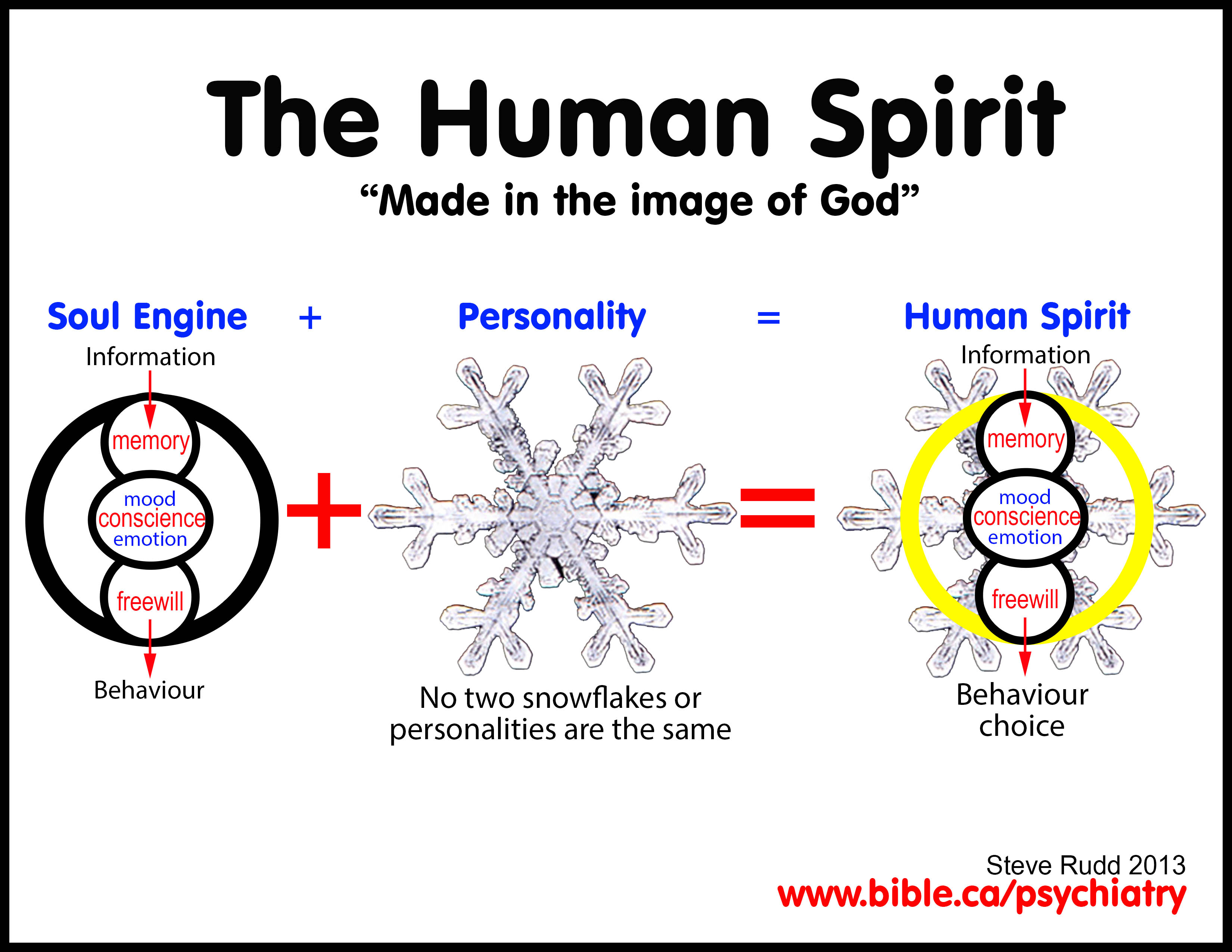
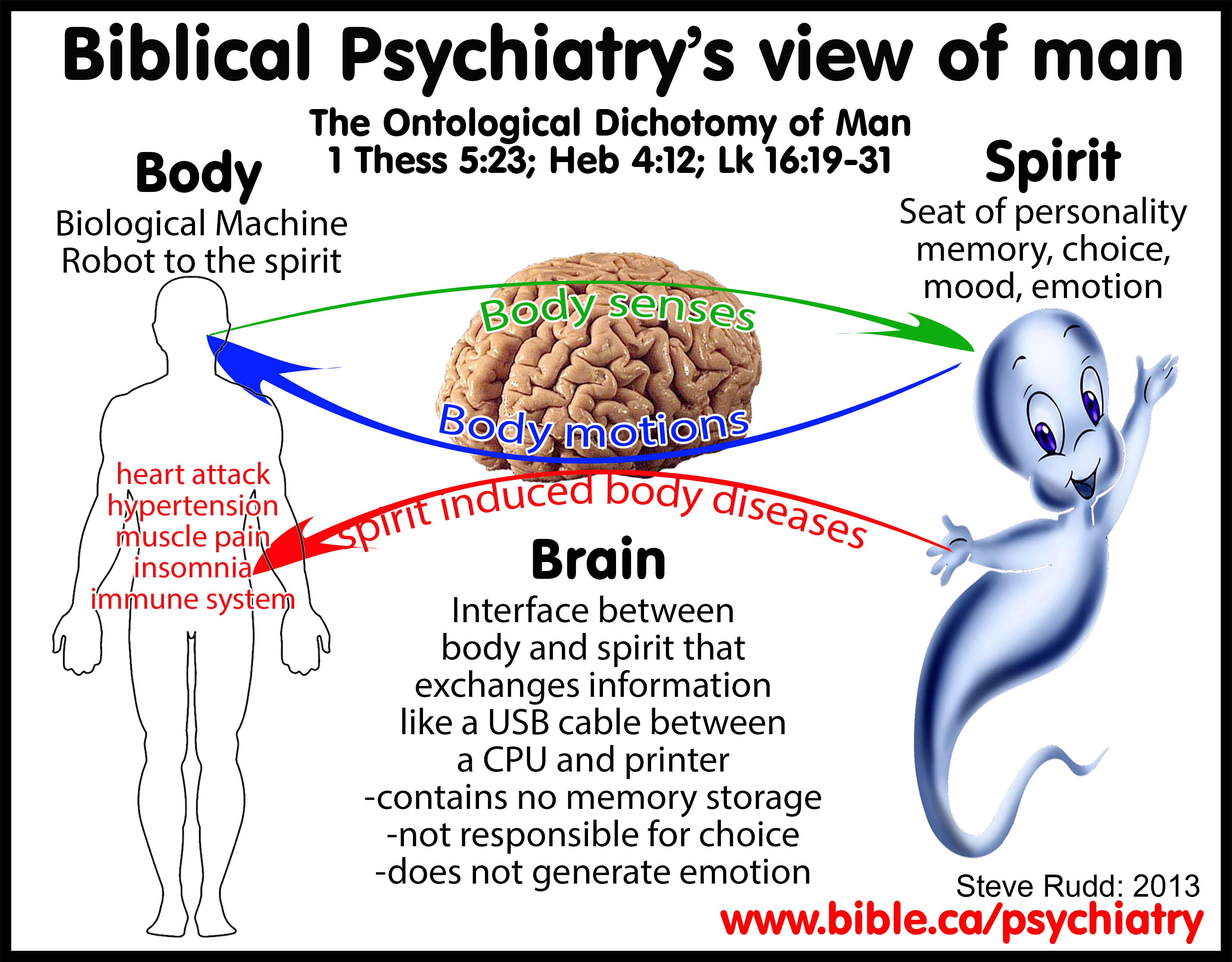
I. The Trichotomous nature of man: Body, Soul, Spirit
"Now may the God of peace Himself sanctify you entirely; and may your spirit and soul and body be preserved complete, without blame at the coming of our Lord Jesus Christ." (1 Thessalonians 5:23)

|
God, Man, and Animals have spirits and souls |
||
|
|
spirit/ruwach |
soul/nephesh |
|
God |
Isa 42:1 |
Isa 42:1; Isa 1 :14; Lev 26:11; Jer 5:9,29;9:9; Zec 11:8; Job 23:13 |
|
Man |
Gen 2:7; 1 Thess 5:23 |
Gen 2:7; 1 Thess 5:23 |
|
Animals |
Gen 6:17; Job 12:7–10 |
Gen 1:20–21,24,30; 9:9-10; Job 12:7–10 |
|
Plants |
Scripture is silent on whether plants have spirits or souls. However, they do have DNA, are living cells, and breath once every 24 hours. For 12 hours plants inhale oxygen and exhale carbon dioxide, then for 12 hours they inhale carbon dioxide and exhale oxygen. Humans, breath 14 times per minute. Plants breath 1 time in 24 hours. It might be inferred that plants also have spirits and souls. |
|
A. Five irrefutable passages that teach conscious life after death:
|
|
TOPIC:
|

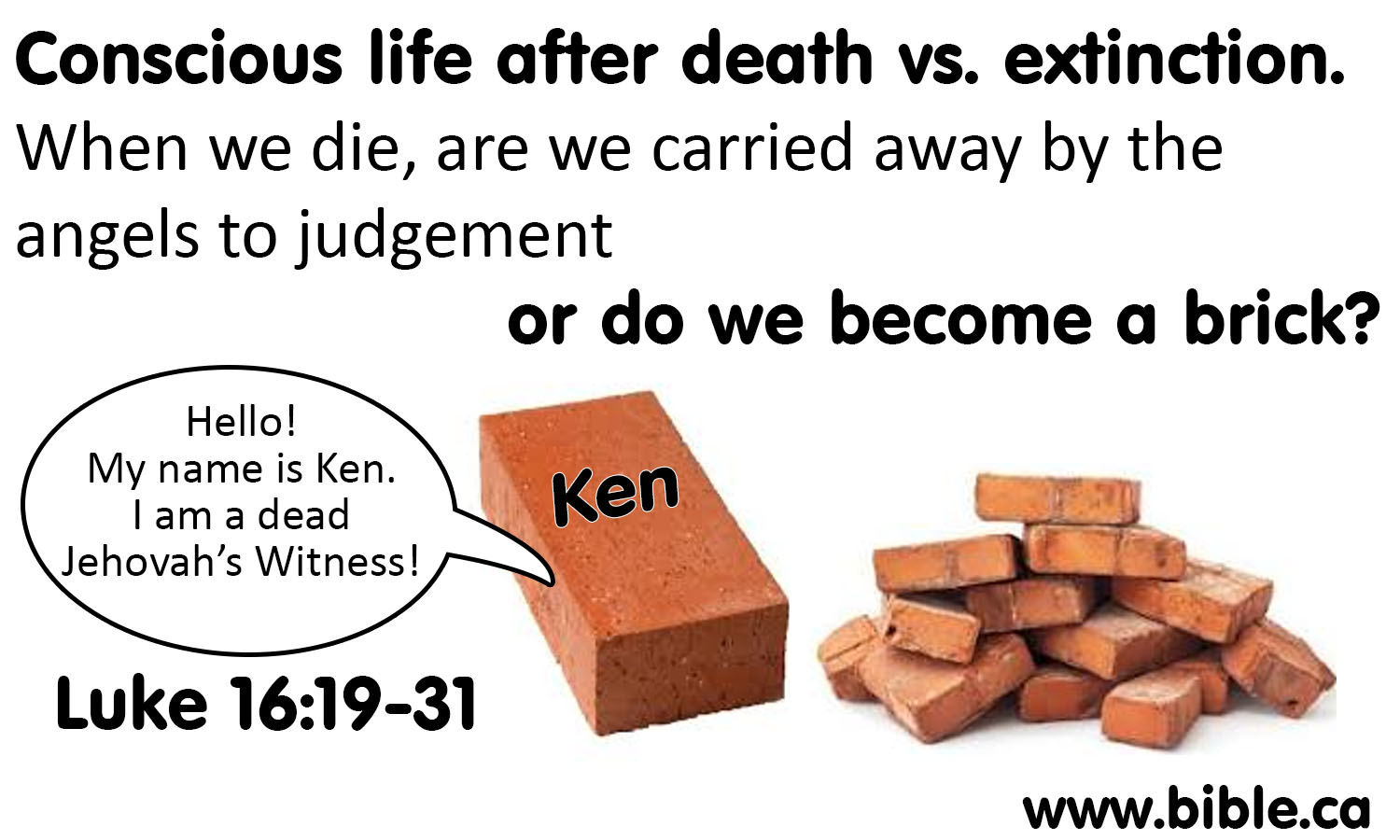
1. Luke 16:19-31: Why would Jesus use pagan false doctrine? The suggestion that Jesus used Jewish Fable and Pagan false doctrine in Luke 16 is inconceivable! Arians, who believe Jesus sided with the Sadducean view of extinction, simply cannot explain Luke 16. They are forced into falsely accusing Jesus of promoting what He knew was pagan false doctrine! The only reasonable conclusion is that conscious life after death IS NOT pagan false doctrine, but the very truth Jesus chose to convey by simply reading Luke 16! Paul condemned using Jewish myths and fables in 1 Tim. 1:4; 4:7; 2 Tim. 4:4; Tit. 1:14; 2 Pet. 1:16! Rather than call themselves false teachers, Arians call Jesus the false teacher! IRREFUTABLE QUESTION: Get your opponent to state that the doctrine of conscious life after death is pagan false doctrine whose origin is Egyptian mythology, Hellenism, and Platonism. Ask, “Why would Jesus use pagan false doctrine in the story of the rich man and Lazarus in Luke 16:21?”
2. Deut 34:5-6: IRREFUTABLE QUESTION: Get your opponent to voice that he believes the phrase, “Gathered to his people” means their dead bodies were buried in a common family cemetery. Abraham (Gen 25:8), Ishmael (Gen 25:17), Isaac (Gen 35:29), Jacob (Gen 49:29), Aaron (Deut 32:50), and Moses (Numbers 27:13; 31:2). The truth is that we are gathered in the spirit world to our families, and the term never means a common physical family graveyard. Ask, “How were Aaron and Moses “gathered to their people” if Aaron was buried alone at the summit of Mt. Hor in Edom, and Moses was buried alone in a secret location in Moab?”
3. Lk 20:37-38: Jesus proved resurrection, by proving the dead are living, conscious, departed spirits. Jesus refuted two false doctrines (extinction at death and no resurrection) by proving that the dead are conscious! If "He is the God of the living" means "living in God's memory, but literally non-existent and extinct", then the Sadducees would agree with this and say that Jesus’ argument doesn't have any bearing on the resurrection! The truth is, Jesus corrected their FALSE VIEW that the dead are extinct, by stating "God is the God of the living, for all live to Him" means, “If the dead are conscious, there is also a resurrection.” IRREFUTABLE QUESTION: Get your opponent to agree that Jesus is talking to Sadducees who did not believe in “spirit”, or conscious life after death, or resurrection and that Jesus was asked to prove there is a resurrection. Ask, “How did Jesus’ quote that “God is not the God of the death, but the living” prove there is a resurrection?”
4. Eccl 9:3-10: The conscious dead in the spirit have no knowledge of life on earth and cannot hear prayers.
a. “there is one fate for all men” means that from a human perspective... under the sun ...all men and animals physically die: Eccl 3:19-20 IRREFUTABLE QUESTION: Ask, “In Eccl 3:19-20, does the phrase “there is one fate for all men” mean that spiritually all men go to either heaven or hell, or from a physical perspective, “under the sun”, all men and animals physically die? Did Jesus lie when he said there are two fates for men, heaven and hell?”
b. "nor have they any longer a reward" IRREFUTABLE QUESTION: Ask, “Does the phrase “the dead no longer have a reward” mean all the dead lose their spiritual eternal reward or the physical reward from their labours accumulated through hard work while alive on earth, “under the sun”? Ask, “Did Jesus lie when he said we have a reward waiting for us when we dies?” Hint: Eccl 9:7-10; 2:18; Ps 146:4 “earthly thoughts/plans come to an end”.
c. "their memory is forgotten" IRREFUTABLE QUESTION: Ask, “Does the phrase "their memory is forgotten" mean all they lose all the memories in their brain, or from a human perspective, “under the sun”, the dead are forgotten by the living within a few generations?” Hint: Eccl 1:11; 2:16; 8:10
d. "the dead know nothing" IRREFUTABLE QUESTION: Ask, “Does the phrase, "the dead know nothing" mean the dead turn into unconscious bricks or that that the departed spirits cannot see or communicate with those they left behind who continue “living under the sun” and praying to Mary, ghosts, or hauntings are impossible?” Hint: Job 14:20-21: “You forever overpower him and he departs (dies); You change his appearance and send him away. “His sons achieve honor, but he does not know it; Or they become insignificant, but he does not perceive it. “But his body pains him, and he mourns only for himself.” (Job 14:20–22)
|
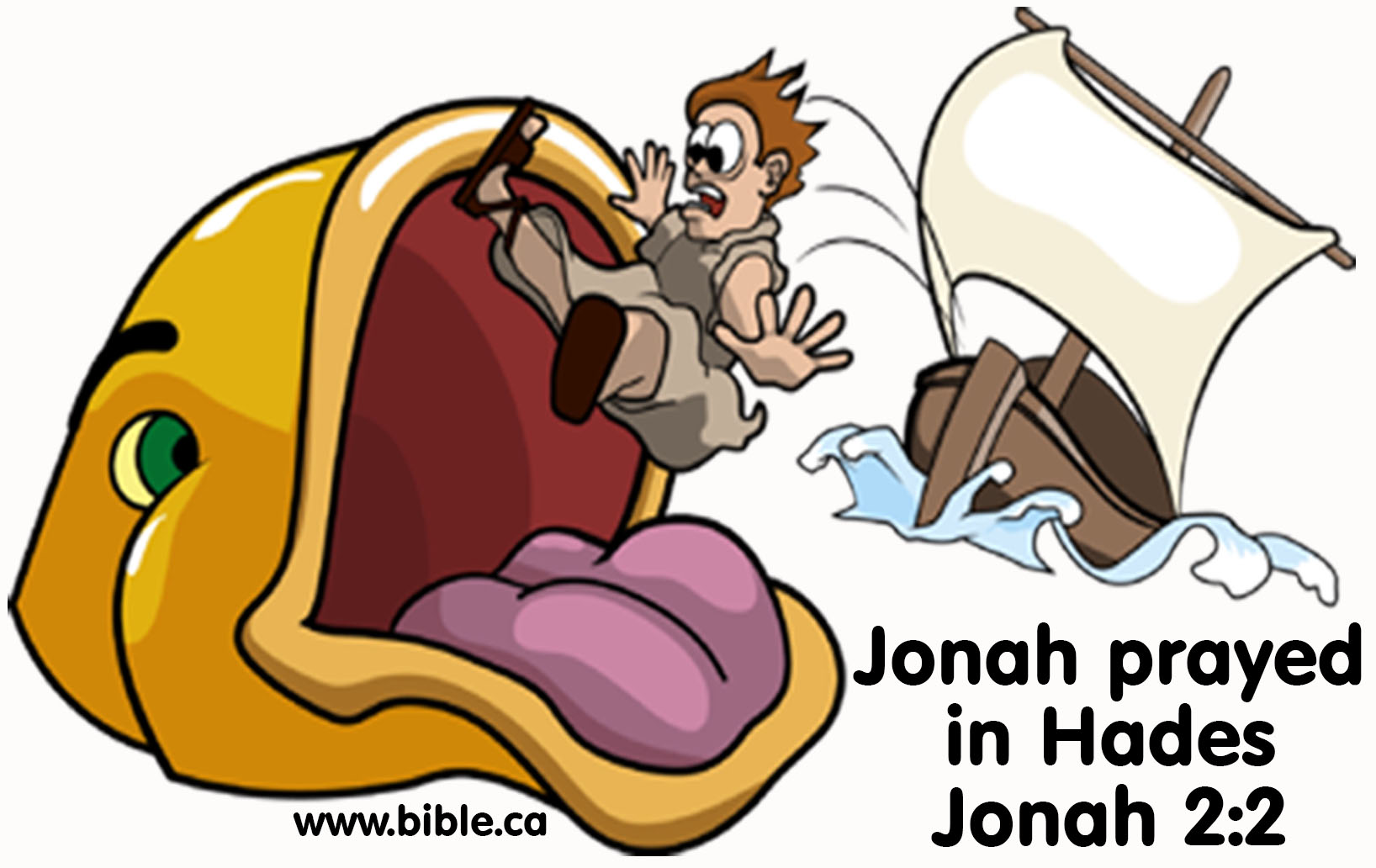
B. Five video Bible scenes of actual life after death: 1. Isa 14:9-11 The dead wait in the spirit world for Nebuchadnezzar, who killed them, to join them. 2. 1 Sam 28:1-20 Samuel talks to Saul. 3. Luke 16:19-31 Three dead people have a conversion: Rich man, Lazarus, Abraham. 4. Jonah 2:2 Jonah was conscious and prayed from Sheol (the pit) as a type of Christ. 5. Rev 6:9-11 Martyred Christians ask God for justice and are told to wait and sleep. |
|
C. Death is a departure from physical earth into the spirit world, not extinction:
1. "You forever overpower him and he departs; You change his appearance and send him away." (Job 14:20)
2. "It came about as her soul was departing, for she died" Gen 35:18
3. "The time of departure has come" 2 Tim 4:6
4. "Lay aside my bodily dwelling... my departure" 2 Pet 1:13ff
5. "Poor man died and was carried away by angels" Lk 16:19-31
6. "To die and be with Christ much better than living in flesh" Phil 1:22
D. Death means separation between two things not extinction:
|
Physical death |
Eccl 12:7 |
body |
S |
soul |
|
spiritual death |
Isa 59:1-2 |
man |
God |
|
|
second death |
Rev 21:8; 22:14-15 |
man |
God |
|
|
dead to sin |
Rom 6:2,11; Heb 7:26 |
Christians |
Sin |
|
|
dead to law |
Rom 7:4 |
Christians |
law |
|
|
marriage dissolved by death |
1 Cor 7:39 |
man |
woman |
E. Death is likened to sleep, not extinction:
1. "And many of those who sleep in the dust of the ground will awake, these to everlasting life, but the others to disgrace and everlasting contempt. Dan 12:2
2. "Our friend Lazarus has fallen asleep; but I go, that I may awaken him out of sleep." The disciplessaid, "Lord, if he has fallen asleep, he will recover." Now Jesus had spoken of his death, but they thought that He was speaking of literal sleep. Then Jesus said to them plainly, "Lazarus is dead". Jn 11:11-14
3. “I will sleep the sleep of death” Ps 13:3
4. Ps 90:5 “Thou hast swept them away like a flood, they fall asleep”
5. Mt 9:24 “He began to say, "the girl has not died, but is asleep." And they began laughing at Him.”
6. Mt 27:52 “tombs were opened; and many bodies of the saints who had fallen asleep were raised”
7. Mk 5:39; Lk 8:52 “The child has not died, but is asleep”
8. Ac 7:60 "Lord, do not hold this sin against them!" And having said this, Stephen fell asleep.”
9. Ac 13:36 "For David ... fell asleep, and was laid among his fathers, and underwent decay”
10. 1 Co 15:6,18,20,51 “some have fallen asleep ... those who are asleep, we shall not all sleep”
11. 1 Th 4:13-15 “those who are asleep ... have fallen asleep in Jesus”
12. 2 Pe 3:4 “ever since the fathers fell asleep”
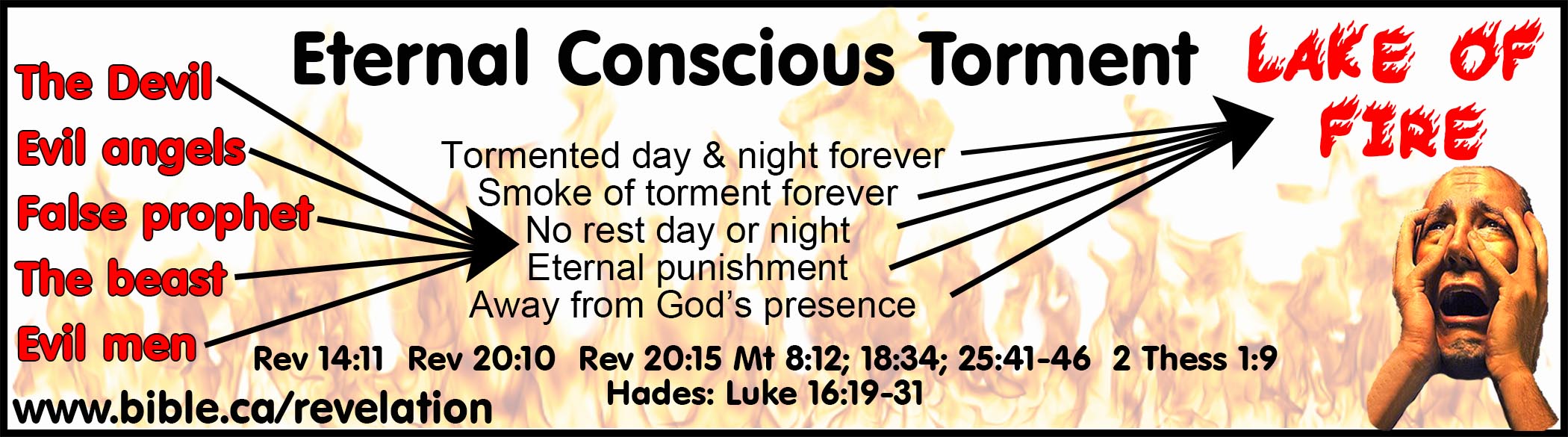
II. Hell is eternal conscious torment:
III. Heaven is in the presence of the Father:

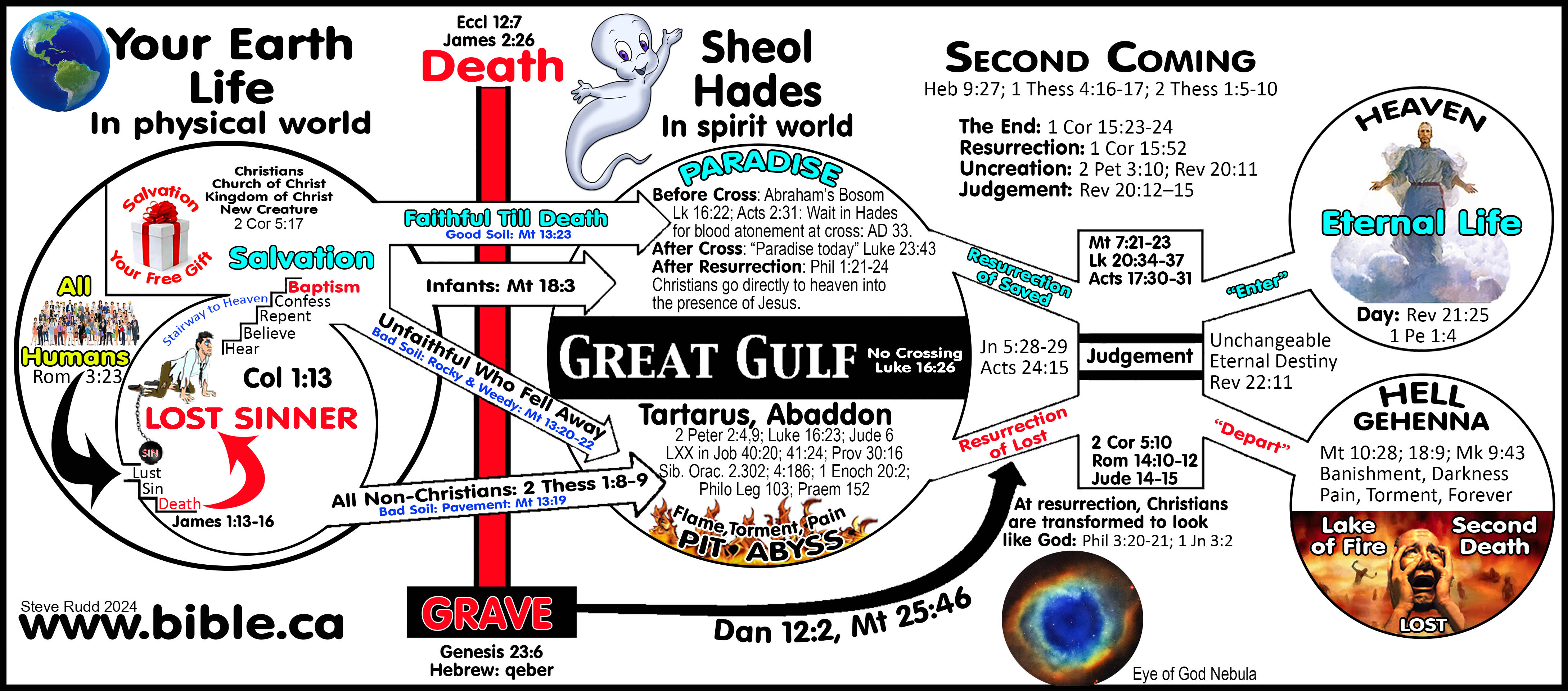
IV. Spiritual destiny of all men:
“it is appointed for man to die once then comes judgement” Hebrews 9:27.
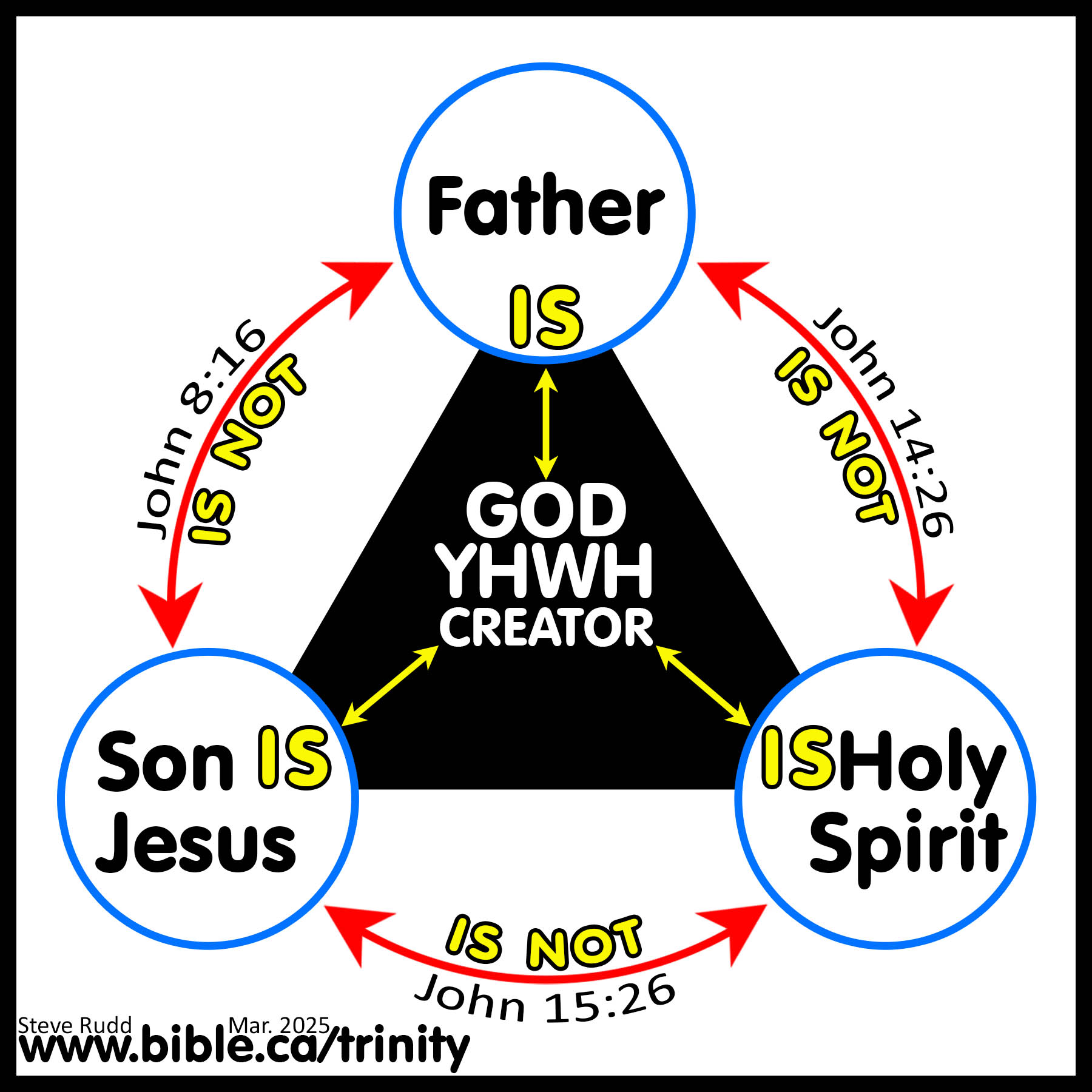
Biblical Trinity
Jesus is creator not a creature, the Holy Spirit is a person not a thing.
Introduction: To prove trinity, you only need to prove either that Jesus is not a creature or that the Holy Spirit is a person.
|
Four variables determine four different views of the Trinity God is one in unity: John 10:30; 17:20-23 |
||||
|
|
Deity of Christ Jn 1:1; 20:28 |
Distinction Gen 1:26; Lk 3:22 |
Personality of Holy Spirit Jn 16:13; Mt 28:19 |
Submission of Jesus 1 Cor 11:3; 15:28 |
|
Biblical Trinity |
|
|
|
|
|
Catholic Trinity |
|
|
|
|
|
Arianism (JW’s) |
|
|
|
|
|
Modalism (UPCI) |
|
|
|
|


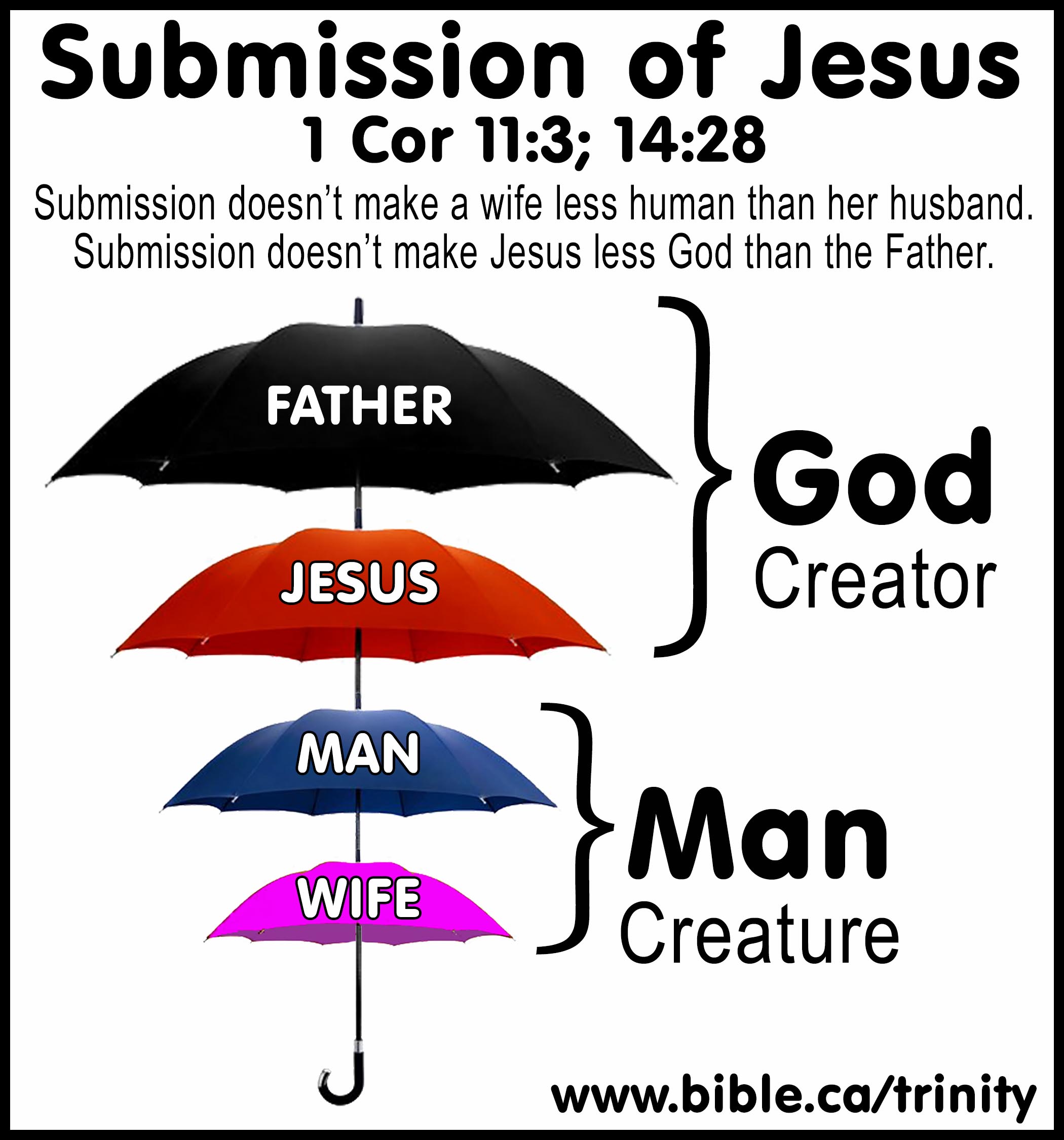
I. Nature of God:
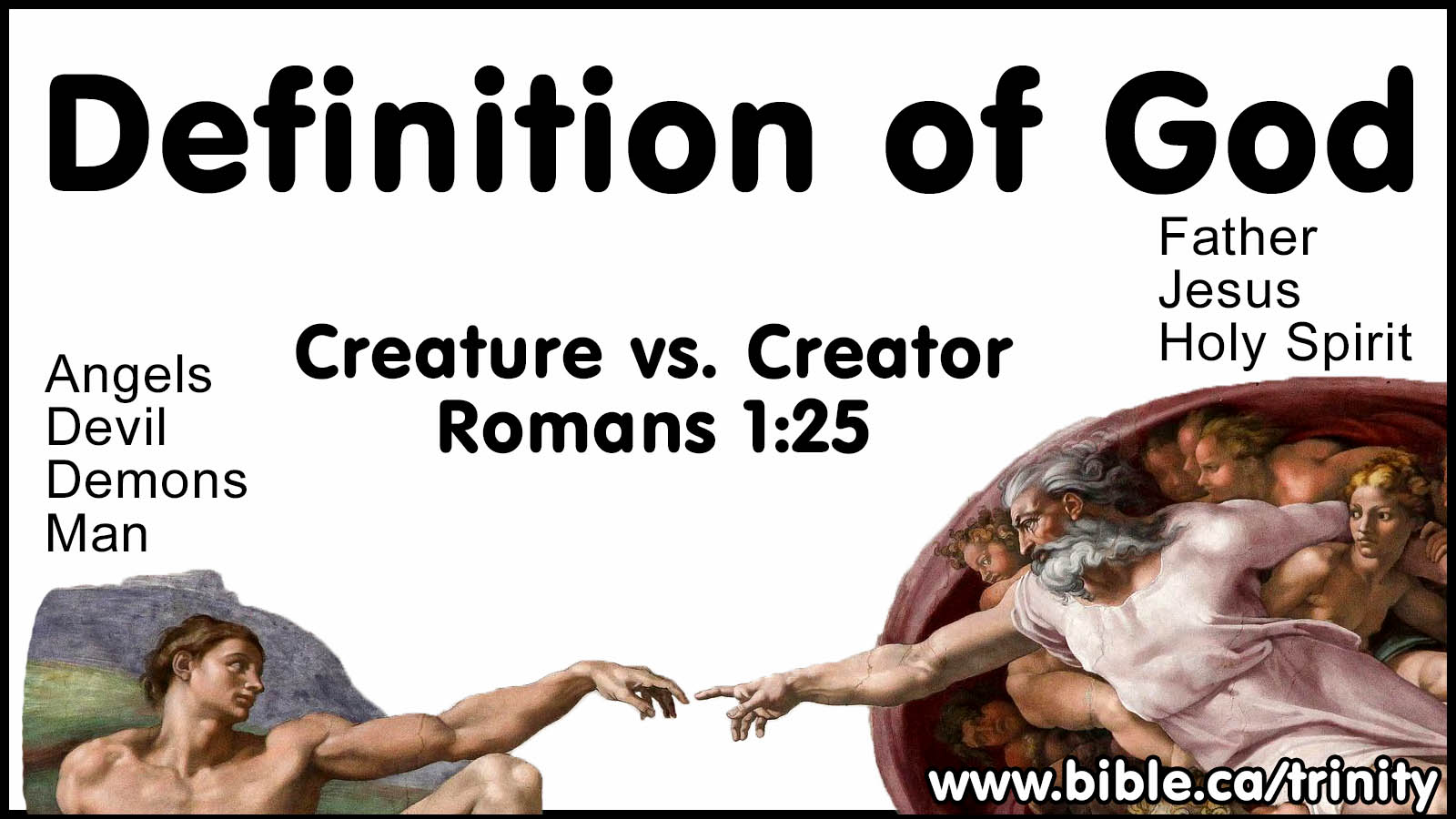
1. Unchangeable Qualities of God: Creator, not creature
a. God is not a creature and never had a beginning point, being eternal: Deut 33:27; Isa 9:6; 1 Tim 1:17; Isa 44:6
b. Jesus is called the creator in Jn 1:3; Col 1:16; Heb 1:10-12
c. Rom 1:25 pagans are condemned because they "worshiped and served the creature rather than the Creator". This proves Jesus is not a creature, for Jehovah's Witnesses have Jesus on both sides being a creature himself, as well as being the creator of man. Rom 1:25 refutes this contradictory false doctrine that Jesus is a creature.
d. The Father, Son and Holy Spirit share the quality of eternal pre-existence with each other equally.
e. No angel, devil, demon or man have ever or will ever possess this quality. It is absolutely unique to God.
2. Qualities unique of God:
a. God is everywhere (omnipresent): Mk 5:10; Jude 6; Rev 20:1-3; 1 Ki 8:27; 2 Chron 2:6; 6:18; Isa 66:1; Acts 7:49; 17:27-28; Ps 139:7-13
b. God is all knowing (omniscient): Ps 139:1-6; Job 42:2; Acts 2:23; 1 Tim 1:17
c. God is all powerful (omnipotent): Gen 17:1; 35:11; Rom 13:1; 1 Tim 6:15; Rev 19:6
3. Qualities that God shares with righteous angels and men after resurrection:
a. God is a Spirit, without flesh and bones: Luke 24:39; John 4:24; Matthew 16:17
b. God is invisible: Ex 33:20; John 1:18; 1 John 4:12; 1 Tim 6:16; Col 1:15; 1 Tim 1:17; Heb 11:27
c. God is immutable (unchangeable) in his nature: Mal 3:6; But God can change his mind: Jonah 3:10; Gen 6:6
d. God is a person: Rom 9:19; Isa 1:18; Rom 11:33-34; Gen 1:27; Ps 18:19; Ps 103:13; Prov 6:16; Ex 20:5; Ps 103:8; Deut 4:25; Gen 6:6; Ps 103:1
e. Moral attributes of love: 1 Jn 4:8,16; Light (truth): 1 Jn 1:5; Jn 17:17; holiness: 1 Pet 1:16; mercy: Ps 103:8; gentleness: Ps 18:35; righteousness: Ps 129:4; goodness: Rom 2:4; perfection: Mt 5:48; justice: Isa 45:21; faithfulness: 1 Cor 10:13; grace: Ps 103:8
II. Deity of Jesus:
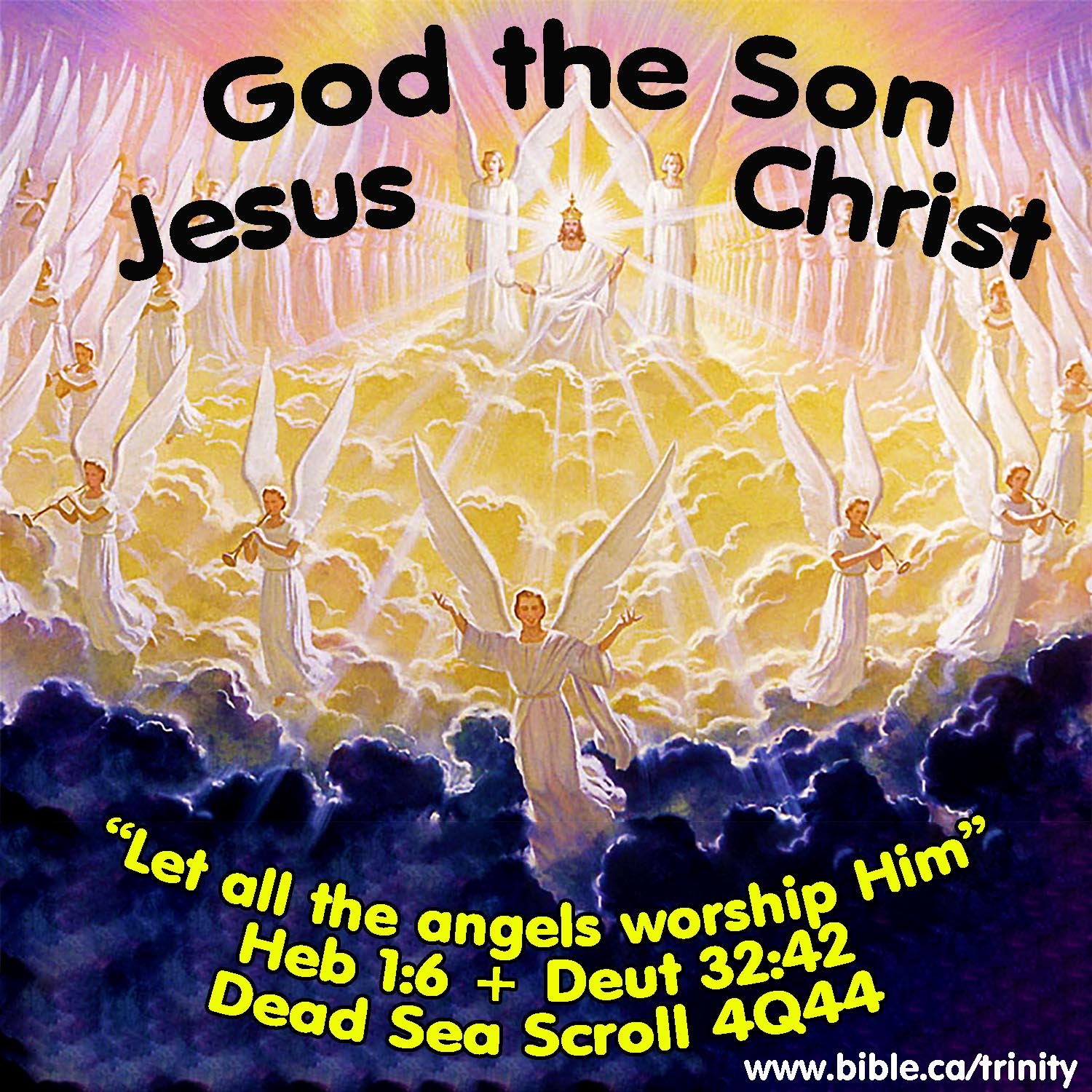
A. God the Son:
1. Jesus is creator: Jn 1:3,10; 1 Cor 8:6; Col 1:16; Heb 1:8-12
2. Jesus is worshipped as God: Rev 5:12-14 Mt 2:2,8; 11; 14:33; 28:9, 17; Luke 24:52; John 9:38; Rom 1:25; Heb 1:6 + Deut 32:43 LXX + Dead Sea Scroll 4Q44 + Justin Martyr, Dialogue 130
3. We pray to Jesus as God:
a. Command: Jn 14:14; 1 Cor 1:2; Eph 5:19; Acts 8:22
b. Example: Rev 22:20, 2 Cor 12:7-9, Acts 7; Acts 8:24
c. Necessary inference: 1 Jn 5:11-15, Acts 1:24; Heb 7:25
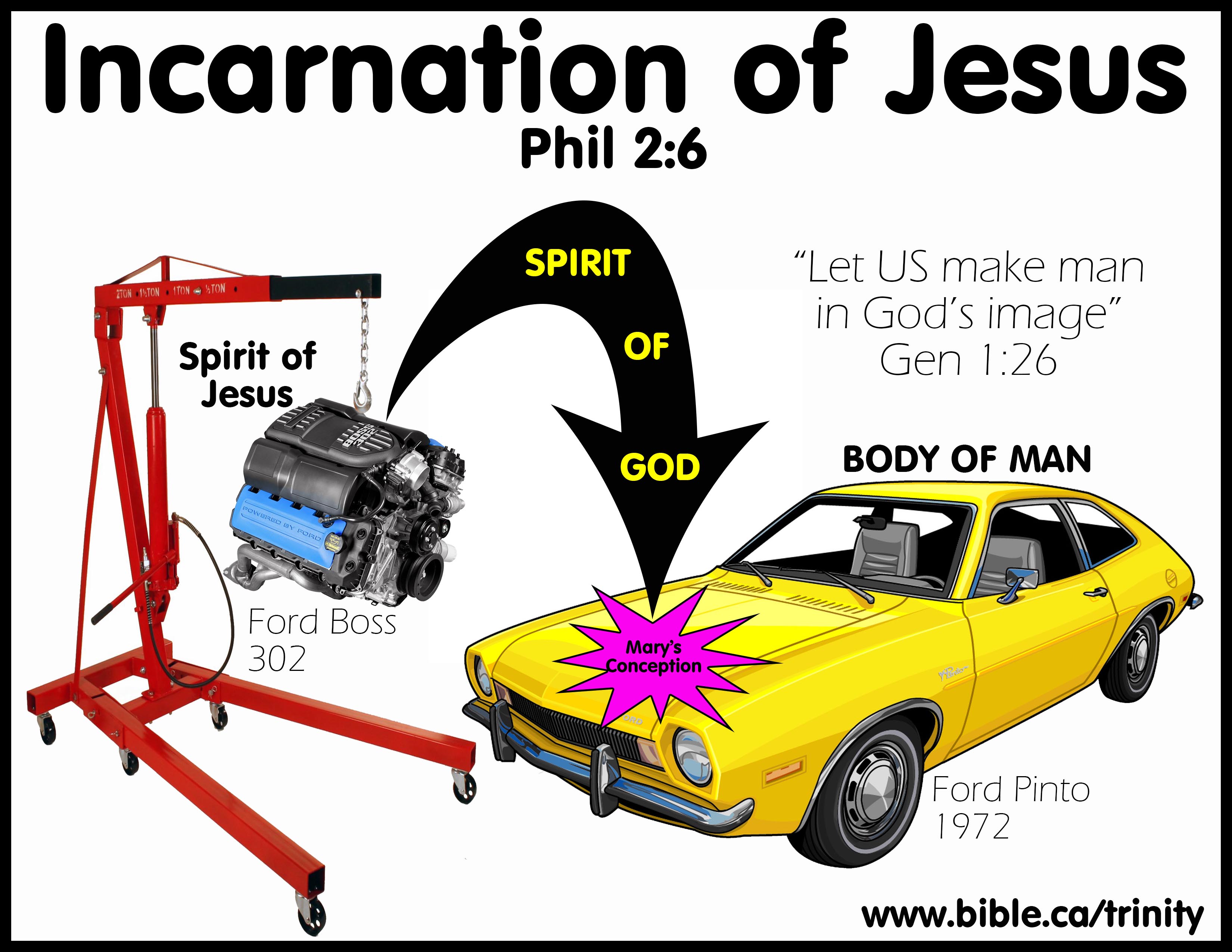
B. Incarnation of Jesus: God became man, creator became creature
1. “God forbids graven images because He made man in His image and allows no other on Earth.” Caleb Stephens
2. 34 Pre-incarnation passages: Micah 5:2; Mt 1:23; 20:28; 1 Jn 2:13; 1 Pe 1:20; 1 Cor 10:3-4; Col 1:15-17; Jn 1:1-2,14-19,29; Jn 3:13,31,34; Jn 6:41,46,62; Jn 7:28-29; Jn 8:23,42,54 ; Jn 13:3; Jn 16:28; Jn 17:5,24; Acts 2:25; 1 Cor 15:45–49; 2 Cor 8:9; Phil 2:6 ; 1 Tim 3:16 ; Heb 1:9; 2:14-18
3. 20 Incarnation trilogy passages that contain all three elements, before incarnation, earth live, after ascension: Jn 16:28; Jn 8:22-23; Rev 1:17-18; Titus 2:13; Phil 2:6; 2 Cor 8:9; Eph 4:8-10; Jn 16:5; Jn 6:60-62; Jn 8:14; Micah 5:2; Heb 1:1-5; Jn 3:13-15;Heb 2:9; Jn 1:1-5,14; 1 John 1:1-2; 1 Tim 3:16; Jn 17:5; Acts 2:25-33
C. Five-minute beginners guide to the Incarnation of Jesus and our hope in heaven:
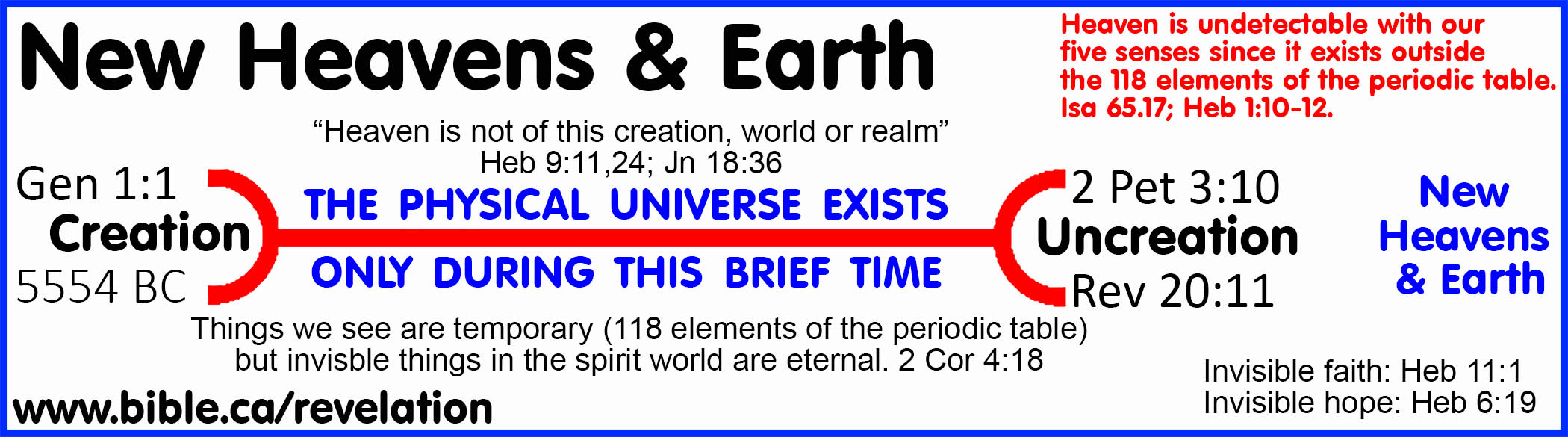
Jesus created the heavens and the earth in Genesis 1, in harmony with the Father’s will (Jn 1:3,10; 1 Cor 8:6; Col 1:16; Heb 1:8-12). Before His incarnation Jesus existed in heaven in the form of God, possessing the very authority, power and appearance of God. In Phil 2:6, the “form of God” is the outward appearance that mirrors and indicates an inward moral reality that Jesus was the Divine creator: Eternally pre-existent uncreated God. Before the incarnation, the “form appearance” seen on the outside, was consistent with “image morality” on the inside. Jesus was equal with God not merely because he had same outward appearance as the Father, being in the “form of God” but because in character, judgment and choices, he was in perfect unity with God (Heb 1:3; 2 Cor 4:4; Col 1:15). While Jesus was in a human body he could say, “my character and moral choices are identical to the conduct and behavour of the Father” John 14:8-9. It is important to differentiate between the “outward-form of God” that Jesus gave up at the incarnation in Phil 2:6 and the inward “character-image of God” that Jesus retained as a man. Jesus consented to the eternal plan of the Father who placed Jesus’ divine Spirit into the body of a man in Mary’s womb. God created man in His own image (Gen 1:26-27), where man’s human spirit is ontologically and “mechanically” identical to the divine Spirit of God. Making man in God’s image facilitated a perfect interchangeability between the divine Spirit of God and the created human body and conversely, the created human spirit with the divine body of God. Think of the incarnation as putting an after-market new engine into an old car body. If both the engine and car body are made by “Ford”, the engine (spirit) drops right into the car (body) because the “motor mounts” of the spirit of God and the spirit of man are identical to run the human body. Jesus was grasping equality with God in His hand, but he “let equality with God go”, releasing his handgrip on equality with God. Jesus’ Spirit was disconnected from His divine “body” of God and placed inside a temporary physical human body inside Mary’s womb. “When Jesus comes into the world he says, ‘a body you prepared for me’” (Hebrews 10:5-7) As a man, he had fully released his grasp of being equal in rank with God. In contrast to Adam, who was a man who reached for equality with God and sinned, Jesus was God, who gave up equality with God to become a man to save Adam and all mankind from their sins. Unitarians correctly connect Adam with Christ in Phil 2:6. Unitarians teach that both Adam and Christ were both creatures, neither being equal with God. They correctly say that Adam in the Garden, reached for equality with God by eating the fruit and sinned. But then they err in saying that Jesus refused to reach out for equality with God to became our saviour. This explanation is almost plausible except it directly violates the specific context of Phil 2:6. The contextual key in Phil 2:6, is that Jesus' possessed equality and gave it up an example of humility for us. For Unitarians, the humility of Christ, is “not trying to become equal with God”, but this is not an act of humility, it is an act of sanity. Creature Jesus was no worthier of praise for not trying to become equal with God, than we are when we deny being equal with God. The Christadelphian view gives praise to a creature, for merely staying within the boundaries of who he knew he really was. A servant is not praised as humble because he does not kill his king to take his place. The Unitarian view, therefore, is preposterous because Jesus is held up as and example of humility for not leading a coup against God's authority. In truth, while Jesus walked the earth as a man, he continued to possess all the fullness of deity as uncreated God (Col 2:9) but his divine powers were limited by His human body. Now even angels were greater in power than Jesus. Although Jesus was "everywhere" (omnipresent) before incarnation, he was limited to being in one place at one time, when he was a man. Although Jesus was "all knowing" (omniscient) before incarnation, he learned things as he grew from a baby to adulthood, when he was a man (Lk 2:52). Although Jesus was all powerful (omnipotent) before incarnation, he got tired (John 4:6), needed sleep (Mark 4:38), grew weak from hunger (Mt 4:2). Simon helped Jesus carry his cross on route to crucifixion (Mark 15:21). Although Jesus was a "spirit" without flesh and bones, before incarnation, he changed and became flesh and bones. Although the Bible says God is immutable (unchangeable) this quality refers not to the presence, knowledge, power or ontological make up of God, but his core moral values. As Jesus grew as a normal human child (Lk 2:52), he recognized he no longer possessed the power and rank of God but was made exactly like his brethren (a man) in all ways” (Heb 2:17) so Jesus humbled Himself before both God and Man and became obedient to God to the point of death on the cross. The death of Christ poses a huge logistics problem for Unitarians because they always deny man consciously survives death (Lk 16:19-31; 20:37-38). In a perfect example of “Domino Theology” Unitarians historically first rejected eternal conscious torment in Hell, then second, conscious life after death, which finally forced them to make Jesus into a creature and strip Him of deity. Indeed, how could a divine Jesus-creator God cease to exist during the three days he was dead. But Jesus certainly saw and likely even talked with the thief on the cross during Jesus’ three days in paradise (Luke 23:43). On the first day of the week, by Jesus’ own divine power, along with the Father and Holy Spirit, Jesus raised himself up from the dead. (Acts 2:32; John 2:19; Rom 1:4). The body of Jesus after the resurrection was identical to His body before the resurrection (Lk 24:36-43; John 20:20, 27; 21:12-14) and he continued in submission to God (Jn 20:17). However, at his ascension after He disappeared in the clouds (Acts 1:9-11), Jesus’ divine spirit was “reverse incarnated” back into the body of God and Jesus’ prayer was answered to be “glorified with the same glory He had with the Father before creation” (Jn 17:5; 1:1; 8:58; 17:24). The downranking and submission of Jesus to the Father at the incarnation (Jn 14:28) is eternal and continues after the second coming. (1 Cor 15:28) At the resurrection, Man’s spirit will be placed in a glorified spirit-body of God identical to Jesus. (1 Jn 3:2) However just as Jesus continued to be uncreated-God when his spirit was placed inside a human body, so too we will continue to be created-man in heaven when our created spirit is placed in our glorified bodies (1 Cor 15:50-54). Jesus did not give up deity by wearing a man-body on earth, and man does not become God by wearing a God-body in heaven. Jesus is ever-divine, and humans are ever-creatures who worship the Father and the Son, as seen in Revelation 4:11 & 5:12. (Mt 2:2,8; 11; 14:33; 28:9, 17; Luke 24:52; John 9:38; Rom 1:25; Heb 1:6 + Deut 32:43 LXX + Dead Sea Scroll 4Q44 + Justin Martyr, Dialogue 130) While man’s spirit is made ontologically identical to God’s spirit “in the image of God”, our goal as Christians is to conform ourselves into the moral image of Christ (2 Cor 3:18) so that our “inward-morality-image” matches our invisible spirit/soul. While in human bodies, Christians are called to act like God, since our spirits were made in the image of God. By putting off the old sinful self and putting on the new image of Christ our conduct is in harmony with our spirit/soul which is also in the image of God and we become partakers of the divine nature! (Eph 4:21-24; 2 Pe 1:2-4). On earth, Christians act like God with divine-appearance spirits but possess human-appearance bodies that do not look like God at all. In heaven, our conduct, spirit and body will all be identical to God! In the resurrection, Christians will shed their human bodies for a “spiritual body” that looks like God’s. (Phil 3:20-21; 1 Cor 15:50-54; 1 Jn 3:2) We will truly be God’s children in body, spirit and holiness, but forever creatures. When angels see us in heaven, they will notice that we are God’s children in outward appearance and inward character! We will be “creature-gods”… God’s literal children. Until then, we wait for the future second coming of Jesus (Heb 9:28) when the elements of the periodic table that make up heaven and earth will be uncreated (Mark 13:31; 2 Peter 3:10-13; Rev 20:11). All men will stand before God in Judgement to an eternity in heaven with God and his angels or in hell with the devil and his demons. (Rev 20:11-15) Jesus said, “leap for joy, for great is your reward in heaven.” (Luke 6:23) "For the creation was subjected to futility, not willingly, but because of Him who subjected it, in hope that the creation itself also will be set free from its slavery to corruption into the freedom of the glory of the children of God." (Romans 8:20–21)
After reading Five-minute beginners guide to the Incarnation
PUSH THE BUTTON

III. Personality of the Holy Spirit: The Holy Spirit is a person not a thing.
Introduction:
1. The Holy Spirit shares all qualities with the Father and Son
|
Character Qualities of the Holy Spirit |
The Father |
The Son |
The Holy Spirit |
|
Inspires Scripture, Speaks, has a mind, a will and makes management decisions directing others for divine purpose |
Jer 3:15; 26:5; Mt 3:17; 10:17-20; Lk 22:42; 1 Thess 2:13; 2 Tim 3:16; Heb 1:1; 2 Pe 1:20-21 |
Mt 10:5; Lk 6:13; 21:12-15; 22:42; 2 Cor 13:3; Eph 4:11 |
Mt 4:1; 1:12; Mk 13:11; Lk 2:26; 4:11; 12:11-12; Jn 16:13-14; Acts 1:16; 2:4; 4:25; 8:29,39; 10:19; 11:12; 13:2; 15:28; 16:6; 20:22-23; 20:28; 28:25; 1 Cor 12:11; Eph 3:5; 1 Tim 4:1; Heb 3:7; 9:8; 10:15; 1 Pet 1:11; 2 Pe 1:20-21; Rev 22:17 |
|
hope |
Rom 15:13 |
1 Tim 1:1 |
Rom 15:13 |
|
Joy |
Rom 15:13 |
Jn 15:11 |
Rom 14:17; 1 Thess 1:6 |
|
fellowship |
Jn 14:23; 1 Jn 1:3-6 |
1 Cor 1:9; 1 Jn 1:3 |
2 Cor 13:14; Phil 2:1 |
|
Loves, Loving |
Deut 7:7-8; Jer 31:3; Jn 3:16; 1 Cor 13:11; Eph 2:4-5; Heb 12:6; 1 Jn 4:8,16 |
Jn 15:13; Eph 5: 25 |
Rom 15:30 |
|
Grace |
Ps 84:11; 1 Pet 5:10 |
Rom 16:20; 1 Thess 5:28 |
Zech 12:10; Heb 10:29 |
|
Who Gives the Christian the Words to Speak? |
Mt 10:17-20 |
Lk 21:12-15 |
Lk 12:11-12 |
|
Lied to |
Hosea 11:12 |
Jn 8:55 |
Acts 5:3 |
|
Bears witness: |
Phil 1:8 |
Rev 1:5; 3:14 |
Acts 5:32 |
|
Compassionate, Comforts, kind |
Deut 4:31; 2 Chron 30:9; Ps 103:8-9; 116:5; Rom 11:22; 2 Cor 1:3; 2 Thess 2:16 |
Mk 6:34; 2 Cor 1:5; 2 Thess 2:16 |
Acts 9:31 |
|
Grieves |
Gen 6:6 |
Mt 26:38; Mk 3:5 |
Isa 63:10; Eph 4:30 |
|
Insulted |
2 Chron 32:17 |
Mt 27:44 |
Heb 10:29 |
|
blasphemed |
Rev 16:11 |
Lk 22:65 |
Mt 12:31 |
|
Abides |
Jn 14:23 |
Jn 14:23 |
Jn 14:17 |
|
Consuming fire, jealous |
Deut 4:24; Nahum 1:2; Heb 12:29 |
2 Thess 1:7; Rev 1:14 |
Mt 3:11 |
|
Faith, faithful |
Deut 32:4; 1 Cor 1:9 |
Rev 3:7 |
2 Cor 4:13 |
|
Peace |
1 Cor 14:33; Rom 15:33; 16:20; 2 Cor 13:11; Phil 4:9; 1 Thess 5:23; Heb 13:20 |
1 Cor 1:3; 2 Cor 1:2; Gal 1:3; Eph 2:14 |
Rom 8:6; 14:17; Gal 5:22; Eph 4:3 |
|
Intercedes like a lawyer |
- |
1 Jn 2:1 |
Rom 8:26; John 14:16,17,26; 16:7 |
2. Two central and irrefutable proof texts: Although the verses give us no information of 4th century Trinitarian doctrine of "three in one" etc., it most certainly proves the Holy Spirit is a person. To suggest we are to be baptized in the name of (or by the authority of) the Father, the Son, and electricity, assaults our common sense. Three persons are clearly implied in this verse. With 2 Cor 13:14, like Mt 28:19, we have a three part combination verse that demands grace, love and fellowship be equally ascribed to three corresponding persons.
a. "Go therefore and make disciples of all the nations, baptizing them in the name of the Father and the Son and the Holy Spirit" Mt 28:19
b. "The grace of the Lord Jesus Christ, and the love of God, and the fellowship of the Holy Spirit, be with you all" 2 Cor 13:14
3. The HOLY SPIRIT a "He" who can be fellowshipped, not an it: 2 Cor 13:14; John 14:16-17,26; 15:26; 16:7-8
A. The Holy Spirit and Jesus are both our helper/lawyer between us and God:
1. Jesus sent "another comforter": ("allos parakletos") Jn 14:16 Greek "allos" another of the same kind. Even if you reject that Jesus is God, another of the same kind as Jesus must be a person! The Arian view would require the word "hetros" another of a different kind. So the Holy Spirit is a person who is a "comforter, helper, advocate". Used of the Holy Spirit 5 times in John 14:26; 15:26; 16:7; 14:16 and once of Christ in 1 John 2:1. When we combine this with the fact that Jesus said the Holy Spirit was another helper, Gr "allos", "another of the same kind", the personality of the Holy Spirit is reinforced even stronger. The Greek word "parakletos" that is used in all these verses was always applied to persons, not things. So the fact that both Greek words "allos" and "parakletos" TOGETHER in the same phrase in reference to Jesus is irrefutable proof that the Holy Spirit is portrayed as a person. In Acts 9:31 Christians were "walking in the fear of the Lord and the comfort of the Holy Spirit." The word, "Comfort" [parakleses] is the verb form of the noun parakletos.
2. Comforter, helper, advocate: "parakletos". The word means, literally, “called to one's side, i.e., to one's aid, is primarily a verbal adjective, and suggests the capability or adaptability for giving aid. It was used in a court of justice to denote a legal assistant, counsel for the defence, an advocate; then, generally, one who pleads another's cause, an intercessor, advocate" (Comforter, W. E. Vine) For such a word to be applied to the Holy Spirit demands he is a person. Otherwise, it is like taking you "lap top computer" into court instead of your lawyer.
B. The "Holy Spirit" contrasts with "unholy Spirit", who are persons:
The very term "Holy Spirit" is used in contrast to "unholy spirits" like demons and the devil: Mark 3:22-23; Mt 12:32; 1 Tim 4:1; 1 Jn 3:24-4:6. If "unholy or evil spirits" are persons, then the Holy Spirit is a person. This point applies to Jehovah's Witnesses but not Christadelphians, because the later do not even ascribe personality to the devil or demons, but view them as the personification of sin and disease respectively. The Spirit The Holy said: "set Barnabas & Saul apart for ME for the work to which I have called them." Acts 13:2 The Spirit the Wicked said to them: "I know Jesus and Paul, but who are you" Acts 19:15
C. The Holy Spirit simply must be a person and is much more than God's power or active force:
1. The Holy Spirit is outright said to have a mind which energy does not. Rom 8:27
2. The Holy Spirit experience emotions, slights and injuries which energy does not: Mt 12:31 (blaspheme energy?); Heb 10:29 (insult energy?); Acts 5:3 (lie to energy?); Rom 15:30 (love energy?); Eph 4:30 + Isa 63:10 (grieve energy?).
3. The Holy Spirit evaluates, reasons and chooses with intelligent freewill which energy cannot do: John 16:13 "He will not speak on His own initiative, but whatever He hears, He will speak"; Acts 15:28 "it seemed good to us and the Holy Spirit"; 1 Cor 2:11 "He knows God's thoughts; Jn 16:13 "He will guide you" ; Acts 13:1-4 "being sent out by the Holy Spirit" ; Acts 16:6 "forbidden by the Holy Spirit to go to Asia" ; Acts 11:12 "He told Peter to go with Cornelius' men; Acts 8:39 "He "caught Phillip away." ; Matt 4:1; 1:12; Luke 4:11 He led Jesus into the wilderness; Acts 20:28 The Holy Spirit has made [appointed] you overseers."
4. The Holy Spirit originates intelligent thought and speaks which energy cannot do: Acts 13:2 "the Holy Spirit said"; 2 Pet 1:21 He guided men to write Scripture and speak from God. The words of the Bible itself were chosen by the Holy Spirit. Energy is not intelligent.; Heb 9:8 "the Holy Spirit is indicating this."; Heb 10:15-17 (Jer. 31:33-34) “Holy Spirit also bears witness to us saying"; Rev 2:7,11,7,29; 3:6,13,22 "... let him hear what the Spirit says to the churches."; Heb 3:7-11 (Ps. 95:7-11) “the Holy Spirit says”; Mark 13:11; 10:19-20 "it is not you who speak, but the Holy spirit" ; Acts 4:25 “He spoke”; Jn 16:13 "Whatever He hears He will speak"; Jn 16:14 "He shall glorify me" ; Rom 8:14 "being led by the Spirit of God" ; Luke 2:26 "He revealed” ; 1 Cor 2:10 "for the Spirit searches the mind of God" ; Eph 3:5 "He reveals the mystery of Christ."; 1 Pet 1:11 "Spirit of Christ" in the prophets "testified”; 1 Cor 2:13 "words taught by the Spirit" ; 1 Ti 4:1 "The Spirit explicitly says" ; Acts 2:4 He gave the Apostles "utterance."
5. The Holy Spirit assists us in ways only another person could: Rom 8:26 "He helps our weaknesses" ; Rom 8:26 "He intercedes for us" ; John 14:16,17,26; 16:7 The helper, advocate, lawyer like Christ 1 Jn 2:1;
6. The Holy Spirit takes actions of intelligent freewill, which energy cannot do: 1 Cor 12:11 The Spirit decides (wills) what spiritual gift each will receive. Makes no sense if energy decides who it will give itself to!; 1 Cor 12:11 ""the same Spirit works all these things." ; 1 Cor 2:10 "the Spirit searches all things" ; 2 Cor 3:6; Gal 6:8 "Shall from the Holy Spirit reap eternal life" Energy is not the source of life.; Rev 22:17 "The Spirit and the Bride say come (invite)" ; 1 Cor 12:13 "He baptizes us into Christ."
7. The Holy Spirit bears witness in a pattern that always involves a person: The "Holy Spirit" is said to speak ("The Holy Spirit Says") , then quotes an Old Testament verse, is a pattern found throughout the New Testament proving He is a person: This is a function of bearing witness to scripture itself and always involves a person.; The "Holy Spirit says" in Heb 10:15-17 which is a quote from Jer 31:33-34.; "The Holy Spirit says" in Heb 3:7-11 which is a quote from Ps 95:7-11.; "Moses says, 'I will make you jealous '" in Rom 10:19 which is a quote from Deut. 32:21; "And Isaiah is very bold and says, "I was found by those who sought Me not'" in Rom 10:20 which is a quote from Is 65:1.
D. The Holy Spirit is a divine person, like the Father
1. The Holy Spirit is outright Called God: Acts 5:3-4 "You have lied unto the Holy Spirit ... you have lied to God" ; Mt 12:28; Lk 11:20 "If I cast out demons by the Spirit of God ... finger of God"; 2 Cor. 3:17-18 "The Lord is the Spirit"
2. The Holy Spirit shares Qualities that only God possesses: Eternal like the Father: Heb 9:14; Omnipresent like the Father: Ps 139:7 ; Omniscient like the Father: 1 Cor 2:10-11
3. The Holy Spirit is divine in power: To create: Ps 104:30 "Thou send forth thy Spirit, they were CREATED." ; To work miracles: 1 Cor 12:11 ; To inspire prophets: 2 Pe 1:21 "men MOVED by the HOLY SPIRIT spoke from God"
4. The Holy Spirit is divine in character: Heb 9:14 "Who through" the ETERNAL Spirit" ; Neh 9:20 "Thy GOOD Spirit" ; He is omnipresent: Ps 139:7-10 "Where can I flee from thy Spirit" ; He is all knowing: 1 Cor 2:11 "The Spirit searches the mind of God"; The Holy Spirit is called "Jehovah, Most High". (Ps 78:17,21; Acts 7:51)
5. Many divine titles & names applied to the Holy Spirit show He is a person and not mere energy: The Spirit of Life (Ezek 37:1-10; Jn 6:63) ; The Spirit of the Lord Jehovah (Isa 61:1-3) ; The Spirit of Holiness (Rom 1:4) ; The Oil of Gladness (Heb 1:9) ; The Holy Spirit of Promise (Eph 1:13) ; The Spirit of Jesus Christ (Phil 1:19) ; The Spirit (Jn 20:22; Gen 2:7) ; The Spirit of the Living God (2 Cor 3:6) ; LORD (Acts 28:25 & Heb 3:7) ; The Spirit of Burning (Fire) (Mt 3:11) ; The Spirit of God (l Cor 3:16) ; The Spirit of burning (Isa 4:3-4) ; The Spirit of Judgment (Isa 4:4) ; The Spirit of His Son (Gal 4:6) ; The Spirit of Glory (1 Pet 4:14) ; God (Acts 5:3-4) ; The Spirit of Life (Rom 8:2) ; The Spirit of God, and of Christ (1 Cor 3:16, Rom 8:9); The Spirit of Christ (Rom 8:9) ; The Eternal Spirit (Heb 9:14) ; The Spirit of Grace (Heb 10:29) ; The Spirit of Wisdom and Knowledge (Isa 11:2) ; The Spirit of Jehovah (Isa 11:2) ; The Spirit of Knowledge and the Fear of the Lord (Isa 11:2) ; The Holy Spirit (Lk 11:13) ; The Spirit of Grace and Supplication (Zech 12:10) ; The Comforter (Jn 14:26); The Spirit of Truth (Jn 14:17; 15:26) ; The Spirit of Jesus (Acts 16:6-7) ; The Spirit of Counsel and Might (Acts 1:8,8:29, 16:6-7)
6. The Holy Spirit speaks in the first person in the New Testament what Jehovah spoke in the first person in the Old Testament. Like Jesus, the Holy Spirit is Jehovah, although not the same person as the Father or the Son.
a. Heb 10:15-17 (Jer. 31:33-34) And the Holy Spirit also bears witness to us; for after saying, 16 "This is the covenant that I will make with them After those days, says the Lord: I will put My laws upon their heart, And upon their mind I will write them," He then says, 17 "And their sins and their lawless deeds I will remember no more." Cautionary note: We recognize there is a partially valid counter argument Anti-Trinitarians could make against our point here in Heb 10:15-17. Rom 10:19, "Moses says, 'I [Jehovah] will make you jealous '" and Rom 10:20, "And Isaiah is very bold and says, "I [Jehovah] was found by those who sought Me not'" We feel the answer is that Moses and Isaiah are both persons who did actually write the texts. The same must also be true for the Holy Spirit that He is also a person. But even admitting this, the Anti-Trinitarian counter argument does not prevent out interpretation that the Holy Spirit is Jehovah in Heb 10:15-17, just that we cannot be certain either way. Both interpretations are possible. However, although this pattern of bearing witness by quoting Old Testament scripture may not definitively prove the Holy Spirit is Jehovah, it does prove He is a person!
b. Heb 3:7-11 (Ps. 95:7-11)Therefore, just as the Holy Spirit says, "Today if you hear His voice, Do not harden your hearts as when they provoked Me, As in the day of trial in the wilderness, Where your fathers tried Me by testing Me, And saw My works for forty years. "Therefore I was angry with them, and said, 'They always go astray in their heart; And they did not know My ways'; As I swore in My wrath, 'They shall not enter My rest. Cautionary note: same as Heb 10:15-17.
c. Isa. 6:8-10 + Acts 28:25-27 Acts 28 shows the Holy Spirit who actually spoke: "The Holy Spirit rightly spoke through Isaiah the prophet to your fathers, 26 saying, 'go to this people and say, "you will keep on hearing, but will not understand".
d. The Holy Spirit is called "Jehovah". (Ex 17:7; Heb 3:7-9; Num 12:6; 2 Pet 1:21) and is invoked as "Jehovah". (Lk 2:26-29; Acts 4:23-25; 1:16,20; 2 Th 3:5) and called "Jehovah of hosts". (Isa 6:3,8-10; Acts 28:25)
Holy Spirit Conclusion:
The Holy Spirit is God and third member of the trinity. The Holy Spirit is a loving divine being personally concerned about you! The Holy Spirit is not some mystical, indefinite, indefinable, ethereal like substance that enshrouds and permeates the universe like a fog. He is not a mere influence, or a vague, impersonal power released in response to human needs. The Holy Spirit is not the personification of God's power or the Bible.