Scourging in the Bible of Jesus
Sample chapter excerpt from “The Suffering of the Lamb”
by Kenneth Vernor and Douglas Raymer
|
|
The Suffering of the Lamb
Buy book by Kenneth Vernor and Douglas Raymer |

TABLE OF CONTENTS
|
Part 1: The Passion of Jesus A Narrative of the Passion Utilizing Extra-Biblical Sources By Kenneth K. Vernor B: The Roman Scourging Method C: The Roman Crucifixion Method D: Textual Conflict About the Timing of the Crucifixion E: Dating Christ’s Crucifixion F: A Brief Case for the Authenticity of the Shroud G: Problems With the Shroud of Turin H: Hematidrosis, Hapax Legomenon, and Hypostatic Union I: The Thief on the Cross J: 51 Days Illustrations |
Part 2: The Suffering of Christ By E. Douglas Raymer 1 This Spectacle 2 The Son of Man Must Suffer Many Things 3 This Is What Is Written: The Messiah Will Suffer 4 How Slow to Believe 5 Then You Will Know That I Am He 6 To Fulfill the Word of Isaiah 7 That the Writings of the Prophets Might Be Fulfilled 8 The Psalms Must Be Fulfilled 9 A Type of the One Who Was to Come 10 Behold, the Lamb of God 11 Beginning with Moses and with All the Prophets 12 That One Man Should Die for the People 13 The Blood of All the Prophets 14 A Merciful and Faithful High Priest 15 If Only There Were Someone to Mediate Between Us 16 By His Wounds You Have Been Healed 17 God’s Love Was Revealed Among Us 18 Since Christ Suffered in the Flesh 19 Let This Mind Be in You 20 To Know Nothing Except Jesus Christ and Him Crucified 21 Consider Him Who Has Endured 22 The Fellowship of His Sufferings Appendix A: Servant of Isaiah 52-53 Appendix B: The Lord’s Supper |

The Roman Scourging Method
Roman Scourging in the Time of Christ
Free Sample Chapter:
The Bible can indeed be the master of understatement. There are many times a Biblical narrative does not give nearly the details a reader desires. The divine purpose for that strategy may well be that the fewer the details, the more accurate the many translations would be that follow the original inerrant Word of God. The scourging of Christ is an example of this technique of limiting the specifics of a particular event, with the restricted text leaving many unanswered questions. The four Gospels, in the New American Standard version, give us the narrative of Christ’s scourging by the Romans.
|
Matthew 27:26 Then he released Barabbas for them; but after having Jesus scourged, he handed Him over to be crucified.
Mark 15:15 Wishing to satisfy the crowd, Pilate released Barabbas for them, and after having Jesus scourged, he handed Him over to be crucified.
John 19:1 Pilate then took Jesus and scourged Him.
Luke merely states in 23:16 Therefore I will punish Him and release Him. |
|
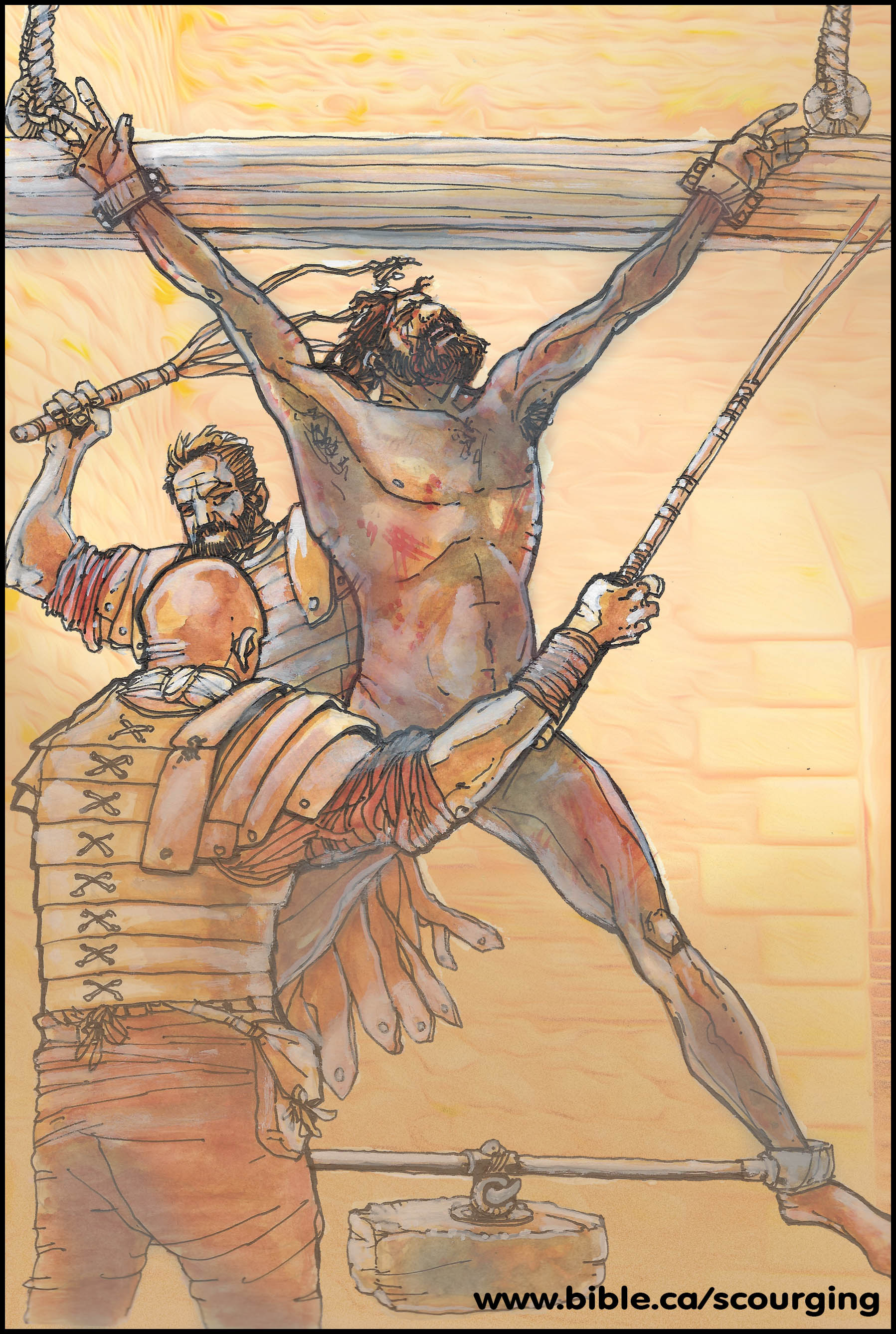
The meager and brief references above, although completely accurate, do not remotely approach describing the horrific flogging Christ received at the hands of the Romans. Obviously, there are different degrees of punishment, and the casual reader of the Scriptures would rarely visualize the animalistic and vicious beating that transpired during a Roman scourging. The Romans didn’t design their brand of scourging as mere punishment—it was intended to wreak extreme physical and mental torment on a person. Since the Bible lacks specific details in the method the Romans used to flog Jesus, we can look at extra-Biblical sources to piece together how the Romans tortured our Lord. Here are my conclusions on how Jesus Christ was flogged.
|
|
One of the first considerations one should make in studying the Romans is noting their extreme cruelty. The Roman soldiers used their downtime to devise, improve, and create more precise methods to torture their victims to the highest levels of pain while still prolonging the onset of death for the victim. During this era, Roman culture did not promote torture to be performed privately, nor was there any concern for legal or political backlash. Conversely, most punishment was administered publicly in order to serve as a deterrent to others. Torture was not frowned upon in the least, and the men responsible for punishing the victims endeavored/aspired to inflict as much pain as possible with their methods.[1] |
There are quite a few references to scourging by historians and other writers. We will take a look at some of them to try to understand how Roman scourging had evolved by the time Christ was flogged. From the earliest of times, we can safely determine that stripping the victim completely bare of all clothing was a common practice.
The Roman historian Titus Livius (Livy), who lived approximately from 64 B.C. to A.D. 17, wrote in his work, The History of Rome, about stripping the victim(s) before scourging. Using accounts of historians preceding him, Livy conveys that as early as 509 B.C., the victims were stripped naked and scourged with rods.[2] Livy also describes a traitor scourged in 396 B.C. who was stripped and beaten with rods.[3] Livy[4] mentions a scourging with rods that occurred in 326 B.C., in which the victim was stripped naked, and another scourging in the same year, in which a young man was also stripped and scourged with rods.[5] Livy reports that in 325 B.C., once again a victim is stripped and scourged with rods. Livy states, “… and mangled with rods in full sight of the Roman people.”[6]
Livy writes about a punishment, including scourging, that occurred in the year 206 B.C.:
|
He had scarcely finished speaking, when, according to the plan preconcerted, every object of terror was at once presented to their eyes and ears. The troops, which had formed a circle round the assembly, clashed their swords against their shields; the herald's voice was heard citing by name the persons who had been condemned in the council; the culprits were dragged naked into the midst of the assembly, and at the same time all the apparatus for punishment was brought forth. They were tied to the stake, scourged with rods, and decapitated; while those who were present were so benumbed with fear, that not only no expression of dissatisfaction at the severity of the punishment, but not even a groan was heard.[7] |
|
This flogging method began with having the victim stripped and tied to a stake. The whip instrument was made of rods. His reference “apparatus for punishment” may even lead one to believe that more torture could have been administered than what Livy states. After the scourging, the victims were beheaded. Therefore, in this instance, the flogging was performed strictly to torture the victims before they were executed. We can see that their nakedness was used to humiliate as the victims were dragged, void of all clothing, throughout the assembly.
Gaius Suetonius Tranquillus (Suetonius), another Roman historian who lived from A.D. 69-122, mentioned scourging in his writings. In his work Caligula[8] he states a victim was stripped before he was scourged, but he does not report what type of scourge instrument was used. This occurred about the year A.D. 40. Around A.D. 68, in his work Nero, Suetonius describes that the method of scourging was to “strip the criminal naked.”[9]
From the above works, we can conclude that it was indeed common, if not routine, to strip a victim completely before scourging. But why strip away the clothing? Several reasons come to mind. We know the Romans wanted to maximize their cruelty in every possible way. Clothing could offer a mild amount of protection for a very brief duration before it was quickly shredded, so they eliminated that meager bit of comfort. Shredded clothes might also hamper the view of their torture product. They were good at scourging and wanted to showcase their talents. However, more than removing that thin barrier of prevention or displaying their skills on bare skin, the Romans wanted to demean the victim in the final hours of life, and ripping away clothes so the person is suddenly presented naked in front of a multitude of strangers was a good way to heap such humiliation.
When a Roman leader formally ordered a victim to be scourged (rather than a slave owner giving the order), thus making the scourging an official act of punishment, I confidently conclude that in virtually all such instances, the victim was stripped naked prior to the scourging. Jesus was ordered scourged by Pilate, so I believe He was taken to a place where public scourgings were conducted and stripped naked in front of many witnesses.
|
The next question to answer is regarding what type of scourge instrument was used. In Livy’s accounts, most such apparatuses were specifically mentioned as rods. In the very first reference in 509 B.C., lictors administered the scourging. Lictors were the private bodyguards of certain prominent Roman officials. They were also responsible for punishing the victims, their superiors dictated. Lictors carried a fasces, which was a bundle of rods with an axe head attached. The rods would be used to make a scourge instrument called a virga whip.[10] The virga whip consisted of three to five rods secured together at the handle. Undoubtedly, this is the instrument to which Livy was alluding.[11] |
|

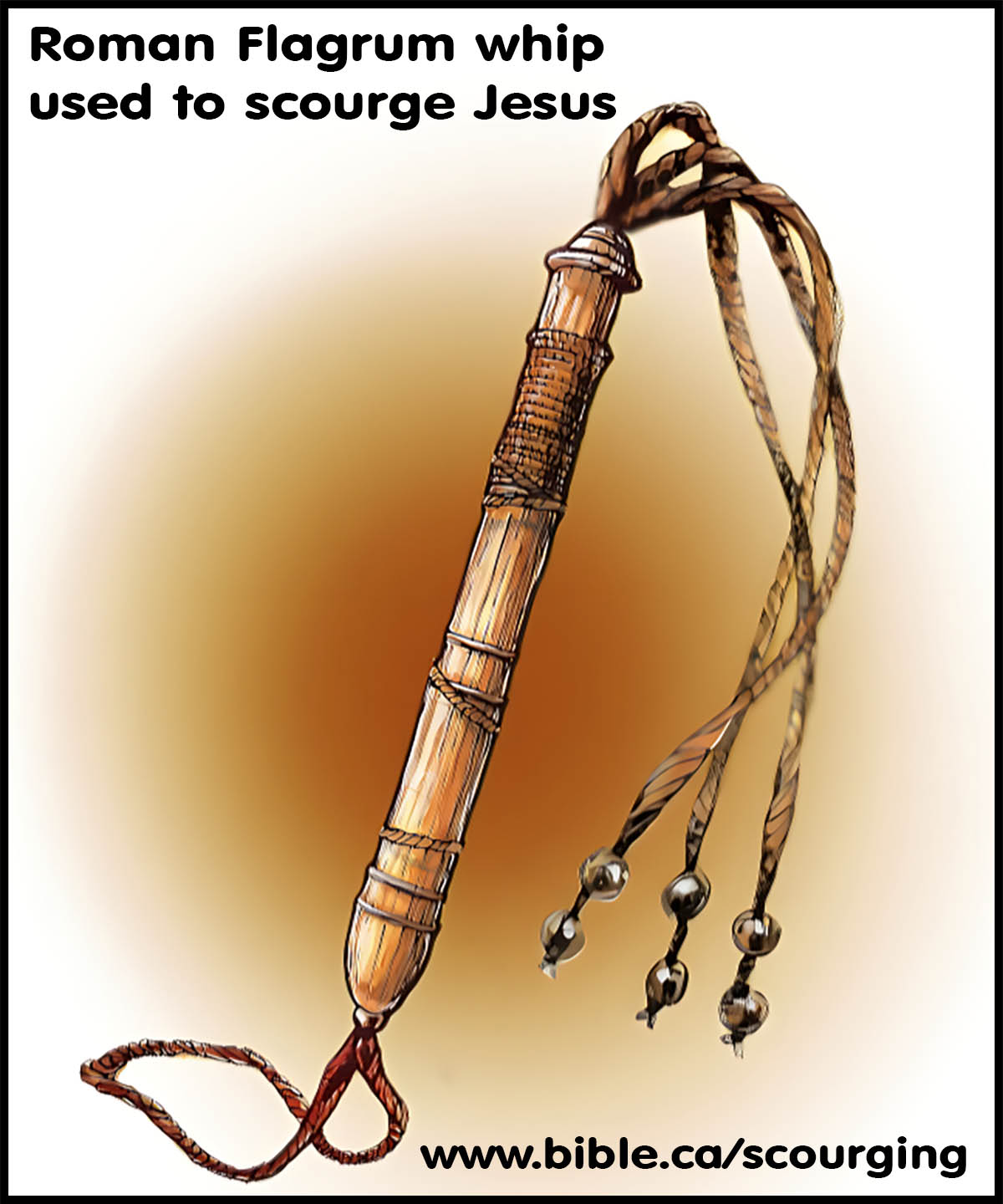
However, there was another scourge instrument used by the Romans within the timeframe of the life of Christ – the flagellum or flagra. This instrument was depicted on Roman coins and on the relief of Roman buildings and other carvings.[12] It had a twelve to sixteen-inch-long handle and several short straps attached to the end opposite the grip. Various implements were attached to the end of each strap depending on what effect the executioner sought. We can read about scourging that tore and ripped the flesh, as well as scourging that bruised and hammered the flesh.
Quintus Horatius Flaccus, the Roman poet known as Horace (65-8 B.C.), mentions the difference:
Let us have a rule to assign just penalties to offences, lest you flay with the terrible scourge what calls for the strap. For as to your striking with the rod one who deserves sterner measures, I am not afraid of that, when you say that theft is on a par with highway robbery, and when you threaten to prune away all crimes, great and small, with the same hook, if men would but give you royal power.[13]
Three different scourging methods that could flay the flesh are described here: the strap, the rods, and the terrible scourge (Horace used the word “flagello” in Latin or “flagellum”). We have already explored scourging by rods, and the use of a strap is fairly common knowledge. We will now explore the scourging by the “terrible Flagellum.”[14]
The historian Eusebius (A.D. 263-339) of Caesarea recounts scourging around the time of Polycarp’s martyrdom (somewhere between A.D. 154-167). He states:
For they say that the bystanders were struck with amazement when they saw them lacerated with scourges even to the innermost veins and arteries, so that the hidden inward parts of the body, both their bowels and their members, were exposed to view.[15]
|
|
This scourging account was undoubtedly administered with a flagellum. There were attachments used that were meant to flay and rip the flesh, as mentioned by Horace. These attachments are called scorpiones and astragals.[16] Livy also circulated an event that took place in 206 B.C. regarding victims being scourged to death.[17] It would be reasonable to assume that at least one of the scourge instruments was the flagellum with scorpiones attachments in both of the aforementioned cases. There was another attachment used on the flagellum: plumbatae. These were lead balls attached to each strap of the flagellum. The intent of the plumbatae was to pummel, bruise, and inflict internal damage to the victim. In 1709, a flagellum was excavated from Herculaneum that had plumbatae attached to its straps.[18] Herculaneum was destroyed by volcanic ash in A.D. 79. |
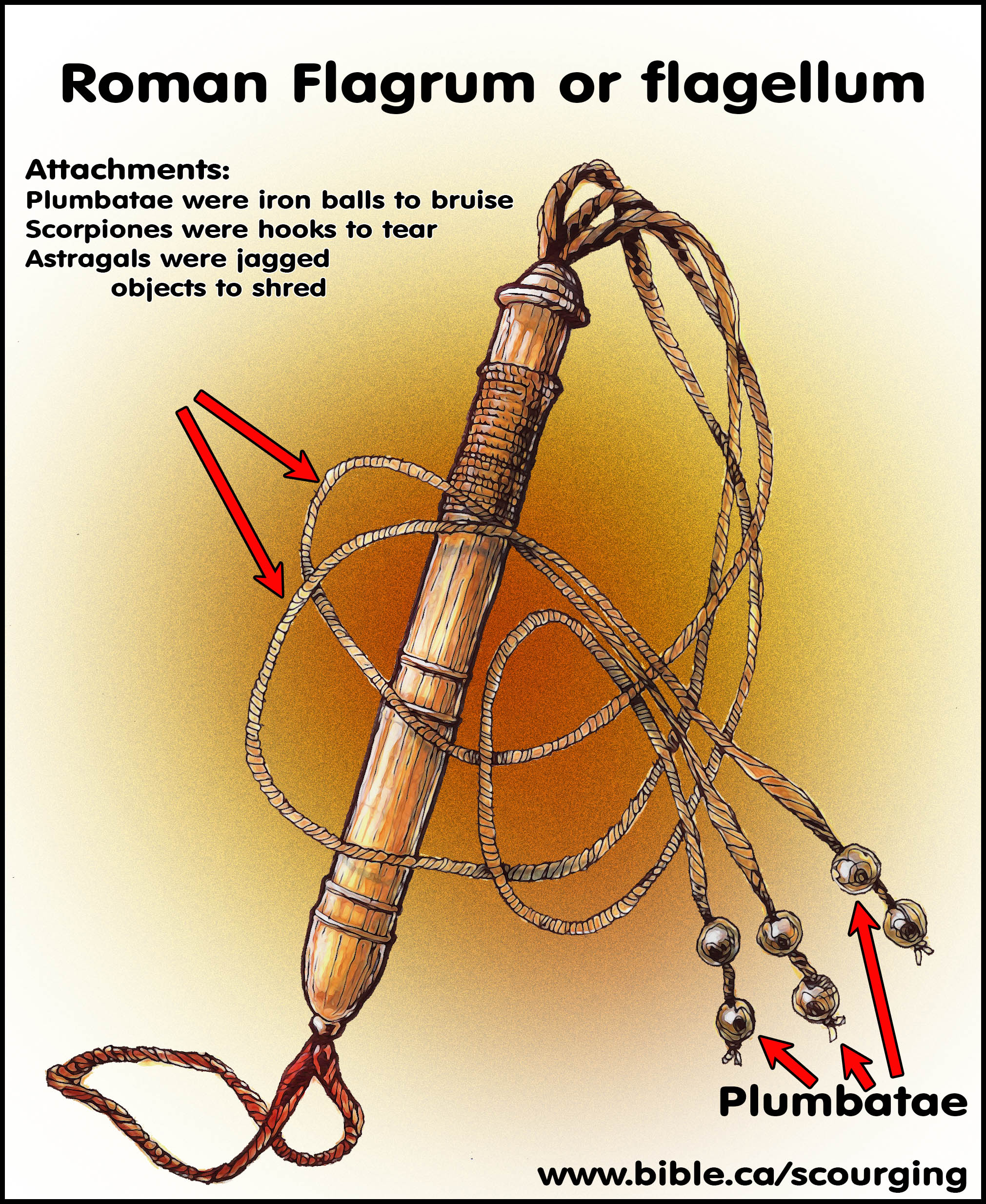
In the Codex Theodosianus, written in A.D. 387, Roman laws were codified. It decreed the punishment for certain crimes to be scourging with plumbatae attachments:
Whoever of the principals or decurions shall be found embezzling public funds or making fraudulent entries or exacting money immoderately, is to be subjected to lashes of the plumbata, and that not only by yourselves, to whom on account of your high place the State is committed, but by the ordinarii judices (provincial governors).[19]
The case can be made that some scourgings were designed for the victim to live. Plato, the Greek philosopher who lived approximately 428-347 B.C., recorded in his book “Laws”:
Whosoever is caught robbing a temple, if he be a foreigner or a slave, his curse shall be branded on his forehead and on his hands, and he shall be scourged with so many stripes as the judges decree, and he shall be cast out naked beyond the borders of the country; for, after paying this penalty, he might perchance be disciplined into a better life. For no penalty that is legally imposed aims at evil, but it effects, as a rule, one or other of two results….[20]
The obvious case to be made here is that there were some scourgings where the victim was meant to live. There are examples of victims being scourged to death[21] as well as being scourged and executed.[22]
In describing an event that occurred in 218 B.C., Polybius, a Greek historian who lived 200-118 B.C., wrote that Hannibal scourged prisoners until “their bodies [were] a mass of bruises.”[23] While the virga (rods) could have been used for that result, the flagellum with plumbatae attachments would be far more effective to bruise the entire body.
Examining the Shroud of Turin armed with the above information, the scourge marks on the back appear to be from straps with two or three plumbatae attachments on each. In the chest area, there are marks consistent with a virga whip. This would make sense, as Pilate did not want to kill Jesus. He wanted Him punished to gain sympathy from the crowd and then released. I conclude that if scourging was administered as punishment for which the victim was meant to live, rods and/or a flagellum with plumbatae attachments would be used. If the victim were to be executed, then astragals and/or scorpiones would be the attachments chosen. (Of course, the other scourge instruments were options to be used as well if the punishment was meant to be prolonged.)
|
I Peter 2:24 “He himself bore our sins" in his body on the cross, so that we might die to sins and live for righteousness;” by his wounds you have been healed.” (NIV) |
|
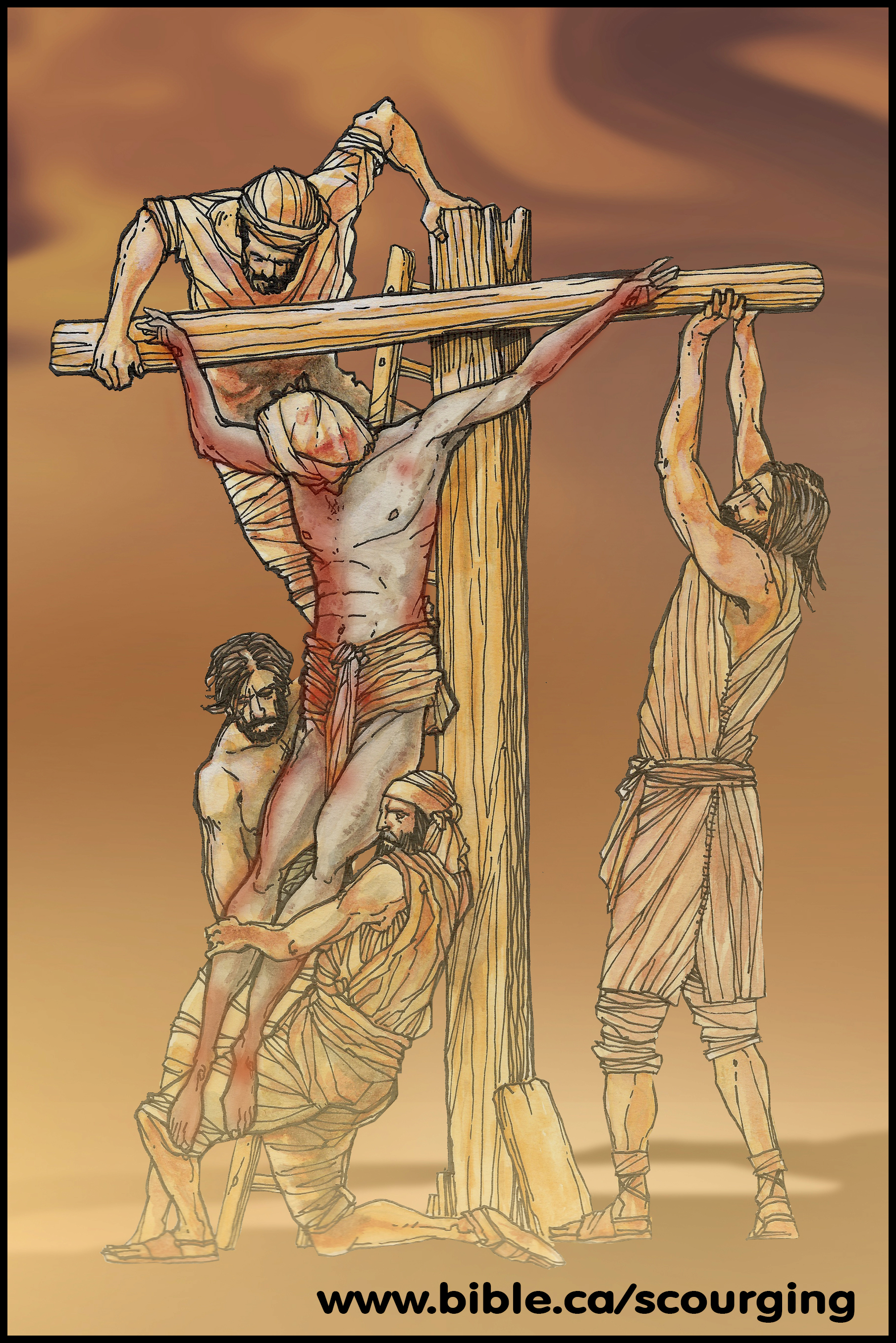
The word “wound” is translated “stripes” in some other English translations. The original Greek word is μώλωπι transliterated to mōlōpi. The word only occurs here in the Bible. The word is defined by Strong’s as “a bruise, wale, wound that trickles with blood.” This is exactly the type of wound that is recorded on the Shroud. Nowhere in the Bible do we find the scourging of Jesus described as flayed, ripped, torn, or shredded. I stand on the theory that the scourge instruments used on Jesus were the flagellum with plumbatae attachments on each strap and the virga whip.
The last element of scourging to consider is how the victim was “secured” before the scourging was administered. We have already seen an example in which the victim was tied to a stake before being scourged.[24] This method is often cited concerning how Jesus was secured before he was flogged. Livy also tells us of a scourging punishment in 670 B.C. in which the victim was to be hung on a tree before he was beaten.[25] Overall, there is little historical detail on the method used by lictors in administering the scourge. However, the Roman writers of comedies and plays often referred to slaves being whipped, and those provide more detail than what we can find from the Roman historians.
One example of this is by the Roman playwright Titus Maccius Plautus (254 – 184 B.C.). known today as Plautus. He was a prolific writer and often wrote of slaves and their punishments. In his play Asinaria,[26] he gives significant detail on how a slave might have been whipped. Here is the excerpt:
LEONIDA
Exerciser of the whip, health to you.
LIBANUS
Keeper of the gaol, how do you do?
LEONIDA
Ha! colonizer of the chains.
LIBANUS
Ha! delight of the scourges.
LEONIDA
When naked, how many pounds do you say you are in weight?
LIBANUS
Upon my faith, I don't know.
LEONIDA
I know that you don't know; but, i' faith, I who have weighed you do know. Tied up naked, you were a hundred pounds in weight when you were hanging with your feet downwards.
LIBANUS
On what evidence is that?
LEONIDA
I'll tell you on what evidence, and in what way. When you are tied up with a full hundred pounds to your feet, when the manacles are fastened to your hands, and tied to the beam, you are weighing neither more nor less than as being a worthless and good-for-nothing fellow.
|
|
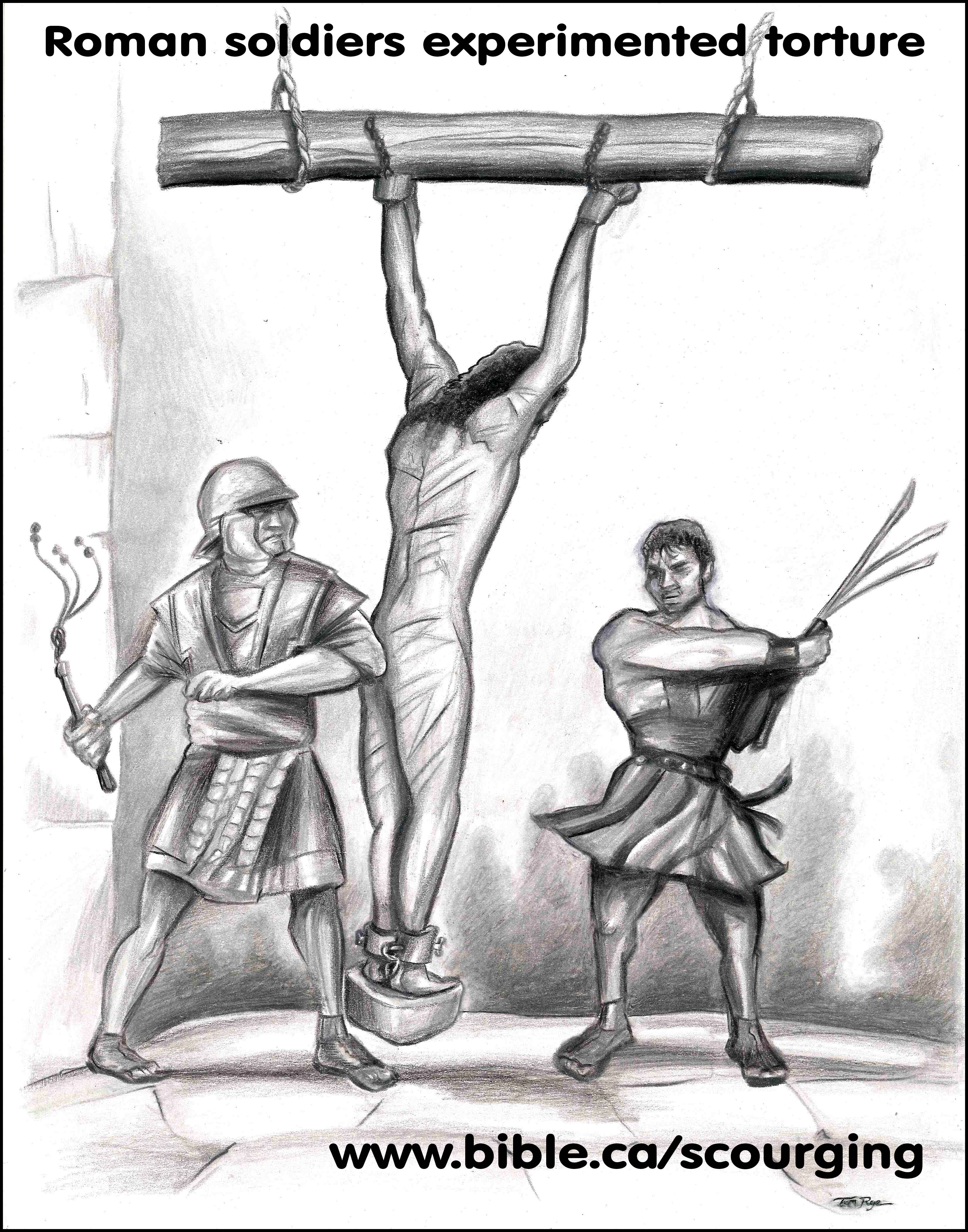
Here, Plautus reveals considerable information about scourging. After the victim was stripped, his hands were manacled and attached to a beam. Then he was hung by his hands with one hundred Roman pounds tied to his feet. (One hundred Roman pounds equate to seventy-five pounds US.[27]) I would surmise from this that the beam had two ropes, one on each end of the beam, to minimize twisting. This method would indeed immobilize the victim and minimize the flinching when the stripes were administered. The lictor would also be free to stand near the victim without concern of being kicked. |
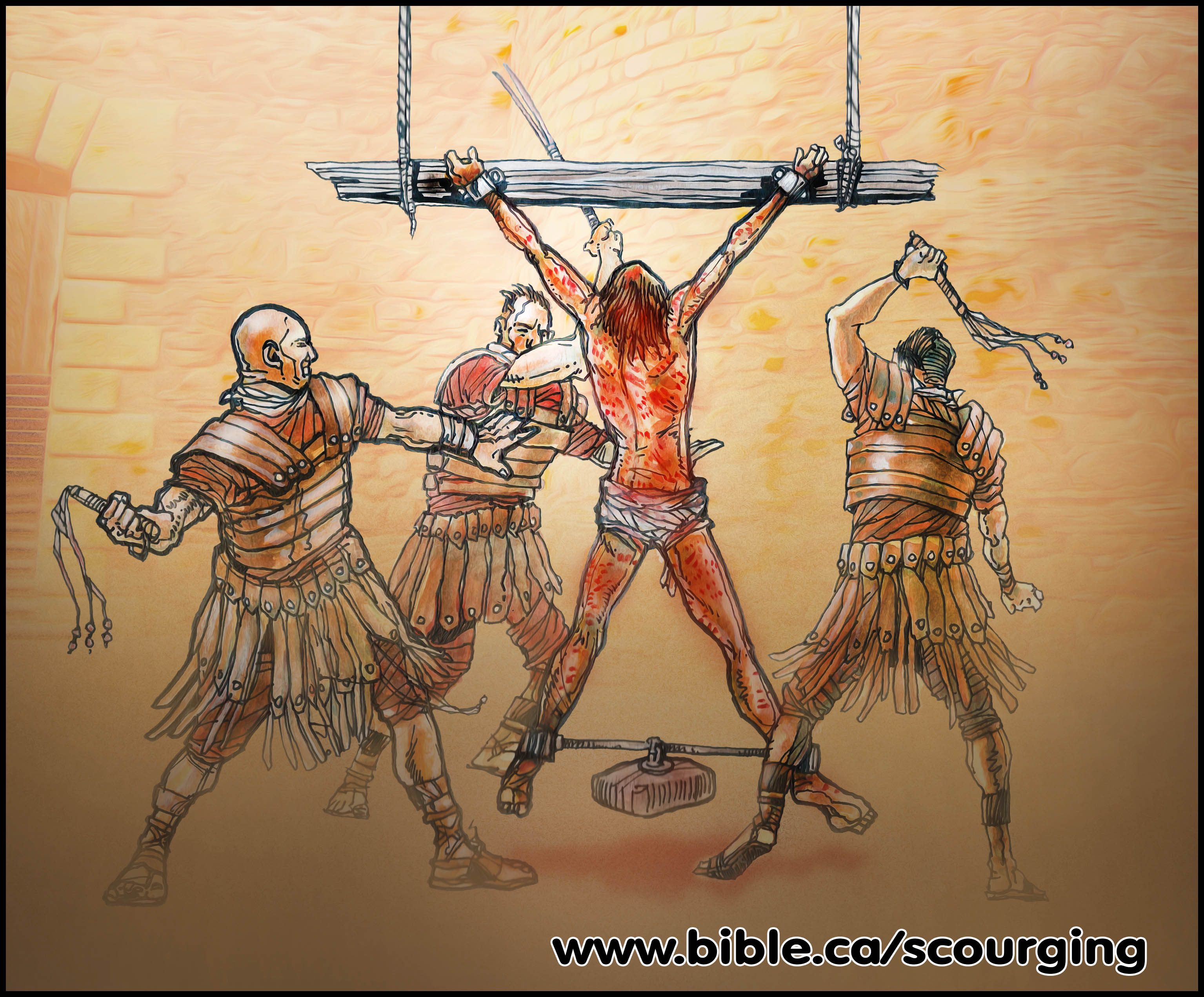
There are more references that confirm this method of securing the victim.
Plautus, Casina, Act II, Scene VI, Line 38 mentions “hanging up by the feet.” William Ramsey, in his Mostellaria of Plautus, 1869, makes the point that this is improperly translated. It should read, “hung up by his hands with his feet weighted.”
Plautus, Poenulus, Act I, Scene I, mentions being “hung up” for scourging. A comment for this line reads, “Be hung up: ‘Pendeam.’ He alludes to the practice of tying slaves up by the hands for the purpose of being flogged.”[28]
Plautus, Mostellaria, Act V, Scene II, states, “Filth, tied up as you hang, you shall be beaten with stripes.”
Plautus, Truculentus, Act IV, Scene III, states, “I interrogated you both, as you were lashed and hanging up by the arms.…”
Plautus, Menaechmi, Act V, Scene V, states, “But, hanging up, I'll flog you with a whip for thirty days.” Henry Thomas Riley comments: “But, hanging up: ‘Pendentem.’ When they were flogged, the slaves were tied up with their hands extended over their heads. Probably, the Doctor is intended to be represented as being a slave; as many of the liberal pursuits were followed by slaves, and sometimes to the very great profit of their masters. The ‘furca’ (for want of a better word, called 'bilboes' in the translation) is referred to in another Note.”
Petronius,[29] in Satyricon: “My open taunts stung the lady, and at last she ran to avenge herself, and called her chamber grooms, and ordered me to be hoisted for flogging.”
Terence,[30] The Eunuch, lines 1017-1022, states, “I believe you; but, perhaps, that which you are threatening, Parmeno, will need a future day; you'll be trussed up directly, for rendering a silly young man remarkable for disgraceful conduct, and then betraying him to his father; they'll both be making an example of you. Laughing.” [“Trussed up” is translated “strung up” in other translations.]
Terence, The Phormio, page 101, Note 219 (John Bond and Arthur Walpole, 1889) states: “You'll get a wigging: ‘I shall be strapped up and flogged.’ There is a contrast between the master's and slave's fate as in Heaut. tibi erunt parata uerba, huic homini uerbera. Slaves were sometimes hung up by the hands, with weights attached to their feet.”
Flagellation & The Flagellants by William Cooper (1877) page 4 – “One way of punishing male slaves was to suspend them by their hands to a strong beam, and attach to their feet a heavy weight, in order that they might not kick the person who flogged them. Ladies used to whip their maids while suspended to the beam, a slight difference, however, being made in the mode of suspension— these victims of the incensed fair being hung up by their hair, a piece of cruel ingenuity that has never been tried in later times, although many persons have been punished for cruelty to their servants.”
Ammianus Marcellinus in The Later Roman Empire: (A.D. 354-378) states in chapter seven, “…who already knew of him as the ringleader of the rioters gave orders that he should be hoisted up to be flogged with his hands tied behind him.” This would not be exactly like the other references above, but it does show the victim was suspended.
Since we can safely confirm this securing method was used, it would stand to reason that the one location that would have such a device in place to best scourge in this fashion would be where scourging was routinely performed. The Praetorium is where Jesus was scourged, and Paul narrowly escaped scourging. Wealthy men who owned multiple slaves would very likely have had this type of suspension device to utilize when needed and to display as a deterrent as well. Therefore, it is highly probable that the Romans would also have had this system at the Praetorium. The Romans liked to develop systems that made their tasks easier and they liked to inflict as much pain as possible. This method of scourging serves both causes very well.
The Book of Acts describes the event where Paul was almost scourged at the Praetorium:
Acts 22:25
As they stretched him out to flog him, Paul said to the centurion standing there, "Is it legal for you to flog a Roman citizen who hasn't even been found guilty?" ((NIV))
The word for “stretching out” in Acts 22:25 is only used once in the Greek New Testament. Here is its definition:
Thayer’s Greek Lexicon, STRONGS NT 4385: προτείνω
προτείνω: 1 aorist προετεινα; (from Herodotus down); to stretch forth, stretch out: ὡςπροέτειναν (Rec. προέτεινεν) αὐτόν τοῖς ἱμᾶσιν, when they had stretched him out for the thongs i. e. to receive the blows of the thongs (by tying him up to a beam or a pillar; for it appears from Acts 22:29 that Paul had already been bound), Acts 22:25 (Winers Grammar, § 31 at the beginning; others (cf. R. V. text) 'with the thongs' (cf. ἱμάς)).
As you can see, Strong’s mentions being tied to a beam. It is unclear how the weights were attached to the hung victim. A case can be made that a “spreader bar” of some type was used. The bar could be an iron or wooden beam. This method would easily allow for weights to be attached and would expose more flesh, the vulnerable inside of the legs, to the scourge instrument. The victim would indeed be helpless and exposed using this method, not to mention the increased humiliation from being placed in this position.
So, after providing the necessary background to lay the foundation for my hypothesis, here is ultimately how I believe Jesus was scourged.
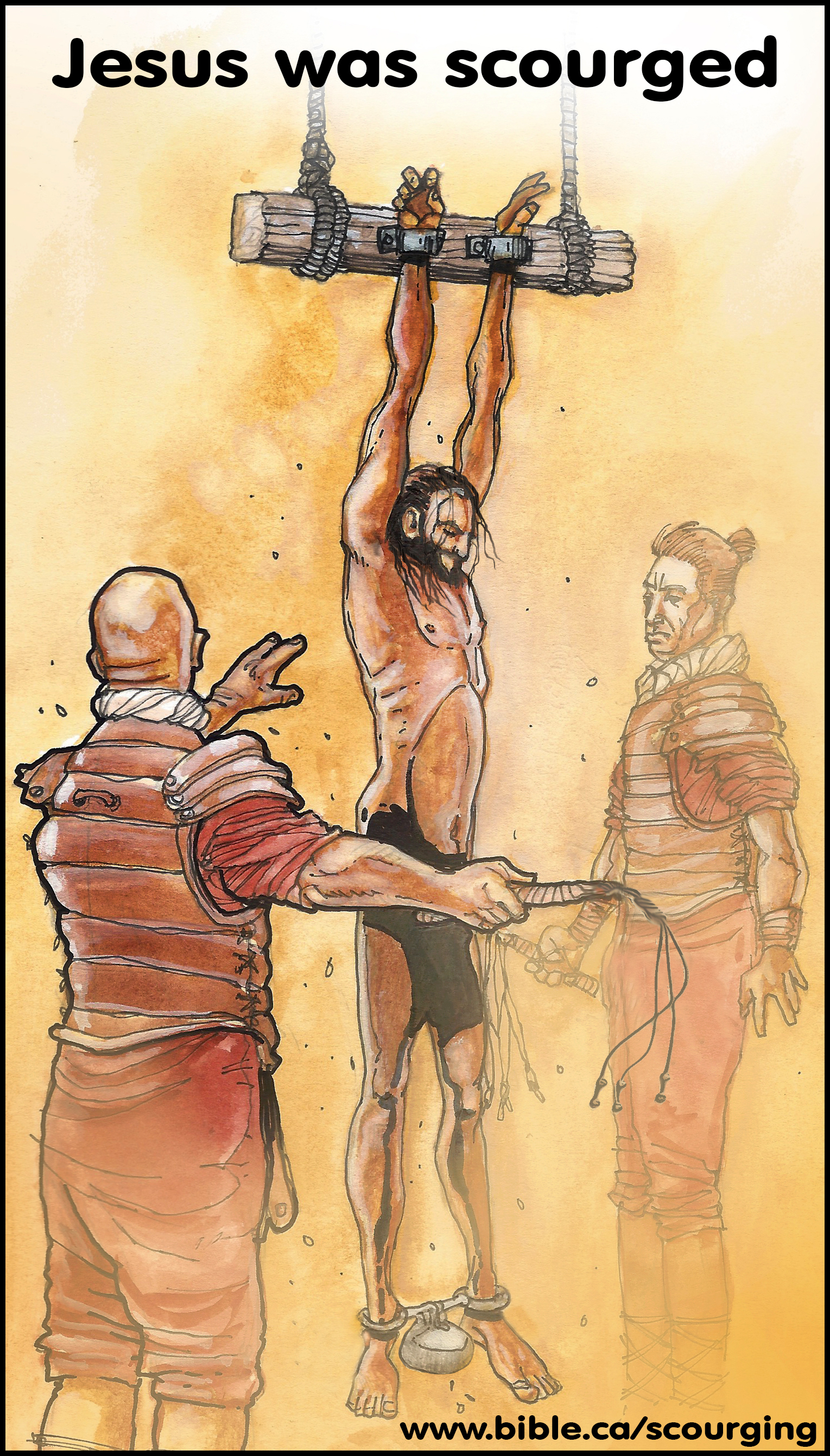
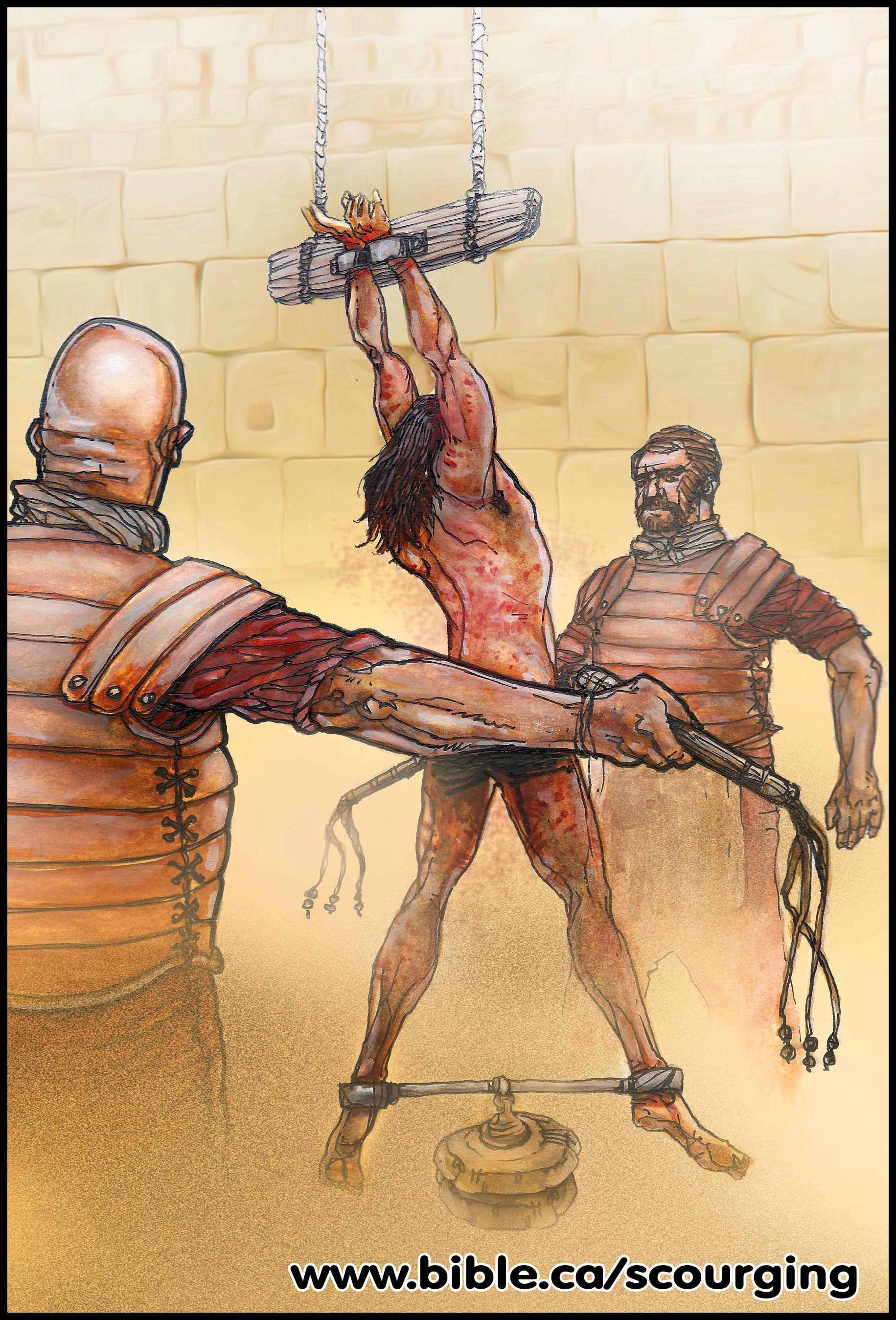
Pilate had six lictors commissioned to him due to his position as Prefect of Judea, and these were the men tasked to carry out Pilate’s order to have Jesus scourged. At least two were used in the actual scourging, and I think four likely would have been involved to increase the severity of the beating. All six may very well have administered the flogging using two different instruments. They stripped Jesus completely, secured His hands to a beam, then hoisted Him by the beam until He was suspended (probably with two ropes to minimize twisting). The Shroud shows many scourge marks on the body’s chest and front of the legs. This eliminates methods that required Jesus to be bound facing a column, post, or wall. I reject the low post[31] because this does not stretch Him out, nor does it give easy access to His chest. (Especially with the virga whip, since the rods would not wrap around the body and strike the chest.) The Shroud depicts marks on His shins as well. The low post also contradicts Acts 22:25, which states that Paul was stretched out to be scourged.
Christ was flogged in the same location where Paul was drawn for his scourging (which the apostle fortunately evaded). Since the Praetorium is a location where the Romans publicly punished their victims, I am convinced the Romans would have such a device there to hoist victims for scourging. This would indeed make the process easier and quicker for the lictors and create a stage to proclaim to others what might happen to them if they disobey the Romans. To reiterate, not only would hoisting and weighting the person provide more of an exhibition, but securing in such a manner would allow the lictor access to wherever he wanted to strike.
|
Christ was hung by His wrists and the Romans affixed a one-hundred-pound weight to His feet. His skin was pulled taut due to the heaviness of the weights. The extreme weight would not allow Jesus to squirm, kick, or flinch. He was completely immobilized with the heft pulling His racked body in a straight downward line. Such a plight would be agonizing even without the vicious subsequent beating as His stretched joints were beset with pain. Christ absorbed the full impact of the scourge instruments. (Note: the Shroud depicts a body that was thoroughly scourged. While there is some overlapping, the lashes are generally expertly placed all over the body without duplication. This might be how a man was scourged if the punishment was designed to allow the victim to live, or at least survive long enough to be crucified. This would also explain the use of the plumbatae attachments as opposed to the scorpiones or astragals.) Illustrations 20-24 depict the above-described method of scourging. |
|
Conclusions
The following are my conclusions based on my study of scourging. I will use the following ratings for the level of confidence I give my conclusions:
100% Biblical Certainty – The Bible clearly states a position
90-99% Historical Certainty – Two or more solid references by ancient writers
80-89% Historically Likely – Two or more references by ancient writers
70-79% Historically Probable – Suggested by historic writings
60-69% Historically Possible – Implied by historic writings
50-59% Philosophical Possibility – Possibility by studying known historical acts
40-49% Suggested Possibility – Doesn’t conflict with ancient writings and fits known actions
30-39% Unlikely – Unlikely and only assumed with influence by ancient writers
20-29% Highly unlikely – Assumption only but does not contradict ancient writings
10-19% Highly Improbable – Conflicts with ancient writings
0-9% Impossibility – Conflicts with the Bible
Roman Law provided for judges or rulers to determine the level of scourging punishment. It is possible that the victim could be thoroughly scourged and yet meant to live after the beating. This would be accomplished with the virga whip and/or the flagellum with plumbatae attachments. The victim would be given stripes over the exposed flesh from the neck down. 94% Certainty
Roman Law provided for judges and rulers to proclaim a victim to be scourged to death. The lictors would use flagellums with scorpiones and astragals attached to the straps for this punishment. Other implements may be used as well if the lictors wanted to prolong the torture. 93% Certainty
Multiple lictors would be used to scourge a victim when a ruler desired a victim to be scourged. 95% Certainty
Lictors would strip the victim, as a general rule, before he was scourged. If it happened in an official place where scourging was routinely administered, then the victim was stripped before the scourging. 96% Certainty
Jesus was scourged by the Romans by the order of Pilate. 100% Certainty
Multiple Lictors were used to administer the scourging to Jesus. 90% Certainty
Jesus was suspended by His hands and weighted at His feet with 100 Roman pounds prior to His scourging. 90% Certainty
Jesus was beaten with a flagellum bolstered by plumbatae attachments as well as a virga whip. 90% Certainty
Jesus had a “spreader bar” of some sort attached to His feet so more of His flesh could be exposed and to provide a place to attach the weights. 51% Certainty
Buy the book:
|
|
The Suffering of the Lamb
Buy book by Kenneth Vernor and Douglas Raymer |

[1] Oxford Encyclopedia of Ancient Greece and Rome Vol. I (2010) pg 85-88
[3] Livy, The History of Rome 6.27
[4] Ibid 8.25
[5] Livy, The History of Rome 8.28
[6] Livy, The History of Rome 8.33
[7] Livy, The History of Rome 28.29
[8] Suetonius, Caligula 26
[9] Suetonius, Nero 49
[10] The Pulpit Commentary Entry on Acts 22:24; https://www.shroud.com/pdfs/duemaggioManservigiENG.pdf pg 5
[11] There are several references of lictors administering scourging: Livy, The History of Rome 1.26; Livy 2.5; Plautus, Epidicus 1.1
[12] The ‘Flagra’ of the Vatican Museums - www.shroud.com/pdfs/duemaggioManservigiENG.pdf
[13] Horace, Satires 1.3.119
[14] The flagellum is referred to as a flagrum and flagra
[15] Eusebius, Ecclesiastical History, Book 4, chap. 15
[16] Zugibe, The Crucifixion of Jesus: A Forensic Inquiry pg 19
[17] Livy, The History of Rome 28. 19
[18] Zugibe, The Crucifixion of Jesus pg 19
[19] Codex Theodosianus XII 1. 117 [Latin] as quoted in Problems of the Roman Criminal Law, Volume 2 by James Leigh Strachan-Davidson pg 172. Also the Codex IX 35, 2, 1 references a scourge with plumbatae attached. Plumbatarum in Latin.
[20] Plato, Laws 9.854d
[21] Livy, The History of Rome 28. 19
[22] Cicero, Philippics 11.2; Livy 9.31; Livy 2.5; Josephus, War 4.326
[23] Polybius, Histories 3.62
[24] Livy, The History of Rome 28.29
[25] Livy, The History of Rome 1.26
[26] Plautus, Asinaria II.2
[27] Roman Weights and Measures - www.tribunesandtriumphs.org/roman-life/roman-weights-and-measures.htm
[28] Footnote in The Comedies of Plautus. Henry Thomas Riley. London. G. Bell and Sons. 1912 (Plautus, Poenulus, Act I, Scene I)
[29] Gaius Petronius Arbiter (Petronius) lived ca. 27 – 66 A.D. and was a Roman courtier during the reign of Nero. He is thought to be the writer of the Satyricon, written around 54-68 A.D.
[30] Publius Terentius After (Terence) ca. 195/185 – ca. 159 B.C. was a Roman playwright.
[31] There are at least four posts or columns displayed in several churches claiming to be the post that Jesus was tied to or suspended from while scourged. Three of these are just fragments. A complete post is displayed in the Basilica of Saint Praxedes in Rome, Italy. It is a low post, so if a victim was scourged on it, he would be placed over it with the victim’s torso placed on the post face down. A fragment that claims to be of the scourging post is located in the wall of Hagios Georgios (Patriarchate) Church, Istanbul, Turkey. The Church of the Holy Sepulchre in Jerusalem has not one but two fragments of a column that is claimed to be part of the scourging post. The last three listed here are each of a different color: black, red, and white. They are not fragments of the same pillar. The first (complete) post is a white and gray mix. Thus, all four are different and clearly are not fragments from the same pillar.