Thutmoses III was not the Pharaoh of Moses’ flight to Midian.
The Pharaoh when Moses fled to Midian didn’t need reign more than 40 years
|
|
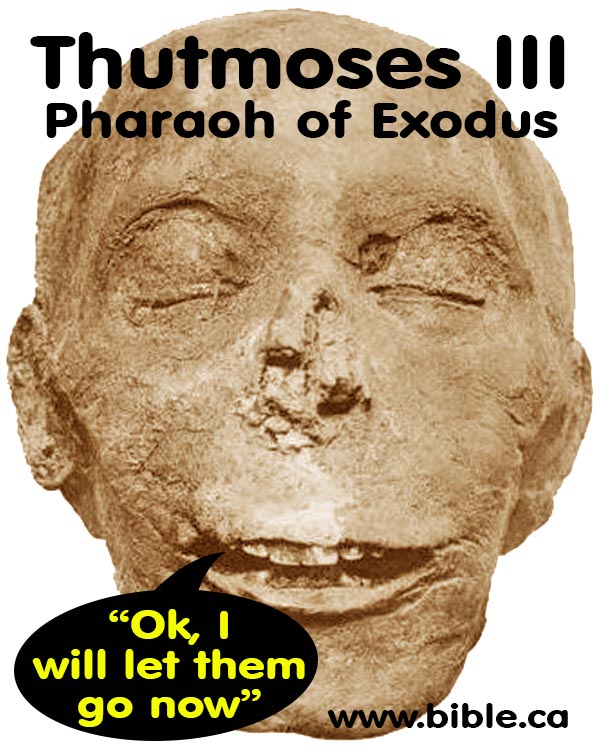
Thutmoses III as the Pharaoh of the Exodus not of Moses’ flight to Midian Thutmoses III was Pharaoh in 1446 BC for a total of 54 years: 1485-1431. There were three distinct phases to his rule. 1. (1485-1464) First as a baby, and his stepmother Hatshepsut ruled as co-regent for 21 years. 2. (1464-1446) Second, after Hatshepsut died, he ruled as Pharaoh for 18 years until the exodus. 3. (1446-1431) Third, he ruled another 15 years after the exodus. |
|
|
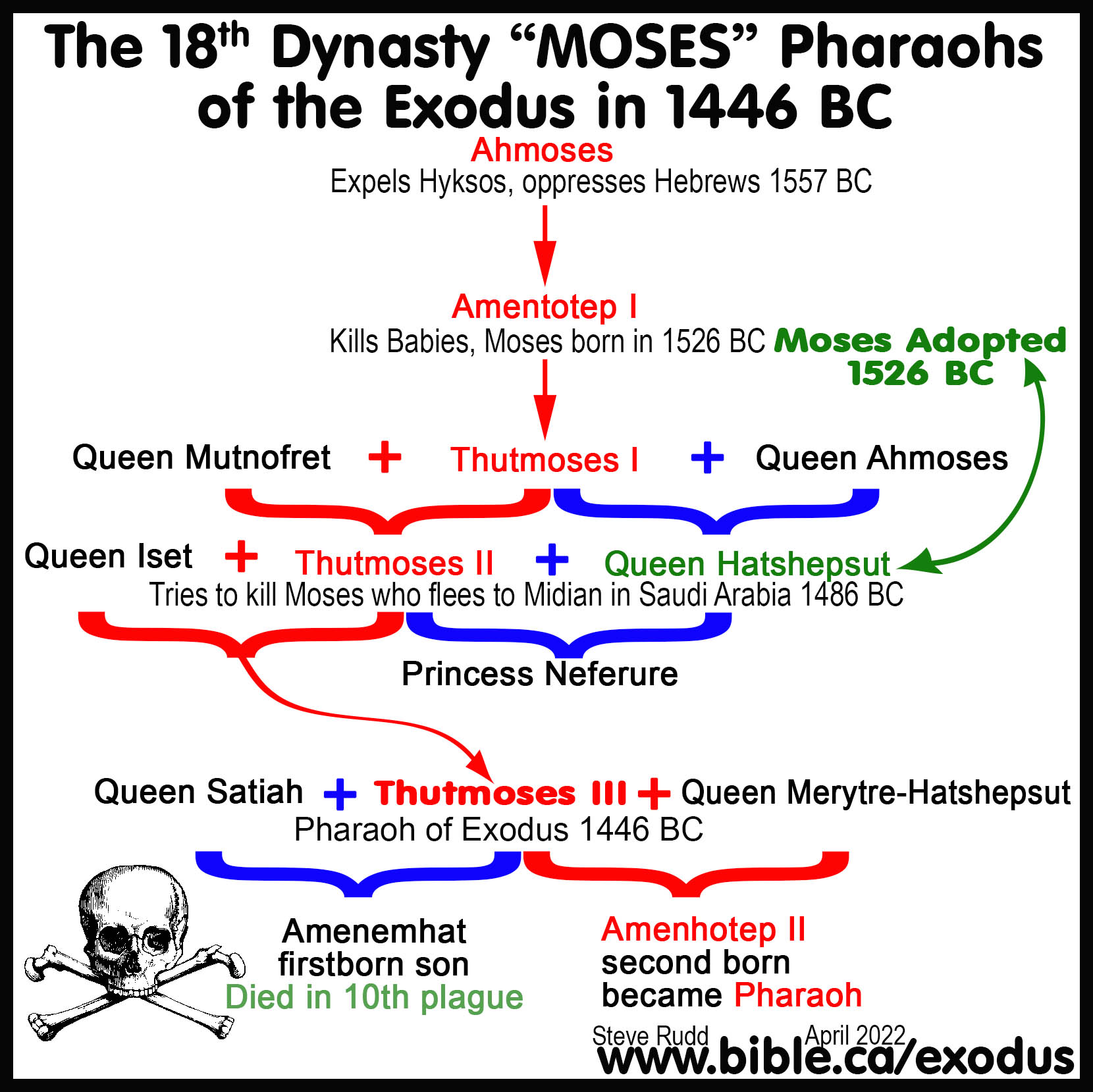
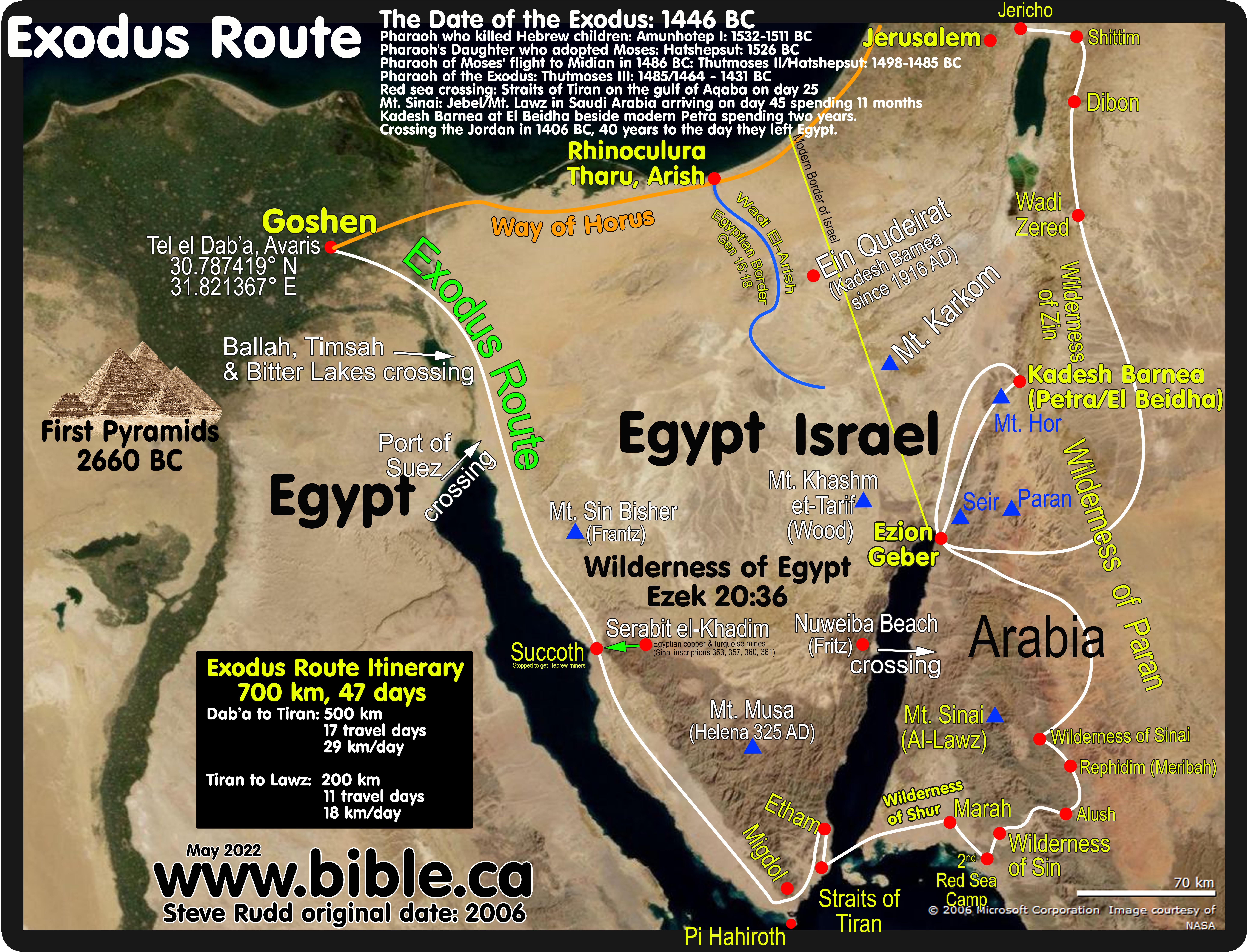
Four Pharaohs of the Exodus 1. Pharaoh who killed Hebrew children: Amenhotep I: 1532-1511 BC
2. Pharaoh's Daughter who adopted Moses: Hatshepsut: 1526 BC
3. Pharaoh of Moses' flight to Midian: Thutmoses II/Hatshepsut: 1498-1485 BC
4. Pharaoh of the Exodus: Thutmoses III: 1485/1464 - 1431 BC |
|
|
Introduction:
1. The “straw man” High Egyptian Chronology argument championed by Doug Petrovich that Thutmoses III was the pharaoh of Moses’ flight:
a. “The king who preceded the exodus pharaoh must have ruled beyond 40 years. … This criterion is not met by the relatively modest reign of Seti I (ca. 1305-1290 sc), the predecessor of Ramesses II. Amenhotep II's predecessor, Thutmose III, ruled just short of 55 years, meaning that Amenhotep II passes this stringent qualification for the predecessor of the exodus pharaoh." (Origins of the Hebrews, Douglas Petrovich, p169, 2021 AD)
b. Petrovich’s error is in stating as fact, that the Pharaoh of the Moses’ flight had to reign longer than 40 years. Most conservative writers who hold to a fifteenth-century Exodus, also use this “straw man” argument when they mistakenly point out that Exodus 4:19 rules out Ramses II as the Pharaoh of the Exodus because his immediate predecessors had a reign less than 40 years. They replicate the false argument against Ramses II as the pharaoh of the exodus and apply it to disqualify Thutmoses III as the pharaoh of the exodus. They wrongly conclude that the only Pharaoh for the Eighteenth or Nineteenth Dynasties who reigned long enough to cover most of Moses’ 40 years in Midian and who preceded the Pharaoh of the Exodus was Thutmose III. This error leads them to petulantly dismiss Thutmoses III as the pharaoh of the exodus and brazenly dismiss Thutmoses II as the pharaoh of Moses’ flight because of his short 13-year reign and the fact he died two years after Moses fled Egypt according to High Egyptian chronology. As a result, High Egyptian Chronology advocates champion Thutmoses III as the Pharaoh of Moses’ flight and Amenhotep II the Pharaoh of the Exodus. As we will see, Petrovich’s “stringent qualification” is a straw man argument that must be outright rejected as sloppy exegesis.
i. False argument #1: According to scripture, it is a “stringent qualification” that the Pharaoh of Moses’ flight was alive for most of the 40 years while Moses was in Midian and died just before God appeared to Moses in the burning bush. Truth: Scripture does not say that, and Petrovich’s “stringent qualification” is a product of his imagination therefore a “unicorn argument”.
ii. False argument #2: Thutmoses III is the only pharaoh who can possibly “fit the bill” of the pharaoh of Moses’ flight to Midian because he reigned over 50 years and died shortly before the burning bush, using High Egyptian Chronology. Truth: This argument is based upon superficial, sloppy, and flawed exegesis of scripture and ignores the fact that Thutmoses III also doesn’t “fit the bill” because he died a whopping 5 years before the burning bush, using High Chronology.
2. Thutmoses II was in fact the pharaoh of Moses’ flight and Thutmoses III was the pharaoh of the exodus using Low Egyptian Chronology as a perfect fit to the Bible blueprint.
I. High vs. Low Egyptian Chronology
|
Thutmoses II vs. Thutmoses III as the Pharaoh of Moses’ flight to Midian 1447 BC: “All the men who were seeking your life are dead.” (Ex 4:19) |
||
|
Pharaoh |
High Egyptian Chronology |
Low Egyptian Chronology |
|
Thutmoses II 'Akheperenre' |
1516–1506 BC |
1498-1485 BC Moses fled to Midian in 1486. Thutmoses II died 38 years before God told Moses “all who want to kill you are dead” |
|
Queen Hatshepsut Ma'atkare' |
1506–1488 BC Adopted Moses. |
1485-1464 BC Adopted Moses. Wife of Thutmoses II also wanted to kill Moses in 1486 BC. Hatshepsut died 17 years before God told Moses “all those who want to kill you are dead” in 1447 BC. |
|
Thutmoses III Menkheperre' |
1488–1452 BC Moses fled to Midian in 1486 BC. Died 5 years before God told Moses “all who want to kill you are dead” in 1447 BC. |
1464-1431 BC Pharaoh of the Exodus Thutmoses III had been Pharaoh 17 years before God told Moses “all who want to kill you are dead” in 1447 BC. |
|
Amenhotep II 'Akheperure' |
1455–1418 BC Pharaoh of the Exodus |
1431-1406 BC Died the year Joshua crossed the Jordan |
1. High vs. Low Egyptian Chronology depends on the geographic location where the heliacal rising Sirius was observed.
2. The Pharaoh of the Exodus is dependant upon High vs. low Egyptian Chronology:
a. Thutmoses III using low chronology: If “heliacal rising” of the Dog Star was observed from Thebes or Elephantine, then low chronology is correct and Thutmoses III would be the Pharaoh of the Exodus because he was Pharaoh in 1446 BC.
b. Amenhotep II using high chronology: If “heliacal rising” of the Dog Star was observed from Memphis, then high chronology is correct, and Amenhotep II would be the Pharaoh of the Exodus because he was Pharaoh in 1446 BC.
3. Sirius is the brightest star in night sky and the brightest star in the Canis Major constellation.
a. In modern astronomy, Sirius is known as “α Canis Majoris”.
b. Sirius is known colloquially as the "Dog Star".
c. To the Egyptians Sirius was the “Dog Star” goddess “Sopdet” who is depicted with a five-pointed star over her head.
d. To the Greeks Sirius was called Sothis.
e. Sirius = Sothis = Sopdet = Dog Star.
3. Low Egyptian Chronology is favoured by most of the worlds leading Egyptologists today:
a. Using Low Egyptian Chronology Thutmoses III is the pharaoh of the exodus in 1446 BC. Using High Egyptian Chronology Amenhotep II is the pharaoh of the exodus in 1446 BC and Thutmoses III was the pharaoh of Moses’ flight.
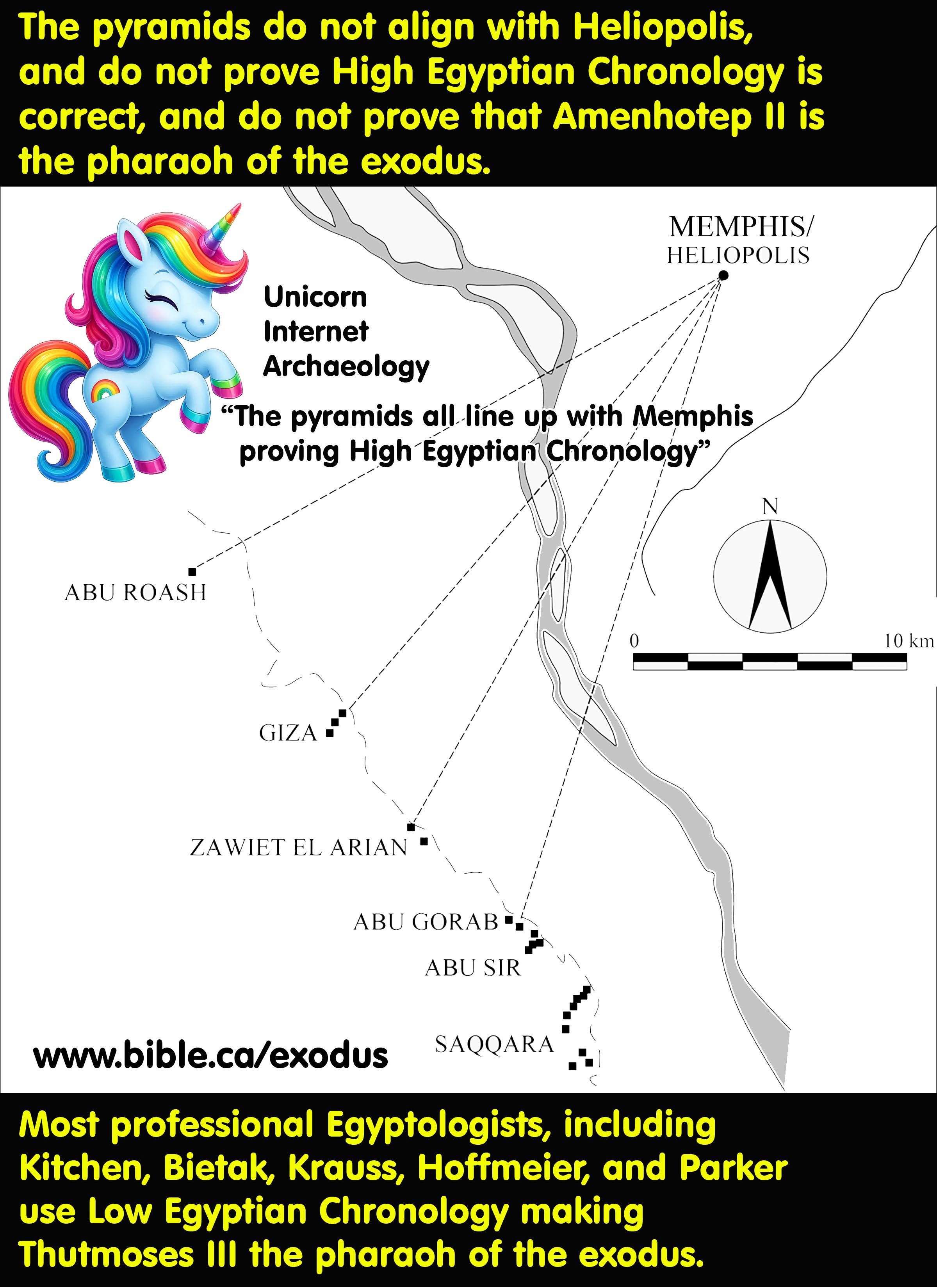
b. Most professional Egyptologists, including Kitchen, Bietak, Krauss, Hoffmeier, and Parker use Low Egyptian Chronology making Thutmoses III the pharaoh of the exodus.
c. “As data continued to accumulate, however, it became increasingly evident that the low chronology was favored by most scholars. A colloquium [conference] on this issue held in 1987 ended with the majority of participants agreeing that “the historical and archaeological evidence tends to support a low chronology”” (Has Radiocarbon Artificially Raised Bronze Age Dates?, K. J. Udd The Near East Archaeological Society Bulletin, 58, p1, 2013)
4. Unicorn Internet Archaeologists (UIA) have fabricated a
“fake news” argument that the pyramids are all aligned with Memphis because
that is where the siting of Sirius (the Dog Star) was taken from. Truth:
The pyramids do not align with Heliopolis, and do not prove High Egyptian
Chronology is correct, and do not prove that Amenhotep II is the pharaoh of the
exodus. Archeological evidence supports that the rising of Sirius was measured
at Elephantine not Memphis.
5. Olympiodorus of Alexandria: AD 565: Reported that Sothic rising was observed from Memphis and celebrated at Alexandria.
a. On p24 of Petrovich’s “Origin of the Hebrews” (2021) he misdated Olympiodorus to AD 6 rather than the correct date of AD 565. The mistake was brought to Petrovich’s attention as an error or typo, but he doubled down that AD 6 was the correct date and this book contained no such error and stands by his date to the present time. Puzzling indeed.
b. Olympiodorus was a pagan who recorded that the rising of the Dog Star was observed by the Egyptians at Memphis and celebrated at Alexandria in AD 565 in his Commentary on the Meteorology of Aristotle 113.47-48. While this may have been true in the late-Byzantine era, it would be absurd to suggest this represented the case during the Pharaonic era, given Alexandria did not exist before 333 BC. The Pharaonic kingdom went extinct during the Persian era, which was 1000 years before Olympiodorus recorded the rising of Sirius was observed at Memphis. If Olympiodorus had preserved the ancient historic pattern of observation and celebration of the heliacal rising, he would not have said the celebration took place at Alexandria. Olympiodorus therefore recorded current events in his day which were demonstrably different from the ancient Egyptian tradition. The Memphis/Alexandria tradition in the 6th century AD, therefore, cannot be used as primary evidence that Memphis was the ancient observation point for the rising of Sirius. It is flawed to argue the Egyptians always observed the rising of Sirius at the same location (i.e., Memphis) from the 12th Dynasty (1900 BC) down to the late Byzantine era to guarantee fixed, trustworthy, and consistent records because Egyptian chronology, in general, is plagued with confusion, errors, gaps, omissions, and inconsistencies. As we have seen in another chapter, Egyptian chronology is hopelessly lost without Bible chronology. The Egyptian capital frequently moved locations from the 12th to 30th Dynasties. The individual ego of Pharaohs who deliberately broke with tradition and changed capital cities like an outer garment, would be equally motivated to change the observation location of the rising of Sirius as part of their unique Pharaonic signature. Akhenaten, for example, made deliberate efforts to break with all tradition. Olympiodorus therefore, provided only peripheral and ephemeral evidence on the ancient location of the observation of the rising of the Dog Star.
c. “The Egyptians themselves, however, never stated where they made their observations of the heliacal rising. The only hint comes from Olympiodorus (6 C.E.) who notes that a Sothic rising was celebrated at Alexandria, after having been observed at Memphis. But, as Krauss insists, one can hardly use this as the basis for establishing where such observations were made in pharaonic times.” (Present Status of Egyptian Chronology, William A. Ward, BASOR 288, p59, 1992 AD)
d. “Olympiodorus was born at the turn of the sixth century CE. His name, which means “gift of Zeus,” implies that he was born to traditionally “Hellenic” parents. As a young man, he would have studied Greek language, literature, and rhetoric before applying to join the philosophical school led by Ammonius, where he found a close-knit academic “family” bound together by a strong, private oral tradition.” (Olympiodorus of Alexandria, Michael Griffin, Brill’s Companion to the Reception of Plato in Antiquity, vol 13, p555, 2018 AD)
II. Debunking Thutmoses III as the pharaoh of Moses’ flight to Midian:
1. According to Low Egyptian chronology, Thutmoses II was the Pharaoh of Moses’ flight to Midian and Thutmoses III was the Pharaoh of the exodus. Thutmoses II died the year after Moses fled to Midian just like Herod the Great died the year after Jesus fled to Egypt. Exodus 4:19 said “all those who seek your life are dead”. This Bible verse does not require that the Pharaoh of the Moses’ flight to Midian in 1485 BC reigned for the next 39 years until he died in 1447 BC.
2. Those who advocate High Egyptian chronology misuse Exodus 4:19 to argue Thutmoses II could not be the Pharaoh of Moses’ flight to Midian because he reigned only 13 years, which is far short of the “required” 40 years to qualify him as such. They also point out that Thutmoses II had been dead 38 years before God told Moses at the burning bush, “all those who seek your life are dead” in 1447 BC. Instead, HC advocates say Thutmoses III was the Pharaoh of Moses’ flight and Amenhotep II his son was the Pharaoh of the exodus. While it is true that Thutmoses III reigned longer than 40 years, such is irrelevant in identifying him as the Pharaoh of Moses’ flight.
a. The High Egyptian Chronology argument: The Pharaoh of the Moses’ flight had to reign longer than 40 years. Most conservative writers who hold to a fifteenth-century Exodus, point out that Exodus 4:19 rules out Ramses II as the Pharaoh of the Exodus because his immediate predecessors had a reign less than 40 years. The only Pharaoh for the Eighteenth or Nineteenth Dynasties who reigned long enough to cover most of Moses’ 40 years in Midian and who preceded the Pharaoh of the Exodus was Thutmose III. Thutmoses II can be dismissed outright because of his short 13-year reign and the fact he died two years after Moses fled Egypt according to High Egyptian chronology. As a result, High Egyptian Chronology advocates make Thutmoses III the Pharaoh of Moses’ flight and Amenhotep II the Pharaoh of the Exodus. As we will see, this “stringent qualification” is a straw man argument.
b. “The king who preceded the exodus pharaoh must have ruled beyond 40 years. … This criterion is not met by the relatively modest reign of Seti I (ca. 1305-1290 sc), the predecessor of Ramesses II. Amenhotep II's predecessor, Thutmose III, ruled just short of 55 years, meaning that Amenhotep II passes this stringent qualification for the predecessor of the exodus pharaoh." (Origins of the Hebrews, Douglas Petrovich, p169, 2021 AD)
3. Debunking the “straw man” argument that Exodus 4:19 prevents Thutmoses III or Ramses II from being the exodus Pharaoh:
a. Eisegesis: The text doesn’t say the Pharaoh who tried to Kill Moses died the same year Moses stood at the burning bush in 1447 BC. The text gives no indication of any kind when he died. The text does not require that the Pharaoh who tried to kill Moses reign for 39 years then die shortly before God appeared to Moses in 1447 BC.
b. Plural attempted killers: The Hebrew word is plural, indicating more than just Pharaoh wanted to kill Moses. This would include Thutmose II’s wife Hatshepsut, who claimed the throne a year after Thutmose II died, court officials and army commanders. “ALL THOSE who sought your life” entirely disproves the requirement that the Pharaoh had to live 39 years after Moses fled to Midian. Pharaoh would order Moses killed but the job of finding and killing Moses would be delegated to many others who outlived both Thutmose II and Hatshepsut. So even if the Exodus 4:19 required (which it does not) men to seek Moses’ life for 39 years until they all died in 1447 BC, the plural “those who seek” include more than just the Pharaoh who issued the death edict!
c. Thutmoses III died 4-6 years before the exodus: High Egyptian Chronology advocates who use Exodus 4:19 to rule out Thutmoses III as the Pharaoh of the Exodus are themselves betwixt, bothered and bewildered to explain away the fact that their Pharaoh of Moses’ flight to Midian (Thutmoses III) had also been dead a whopping 5 years before God appeared to Moses at the burning bush and said, “all those who sought your life are dead”. Either the text demands the Pharaoh of Moses flight died shortly before 1447 BC or it does not! It cannot be argued both ways! In Low Egyptian Chronology, before God appeared to Moses at the burning bush, Thutmoses II died 38 years earlier and Hatshepsut died 17 years earlier. In High Chronology Thutmose III died 5 years earlier so even he failed the “stringent qualification” straw man test.
4. The misuse of Exodus 4:19 is a classic case of formulating one false argument to refute another false idea, then using that same false argument to disprove something that is true. For example, Seventh-day Adventists use Exodus 20 to teach the falsehood that Christians are required to keep the Ten Commandments which they use to prove the falsehood of Saturday Sabbath keeping on the 7th day of the week is required of Christians. SDA’s then use this same false argument to prove Sunday Christian assemblies on the first day of the week are wrong. Their terrifying conclusion to the uninformed is that “Sunday-keeping is the Mark of the Beast” and “see you at church next Saturday”. In the same way, High Egyptian Chronology advocates formulated a false argument in Exodus 4:19 to refute that Rameses II was the Pharaoh of the Exodus (which is true, he was not the Pharaoh of the Exodus), then used this same false argument to disqualify Thutmoses III as the Pharaoh of the Exodus (which is false, he really was the Pharaoh of the Exodus!).
5. The error of High Chronology advocates misusing Exodus 4:19 to disqualify Thutmoses III as the Pharaoh of the Exodus is summed up brilliantly and eloquently by Charles H, Dyer in association with the Dallas Theological Seminary:
a. “A second minor argument offered in favor of an early date for the Exodus [1446 vs. 1252 BC] is based on the chronology of the life of Moses. Moses was 40 years old when he fled from the Pharaoh after killing an Egyptian (Exod. 2:11–15; Acts 7:23–29). Moses was 80 years old when God told him to go back to Egypt “for all the men who were seeking your life are dead” (Exod. 4:19; cf. 7:7; Acts 7:30). Since the Pharaoh had been seeking Moses’ life (Exod. 2:15), one needs to find a Pharaoh who reigned for approximately 40 years to fulfill the chronological gap. Only two kings lived long enough to fill this gap—Thutmose who reigned for 54 years (1504–1450 b.c.) and Rameses II who reigned for 66 years (1290–1224 b.c.). However, Rameses II must be eliminated because the Pharaoh following him would be Merneptah and it was during his reign that the stele was written which identified his victory over the Israelites in Palestine. Thus, Thutmose III must have been the Pharaoh of the oppression and Amenhotep II the Pharaoh of the Exodus. The main argument against this position is that it assumes that the Pharaoh must have lived for the 40 years Moses was in the wilderness even though the biblical text never says that. Theoretically the Pharaoh could have died years earlier. Thus the argument is interesting, but irrelevant. While it does not prove the early date, neither does it disprove it.” (The Date of the Exodus Reexamined, Charles H, Dyer, Dallas Theological Seminary, Bibliotheca Sacra 140, p140, 1983 AD)
6. Just as Psalm 136:15 does not require the Pharaoh of the Exodus to die in the Red Sea in 1446 BC, so too Exodus 4:19 does not require the Pharaoh of Moses’ flight to Midian to reign for the 39 years until God appeared to Moses at the burning bush in 1447 BC.
a. Thutmose II and Hatshepsut were the Pharaoh’s of Moses’ flight to Midian not Thutmoses III.
b. Thutmoses III was the Pharaoh of the exodus not Amenhotep II or Ramses II.
Conclusion:
1. Scripture has no such “stringent qualification” for the pharaoh who caused Moses to flee to Midian in Saudi Arabia, where Mt. Sinai is located, to have died shortly before the burning bush in 1447 BC.
a. Petrovich’s “stringent qualification” is a straw man argument that must be outright rejected as sloppy and superficial exegesis.
b. The lengths of pharaonic reigns of the 18th dynasty pharaohs provide zero evidence as to either the pharaoh of the exodus or the pharaoh from whom Moses’ fled.
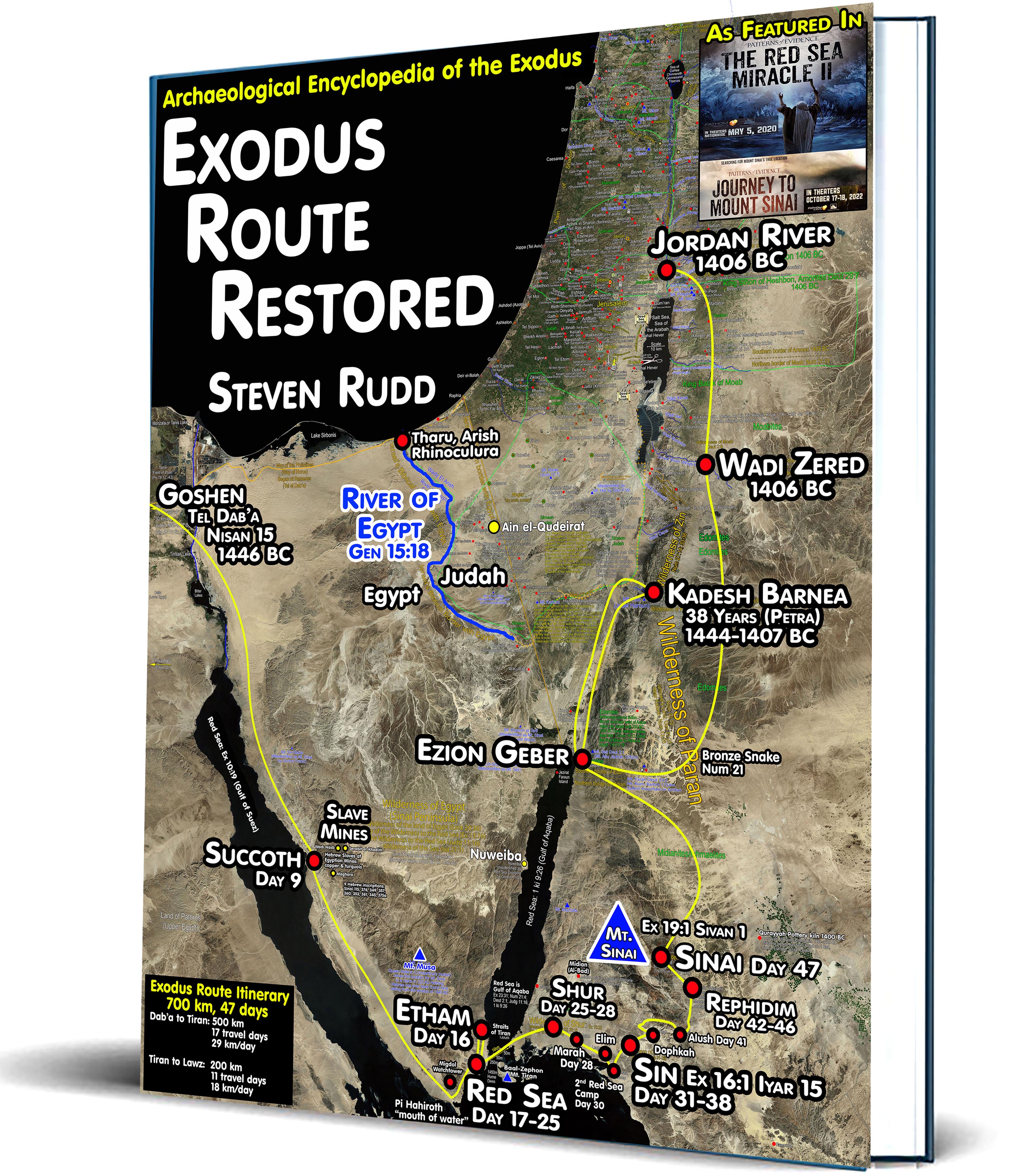
2. Buy the book! The details in this online monograph are sourced from Exodus Route Restored, by Steven Rudd, 2022.
3. Overview of the exodus: The Exodus story is surprising, shocking, dramatic, and orchestrated by the providence of God. In 1526 BC Amenhotep I killed the Hebrew children when his 15-year-old granddaughter, Hatshepsut adopted Moses from the Nile. Moses grew up as the rightful heir to the throne and Hatshepsut was never able to produce a male heir for her husband Thutmoses II (cf. Josephus Antiquities 2.232-233). When Moses about the age of 37, Thutmoses II had taken a second wife named Iset, who bore him a full-blooded heir to the throne named Thutmoses III. This was the Pharaoh of the exodus. The stage was set for a great battle for the Egyptian throne between the Hebrew adopted Moses and Thutmoses III. At age 40 (1486 BC) Moses killed an Egyptian, triggering death threats from his adoptive mother Hatshepsut and her husband Thutmoses II. The infanticide against baby Moses by Amenhotep I recurred at the hands of his own “mother” Hatshepsut 40 years later when she appointed several of her officials to hunt for Moses. The year after Moses fled to Midian, Thutmoses II died in 1485 BC and Thutmoses III ascended the throne, but since he was only an infant, Hatshepsut was coregent with him for 21 years until she died in 1464 BC. Another 18 years pass until Moses is told by God at the burning bush that “all the men who were seeking your life are dead.” (Ex 4:19) Those who wanted to kill Moses would not be limited to Thutmoses II who died the year after Moses fled, or Hatshepsut who died 21 years after Moses was in Midian, but likely included other high-ranking officials who recently died while Moses stood at the burning bush. In 1446 BC, 80-year-old Moses returned to Egypt and faced his 40-year-old stepbrother, Pharaoh Thutmoses III to claim the throne that was rightfully his as firstborn. Instead of saying, “I am Pharaoh, give me the throne as king of Egypt”, Moses demanded “let my people go as king of the Hebrews”! The tension, pride, heartbreak, and rivalry were intense. Meanwhile, Thutmoses III had two sons by two different wives. Firstborn Amenemhat died in the 10th plague and second born Amenhotep II succeeded his father 15 years later in 1431 BC and died the year Joshua crossed the Jordan in 1406 BC. The Amarna Letters recorded the conquest of Joshua in 382 cuneiform clay tablets that were sent to Thutmoses IV, firstborn son of Amenhotep II, who became Pharaoh the year the conquest began and his son Pharaoh Amenhotep III who died two years before Joshua in 1358 BC. As a witness to the Exodus and conquest by the monotheistic Hebrews, Pharaoh Akhenaten himself converted to pagan monotheism of sun worship. He founded the new capital city of Amarna where he housed the collection of 382 Amarna tablets as a monument to the power of monotheism. After Akhenaten died in 1341 BC, his son, King Tut reverted to the polytheistic gods of Egypt, buried the city of Amarna in sand and moved the capital back to Thebes. This was the same year that the faithless tribe of Dan set up their pagan silver/gold calf (Judg 17:4; 1 Ki 12:28) at the headwaters of the Jordan river as a stumbling block to the Hebrews. It remained there until the time of the Assyrian captivity in 723 BC and destruction of Solomon’s temple in 587 BC. The entire Amarna Tablets collection lay buried undisturbed for the next 3228 years until they were discovered intact in 1887 AD. What you read in the Book you find in the ground!
Buy “Exodus Route Restored” book by Steven Rudd
Click to order: Buy Exodus Route Restored
ISBN: 9798619062717
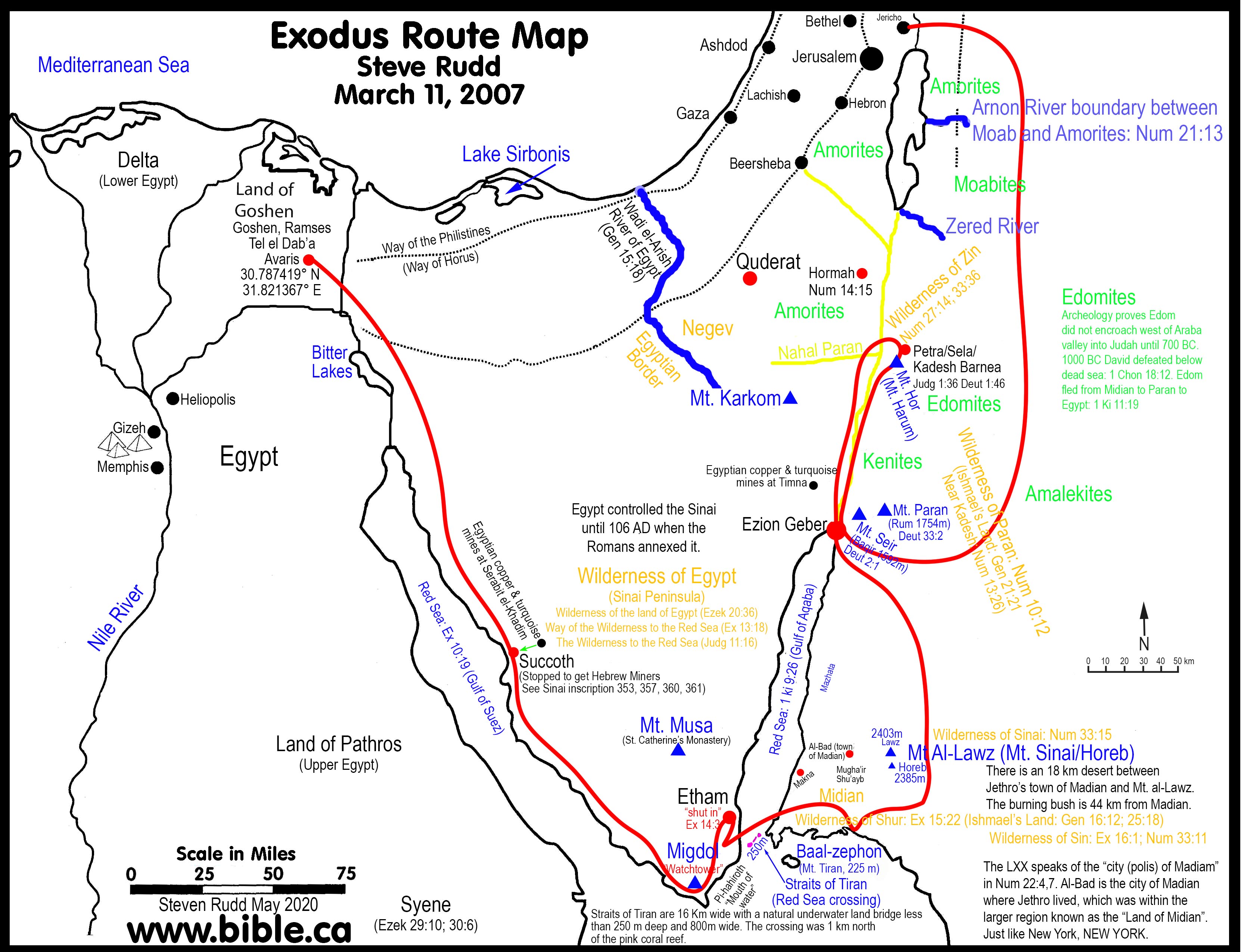
In AD 2005, using the Bible only, Steven Rudd identified 14 keys to decoding the Exodus Route with the Red Sea crossing at the Straits of Tiran, Mt. Sinai in Saudi Arabia and Kadesh Barnea at modern Petra. Then ancient literary sources and archaeology was found to confirm the route. What you read in the book you find in the ground!
|
Click to order: Buy Exodus Route Restored ISBN: 9798619062717
Click to order: Red Sea Miracles I & II
As featured in Tim Mahoney’s Patterns of Evidence “The Red Sea Miracle II” Coming to Theatres May 5, 2020
|
|

Click to order: Buy Exodus Route Restored
ISBN: 9798619062717
 Thutmoses
III was not the Pharaoh of Moses’ flight to Midian. The Pharaoh when Moses
fled to Midian didn’t need reign more than 40 years
Thutmoses
III was not the Pharaoh of Moses’ flight to Midian. The Pharaoh when Moses
fled to Midian didn’t need reign more than 40 years
Thirty-eight
continuous years at Kadesh Barnea
Miracles
of the Exodus and Red Sea Crossing
|
|
|
Click to order: Buy Exodus Route Restored
ISBN: 9798619062717
By Steve Rudd: Contact the author for comments, input or corrections.