The Exodus Route: 15 Stops between Kadesh Barnea to Jordan
 Exodus Route index page
Miracles of the Exodus and
Red Sea Crossing
The way of the
spies and Hormah
|
|
|
|
|
Exodus locations: |
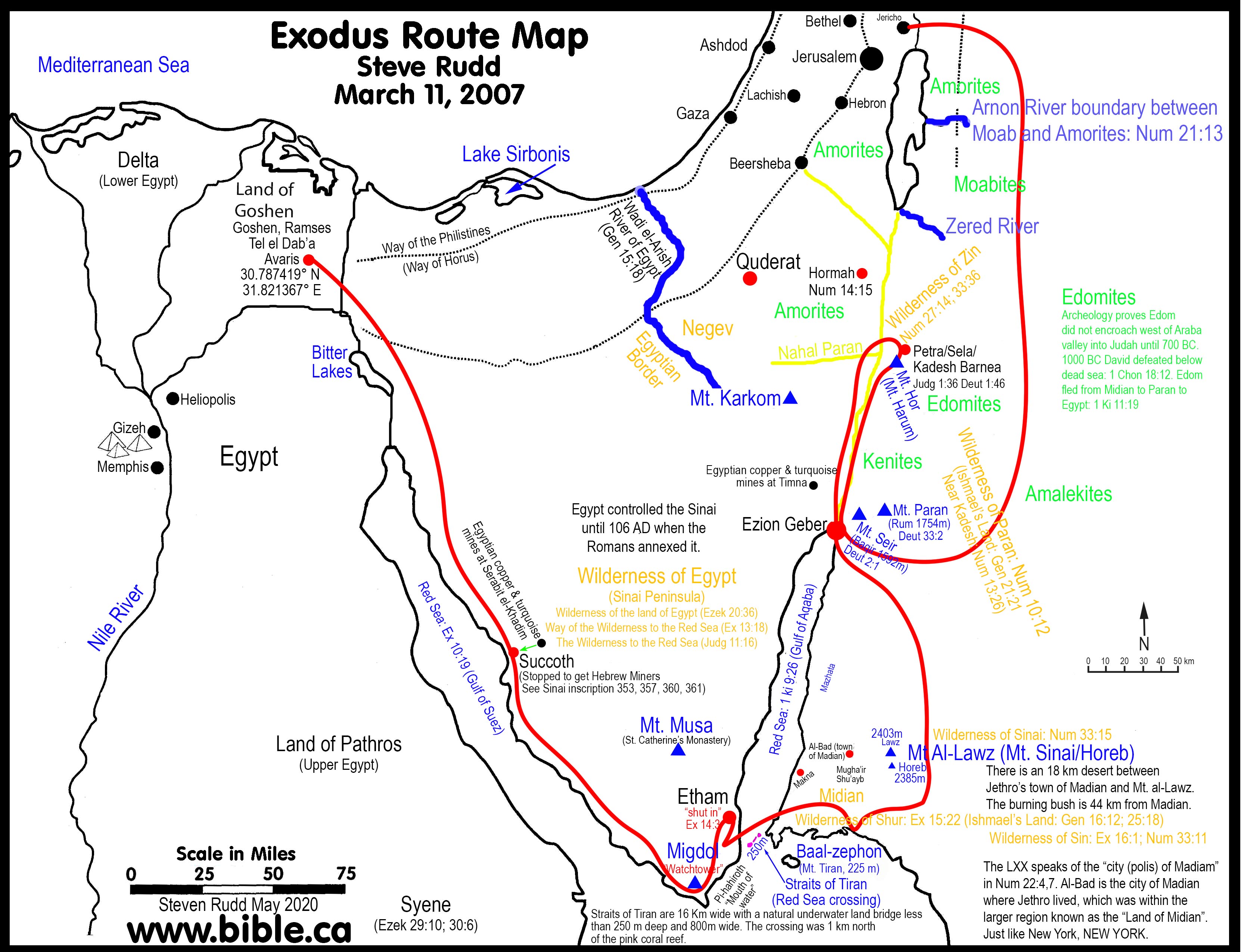
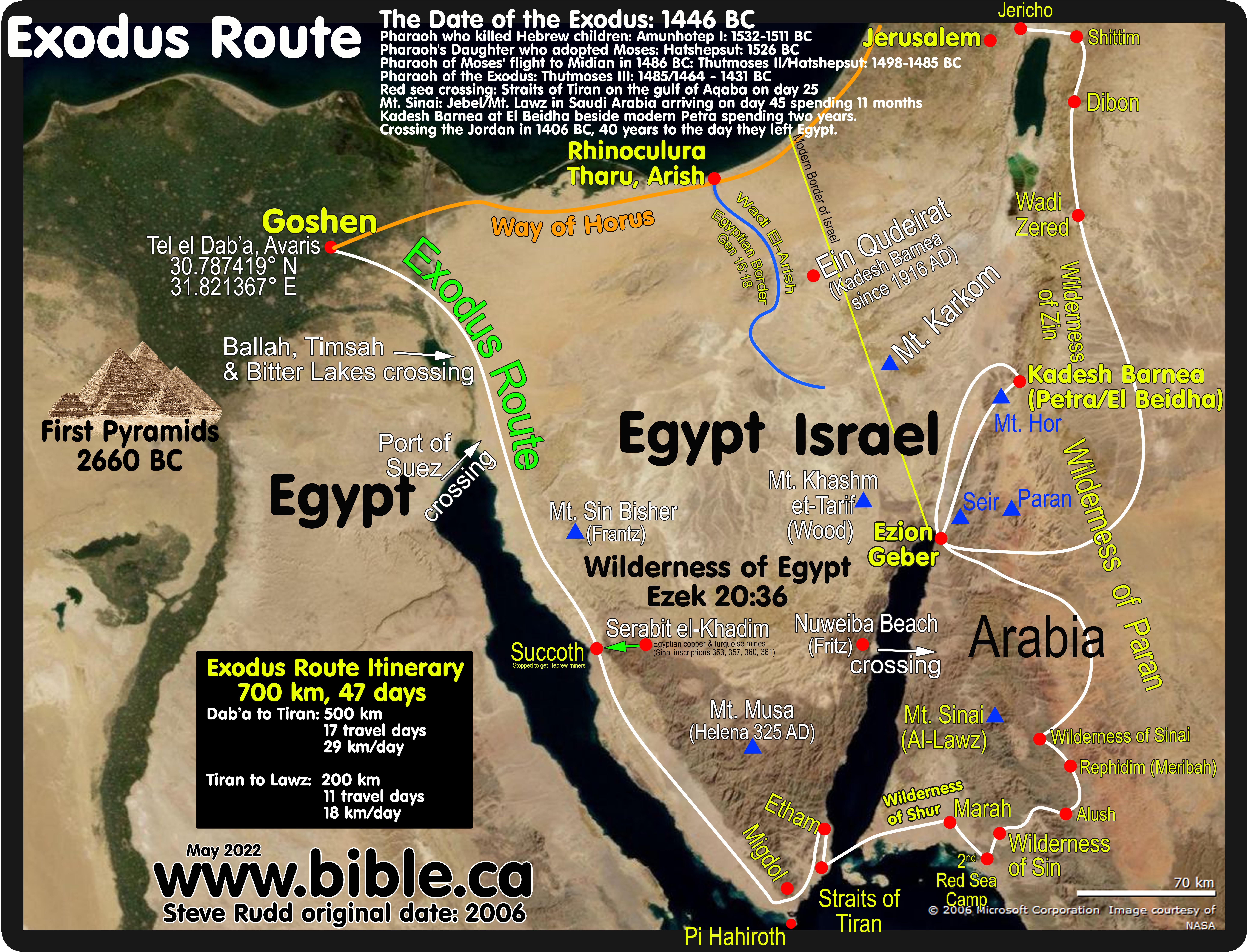

The sequence of movement after Mt. Sinai (modern Saudi Arabia):
A. They left Mt. Sinai and passed by Ezion Geber, then Mt. Seir, then came to Kadesh Barnea. This is almost a straight line of travel north. From this we know that Mt. Seir is south of Kadesh:
- "It is eleven days' journey from Horeb (Sinai) by the way of Mount Seir to Kadesh-barnea." Deuteronomy 1:2
- "They journeyed from Ezion-geber and camped in the wilderness of Zin, that is, Kadesh." Numbers 33:36
- ""Then we set out from Horeb, and went through all that great and terrible wilderness (of Paran) which you saw on the way to the hill country of the Amorites (which they never entered), just as the Lord our God had commanded us; and we came to Kadesh-barnea." Deuteronomy 1:19
B. From Kadesh Barnea, Moses sent the 12 spies to the northern edge of the wilderness of Zin across the Arabah valley into the Negev. It is important to note that Israel never actually sets foot in the negev during the 40 years in the wilderness. This proves that Kadesh Barnea cannot be at Ein el-Qudeirat or Ein Qedeis, since both are in the Negev, not to mention within the formal boundaries of the promised land.
- "When Moses sent them to spy out the land of Canaan, he said to them, "Go up there into the Negev; then go up into the hill country." Numbers 13:17
- "So they went up and spied out the land from the wilderness of Zin as far as Rehob, at Lebo-hamath." Numbers 13:21
C. A bad report came back and Israel rebelled and was forbidden to enter the promised land. Some disobeyed and attacked the Amorites on the western side of the Arabah valley. Many Jews were killed by the Amorites who lived in what would eventually become the territory of Judah. Notice that the Amorites defeated disobedient Israel from "Seir to Hormah", which is a straight line that parallels the southern Arabah valley. Israel was reprelled east of the Arabah valley to the border of Edom. Mt. Seir is due south of Kadesh on the east side of the Arabah valley. Hormah is north of Kadesh, just west of the Arabah valley.
- "The Amorites who lived in that hill country came out against you and chased you as bees do, and crushed you from Seir to Hormah." Deut 1:44
- "they (12 spies) proceeded to come to Moses and Aaron and to all the congregation of the sons of Israel in the wilderness of Paran, at Kadesh; and they brought back word to them and to all the congregation and showed them the fruit of the land." Numbers 13:26
D. After being forbidden to enter the promised land God told Moses to turn around and go south from Kadesh Barnea (near Petra) towards the Red Sea (Ezion Geber). It appears, however, that they never moved from Kadesh for the duration of the next 38 years. If they did move south, they came back soon after. Perhaps God changed his mind.
- "'But as for you, turn around (heading south towards Ezion Geber) and set out for the wilderness (Paran) by the way to the Red Sea.'" Deut 1:40
- ""Now the Amalekites and the Canaanites live in the valleys; turn tomorrow and set out to the wilderness by the way of the Red Sea." Numbers 14:25
E. They spent 38 years at Kadesh: "So you remained in Kadesh many days, the days that you spent there." Deuteronomy 1:46
1. Many commentators mistakenly believe Num 20:1 was the 40th year, but they are wrong. The verse tells us they arrived at Kadesh in the first month, but does not tell us the year! It does not say, "the first month in the 40th year". Since Israel left Sinai in the second month of the second year after leaving Egypt (14 months), this means they arrived at Kadesh in the first month of the third year after leaving Egypt or 24 months.
2. Click here for detailed outline that proves Israel never left Kadesh Barnea but spent 38 continuous years camped there.
F. Soon after, Korah Rebelled at Kadesh Barnea: (Numbers 16) This means that at Kadesh, the ground opened up somewhere and they fell in. Also the 250 elders of the tribes were killed by fire and their incense pans were hammered into plating for the alter of burnt incense as a constant reminder of that rebellion and that only Levites can offer incense. The next day 14,700 people died from a plague.
G. At Kadesh Barnea, Miriam dies and Moses strikes the rock twice for water and is forbidden to enter the promised land: (Numbers 20). This means that Kadesh did not have a large natural water supply except by miracle.
- ""Why have you made us come up from Egypt, to bring us in to this wretched place? It (Kadesh Barnea) is not a place of grain or figs or vines or pomegranates, nor is there water to drink."" Numbers 20:5
- "Then Moses lifted up his hand and struck the rock twice with his rod; and water came forth abundantly, and the congregation and their beasts drank. But the Lord said to Moses and Aaron, "Because you have not believed Me, to treat Me as holy in the sight of the sons of Israel, therefore you shall not bring this assembly into the land which I have given them."" Numbers 20:11-12
- Today, many sites are rejected as being possible candidates for Kadesh Barnes because there "is not enough water". Yet the real Kadesh Barnea of the Bible was described as a waterless place. There was a spring at the time of Abraham, but no evidence it was even still flowing at the time of the exodus in 1446 BC. Kadesh had a supernatural water supply.
- Before 1881 AD everyone felt that Kadesh was near or at Petra, but was rejected in favour of or Ein Qedeis in 1881 AD because it had a larger natural water supply.
- Then in 1905 AD, Ein Qedeis was rejected in favour of Ein el-Qudeirat because it had the largest water supply in the entire Sinai.
- To reject Petra, for example for Ein el-Qudeirat on the basis that Qudeirat had a large natural water supply and Kadesh none, is as ridiculous as it is faithless. The water at Ein el-Qudeirat is estimated to support 20 families at the most. This is ridiculous, since it could not support Israel in the wilderness. And ignoring that the water supply was miraculous, is faithless.
H. After 40 years were up and while at Kadesh Barnea, Moses twice asked the Edomites to pass through their land to finally enter the promised land. This route would have first been east from Petra (Kadesh Barnea), then straight north. Edom refused, and brought an army to the edge of Kadesh. This heartless action later brought about condemnation from God who pronounced extinction upon Edom. The same request was made of Moab, who also refused to let Israel pass. Israel stayed a bit longer at Kadesh. What is important to notice, is that Israel wanted to go from Kadesh Barnea and head due East to the Kings Highway, then north. This is the route they wanted to take, but instead they eventually went south to the Red Sea, east past the territory of Edom, then north, well east of the Kings Highway.
1. "then Israel sent messengers to the king of Edom, saying, "Please let us pass through your land," but the king of Edom would not listen. And they also sent to the king of Moab, but he would not consent. So Israel remained at Kadesh." Judges 11:17
2. "From Kadesh Moses then sent messengers to the king of Edom: "Thus your brother Israel has said, 'You know all the hardship that has befallen us; that our fathers went down to Egypt, and we stayed in Egypt a long time, and the Egyptians treated us and our fathers badly. 'But when we cried out to the Lord, He heard our voice and sent an angel and brought us out from Egypt; now behold, we are at Kadesh, a town on the edge of your territory. 'Please let us pass through your land. We will not pass through field or through vineyard; we will not even drink water from a well. We will go along the king's highway, not turning to the right or left, until we pass through your territory.' " Edom, however, said to him, "You shall not pass through us, or I will come out with the sword against you."" Numbers 20:14-18
3. Moses
had requested both Edom and Moab to pass through their land but were refused:
Judges 11:14-26. In about 1100 BC Jephthah asked the king of the Ammonites for
peace and recount the exodus period of 1406 BC:
"But Jephthah sent messengers again to the king of the sons of Ammon, and
they said to him, "Thus says Jephthah, 'Israel did not take away the land
of Moab nor the land of the sons of Ammon. 'For when they came up from Egypt,
and Israel went through the wilderness to the Red Sea and came to Kadesh, then Israel sent messengers to the king of Edom, saying,
"Please let us pass through your land," but the king of Edom would
not listen. And they also sent to the king of Moab, but
he would not consent. So Israel remained at Kadesh. 'Then they went
through the wilderness and around the land of Edom and
the land of Moab, and came to the east side of the land of Moab, and they
camped beyond the Arnon; but they did not enter the territory of Moab, for the
Arnon was the border of Moab. 'And Israel sent messengers to
Sihon king of the Amorites, the king of Heshbon, and Israel said to him,
"Please let us pass through your land to our place." 'But Sihon did
not trust Israel to pass through his territory; so Sihon gathered all his
people and camped in Jahaz and fought with Israel. 'The Lord, the God of
Israel, gave Sihon and all his people into the hand of Israel, and they
defeated them; so Israel possessed all the land of the Amorites, the
inhabitants of that country. 'So they possessed all the territory of the
Amorites, from the Arnon as far as the Jabbok, and from the wilderness as far
as the Jordan. 'Since now the Lord, the God of Israel, drove out the Amorites
from before His people Israel, are you then to possess it? 'Do you not possess
what Chemosh your god gives you to possess? So whatever the Lord our God has
driven out before us, we will possess it. 'Now are you any better than Balak
the son of Zippor, king of Moab? Did he ever strive with Israel, or did he ever
fight against them? 'While Israel lived in Heshbon and its villages, and in
Aroer and its villages, and in all the cities that are on the banks of the
Arnon, three hundred years, why did you not
recover them within that time?" Judges 11:14-26
4. "Thus says the Lord God, "Behold, I am against you, Mount Seir, And I will stretch out My hand against you And make you a desolation and a waste. "I will lay waste your cities And you will become a desolation. Then you will know that I am the Lord. "Because you have had everlasting enmity and have delivered the sons of Israel to the power of the sword at the time of their calamity, at the time of the punishment of the end," Ezekiel 35:3-5
5. "Thus says the Lord, "For three transgressions of Edom and for four I will not revoke its punishment, Because he pursued his brother with the sword, While he stifled his compassion; His anger also tore continually, And he maintained his fury forever." Amos 1:11
I. Finally they left Kadesh Barnea (Petra area) and Moses went due south towards Ezion Geber and came to Mt. Hor where Aaron died. They could not go north or east because of Edom's army. God wanted them to enter the promised land via the Jordan River, so they could not go west. So the only direction they could go is due south towards the Red Sea. They departed Kadesh Barnea traveled due south and came to Mt. Hor. This proves that Mt. Hor is south of Kadesh Barnea. This was the long route and Israel became impatient and angry because of the extra time it was going to take. If their destination was North west, why are thy going south, then east? Edom and Moab refused the easy direct route!
- Mt. Hor is south of Kadesh Barnea: "Thus Edom refused to allow Israel to pass through his territory; so Israel turned away from him. Now when they set out from Kadesh, the sons of Israel, the whole congregation, came to Mount Hor." Numbers 20:21-22
- "Take Aaron and his son Eleazar and bring them up to Mount Hor ... "When all the congregation saw that Aaron had died, all the house of Israel wept for Aaron thirty days." Numbers 20:25,29
- "Then they set out from Mount Hor by the way of the Red Sea, to go around the land of Edom; and the people became impatient because of the journey. Numbers 21:4
J. Mt. Hor to Mt. Seir: After Aaron died, they left Mt. Hor and continued to travel south (on the Arabah road) towards Ezion Geber at the Red sea and began to circle Mt. Seir for many days. This proves that Mt. Seir is south of both Kadesh Barnea and Mt. Hor. Most commentators view the "many days circling Mt. Seir", as being the full 38 years and the reference to Mt. Seir as the general territory. We see Mt. Seir at the a literal single mountain stronghold, not the general region of Edom. We understand that "Mt. Seir" in the Bible sometimes refers to the literal mountain and other times the entire territory of Edom. We believe we are correct because Israel just left Kadesh, where they had "spent many days" and then arrived at Mt. Seir. We view it as a few weeks or months literally circling Mt. Seir rather than a figurative moving around on the edge of Edomite territory for 38 years. Having said this, it is highly unusual that Israel would circle Mt. Seir, the capital of the territory of Edom, after Edom came to them by force further north at Mt. Hor and forbade them to cross through their land en route to the promised land. Perhaps it was a deliberate intimidating tactic by Israel, since God later pronounced that the entire nation of Edom would go into extinction for being cruel to their "brother" Israel. When they finally did cross near Edom God told them not to provoke or be arrogant towards them. Perhaps the circling was an "in your face" provocation to Edom to intimidate them, but God warned of this attitude when they finally did cross over through Edom's and Amon's land. God told Israel that Edom would be afraid of them, the same Edom who had come against them at Kadesh a few months before with a bold army. How things have now changed, they are almost taunting them into terror by circling their capital "mountain" city. Most notably, whereas they asked permission to cross twice and were denied, now they crossed in confidence without asking permission. However, it seems that Edom and Moab finally gave consent and allowed them to pass through their land. (Deut 2:28-29)
- Mt. Seir is south of both Kadesh Barnea and Mt. Hor: "Then we turned (south) and set out for the wilderness by the way to the Red Sea, as the Lord spoke to me, and circled Mount Seir for many days." Deuteronomy 2:1
- "command the people, saying, "You will pass through the territory of your brothers the sons of Esau who live in Seir; and they will be afraid of you. So be very careful; do not provoke them, for I will not give you any of their land, even as little as a footstep because I have given Mount Seir to Esau as a possession." Deuteronomy 2:4-5
- After crossing the Red Sea 40 years earlier: "Then the chiefs of Edom were dismayed; The leaders of Moab, trembling grips them; All the inhabitants of Canaan have melted away." Exodus 15:15
- To the Amorite King: "'let me pass through on foot, just as the sons of Esau (Edomites) who live in Seir and the Moabites who live in Ar did for me, until I cross over the Jordan into the land which the Lord our God is giving to us.'" Deuteronomy 2:28-29
K. Journey begins: Finally, after circling Mt. Seir for many days, in open defiance of the Edomites, God commanded them to go north to enter the promised land. However the actual route was south, then east across the wilderness of Paran, until they came to the eastern border of Edom and Moab. Then they turned north and passed by the way of the wilderness of Moab. They had traveled on the Arabah road and passed right by Elat and Ezion-Geber which were port cities of the Red Sea (Gulf of Aqaba). They went due east from Ezion-Geber, crossing the wilderness of Paran, then turning north, they skirted around the east side of Edom and Moab.
- "You have circled Mt. Seir long enough. Now turn north," Deuteronomy 2:3
- ""So we passed beyond our brothers the sons of Esau, who live in Seir, away from the Arabah road, away from Elath and from Ezion-geber. And we turned and passed through by the way of the wilderness of Moab." Deuteronomy 2:8
- "'Then they went through the wilderness and around the land of Edom and the land of Moab, and came to the east side of the land of Moab, and they camped beyond the Arnon; but they did not enter the territory of Moab, for the Arnon was the border of Moab." Judges 11:18
- "They journeyed from Oboth and camped at Iyeabarim, in the wilderness which is opposite Moab, to the east." Numbers 21:11
- From there they journeyed and camped on the other side of the Arnon, which is in the wilderness that comes out of the border of the Amorites, for the Arnon is the border of Moab, between Moab and the Amorites." Numbers 21:13
L. Bronze Snake: Somewhere after leaving Mt. Seir and the Ezion Geber area, travelling east then north to the wilderness of Moab, God sent snakes to bite and kill those who were impatient with the journey and were grumbling about the food. Moses set up the bronze serpent to save them if they looked at it. It would have been totally unfamiliar territory and it must have been terrifying for Israel. They had never been that far east before and they had no idea where they were really going. The snakes was the second last "culling of the unfaithful" of the 40 years in the wilderness.
- "Then they set out from Mount Hor by the way of the Red Sea, to go around the land of Edom; and the people became impatient because of the journey. The people spoke against God and Moses, "Why have you brought us up out of Egypt to die in the wilderness? For there is no food and no water, and we loathe this miserable food."" Numbers 21:4-5
- " The Lord sent fiery serpents among the people and they bit the people, so that many people of Israel died." Numbers 21:6
- "And Moses made a bronze serpent and set it on the standard; and it came about, that if a serpent bit any man, when he looked to the bronze serpent, he lived." Numbers 21:9
M. They camped in the valley of the Zered wadi, and Moses addressed the people. Zered is the boundary between Edom and Moab. They were well east of Moab's territory. Duet 1:2 contrasts nicely with 2:14. They could have been left Mt. Sinai and been in the promised land in a few weeks, but instead, because of their sin, rebellion, faithlessness and disobedience, the 11 day journey took 38 years.
- "It is eleven days' journey from Horeb by the way of Mount Seir to Kadesh-barnea." Deuteronomy 1:2
- "They journeyed from Oboth and camped at Iyeabarim, in the wilderness which is opposite Moab, to the east. From there they set out and camped in Wadi Zered." Numbers 21:11-12
- "So we passed beyond our brothers the sons of Esau, who live in Seir, away from the Arabah road, away from Elath and from Ezion-geber. And we turned and passed through by the way of the wilderness of Moab." Deuteronomy 2:8
- "'Now arise and cross over the brook Zered yourselves.' So we crossed over the brook Zered. Now the time that it took for us to come from Kadesh-barnea until we crossed over the brook Zered was thirty-eight years, until all the generation of the men of war perished from within the camp, as the Lord had sworn to them." Deuteronomy 2:13-14
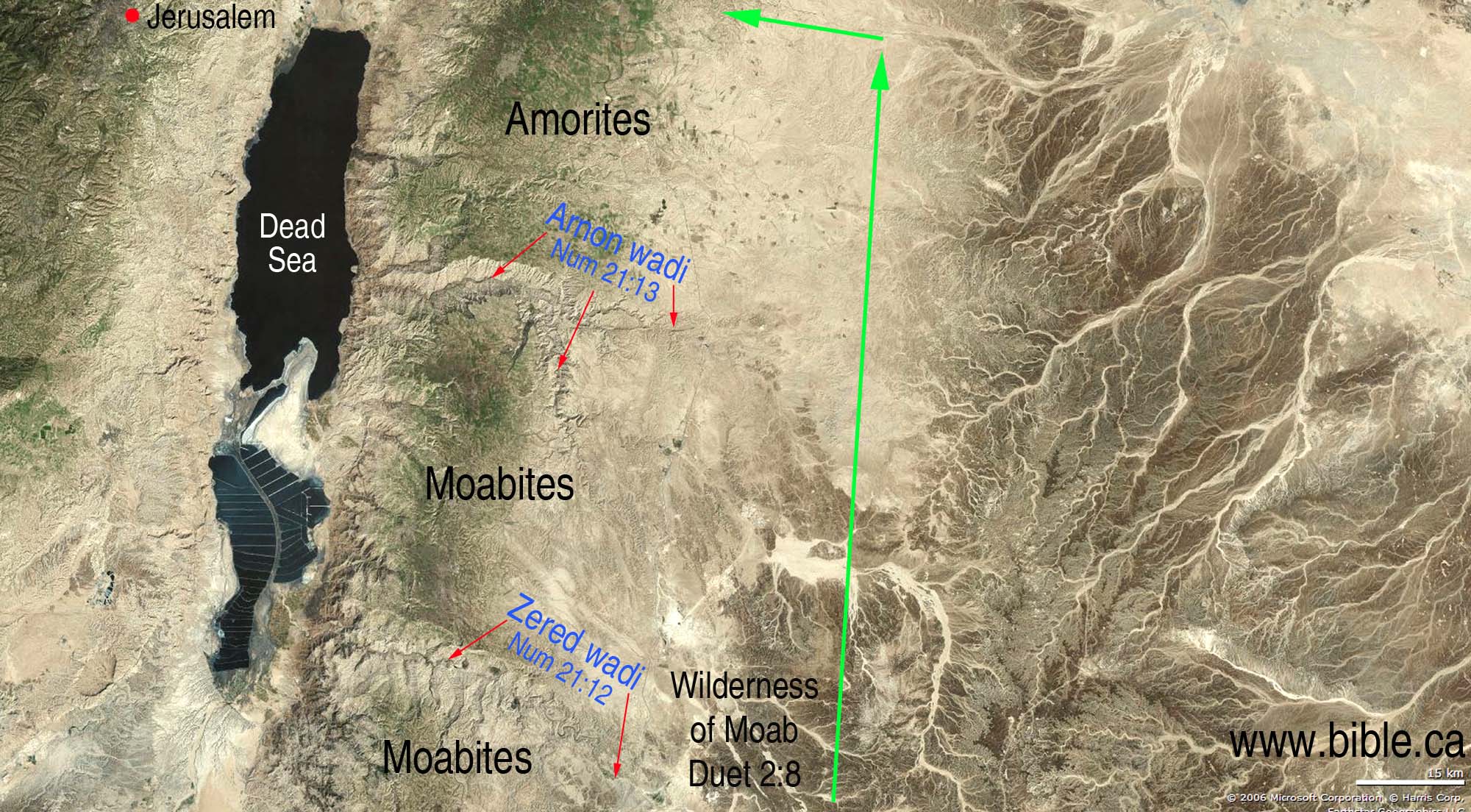
N. The conquest begins. God led Israel east of Moab's and the Amorites territory and remained outside their land. After camping in the dry riverbed of the Zered wadi, they crossed the Zered and began to move north. Crossing the Zered, marks the formal beginning of the conquest. God told Moses that he would put fear into the hearts of the gentiles and they would be defeated. Israel was due east of Jericho and needed to travel west, to cross the Jordan. While still outside the Amorite territory, Israel politely asked permission to cross their land, as Edom and Moab had finally allowed. The Amorites came by force with an army supposing that Israel would retreat, like they did several months when the Edomites brought their army against Israel. This time God told them to fight and the Amorites were destroyed and Israel lived in their cities.
- "And we turned (north) and passed through by the way of the wilderness of Moab." Deuteronomy 2:8
- "'Now arise and cross over the brook Zered yourselves.' So we crossed over the brook Zered." Deuteronomy 2:13
- "'Then they went through the wilderness and around the land of Edom and the land of Moab, and came to the east side of the land of Moab, and they camped beyond the Arnon; but they did not enter the territory of Moab, for the Arnon was the border of Moab." Judges 11:18
- From there they journeyed and camped on the other side of the Arnon, which is in the wilderness that comes out of the border of the Amorites, for the Arnon is the border of Moab, between Moab and the Amorites." Numbers 21:13
- To the Amorite King: "'let me pass through on foot, just as the sons of Esau (Edomites) who live in Seir and the Moabites who live in Ar did for me, until I cross over the Jordan into the land which the Lord our God is giving to us.'" Deuteronomy 2:28-29
- "'Arise, set out, and pass through the valley of Arnon. Look! I have given Sihon the Amorite, king of Heshbon, and his land into your hand; begin to take possession and contend with him in battle. 'This day I will begin to put the dread and fear of you upon the peoples everywhere under the heavens, who, when they hear the report of you, will tremble and be in anguish because of you.' "So I sent messengers from the wilderness of Kedemoth to Sihon king of Heshbon with words of peace, saying," Deuteronomy 2:24-26
O. Defeat of Amorties: Moses asks the King of the Amorites permission to pass through their land and were refused. Like Edom a few months earlier, they came by force with an army to prevent Israel from passing through their land. Israel attacked and defeated the Amorites and took possession of their land. It is important to note that this parcel of land was never originally part of the land promised to Abraham.
- "Then Israel sent messengers to Sihon, king of the Amorites, saying, "Let me pass through your land. We will not turn off into field or vineyard; we will not drink water from wells. We will go by the king's highway until we have passed through your border." But Sihon would not permit Israel to pass through his border. So Sihon gathered all his people and went out against Israel in the wilderness, and came to Jahaz and fought against Israel. Then Israel struck him with the edge of the sword, and took possession of his land from the Arnon to the Jabbok, as far as the sons of Ammon; for the border of the sons of Ammon was Jazer. Israel took all these cities and Israel lived in all the cities of the Amorites, in Heshbon, and in all her villages." Numbers 21:21-25
- "'Then I brought you into the land of the Amorites who lived beyond the Jordan, and they fought with you; and I gave them into your hand, and you took possession of their land when I destroyed them before you." Joshua 24:8
- "Thus Israel lived in the land of the Amorites." Numbers 21:31
P. Moses never set foot in the "promised land": Amorite territory was never originally part of the promised land. Israel told the Amorites that they did not want to posses their land and asked permission to cross over. For "breaking faith" with God by taking credit for bringing water out of the rock at Kadesh Barnea 38 years earlier, Moses was forbidden to actually set foot in the promised land. He was told that he could only view it from the top of Mt. Pisgah. Although Mt.Pisgah was in Amorite territory and not part of the land promised to Abraham, Gad and Reuben made a special request, as an exception, to be given the land as their inheritance. Moses allowed this exception based upon the condition that the men would fight along side Israel on the other side of the Jordan. If they did not join them in the fight, the deal was off and they would be given part of the land promised to Abraham. In this way there is no contradiction with Moses being forbidden to set foot in the promised land, yet walked through the Amorite land, that would by exception, become part of the promised land given to the tribes Gad and Reuben. Had the Amorites granted permission for Moses to cross their land, it would never had been part of the promised land.
- To the Amorite King: "'let me pass through on foot, just as the sons of Esau (Edomites) who live in Seir and the Moabites who live in Ar did for me, until I cross over the Jordan into the land which the Lord our God is giving to us.' ""But Sihon king of Heshbon was not willing for us to pass through his land; for the Lord your God hardened his spirit and made his heart obstinate, in order to deliver him into your hand, as he is today." Deut 2:28-30
- "Then Moses lifted up his hand and struck the rock twice with his rod; and water came forth abundantly, and the congregation and their beasts drank. But the Lord said to Moses and Aaron, "Because you have not believed Me, to treat Me as holy in the sight of the sons of Israel, therefore you shall not bring this assembly into the land which I have given them."" Numbers 20:11-12
- "'Not one of these men, this evil generation, shall see the good land which I swore to give your fathers, except Caleb the son of Jephunneh; he shall see it, and to him and to his sons I will give the land on which he has set foot, because he has followed the Lord fully.' "The Lord was angry with me also on your account, saying, 'Not even you shall enter there. 'Joshua the son of Nun, who stands before you, he shall enter there; encourage him, for he will cause Israel to inherit it." Deuteronomy 1:35-38
- "'Let me (Moses), I pray, cross over and see the fair land that is beyond the Jordan, that good hill country and Lebanon.' "But the Lord was angry with me on your account, and would not listen to me; and the Lord said to me, 'Enough! Speak to Me no more of this matter. 'Go up to the top of Pisgah and lift up your eyes to the west and north and south and east, and see it with your eyes, for you shall not cross over this Jordan. 'But charge Joshua and encourage him and strengthen him, for he shall go across at the head of this people, and he will give them as an inheritance the land which you will see.' "So we remained in the valley opposite Beth-peor." Deuteronomy 3:25-29
- ""Now the Lord was angry with me on your account, and swore that I would not cross the Jordan, and that I would not enter the good land which the Lord your God is giving you as an inheritance. "For I will die in this land, I shall not cross the Jordan, but you shall cross and take possession of this good land." Deuteronomy 4:21-22
- "Then the Lord said to Moses, "Go up to this mountain of Abarim, and see the land which I have given to the sons of Israel. "When you have seen it, you too will be gathered to your people, as Aaron your brother was; for in the wilderness of Zin, during the strife of the congregation, you rebelled against My command to treat Me as holy before their eyes at the water." (These are the waters of Meribah of Kadesh in the wilderness of Zin.)" Numbers 27:12-14
- ""For it is not an idle word for you; indeed it is your life. And by this word you will prolong your days in the land, which you are about to cross the Jordan to possess." The Lord spoke to Moses that very same day, saying, "Go up to this mountain of the Abarim, Mount Nebo, which is in the land of Moab opposite Jericho, and look at the land of Canaan, which I am giving to the sons of Israel for a possession. "Then die on the mountain where you ascend, and be gathered to your people, as Aaron your brother died on Mount Hor and was gathered to his people, because you broke faith with Me in the midst of the sons of Israel at the waters of Meribah-kadesh, in the wilderness of Zin, because you did not treat Me as holy in the midst of the sons of Israel. "For you shall see the land at a distance, but you shall not go there, into the land which I am giving the sons of Israel."" Deuteronomy 32:47-52
- "Moses said to them, "If the sons of Gad and the sons of Reuben, everyone who is armed for battle, will cross with you over the Jordan in the presence of the Lord, and the land is subdued before you, then you shall give them the land of Gilead for a possession; but if they will not cross over with you armed, they shall have possessions among you in the land of Canaan." The sons of Gad and the sons of Reuben answered, saying, "As the Lord has said to your servants, so we will do. "We ourselves will cross over armed in the presence of the Lord into the land of Canaan, and the possession of our inheritance shall remain with us across the Jordan." So Moses gave to them, to the sons of Gad and to the sons of Reuben and to the half-tribe of Joseph's son Manasseh, the kingdom of Sihon, king of the Amorites and the kingdom of Og, the king of Bashan, the land with its cities with their territories, the cities of the surrounding land." Numbers 32:29-33
Q. Defeat of Moabites and Baalam's prophecy: Moab sent word back to the elders of the town of Midian (modern Al-Bad) near mount Sinai in modern Saudi Arabia to hire Balaam to curse Israel.
- "So the elders of Moab and the elders of Midian departed with the fees for divination in their hand; and they came to Balaam and repeated Balak's words to him." Numbers 22:7
- "'Then Balak the son of Zippor, king of Moab, arose and fought against Israel, and he sent and summoned Balaam the son of Beor to curse you. 'But I was not willing to listen to Balaam. So he had to bless you, and I delivered you from his hand." Joshua 24:9-10
- "Woe to them! For they have gone the way of Cain, and for pay they have rushed headlong into the error of Balaam, and perished in the rebellion of Korah." Jude 11
- "forsaking the right way, they have gone astray, having followed the way of Balaam, the son of Beor, who loved the wages of unrighteousness;" 2 Peter 2:15
R. The last major slaughter of the Jews at the hands of God came at Shittim where they worshipped Baal of Peor by mingling with the pagan women of Midian. God killed 24,000 Jews there. Midian, who had allied with was defeated by Israel.
- "Take full vengeance for the sons of Israel on the Midianites; afterward you will be gathered to your people. Moses spoke to the people, saying, "Arm men from among you for the war, that they may go against Midian to execute the Lord's vengeance on Midian." Numbers 31:2-3
- "The Lord said to Moses, "Take all the leaders of the people and execute them in broad daylight before the Lord, so that the fierce anger of the Lord may turn away from Israel."" Numbers 25:4
- "Those who died by the plague were 24,000." Numbers 25:9
S. Crossed the Jordan exactly 40 years to the day after leaving Goshen:
1. Aaron died on the 1st day of the 5th month of the 40th year of the wilderness wandering (summer 1407 BC).
2. Shortly after mourning Aaron for 30 days, the people left Mount Hor, defeated the Transjordan nations, and then mourned for Moses 30 days.
3. They crossed the Jordan on the 10th day of the 1st month of the 41st year (spring, 1406 BC), four days before the 41st Passover, which was exactly 40 years to the day they left Goshen.
4. They started counting sabbatical years and Jubilee after crossing the Jordan. (Num 33:38; 20:28; Deut 34:8; Josh 4:19; 5:10)
The 15 stops between Kadesh and the Jordan
|
wilderness of Zin, that is, Kadesh Kadesh Barnea |
"Then the sons of Israel, the whole congregation, came to the wilderness of Zin in the first month; and the people stayed at Kadesh. Now Miriam died there and was buried there." Numbers 20:1 "So they went up and spied out the land from the wilderness of Zin as far as Rehob, at Lebo-hamath." Numbers 13:21 "for in the wilderness of Zin, during the strife of the congregation, you rebelled against My command to treat Me as holy before their eyes at the water." (These are the waters of Meribah of Kadesh in the wilderness of Zin.)" Numbers 27:14 "because you broke faith with Me in the midst of the sons of Israel at the waters of Meribah-kadesh, in the wilderness of Zin, because you did not treat Me as holy in the midst of the sons of Israel. " Deuteronomy 32:51 |
|
1. Mount Hor, at the edge of the land of Edom |
"Now when they set out from Kadesh, the sons of Israel, the whole congregation, came to Mount Hor. Then the Lord spoke to Moses and Aaron at Mount Hor by the border of the land of Edom, saying, " Numbers 20:22-23 "Then they set out from Mount Hor by the way of the Red Sea, to go around the land of Edom; and the people became impatient because of the journey. " Numbers 21:4 "So we passed beyond our brothers the sons of Esau, who live in Seir, away from the Arabah road, away from Elath and from Ezion-geber. And we turned and passed through by the way of the wilderness of Moab." Deuteronomy 2:8 "They journeyed from Kadesh and camped at Mount Hor, at the edge of the land of Edom. Then Aaron the priest went up to Mount Hor at the command of the Lord, and died there in the fortieth year after the sons of Israel had come from the land of Egypt, on the first day in the fifth month. Aaron was one hundred twenty-three years old when he died on Mount Hor. Now the Canaanite, the king of Arad who lived in the Negev in the land of Canaan, heard of the coming of the sons of Israel." Numbers 33:37-40 |
|
2. Zalmonah "shady" (Enhanced Strong's Lexicon) |
"Then they journeyed from Mount Hor and camped at Zalmonah." Numbers 33:41 |
|
3. Punon. "darkness" (Enhanced Strong's Lexicon) bronze snake |
"They journeyed from Zalmonah and camped at Punon." Numbers 33:42 "Then they set out from Mount Hor by the way of the Red Sea, to go around the land of Edom; and the people became impatient because of the journey. The people spoke against God and Moses, "Why have you brought us up out of Egypt to die in the wilderness? For there is no food and no water, and we loathe this miserable food." The Lord sent fiery serpents among the people and they bit the people, so that many people of Israel died. So the people came to Moses and said, "We have sinned, because we have spoken against the Lord and you; intercede with the Lord, that He may remove the serpents from us." And Moses interceded for the people. Then the Lord said to Moses, "Make a fiery serpent, and set it on a standard; and it shall come about, that everyone who is bitten, when he looks at it, he will live." And Moses made a bronze serpent and set it on the standard; and it came about, that if a serpent bit any man, when he looked to the bronze serpent, he lived. Now the sons of Israel moved out [from Punon] and camped in Oboth." Numbers 21:4-10 "He removed the high places and broke down the sacred pillars and cut down the Asherah. He also broke in pieces the bronze serpent that Moses had made, for until those days the sons of Israel burned incense to it; and it was called Nehushtan." 2 Kings 18:4 "As Moses lifted up the serpent in the wilderness, even so must the Son of Man be lifted up so that whoever believes will in Him have eternal life." John 3:14-15 |
|
4. Oboth "water-skins" (NASB dictionary and Enhanced Strong's Lexicon) |
"They journeyed from Punon and camped at Oboth." Numbers 33:43 "Now the sons of Israel moved out and camped in Oboth." Numbers 21:10 |
|
5. Iye-abarim or Iyim "ruins of Abarim" (Enhanced Strong's Lexicon) at the southern or eastern border of Moab. |
"They journeyed from Oboth and camped at Iyeabarim, in the wilderness which is opposite Moab, to the east. From there they set out and camped in Wadi Zered." Numbers 21:11-12 "They journeyed from Oboth and camped at Iye-abarim, at the border of Moab." Numbers 33:44 |
|
6. Zered Wadi "From an unused root meaning to be exuberant in growth" (Enhanced Strong's Lexicon) |
"From there [Iyim or Iyeabarim] they set out and camped in Wadi Zered." Numbers 21:12 Literally: "woody brook-valley" The book of Deuteronomy was written from here. |
|
7. Dibon-gad.
"wasting Gad" (Enhanced Strong's Lexicon) |
"They journeyed from Iyim [Iye-abarim] and camped at Dibon-gad." Numbers 33:45 The Moabite Stone, which was discovered at Dhiban in 1868, describes King Mesha's rebellion against Israel and the reestablishment of Moabite independence (ca. 840 b.c.). Line one of this inscription refers to Mesha as 'the Dibonite.' It is clear that ninth-century Dibon was important for military, political, and religious reasons. The site's continuing importance is confirmed by later references to Dibon in Isa. 15:2, 9 and Jer. 48:18, 22. Excavations were conducted at Dibon between 1950 and 1956; these investigations recovered material from the Early Bronze, Iron Ages I-II, Nabatean, Roman, Byzantine, and Arab periods (3000 b.c.-a.d. 1500), but there is a notable absence of Middle and Late Bronze Age remains. |
|
|
The list of Numbers 33 jumps from Dibon to Almon-diblathaim. The 5 stops of Arnon, Beer, Mattanah, Nahaliel, Bamoth are missing from the list of stops in Numbers 33. These 5 stops may be listed in the now lost: "Book of the Wars of Yahweh" (Num 21:14) Bamoth is listed with Dibon in the territory of Reuben: Joshua 13:15-19 |
|
8. Arnon "rushing stream" (Enhanced Strong's Lexicon) |
"From there [wadi Zered] they journeyed and camped on the other side of the Arnon, which is in the wilderness that comes out of the border of the Amorites, for the Arnon is the border of Moab, between Moab and the Amorites." Numbers 21:13 |
|
9. Beer "well" (Enhanced Strong's Lexicon) |
Miraculous water from the well "Beer" means well and is probably not a name. "From there they continued to Beer, that is the well where the Lord said to Moses, "Assemble the people, that I may give them water." Then Israel sang this song: "Spring up, O well! Sing to it! "The well, which the leaders sank, Which the nobles of the people dug, With the scepter and with their staffs." And from the wilderness they continued to Mattanah," Numbers 21:16-18 |
|
10. Mattanah |
And from the wilderness they continued to Mattanah," Numbers 21:16-18 |
|
11. Nahaliel |
"and from Mattanah to Nahaliel" Numbers 21:19 |
|
12. Bamoth |
"and from Nahaliel to Bamoth," Numbers 21:19 "Heshbon, and all its cities which are on the plain: Dibon and Bamoth-baal and Beth-baal-meon," Joshua 13:17 |
|
|
The list of Numbers 33 resumes here. The 5 stops of Arnon, Beer, Mattanah, Nahaliel, Bamoth are missing from the list of stops in Numbers 33. "So Moses gave an inheritance to the tribe of the sons of Reuben according to their families. Their territory was from Aroer, which is on the edge of the valley of the Arnon, with the city which is in the middle of the valley and all the plain by Medeba; Heshbon, and all its cities which are on the plain: Dibon and Bamoth-baal and Beth-baal-meon, and Jahaz and Kedemoth and Mephaath, and Kiriathaim and Sibmah and Zereth-shahar on the hill of the valley," Joshua 13:15-19 |
|
13. Almon-diblathaim "concealing the two cakes". (Enhanced Strong's Lexicon) |
"They journeyed from Dibon-gad and camped at Almon-diblathaim." Numbers 33:46 |
|
14. Mt. Nebo Pisgah Abarim "regions beyond" (Enhanced Strong's Lexicon) mountains of Abarim, before Nebo. |
"They journeyed from Almon-diblathaim and camped in the mountains of Abarim, before Nebo." Numbers 33:47 "and from Bamoth to the valley that is in the land of Moab, at the top of Pisgah which overlooks the wasteland." Numbers 21:20 |
|
15. Jordan River plains of Moab by the Jordan opposite Jericho. Beth-jesimoth = "house of the desolation" (Enhanced Strong's Lexicon) Abel-shittim "meadow of acacias" (Enhanced Strong's Lexicon) |
"They journeyed from the mountains of Abarim and camped in the plains of Moab by the Jordan opposite Jericho. They camped by the Jordan, from Beth-jeshimoth as far as Abel-shittim in the plains of Moab." Numbers 33:48-49 Jordan River in the plains of Moab by the Jordan opposite Jericho. |
By Steve Rudd: Contact the author for comments, input or corrections.