Origin of Synagogues in Alexandria in 280 BC as a prototype of the Church
|
|
Bible Blueprint Decalogue Curriculum 150 pages, 8.5 x 11, full color or digital |
See also: Origin of Synagogues website
Synagogues began in Alexandria Egypt in 280 B.C.
Steven Rudd AD 2017
Introduction:
See also: Origin of Synagogues website
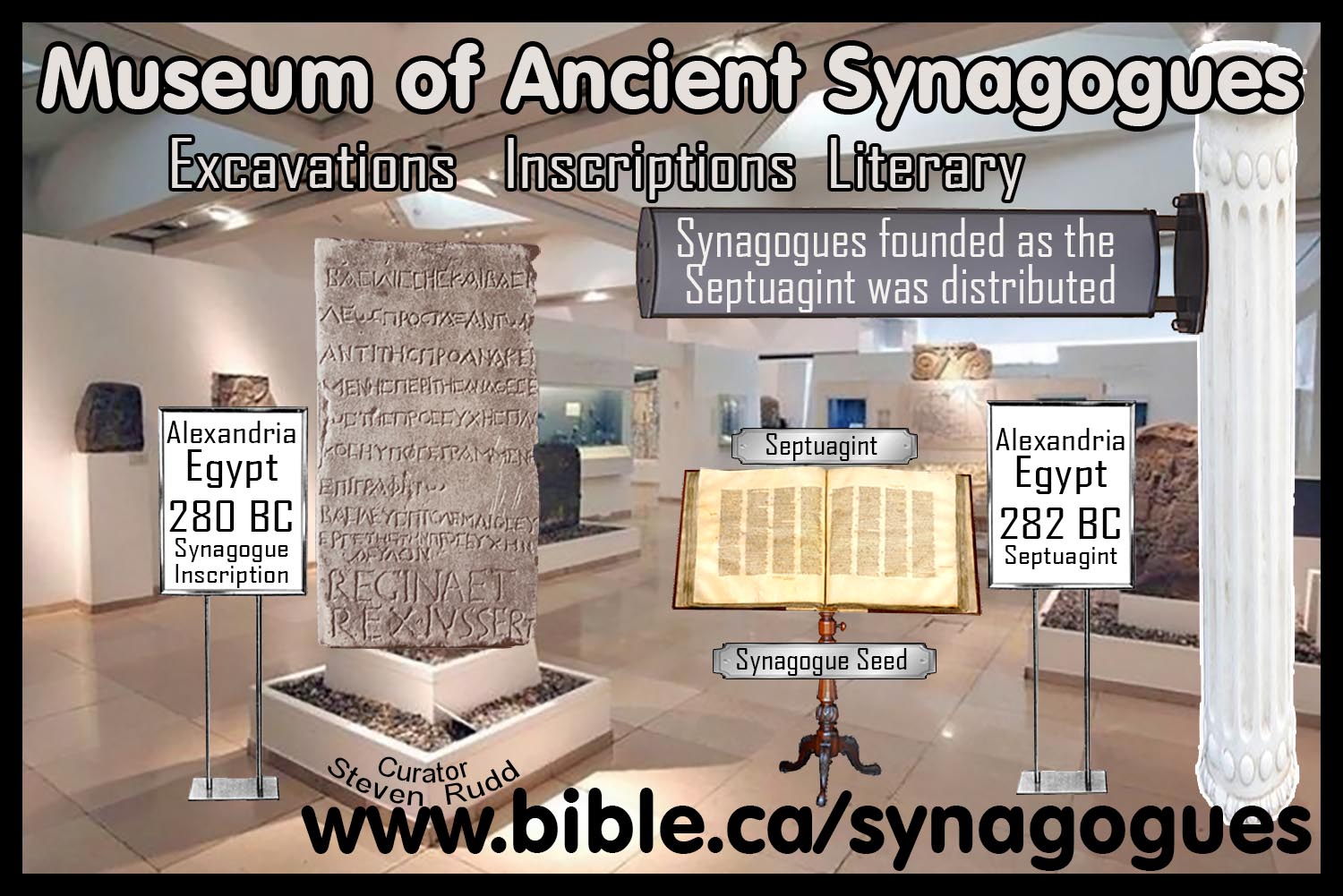
The very first Synagogue on earth was the “Great Basilica Synagogue of Alexandria (Egypt: 280 BC - 117 AD) referenced by Philo in 38 AD, which the Jerusalem Talmud in 400 AD says Hadrian destroyed in 117 AD. Synagogues originated in 280 BC at Alexandria, Egypt as a direct result of Ptolemy II translating the Hebrew Torah in the Greek Septuagint. In fact, by Philo 38 AD, Explicitly dated the origin of Synagogues to 262 BC in Egypt. By the time of Jesus, there were thousands of synagogues in the world and more than 400 in Jerusalem alone. The Greek Tanakh (LXX) was the “standard issue, Jerusalem certified” translation used in every synagogue because Hebrew was functionally extinct in the world by 100 BC. This book, published in May 2017 AD by Steven Rudd identifies 54 second temple period synagogue buildings from archeological top plans, inscriptions and literary sources. For the Jew, this book provides an historically and scientifically accurate view of their amazing Hebrew faith and worship in the ancient synagogue as they transitioned away from Temple worship. Indeed most Jews are unaware that Mosaic Judaism (1446 BC – 70 AD) went irrevocably extinct with the destruction of Herod’s temple. Jewish weekly sabbath day synagogue worship is nowhere to be found in the inspired Tanakh and is as much a human origin, manmade system as weekly Friday worship in a Mosque. For the Christian, this book provides the tools and evidence to prove that the church of the first century was an exact replica of the Jewish Synagogue which YHWH adopted, certified and “rubber stamped” with His approval in the pages of the 27 New Testament books of the Christian Bible. The great prophecy: “Out of Egypt did I call my Son”. Moses and Israel were called out of Egypt (1446 BC), Jesus was called out of Egypt (1 AD), and the church (33 AD) via Synagogues that began in Egypt in 280 BC, were called “Out of Egypt”.
See also: Synagogues originated at Alexandria Egypt in 280 BC spawned by the Septuagint
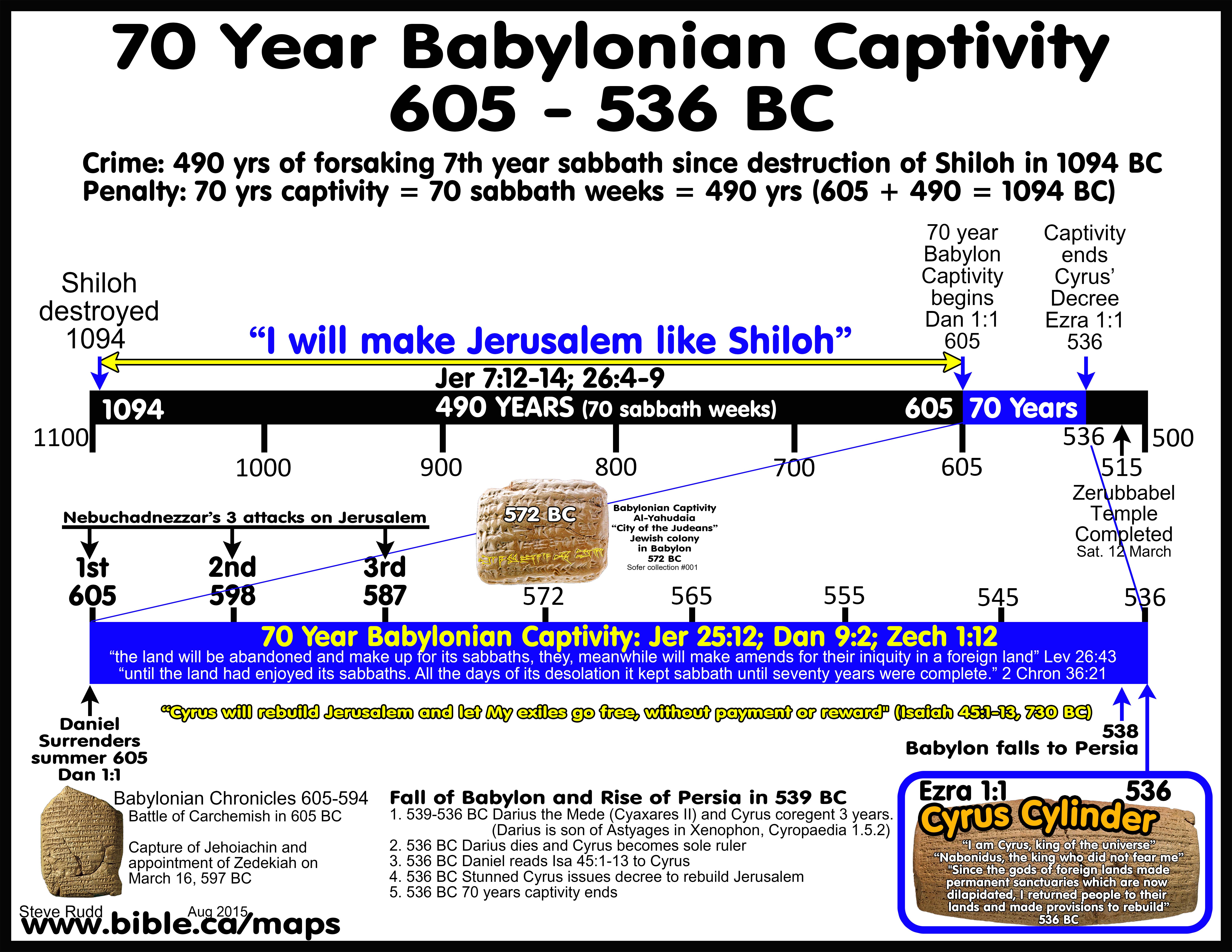
It was God’s providential plan at the beginning of the Babylonian captivity in 605 BC to prepare the children of Abraham for the coming of Jesus their Messiah through the synagogue which was the prototype of the Church of Christ which began on resurrection Sunday morning on 5 April 33 AD. It was then that God’s eternal plan in the Garden of Eden was fully realized in a gradual historic transition from patriarchal worship, to temple worship, to synagogue worship and finally the church. Archeology without a Bible foundation is just a pile of worthless sand. Without faith it is impossible to please YHWH and without faith in the historical accuracy of the New Testament it is impossible to discover the origin and purpose of Synagogue worship in relation to God’s eternal plan.
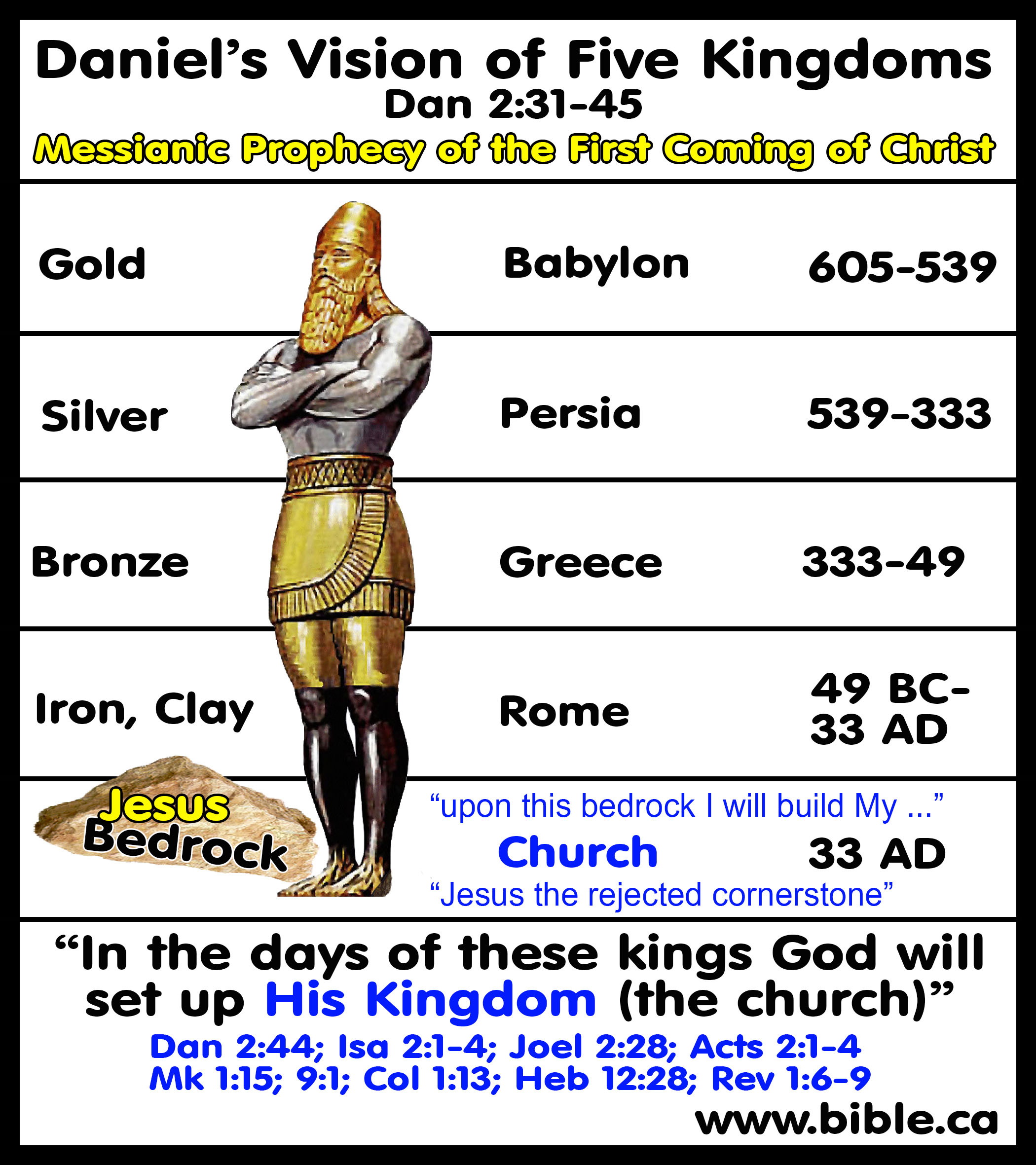
From the Garden of Eden, God purposed to send his Son Jesus Christ the Messiah, to save all mankind through his shed blood on the cross. Nothing in physical Israel’s history was by chance. God’s plan was seen in the prophecy of Daniel 2 in the vision of the five kingdoms, Babylon, Persia, Greece, Rome, Church which spanned a history of 605 BC – 33 AD) God’s eternal purpose in the Garden was the Church. Daniel’s prophecy is about the transition from Mosaic temple worship to the Christian church. God’s plan was to quickly spread the good news of eternal salvation through Jesus’ blood to the entire world but some huge changes needed to take place.
|
|
The Church was the 5th kingdom of Daniel 2 1. First in the Babylonian captivity and the Persian empire, it spread Jews to every part of the world. 2. Second, God used Alexander the Great in 333 AD to make the Greek universal language of both Jew and Gentile. 3. Third, in 282 BC, God used Ptolemy II to create a “Jerusalem certified” translation of the Hebrew scriptures in Alexandria Egypt for a large population of Jews who spoke exclusively Greek and were “unable to read the Hebrew Bible for themselves”. 4. Fourth, God gave independence back to the Jewish nation for a brief 47 years under the Maccabees (110 - 63 BC) to standardize synagogues worship and ensure each one had a copy of the Septuagint in preparation for the Christian missionaries. |
See also: God’s eternal plan: The providential transition from Temple to Synagogue to Church
Archaeological and literary evidence supports the existence of 55 synagogues from the late second temple period. The synagogue system, a bridge connecting the temple and the church, emerges in Alexandria, Egypt in 280 BC, as a direct result of the Greek translation of the Septuagint (LXX) in 282 BC, which served the spiritual needs of the local Jewish community. Small groups likely met in homes to pray and study Torah. Being functionally illiterate in Hebrew, Greek was their lingua franca. These home groups became the millieu out of which the synagogue system emerges. Think of the Septuagint as synagogue seed because wherever copies were distributed, a synagogue, initially called a “house of prayer” (Greek: proseuche) was born.
The first synagogue, The Great Basilica Synagogue of Alexandria, appears around 280 B.C. and operates until its destruction by Hadrian in A.D. 117.[1] This synagogue and the hundreds that follow serve as a prototype of the church in form, function, and liturgy.
From Temple to Synagogue to Church
Daniel’s surrender in 605 B.C. not only marked the beginning of the 70-year Babylonian captivity, but it also began the transition from Mosaic Judaism to Christianity. Daniel’s two messianic “time” prophecies (Dan 2:44, 9:24) created a window of expectation for the coming of the messiah between 49 B.C., with the rise of Rome, the 4th kingdom, and the resurrection of Jesus in A.D. 33, which marked the end of the 70 weeks. Daniel 2 indicates that the kingdom of God (the 5th kingdom) would be established at the same time as the 4th kingdom (Rome). The 70 weeks of Daniel 9 starts at the decree to rebuild Jerusalem (Artaxerxes I in 458 B.C., Ezra 7:8) and ends with the coming of the Messiah (A.D. 33, resurrection), which is exactly 490 years to the solar day.
The overlay of messianic prophecy onto observable history reveals that synagogues may have been God’s provisional step between the temple and the church. The A.D. 70 destruction of the Jerusalem temple results in the extinction of Mosaic Judaism. Ironically today, the Rabbinical synagogue system is Judaism’s only liturgical option where weekly sabbath services have a church-like feel.
Two popular views:
Among Jews today, there are two contradictory theories about the origin of synagogues.
First, it is widely believed among the Rabbinical faith community that synagogues began in Babylon during the captivity of 605 B.C. in the absence of the Solomonic temple. However, there are no references to synagogues in the Old Testament, no early literary references or inscriptions, and no archaeological remains for any synagogue in Babylon. The Jerusalem Talmud (A.D. 400) references the “synagogue of Babylonians” which was in use in Zippori (not Babylon) around A.D. 160 in connection with Rabbi Yose who wrote the Sedar Olam.[2] The Babylonian Talmud (A.D. 500) references the “synagogue of Shaf VeYativ in Nehardea” at the time of the 605 B.C. captivity, but this very late source follows a pattern of defining a synagogue as any place Torah is read and is purely conjectural.[3] The tradition that the exiles who were deported with Jehoiachin in 597 B.C., hauled stone and dirt from the Jerusalem temple site to build a synagogue in Nehardea lacks credibility. While Josephus records a sizable population of Jews at Nehardea Babylon who send their half-shekel temple tax to Jerusalem in the first century, there is no reference to any synagogue there.[4]
Second, some archaeologists reject the existence of synagogues before A.D. 70, theorizing their emergence was a replacement of the temple only after its destruction. The archaeological and literary evidence soundly refutes this conclusion. Their views are summed up by archaeologist Rachel Hachlili who says,
“New Testament accounts of activities in 'synagogues' do not necessarily reflect the historical reality of the time.”[5]
“Kloppenborg holds that it is possible that Luke ("for he loves our nation and it was he who built us our synagogue.” Luke 7:5) added these verses, thus they do not provide compelling evidence of the synagogue as a building; Luke might be presenting a later Diaspora practice rather than early 1st c. CE Galilean one. The Gospel writings refer to an assembly and make no comments that could clearly testify to the existence of an architectural structure called a synagogue.”[6]
“The destruction of Jerusalem and the Temple was a turning point in the creation of the synagogue, in terms of both architecture and the customs and rituals practiced. The response to the catastrophe of 70 CE was the adoption of Torah reading, study, and prayer as a replacement for the sacrificial cult, making public worship the custom of the synagogue. This new, important, and unique Jewish institution already existed during the Second Temple period.”[7]
“As long as the Temple existed in Jerusalem, the Jews were careful to avoid any competition with it.”[8]
“The evidence of structures dating from the first century B.C.E. to the first century C.E. at remote sites in the Land of Israel and in the Diaspora, taken together with the terms proseuche, synagogue and beth knesset, indicates that the communal structures we call synagogues served as multipurpose places of assembly. Certainly it is conceivable that the pre-70 C.E. structures had didactic functions as well as being centres for assembly and for the community, but they were not places of cult or worship.”[9]
The bias among some archaeologists against the NT as evidence that synagogues existed before A.D. 70 leads them to wrongly conclude that they were born in the religious vacuum after the temple’s destruction. However, when archaeologists dismiss a major literary source like the New Testament, it is a red warning flag they are very wrong. The recent discovery of the Magdala synagogue, which dates to 50 B.C., has become the Achilles' heel of their bias.
The Septuagint was the progenitor of the synagogue
Daniel 8:8 likely refers to both Alexander the Great and Ptolemy I. These rulers played pivotal roles in the transition from synagogue to church. After the destruction of the first temple on 10th Av 587 B.C. the Jews living in Babylon adopted Aramaic as their working language. With the conquest of Alexander in 333 B.C., Greek became the dominant language for the diaspora Jews.[10] In Judea, the Jews were bilingual with Aramaic continuing as the mother tongue in the home, but Greek served as the language of the marketplace.[11] Jesus was probably quadrilingual in Aramaic, Greek, Latin and Hebrew.[12] Ptolemy I built the Library of Alexandria, and his son Ptolemy II translated the Torah into Greek for the Library. It is reasonable to speculate that the Greek speaking Jews at Alexandria quickly made copies of the Septuagint and began gathering in small groups to read/study Scripture and pray. Wherever the new Greek Bible was distributed to the diaspora Jews throughout the world, they too would gather on the Sabbath to read and pray. The synagogue movement therefore, was born out of the translation of the Septuagint.
The translation work at Alexandria paved the way for the ministry of the Apostles in two ways. First, by equipping thousands of synagogues inside and outside Judea, with an authorized translation of the Hebrew scriptures. Second, Christian baptism was facilitated because each synagogue had a Mikveh (immersion pool) in which worshippers would immerse every Sabbath before entering the synagogue for ritual purity.[13] [14] Since weekly worship is absent from Mosaic Judaism, only the most devout Jews participated in synagogue worship by freewill. This is reflected in synagogue excavations where perimeter bench-seating capacity averaged 50 worshippers.
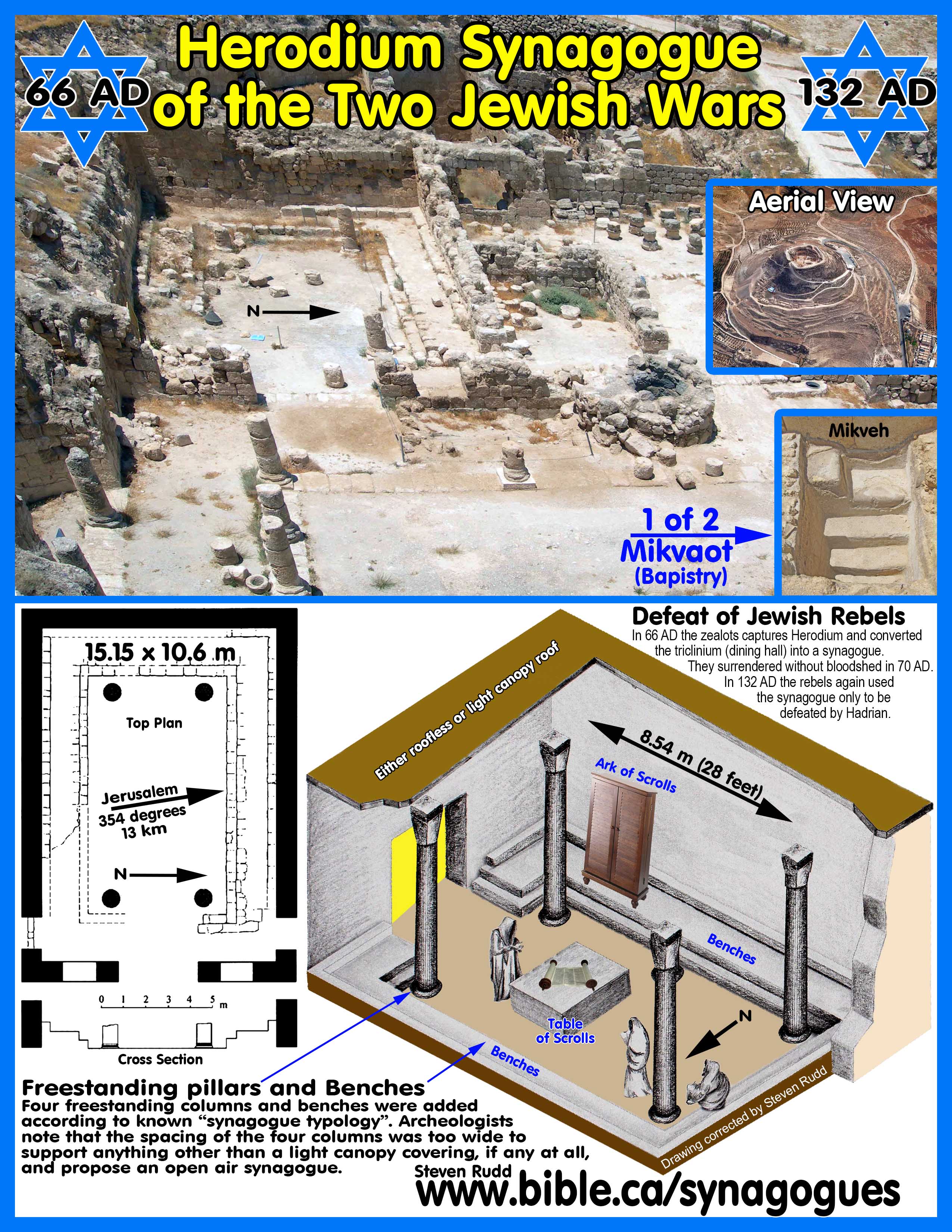
Herodium Synagogue with seating for 40
The church is an exact replica of the synagogue in work and worship:
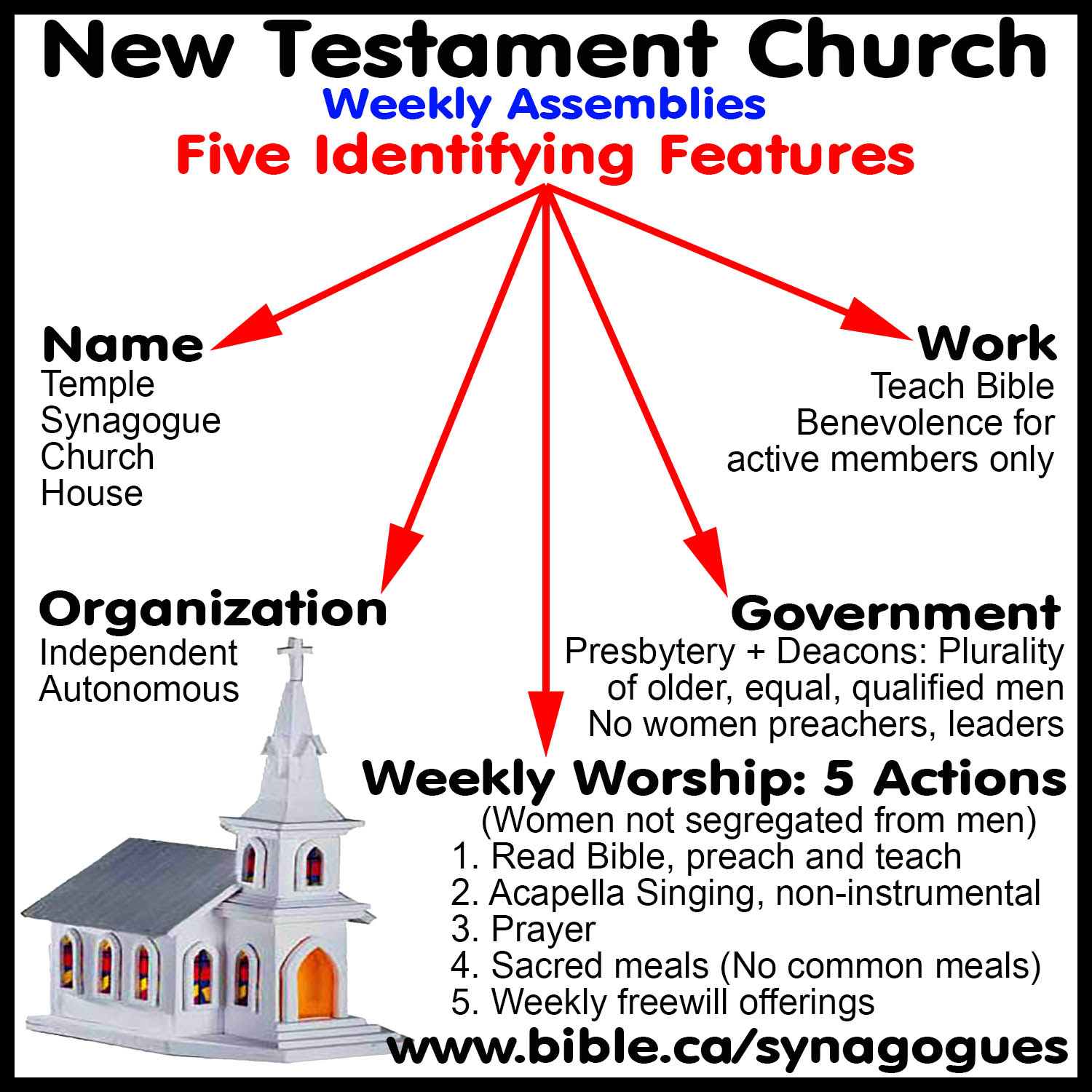
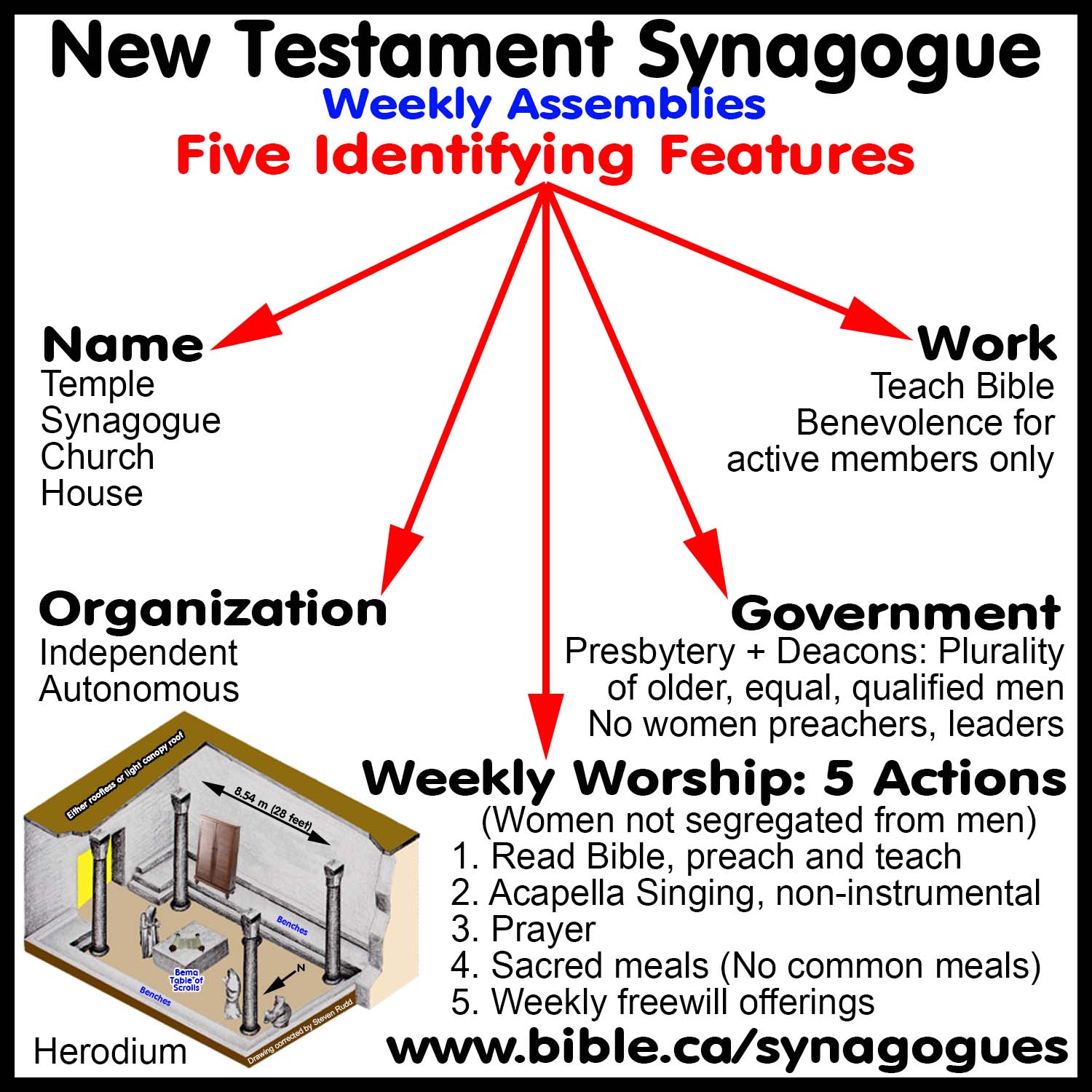
There was no segregation of men and women in synagogue worship. [15] Instead, husbands, wives and children worshipped together just like in churches today.[16] Instead of segregation by gender, families were grouped by vocation and sorted by age.[17] [18] [19] Each man read from and had access to a complete copy of the Greek Tanakh which was stored in the Ark of the Scrolls in the synagogue. [20] Singing in synagogues was in responsive acapella style.[21] [22] [23] [24] [25] Weekly freewill contributions were collected each Sabbath and sent to Jerusalem.[26] [27] [28] Local synagogue government was Presbyterian.[29] [30] Sacred communion meals were eaten several times a year with unleavened bread and leaven-free grape juice as witnessed by the Elephantine Papyri,[31] and synagogue Mazzot ovens excavated at Masada and Ostia. The first century church was identical to synagogues in almost every way.
All this providentially prepared the Jewish people to become accustomed to what would become church worship, which was very different from temple worship. The Jewish synagogue was a prototype of the Christian Church in form, function and worship, just waiting for Apostle Paul to preach about Jesus the risen Messiah. Paul walked into Berea, quoted messianic passages which the Bereans “examined daily” for themselves from their own synagogue Septuagint Tanakh (Acts 17:11). The Septuagint was the standard issue Tanakh, and the accepted and trusted translation in every synagogue much like the King James Version was in up to the 19th century AD.[32] They would then be baptized in the synagogue Mikveh. God created a vast network of independent Jewish synagogues before the birth of Christ, that appear to be an exact replica of what the Christian church was to become.
The church adopted its format from the synagogue, not the other way around.[33] The earliest church was similar in worship, liturgy and function to the synagogue. Jewish sources call the synagogue a “church” [ecclesia][34]. James 2:1 called the church a “synagogue” [synagogos]. Jewish Rabbis of the first century even preached the same kind of uplifting sermon topics, designed to enrich every day life and endure daily battles as in the church today.[35]
|
The Synagogue was the prototype of the Christian Church for Worship and Function Prototype |
|||
|
Prototype |
Jerusalem Temple |
Synagogue |
Church |
|
Who controlled |
Sadducees:
|
Not
initially, but by 100 B.C. Pharisees took over control. |
Christians: Jew and Gentile |
|
Weekly attendance |
No (3 times a year) |
Yes: every Sabbath (7th day) |
|
|
Government |
Levitical High priest Sole top authority |
Democracy: Body of equal rulers (Mark 5:22, 35-36, 38; Luke 8:41, 13:14) |
Democracy: plurality of equal elders/ bishops/ shepherds. 1 Tim 3; Tit 1 |
|
Clericalism |
Yes: Non-priests who entered the Holy Place were stoned. |
No: Any Jew could lead any event in the synagogue. |
No: Every Christian is a priest. Any man can preach, read, pray or officiate communion. |
|
Age of participation |
30 years for priests: Num 4. Ezek 1:1; John the Baptist and Jesus: Luke 3:23 |
Any pubescent boy |
Any baptized boy |
|
Independent and Autonomous |
Yes |
Yes |
Yes until 4th century when the diocese was invented. |
|
Animal sacrifices |
Yes |
No |
No |
|
Focal point |
Outward ritual of sacrifice & libation |
Inward devotion of Torah study & prayer |
Inward devotion of Bible study & prayer |
|
Physical “no go zones” for common Jews in building |
Yes |
No |
Not until the 4th century when the clergy/laity distinction was invented. |
|
Who can access the Torah inside the “Ark” (Bible). |
Only Priests can touch Ark of Covenant. |
Any Jew can access the Ark of Scrolls in the synagogue. |
All Christians have equal access to Bible in church. |
|
Instrumental Music in worship |
Yes |
No |
No. Until 1054 A.D. |
|
Who conducted public Bible readings in 30 A.D. |
Priest in Hebrew which no one understood because the masses spoke Aramaic and Greek. |
Any Jew in Greek which all understood |
Any Christian in Greek which all understood |
|
Language of Scripture |
Hebrew |
Greek Septuagint |
Greek Septuagint |
|
Physical worship |
Most sacrifices kept at distance from the people. |
All drew close to with spiritual events equally |
Everyone directly shares the most sacred blood and body in Communion |
|
Bible experts |
High Priest |
Pharisees |
Ministers and overseers |
|
Names |
temple [hieron] |
house of prayer [proseuche], Synagogue [synagōgē], Church [ekklesia], Temple, House |
Synagogue [synagōgē], Church [ekklesia], Temple, House |
|
Water of purification (Mode) |
Brass Laver (Sprinkling) |
Mikveh (immersion) |
Baptism (immersion) |
|
Water of purification (purpose) |
Brass Laver (remove sin) |
Mikveh (remove sin) |
Baptism: Acts 22:16 (Remove sin) |
|
Clothing after purification (clothed with garments of salvation) |
Garments of salvation: Priests special clothing. |
Mikveh: Isaiah 61:10 (wore white robe after immersion) |
Baptism (“Put on” Christ: Gal 3:26-27) |
|
Legal civil system |
Levitical priests |
Board of Elders |
Christians |
|
Worship liturgy |
Animal sacrifices, song, prayer, bread, incense, candles |
Holy bread, song, prayer, public reading of scripture, preaching, collections |
Break bread, song, prayer, public reading of scripture, preaching, collections |
|
Freestanding Columns |
Solomon’s two freestanding temple columns: (Jachin, Boaz) 1 Kings 7:21 |
The Herodium Synagogue had freestanding columns that were symbolic not structural |
Christians are the freestanding columns and the church is the pillar of truth. 1 Tim 3:15; Rev 3:12. The first church buildings had columns. |
|
Refugee sanctuary |
Yes “horns of altar” 1 Ki 1:50; 2:28 Cities of refuge. |
Yes: Refugee Asylum Sanctuary Status in Synagogues |
Yes: Refugee Asylum Sanctuary Status in Churches |
|
Sacred meals eaten |
Yes Passover |
Yes Passover |
Yes Communion |
|
Common meals eaten |
Yes (priests ate the leftover portion of sacrifices animals) |
No. |
No:
Forbidden in |
|
Frequency of eating unleavened bread |
Mazzot: yearly |
Mazzot: yearly |
Communion: weekly |
|
Women segregated in worship |
YES. temple had a separate court for the women, as seen in the Wailing Wall today. |
No: women sat with husbands and children |
No: women sat with husbands and children |
|
Women reading, praying, teaching, leading worship |
No |
No: A woman is seductive (Talmud, b. Ber. 3:5, I.16.F) |
No: Flat forbidden 1 Tim 2:12 |
|
Schools |
No |
Every Synagogue was a school |
Every church is a school |
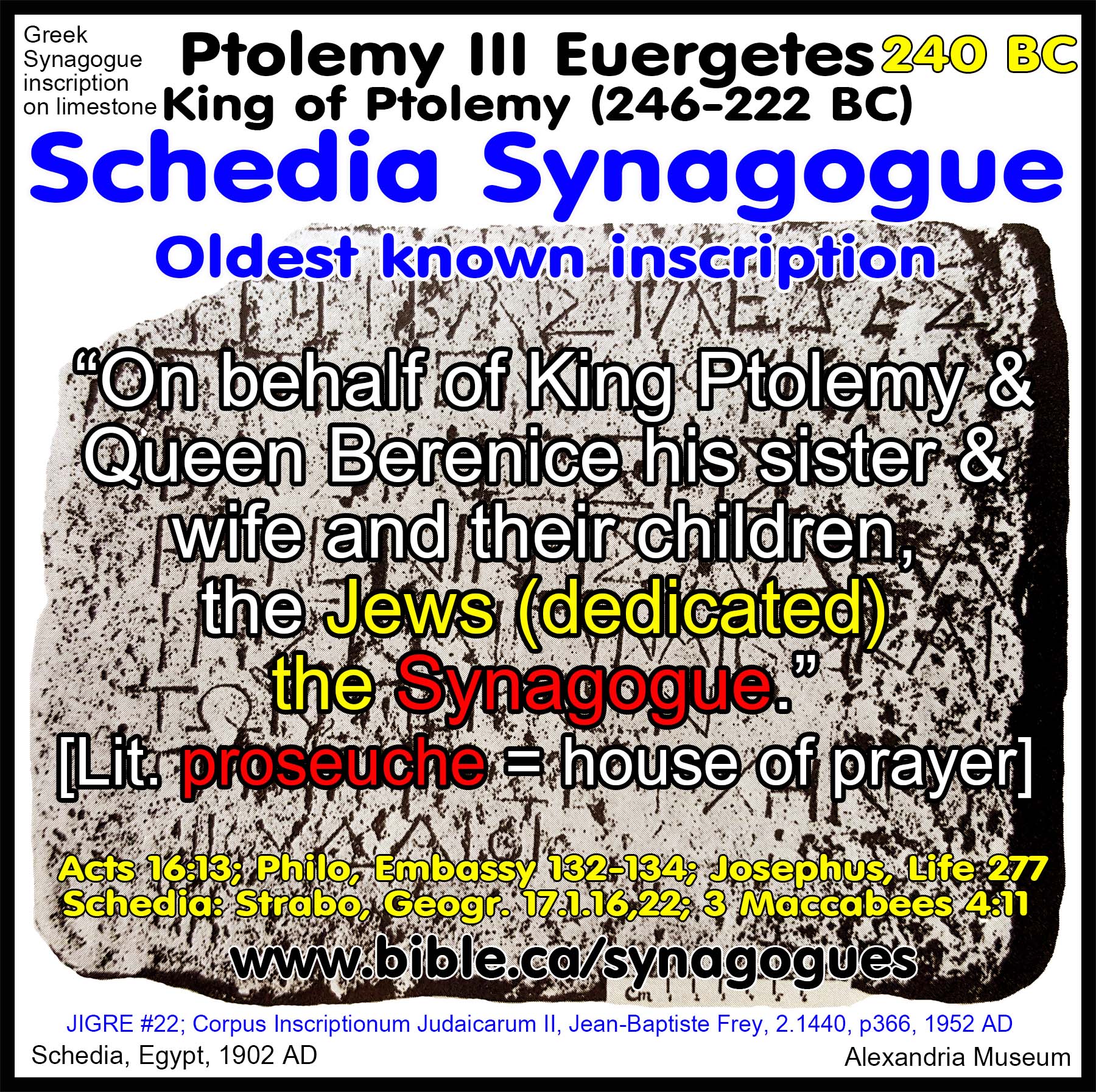
Oldest known synagogue inscription in the world:
Evidence for 55 second temple synagogues:
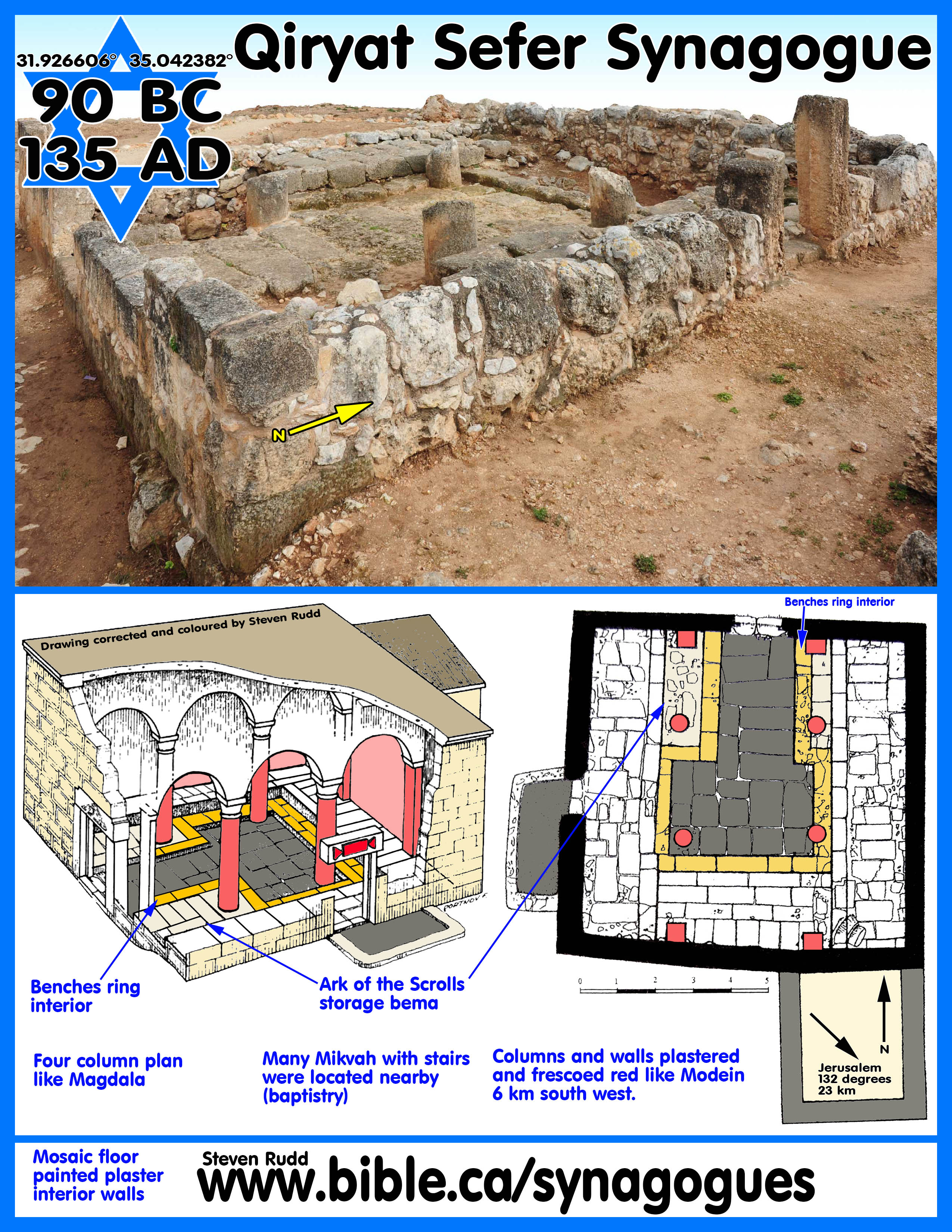
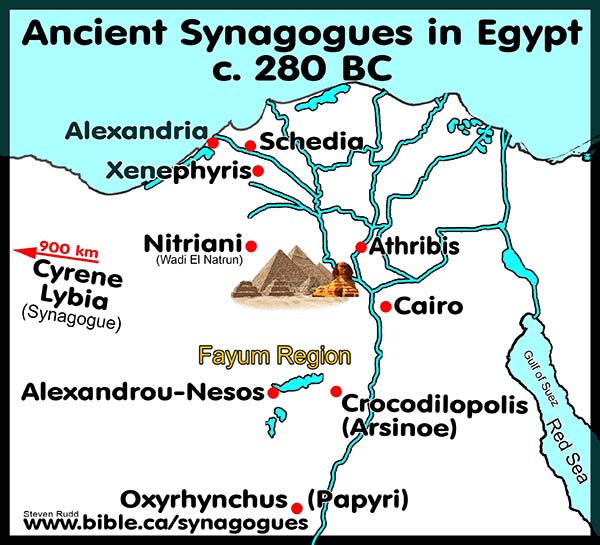
Synagogue Occupation Date = SOD. The SOD equals the earliest possible date from any combination of archaeological sites, inscriptions, and literary sources. For example, the SOD for Nazareth is A.D. 30 because the New Testament says there was a synagogue in Nazareth, even though no inscriptions or sites are known. The SOD for Schedia, Egypt is 240 B.C. based upon the oldest synagogue inscription ever found, even though no literary sources or sites are known. The SOD for the archaeological synagogue site at Qiryat Sefer, near Modein, is 90 B.C. even though no literary sources or inscriptions are known. It features red fresco walls and four red columns like Magdala.
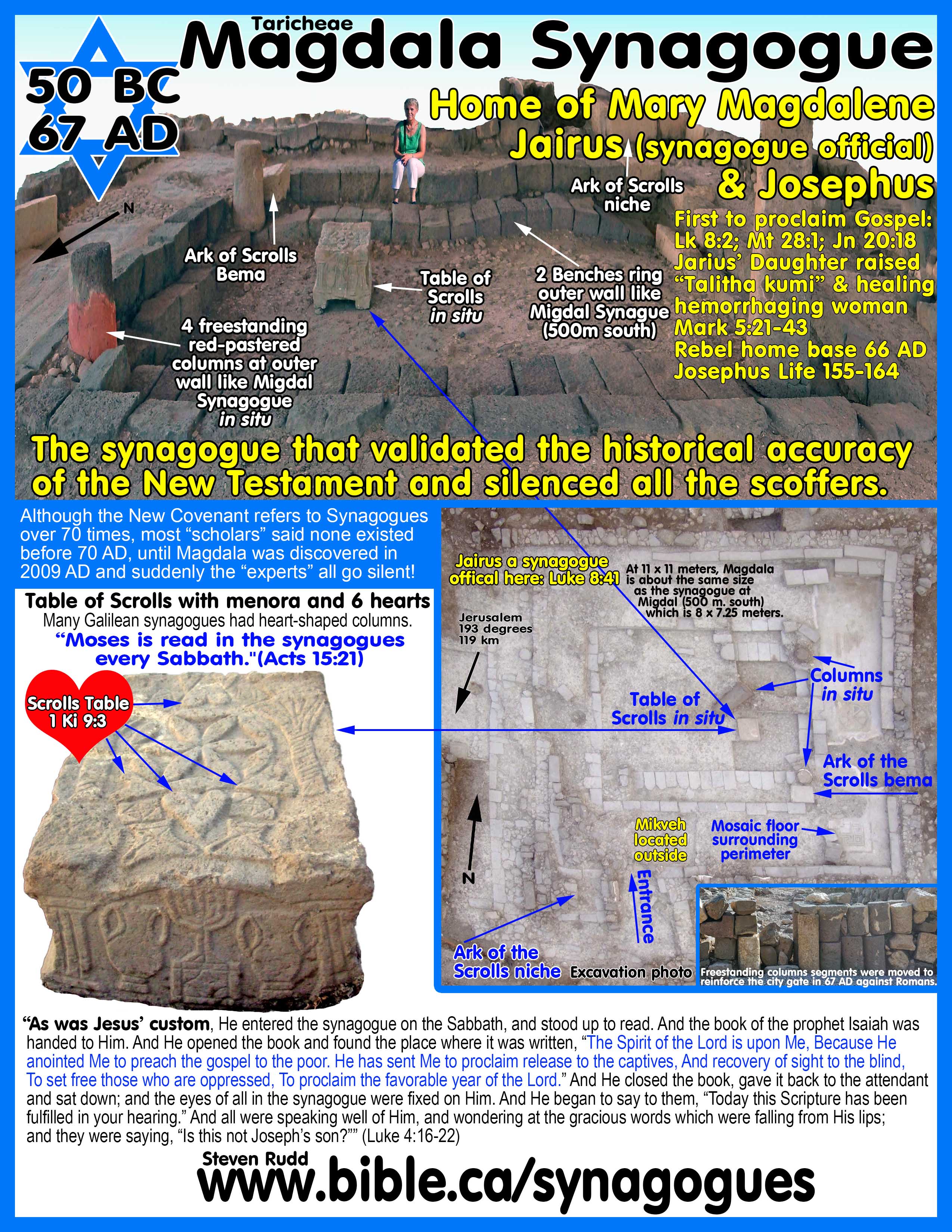
The Synagogue at Magdala
The SOD for the recently discovered synagogue site at Magdala is 50 B.C., and it is likely mentioned in Mk 5:21-43. This town is the home of Mary Magdalene, the place Jesus healed the daughter of a synagogue official named Jarius, the site of the healing of the hemorrhaging woman. Magdala was also the rebel base of Josephus during first Jewish war in A.D. 66.[36]
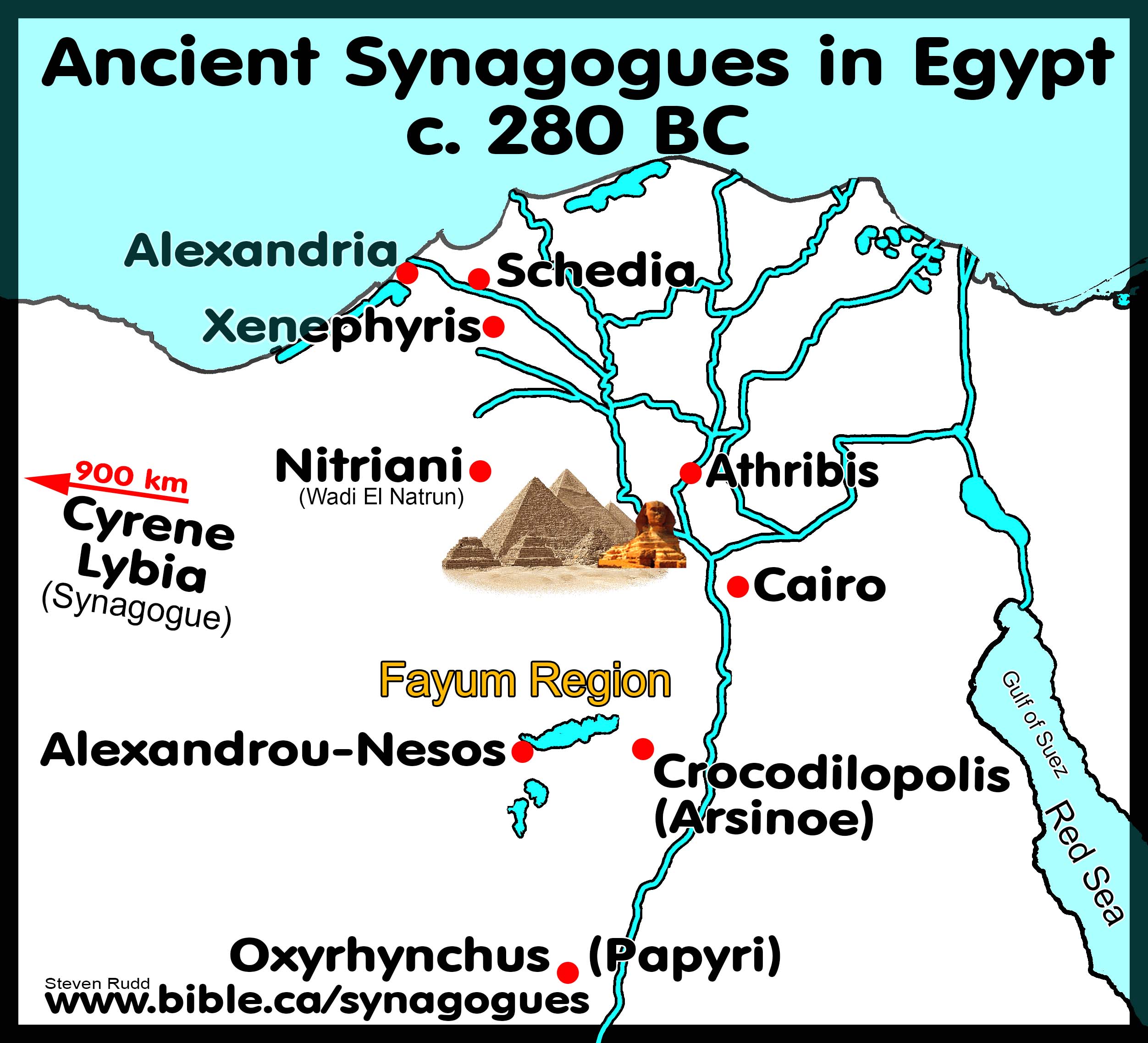
The oldest synagogue inscriptions are from Egypt
From the archaeological record of extant synagogue inscriptions, the first formal synagogue buildings were either converted from houses or built from scratch, at the time of Ptolemy III. (246 B.C.) Indeed, the three oldest synagogue building inscriptions all dedicate the synagogue to Ptolemy III in the cities of Cairo, Crocodilopolis and Schedia in Egypt.
First Synagogue was the Great Basilica Synagogue of Alexandria, Egypt: 280 B.C. – A.D. 117.
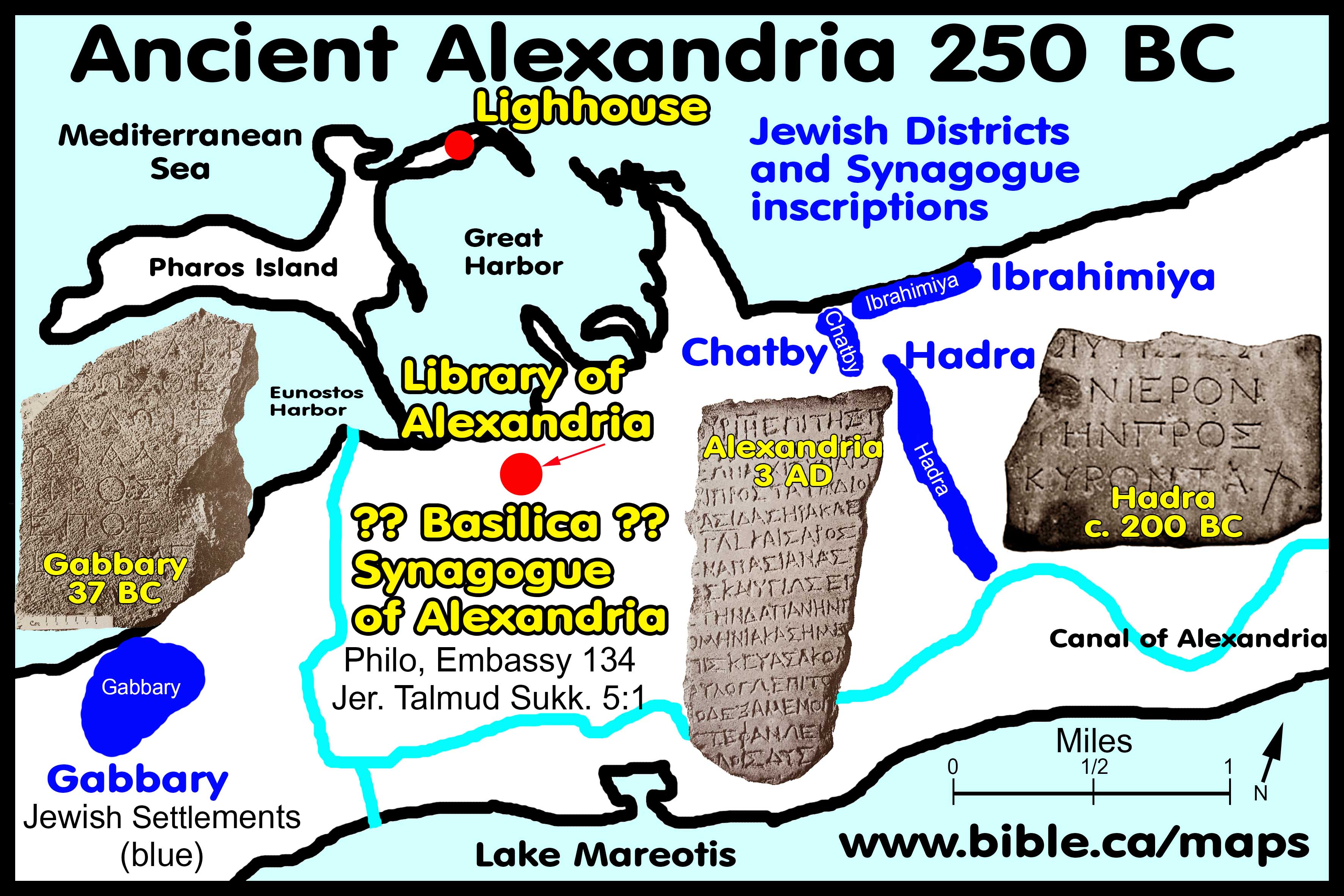
Alexandria is where the greatest number of inscriptions have been found in one city. As early as Philo[37] A.D. 38 and as late as Babylonian Talmud[38] (A.D. 500) the “Great Basilica Synagogue of Alexandria” was considered the oldest and the largest synagogue in the world as a witness to the birthplace of Synagogues. The Tosefta A.D. 250 called this second temple synagogue “the Great Glory of Israel.”[39] The Jerusalem Talmud said Hadrian destroyed it.[40] It is also informative that 90% of the oldest synagogue stone inscriptions are written in Greek and not Hebrew.
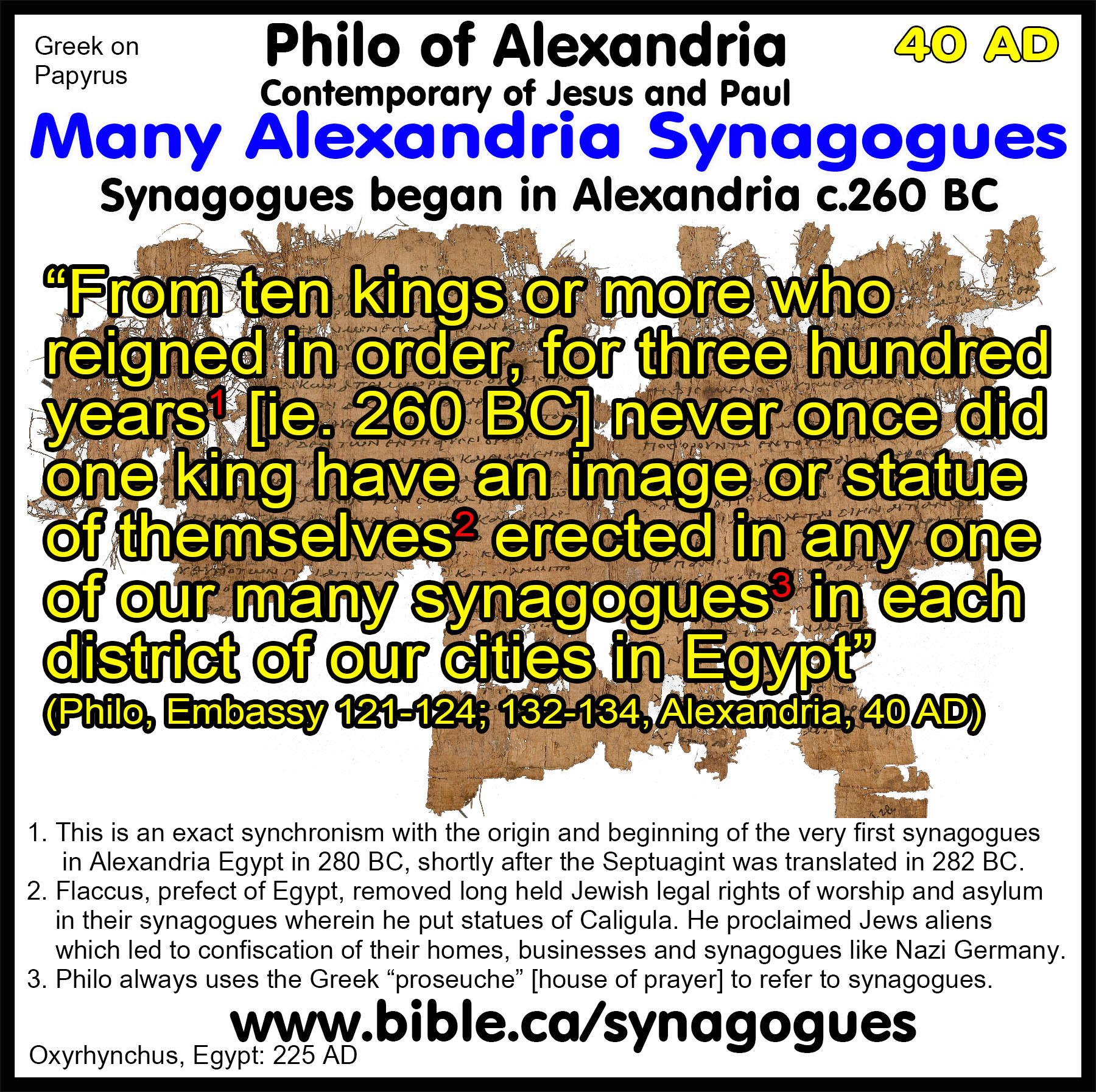
Philo explicitly dates the origin of Synagogues to 262 B.C.
Philo explicitly dated the origin of Synagogues to 262 B.C. [41] This incredible chronological synchronism has been missed by most scholars! Just as Jephthah’s 300 years (Judges 11:26) gives us the date of the Conquest at 1406 B.C., so too Philo’s 300 years gives us the date for the first synagogues IN EGYPT in 262 B.C.!
Synagogue architecture present in every church today:
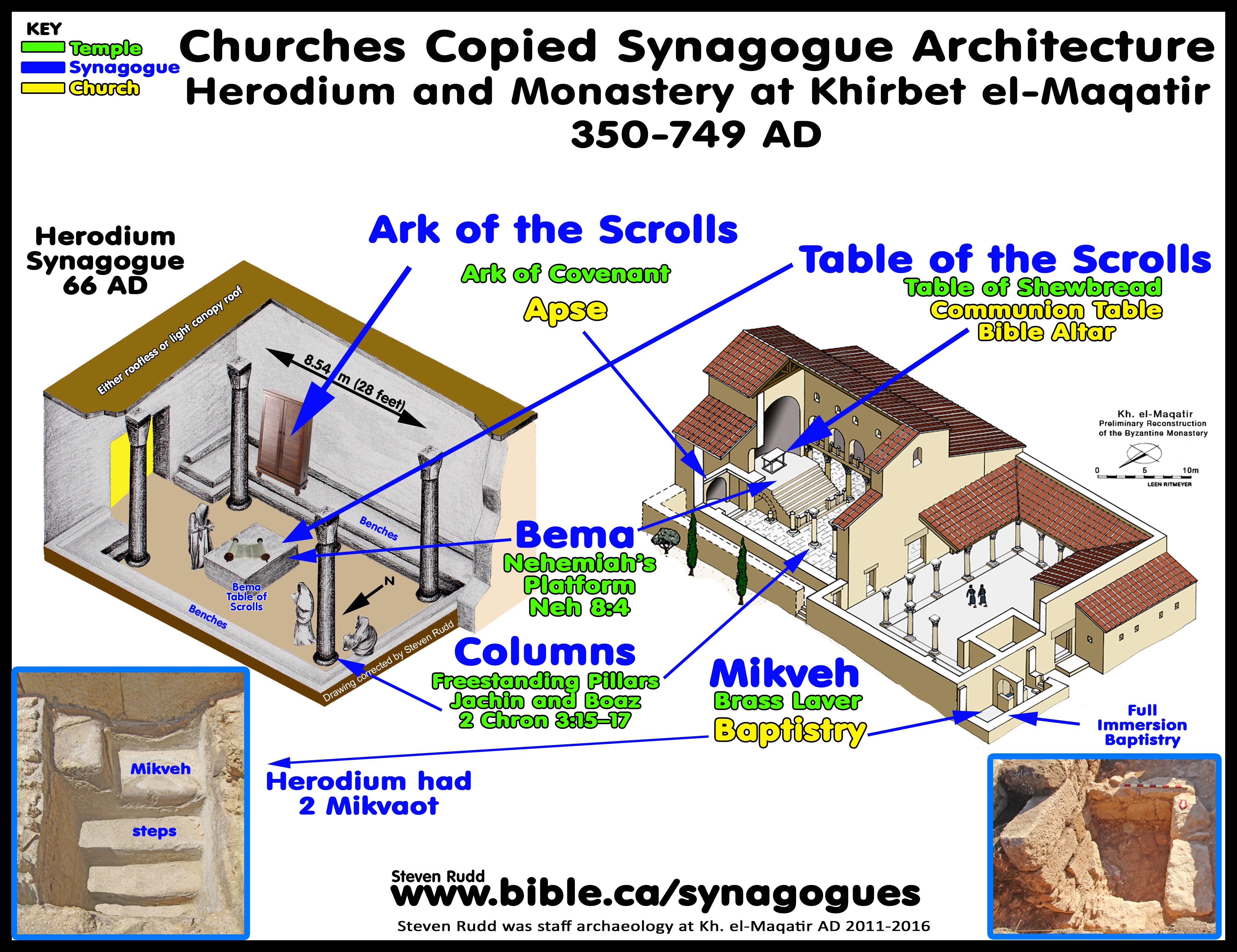
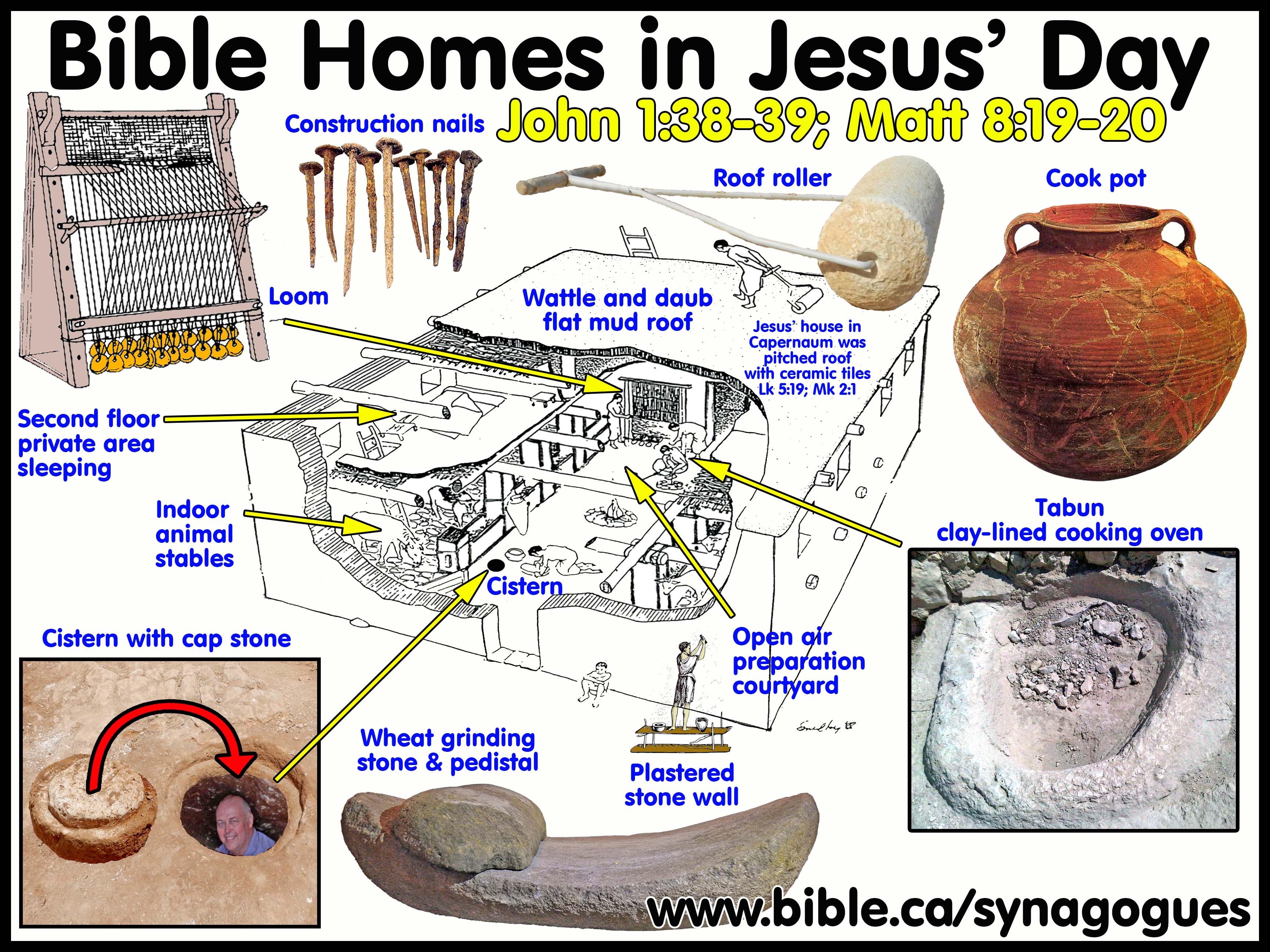
Every church on earth today has physical architectural remnants of the ancient synagogue. The first church buildings were erected in the early Byzantine era around A.D. 327. The church at Khirbet el-Maqatir[42] dates to A.D. 375-749 and shares most of the architectural features of first century synagogues including a full immersion baptistry (mikveh), double columns and a bema (raised area where the readings were done). Yet even the simplest “house churches” today have a table, however crude, that the elements of the communion rest upon which was derived from the Table of the Scrolls. In a long list of ways, the early church was a mirror replica of Jewish synagogue architecture. The Synagogue Mikveh became the Church baptistry. The Synagogue bema derived from Ezra became the Church Pulpit. The Synagogue Niches and Ark of the Scrolls became the Church Apse. The Synagogue Table of the Scrolls became the church Communion Table. The Christian church will forever show vestiges of it ancient Jewish heritage formulated in Egypt.
|
Synagogue Architectural Typology incorporated into the Christian Church |
|||
|
Architecture |
Probable Mosaic origin |
Synagogue Typology |
Church Typology |
|
Mikveh (baptistry) |
Tabernacle and Temple Brass was basin for cleansing |
Every synagogue had a nearby Mikveh for full immersion for ritual purity. Many Jews became Christians in their synagogue Mikvehs. |
Mark 16:16; Acts 2:38; 22:16; 1 Pe 3:21 Ritual purity by washing away sins through the blood of Christ in obedience to the great commission: Mt 28:18-19. |
|
Freestanding columns |
Solomon’s temple freestanding pillars: Jachin and Boaz |
Freestanding columns at Herodium and Magdala |
Antitype of Individual Christians and the Church as a Pillar of Truth |
|
Bema (raised area) |
Ezra’s platform on top of which he read the Law (Torah) Nehemiah 8:4 |
Raised are in center where the reader or speaker would stand |
Prototype of the Pulpit: Raised area at front where preacher stands |
|
Synagogue perimeter bench seating |
None |
Center focused benches lining the perimeter of the assembly room. |
Metaphor for our equality in Christ. |
|
Moses Seat (government) |
Moses authority |
Privilege, preference, being first, special recognition. |
Metaphor for pride. Replaced by Christ: Deut 18:18 |
|
Niches and Ark of the Scroll (storage) |
“Ark of Covenant” inside was the ten commandments on the side was the Torah |
“Ark of the Scrolls” wooden cart, cabinet sometimes placed in a niche in a outside wall. |
Architectural Prototype of the Church Apse |
|
Table of the Scrolls |
Table of shewbread |
Stone or wooden table scroll were placed upon during worship services. |
Prototype of the Lord’s supper table |
Conclusion:
The Septuagint was the providential agent that gave birth the synagogue movement in 280 B.C. as a proto-type for the church in A.D. 33. When the Jews who had worshipped in a synagogue their entire life converted to Christianity, church worship was a familiar and easy transition except Jesus, not Moses was the central lawgiver. This is exactly what God had intended from the beginning of time. (Eph 3:8-12) "When the fullness of the time came, God sent forth His Son, born of a woman, born under the Law, so that He might redeem those who were under the Law, that we might receive the adoption as sons." (Galatians 4:4–5) “to Him be the glory in the church and in Christ Jesus to all generations forever and ever. Amen." (Ephesians 3:21)

See also: Origin of Synagogues website
Steven Rudd, 2017

[1] Jerusalem Talmud, y. Sukk. 5:1, I.5.A–H, describing the second temple synagogue in Alexandria, A.D. 400.
[2] Jerusalem Talmud, y. Meg. 75B, A.D. 400.
[3] Babylonian Talmud, b. Meg. 29A, A.D. 500.
[4] Josephus, Antiquities 18.310-313. Neerda of Josephus = Nehardea of the Talmud.
[5] Rachel Hachlili, Ancient Synagogues - Archaeology and Art: New Discoveries and Current Research, p. 10, A.D. 2013.
[6] Ibid, p. 7.
[7] Ibid, p. 4.
[8] Ibid, p. 16.
[9] Ibid, p. 16.
[10] H. B. Swete, An Introduction to the Old Testament in Greek, p. 8, A.D. 1914.
[11] Marcos, N. Fernández, The Septuagint in Context: Introduction to the Greek Version of the Bible, p. 333, A.D. 2000.
[12] Howard F. Vos, Archaeology And The Text Of The Old Testament, Bible and Spade, Vol. 7, No. 1, p. 19, A.D. 1978.
[13] J. Eisenberg, J., The Jewish Publication Society dictionary of Jewish words, p. 107, A.D. 2001.
[14] The Hasidic and Kabbalistic traditions practice immersion before entering the synagogue each Sabbath.
[15] Rachel Hachlili, Ancient Synagogues - Archaeology and Art: New Discoveries and Current Research, p. 280, A.D. 2013.
[16] Peter Richardson, Building Jewish in the Roman East, p. 130, A.D. 2004.
[17] Philo, Good Man 81
[18] Josephus, Antiquities 14.259–261: decree of 94 B.C.
[19] Jerusalem Talmud, y. Sukk. 5:1, I.5.A–H, describing the second temple synagogue in Alexandria, A.D. 400.
[20] Philo, Good Person 81–84
[21] Babylonian Talmud, b. Git. 1:1, I.31.A–D
[22] McClintock & Strong, Cyclopaedia of Biblical, Theological, and Ecclesiastical Literature, Vol. 6, p. 762, Music, Instrumental. Many Protestant reformers were opposed to instrumental music including Martin Luther (Erinnerungs Schrifft etlicher vom Adel vnd Stedten, 1597 AD, pp. 74-76), John Calvin (Commentary on Psalms 33), Adam Clark (Commentary, Vol. 4, p. 684), John Wesley (Adam Clarke's Commentary, Vol. 4, p. 685), Charles Spurgeon (Commentary on Psalm 33:2 and Psalm 42:4).
[23] Anchor Bible Dictionary, Music, Volume 4, Page 934.
[24] Everett Ferguson, A Cappella Music in the Public Worship of the Church, p. 44, A.D. 2013. Ferguson notes that instrumental music was banned in first century synagogues.
[25] The Greek Orthodox and Roman Catholic church broke communion with each other in AD 1054 for four doctrinal reasons including the introduction of instrumental music in worship by the Western church. The Greek Orthodox church continues their first century practice of acapella worship down to the present day.
[26] Josephus, Antiquities 16.167-168
[27] Marcus Tullius Cicero, 106-54 B.C., For Flaccus 28, Speech of M. T. Cicero in defence of Lucius Valerius Flaccus, 59 B.C.
[28] Replicating the ancient pattern of synagogues sending freewill offerings to the Temple in Jerusalem, Paul instructed the churches of Galatian and Corinth to make freewill weekly 1st day collections (as opposed to tithing) and then send the money to Jerusalem to help needy Christians (1 Cor 16:2; 2 Cor 9:7).
[29] Xenephyris synagogue inscription: B.C. 139. JIGRE #24; Corpus Inscriptionum Judaicarum II, Jean-Baptiste Frey, 2.1441, A.D. 1952.
[30] First century synagogues and churches both featured a plurality of elders who functioned as co-equal overseers. Luke 8:49; Acts 13:15; Acts 14:23; Titus 1:5.
[31] “Be pure: Do not drink [anything leavened] Do not [eat] anything leavened”, Bezalel Porten, Context of Scripture, The Elephantine Passover Letter, 3.46, 419 B.C. The New Testament never refers to the Lord’s Supper “blood” as wine (Greek, oinos) but instead calls it “fruit of the vine”. Matthew 26:29; Mark 14:25; Luke 22:18.
[32] A Greek-English Lexicon of the Septuagint, J. Lust, E. Eynikel, K. Hauspie, Introduction, A.D. 2003
[33] Peter Richardson, Building Jewish in the Roman East, p. 343, A.D. 2004
[34] Philo, The Special Laws, I 325. A.D. 30.
[35] “On the seventh day there are spread before the people in every city innumerable lessons of prudence, and temperance, and courage, and justice, and all other virtues; during the giving of which the common people sit down, keeping silence and pricking up their ears, with all possible attention, from their thirst for wholesome instruction” Philo, The Special Laws, II 62.
[36] Josephus Life 155-164
[37] Philo, Embassy/Legat. 132-139, Alexandria, A.D. 41.
[38] Babylonian Talmud, b. Sukk. 5:1d, I.2.A–H, describing the second temple synagogue in Alexandria, A.D. 500.
[40] Jerusalem Talmud, y. Sukk. 5:1, I.5.A–H, describing the second temple synagogue in Alexandria, A.D. 400.
[41] Philo, Embassy/Legat. 132-139, Alexandria, A.D. 41-45.
[42] The author was a square supervisor of the church at Khirbet el-Maqatir excavations from 2011-2016 with ABR, under directors Dr. Bryant Wood and Dr. Scott Stripling.